Home Office Organization for a Closed Shredder Bay
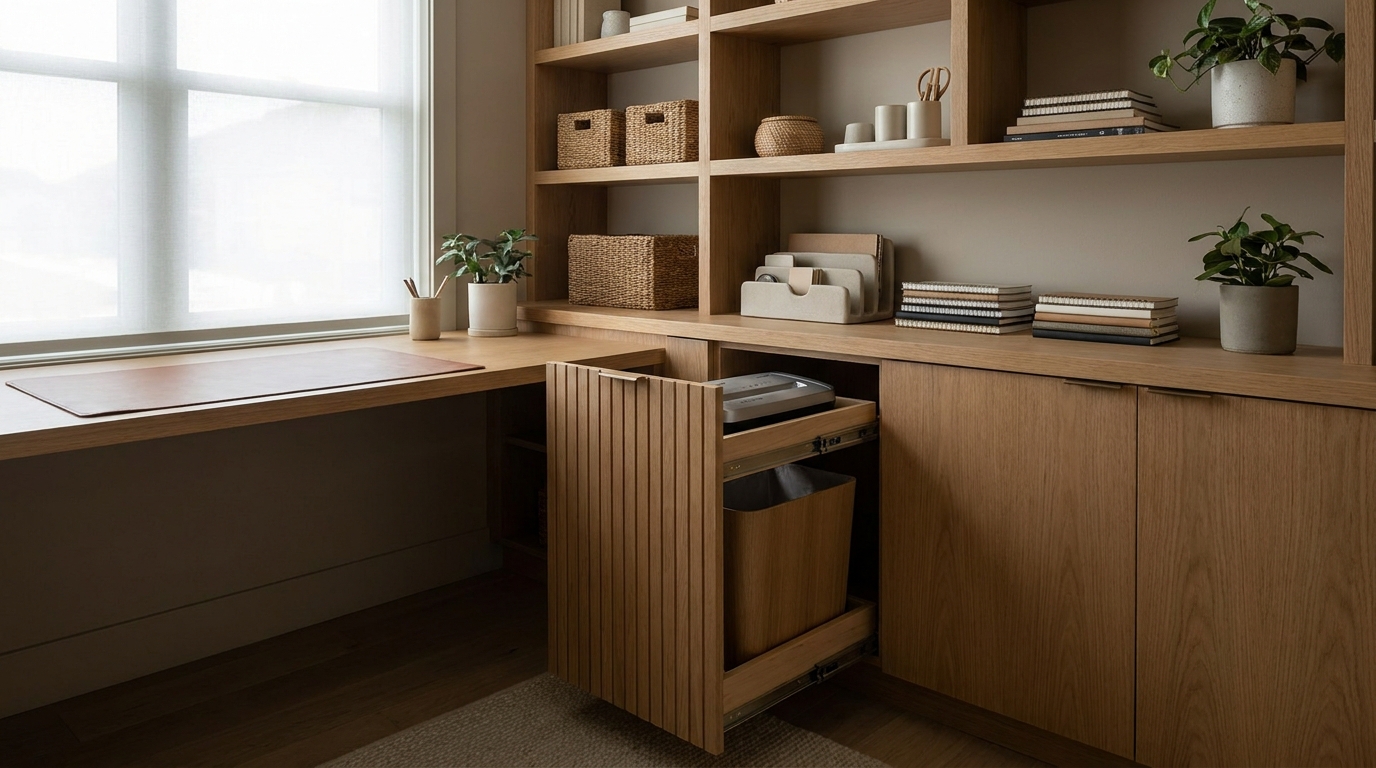
A clear desk needs a home for the shredder that is not the floor and not the work surface. Home office organization for this job is a closed cabinet with two jobs: a bank for papers you still have to keep, and a bay that holds the shredder, a catch bin, and a short shelf for pages that are ready to be destroyed. The IRS page on how long to keep records, last reviewed June 30, 2026, says you generally must keep records that support an item of income, a deduction, or a credit until the period of limitations for that return runs out [1]. A November 26, 2018 IRS release says paper tax returns and supporting documents should be shredded before they are discarded, and only once they are past their useful date [2].
1. Give the keep papers their own bank
The bay fails if "keep" and "shred" share one shelf. One labeled section is only for records still inside the IRS window. The shred shelf is only for pages that have cleared that window, plus any longer hold an insurer or a creditor still wants.
The June 30, 2026 page describes federal periods. It is not a ruling on your return, and it is not a reason to shred early. Unless that page states otherwise, the years run after the return was filed, and a return filed before the due date is treated as filed on the due date [1].
- Three years is the general period, not a universal cutoff. Keep records for 3 years if the longer situations on that page do not apply to you [1].
- A later refund claim can use the later of two dates. If you file a claim for credit or refund after you file the return, keep records for 3 years from the date you filed the original return or 2 years from the date you paid the tax, whichever is later [1].
- A large omission stretches the period to 6 years. Keep records for 6 years if you do not report income that you should report, and it is more than 25% of the gross income shown on your return [1].
- Some claims stay at 7 years. Keep records for 7 years if you file a claim for a loss from worthless securities or a bad debt deduction [1].
- Two situations do not expire. Keep records indefinitely if you do not file a return, and keep them indefinitely if you file a fraudulent return [1].
- Employment tax records have their own hold. Keep employment tax records for at least 4 years after the date that the tax becomes due or is paid, whichever is later [1].
Property records do not follow the ordinary 3-year habit. Keep records relating to property until the period of limitations expires for the year in which you dispose of the property, because you need them for depreciation, amortization, or depletion, and for gain or loss when you sell [1]. Improvement receipts stay on the keep side through that year of sale and the limitation period after it.
When records are no longer needed for tax purposes, do not discard them until you check other reasons to hold them. The IRS names insurance companies and creditors as people who may want papers longer than the tax period [1].
The November 26, 2018 release is older, so do not read it as a newer, shorter rule. It says the IRS generally recommends keeping copies of tax returns and supporting documents at least 3 years, employment tax records at least 4 years after the tax becomes due or is paid, whichever is later, and tax records at least 7 years if a return claims a loss from worthless securities or a bad debt deduction [2]. Those are "at least" lines. They do not erase the 6-year case or the indefinite cases on the page reviewed in 2026.
After the useful date has passed, that 2018 release says to shred the paper rather than drop it in the trash [2]. It also says paper records should sit in a secure spot, preferably under lock and key, such as a secure desk drawer or a safe [2]. The shredder bay is not that spot. Keep those files in a closed section of the same cabinetry, off the desktop.
2. Use a short shelf for pages that are actually finished
The short shelf is the only landing spot for paper on its way into the machine. It sits above or beside the feed slot, and it is shallow on purpose. A deep shelf becomes a second inbox. A short one holds a stack you can finish in one session.
Paper tax returns and supporting documents go there only after their useful date, and then they are shredded before they are discarded [2]. Bank statements and tax documents are a particular risk in ordinary trash. USAGov, last updated July 22, 2025, lists going through your trash to retrieve bank statements or tax documents as one way scammers take personal information [3].
If those pages still support a return, they stay on the keep side. If the IRS clock has run, and you have checked the other holds, they wait on the shred shelf and then go through the machine [1][3]. A Social Security card does not belong there. USAGov says to store personal information, including your Social Security card, in a safe place, and not to carry it in your wallet [3].
- Label the shelf "shred," not "mail." New bills and receipts start in the active file. The shelf is only for destruction.
- Move one tax year at a time. Match the folder to the period on the IRS page before it leaves the keep bank [1].
- Keep the stack smaller than one hand. Past a single session, the bay is storing delay.
- Leave the keep drawer shut while you shred. Two open piles in the same reach will get mixed.
We size that shelf to the bay and to the shredder you own. No safety sheet prints a standard stack height. If you cannot see the feed slot, the shelf is too deep or too low.
3. Set the shredder up off the floor, behind a door
A shredder on the floor sits in the path of feet, cords, and curious hands. The closed bay puts the machine around counter or desk height, behind a door, so the slot is not at ankle level. That height is our cabinet practice. It is not a dimension a federal page printed for cabinetmakers.
In CPSC Publication 5127, dated March 2012, the agency said it had received reports of finger amputations, lacerations, and other finger injuries from paper shredders, especially machines made before 2007, and that these injuries typically occur to children under the age of 5 [4]. The alert says children may turn a shredder on when no adult is there, and that injuries can still happen during supervision, because a child who does not let go of the paper can be pulled in [4].
- Do not let children run the machine, even with an adult nearby. The alert says shredders can pull fingers in before a child has time to react [4].
- Put the machine where children reach it less easily. The alert says to place the paper shredder in an area less accessible to children [4]. A closed door above the floor is our version of that placement.
- Unplug it when the session is over. The alert says to unplug the power cord when the shredder is not in use [4].
- Keep hands, hair, ties, and long necklaces out of the slot. The alert says not to place hands or fingers in the opening, and not to run the machine in loose clothing that could enter the feed [4].
The 2012 alert also says newer shredders, made after 2007, are safer in design because they reduce the chance of a child's fingers entering the opening [4]. That is not permission for a child to feed paper. The line we repeat is the alert's own line: never, even under adult supervision.
Pets are a manufacturer warning, not a CPSC line. A Fellowes safety sheet for the 8C, X-8C, 8Cd, and 9Cd models, from a PDF dated September 7, 2017, says to keep the shredder away from children and pets, to keep hands away from the paper entry, and to set the unit off or unplug it when it is not in use [6].
That sentence is not a test of every brand. A floor-level slot is still a poor fit where a toddler or a pet investigates openings. The door stays closed between sessions, and the plug comes out.
4. Leave the ventilation the safety sheet calls for
A tidy bay can still overheat a motor if the housing is boxed in. The door closes so the slot is covered. The air path stays open.
A Town of Wellesley safety sheet, from a PDF created on July 20, 2017, says to locate the paper shredder at least 4 inches from walls or furniture so air can flow through the ventilation slots [5]. Inside a cabinet, the back and side panels are the furniture, so we leave at least that 4-inch gap [5]. If your manual prints a larger gap, we use the manual. The Wellesley figure is a floor we will not go under, not a number that fits every brand.
That sheet is a workplace precaution, and it tells those users to put only paper in the shredder [5]. Your manual decides whether a card is allowed. We will not cover the vents just to let the door sit flush.
If the motor overheats, the sheet says to turn the shredder off and let it cool for at least 15 minutes before using it again [5]. A closed door is not a reason to skip that pause.
The 2017 Fellowes sheet says not to place those models near or over a heat source or water [6]. We do not put this bay over a radiator or a supply register. The sheet also says the outlet has to sit near the equipment and stay easy to reach, and that energy converters and extension cords should not be used with that product [6].
5. Make the bin and the plug easy to reach
A full bin is how a bay becomes a stuffed closet. The Wellesley sheet says to disconnect the power source before removing and emptying the waste container, or when cleaning the shredder [5]. We build a pull-out sized to the basket you use, with room to unplug first. If the basket is an odd shape, we size the opening to that box.
The Wellesley sheet also says to locate the shredder and the power cord outside of foot traffic areas [5]. A cord across the knee space fails that line. The Fellowes sheet wants the outlet near the machine and easy to reach [6].
The plug, or a switch you can see, belongs at the front of the bay, not behind a fixed panel. A small card inside the door can carry the habits.
- Unplug when you walk away. The 2012 CPSC alert says to unplug when the shredder is not in use, and the 2017 Fellowes sheet says to set those models off or unplug them when idle [4][6].
- Empty only after power is disconnected. That is the Wellesley rule for the waste container [5].
- Stop for the cool-down. At least 15 minutes after an overheat, on that same 2017 sheet [5].
- Keep hair and clothing back. The CPSC alert names hair, ties, long necklaces, and loose clothing, and the Wellesley sheet names jewelry, long hair, neckties, and lanyards [4][5].
We do not print a sheet-count limit on that card unless it is copied from the manual in your hand. Capacity is a model fact. Guessing it is how motors overheat.
6. Keep the desktop for the work
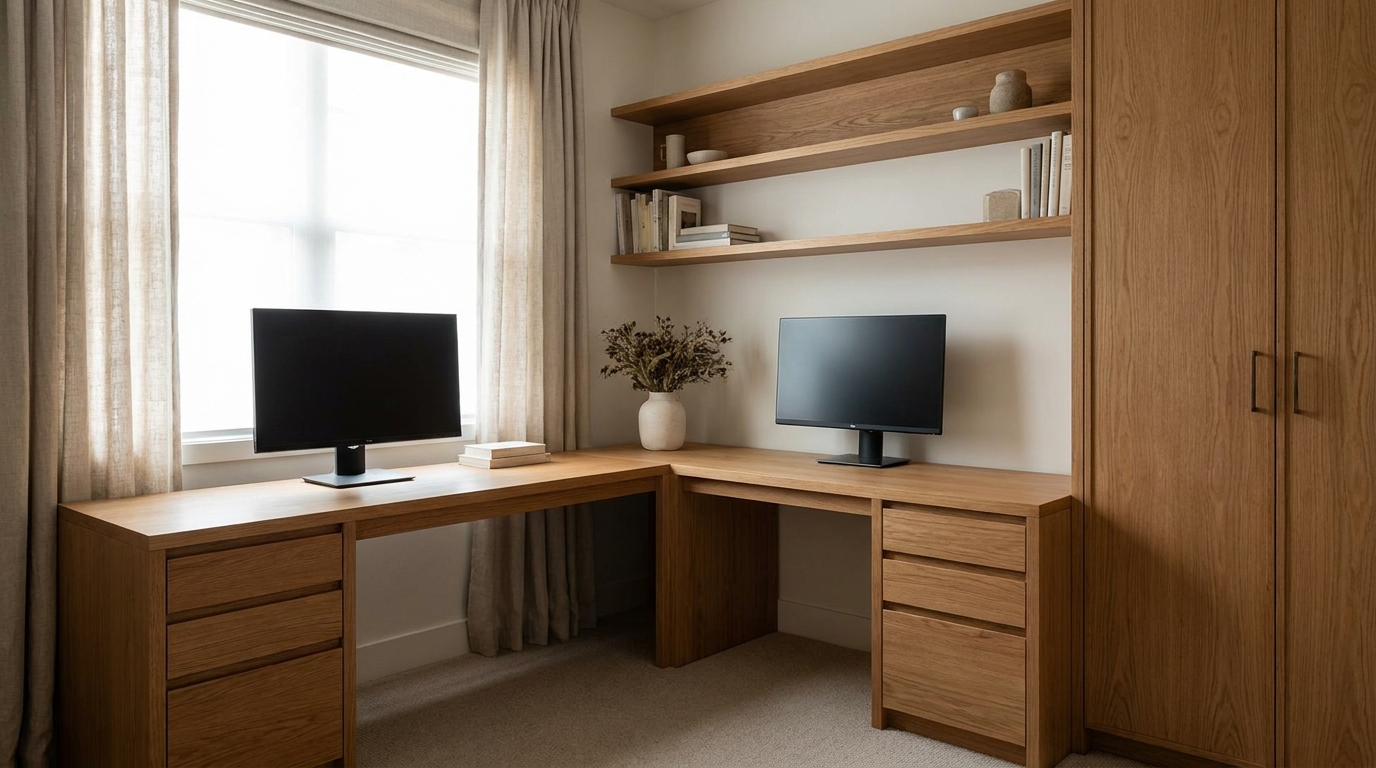
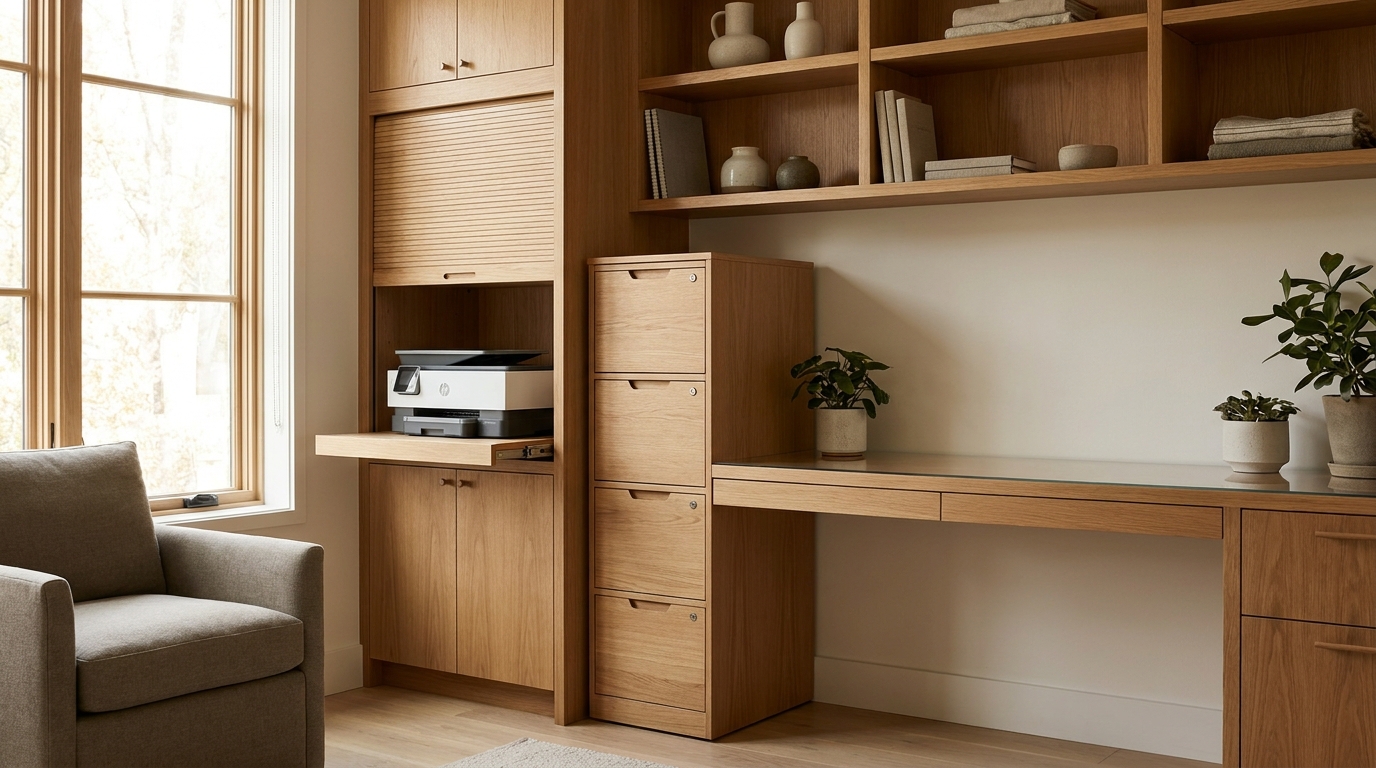
The bay is one piece of the office, not a gadget in the walkway. On our home office page, built-in desks, filing, and document storage are planned as one system. The keep bank is the file section, and the shred side is the closed compartment.
That split is the home office organization we build when paper takes over the afternoon. Keep papers go to the labeled bank. Finished pages go to the short shelf. The machine stays up, ventilated, and unplugged between uses.
In Charlotte, and in nearby Fort Mill, the office often shares the room with homework or the household mail. Custom cabinetry lets us match the bay to the shredder you own and to the wall you have. We read the manual for clearance before we draw the door. The first visit is a free in-home design consultation, and professional installation is part of the work.
Practical takeaways
- Sort with the IRS page reviewed on June 30, 2026. Three years is the general period only when the longer situations do not apply, and some records stay indefinitely [1].
- Do not shred a tax file on closing day or on a hunch. Property records stay until the limitation period ends for the year you dispose of the property [1].
- Shred finished tax paper instead of trashing it. The November 26, 2018 IRS release says to shred those papers once they are past their useful date [2].
- Keep bank statements and tax documents out of the household trash. USAGov, updated July 22, 2025, says scammers look there, and it says to store a Social Security card in a safe place [3].
- Close the door, and still unplug. The March 2012 CPSC alert says to place the shredder where children reach it less easily, and never to let children run it, even with an adult there [4].
- Leave at least 4 inches for airflow, then wait at least 15 minutes after an overheat. Both figures are on the July 2017 Wellesley sheet, which also says to disconnect power before emptying the bin [5].
- Follow the manual on pets, heat, and the outlet. The September 2017 Fellowes sheet covers those points for specific models only [6].
How we can help
Have more questions or want to get in touch? Start at our contact page, call (704) 604-3870, or email design@theclosetrehab.com. Our team plans and installs custom home office cabinetry for Charlotte and the surrounding area, and the work begins with a free in-home design consultation.
Citations
- Internal Revenue Service, "How long should I keep records?" (2026-06-30)
- Internal Revenue Service, "Get Ready for Taxes: Safekeeping tax records helps for future filing, amended returns, audits" (2018-11-26)
- USAGov, "Identity theft" (2025-07-22)
- U.S. Consumer Product Safety Commission, "Paper Shredder Safety Alert" (2012-03)
- Town of Wellesley, Massachusetts, "Paper Shredder Safety" (2017-07-20)
- Fellowes, "Powershred 8C, X-8C, 8Cd, and 9Cd Important Safety Instructions" (2017-09-07)