Kids Closet Design Charlotte That Grows With Them
Kids outgrow fixed closet layouts almost as fast as they outgrow last season's jeans. Smart kids closet design in Charlotte homes starts with adjustable rods, flexible cubbies, and zones you can reassign as toys give way to sports gear and then to teen wardrobes. Growth is not a surprise event. Pediatric growth tracking exists because children's bodies change on a schedule clinicians monitor for years, which is why storage that only fits today's size often fails by next year.[1] A closet that can shift with the child saves money, reduces bedroom clutter, and keeps daily routines calmer for the whole household.
Why kids need storage that can change with them
A child's wardrobe is a moving target. Infant onesies become toddler tees, then school uniforms, then longer sleeves and hanging sportswear. The U.S. Centers for Disease Control and Prevention (CDC) recommends WHO growth standards for children from birth to 2 years and CDC growth charts after that age, which is a clinical reminder that height and body proportions keep shifting through early childhood.[1] Clothing length, shoe volume, and accessory piles expand in the same arc. Fixed single-height rods and a couple of deep shelves rarely keep up.
Independence grows on a parallel track. By age 4, many children are learning colors, shapes, and sizes, and parents are encouraged to offer simple choices about what to wear or play with.[2] A closet with low, labeled cubbies and reachable hanging space supports that practice. A closet that forces everything onto a high bar or into a stuffed bottom drawer teaches the opposite lesson: only adults can manage clothes, so clothes end up on the floor.
Charlotte-area homes (Ballantyne, Fort Mill, Indian Trail, and nearby suburbs) often pair modest closet footprints with busy family schedules. Closet rehab for kids is not about boutique display. It is about durable systems that absorb seasonal swaps, hand-me-downs waiting for a sibling, and the toy-to-teen transition without a full remodel every few years.
Design principles for a growing kids closet
Adjustable hanging rods
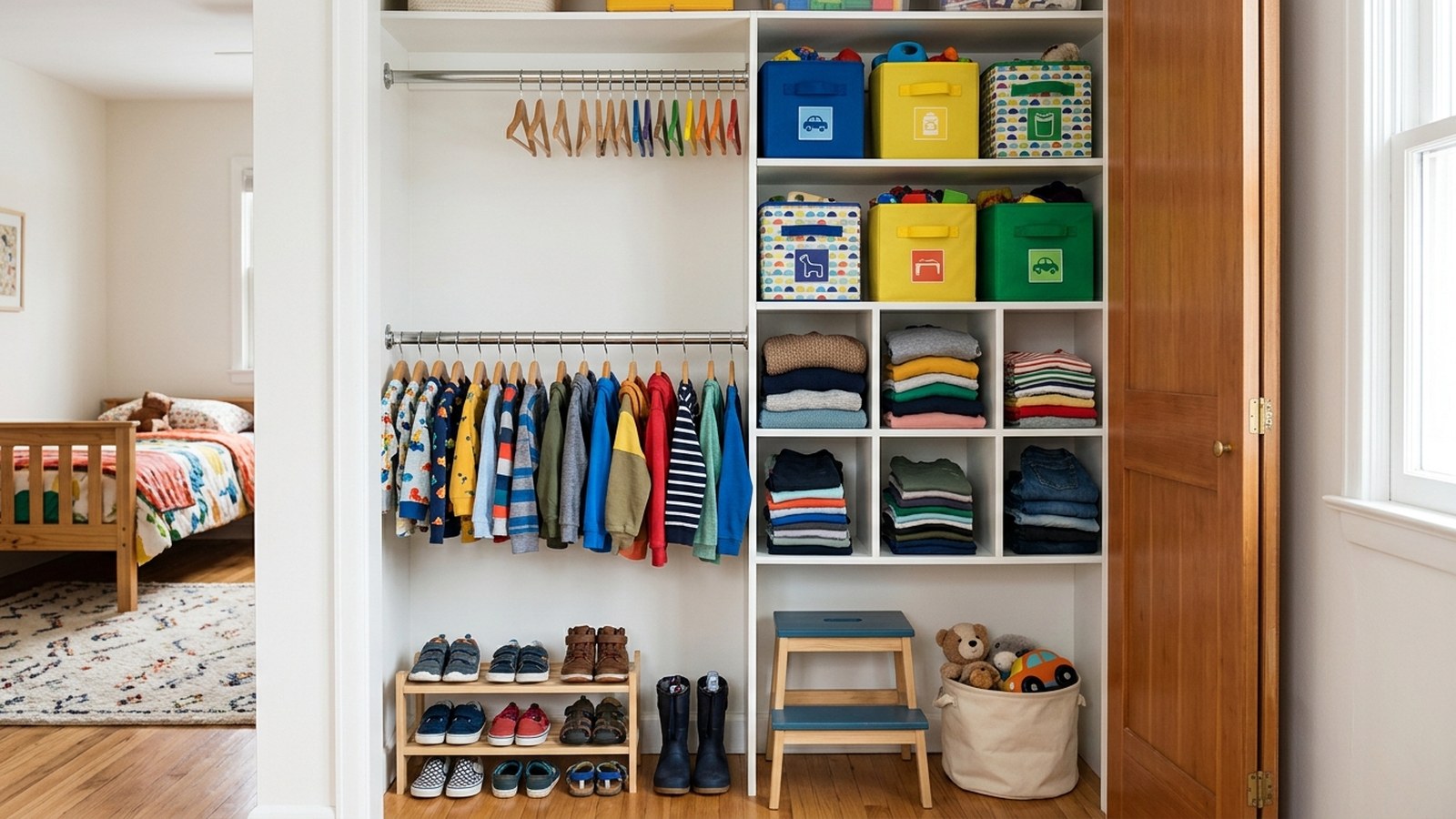
Rods that move up (or down) are the backbone of long-term kids closet design. Toddlers need hanging space within reach so they can hang a jacket without climbing. School-age kids need a mid height for dresses, polos, and hoodies. Teens often need full adult rod height plus more linear inches for longer garments.
In custom work, we plan for:
- Dual rods where double hanging multiplies capacity in a narrow footprint
- One lower "kid height" rod that can later become a second full-height zone or shelf stack
- Clearance for hangers to slide freely so the system still works when the wardrobe is full, not only when it is newly organized
Adjustability is hardware, not hope. Shelf pins, slotted standards, and reconfigurable panels let you change the layout without throwing out the carcass. That is how a closet bought for a 5-year-old still earns its keep at 15.
Cubbies that do more than hold toys
Open cubbies are the Swiss Army knife of kids storage. Early on they hold bins of blocks, dolls, or cars. Later they hold backpacks, folded sports uniforms, or shoe pairs. Cube grids with matching bins also make "put it back" a visual task instead of a memory test, which matters when you are teaching routines.
Useful cubby rules of thumb:
- Keep frequently used items between roughly knee and shoulder height for the child's current size
- Reserve top cubes for out-of-season or rarely used items adults manage
- Use consistent bin sizes so labels and photos stay readable as contents change
- Leave one empty cube as surge space for projects, overnight bags, or laundry overflow
As toys shrink and clothing grows, you can convert cubes from play storage to folded stacks, hat and belt homes, or charging drawers for devices kept outside the sleep zone (more on that below).
Zones that match real mornings
A good kids closet has zones mapped to the day, not only to product categories. Typical zones we design with families:
- Get dressed zone: current-size hanging, a short stack of everyday shelves, and a small place for tomorrow's outfit
- School and sports zone: backpack hook or cubby, cleats or sneakers, water bottle shelf
- Seasonal and hand-me-down zone: labeled higher storage so next size up does not mix with what fits now
- Quiet evening zone: soft items and pajamas kept ready so bedtime is not a scavenger hunt
That last zone matters more than many remodel conversations admit. Sleep researchers and pediatric groups keep pointing parents back to calm, consistent bedtime environments. National Sleep Foundation data show nearly half of U.S. children (44%) do not consistently get the recommended amount of sleep for their age, and guidance includes keeping the bedroom cool, dark, and quiet while protecting a wind-down ritual.[3] The American Academy of Pediatrics, through HealthyChildren.org, also urges regular routines, screens out of bedrooms (especially at night), and a sleep-supportive room where the bed is not a dumping ground for toys.[4] A closet that swallows daytime clutter is not a luxury finish. It is part of protecting the bedroom as a place to rest.
Safety first: furniture, climbing, and air quality
Kids explore vertical space. They climb for a favorite shirt or a bin of toys parked "out of the way" on a high shelf. That makes free-standing clothing storage a real injury risk if it can tip.
The U.S. Consumer Product Safety Commission reports that tip-over incidents send thousands of people to emergency rooms each year, with children under 18 accounting for 44 percent of those injuries (about one child treated every 53 minutes in recent multi-year estimates). Children also represent 71 percent of tip-over fatalities associated with this hazard, and more than half of reported fatalities involve children ages 1 to 3.[5] CPSC continues to urge families to anchor dressers, bookcases, and similar furniture, avoid storing appealing items where children may climb, and place heavier items lower.
Federal safety policy moved with that risk. Under the STURDY law, CPSC adopted ASTM F2057-23 as a mandatory safety standard for clothing storage units, with requirements aimed at protecting young children from tip-over injury and death. As of September 1, 2023, newly manufactured clothing storage furniture must meet updated safety criteria, and CPSC still recommends anchoring storage units regardless of when they were made.[6]
What that means in a kids closet remodel:
- Prefer built-in systems fastened to wall structure over tall freestanding towers kids can pull
- Keep tempting toys and remotes out of high shelves that invite climbing
- Use soft-close drawers with stops, and hardware rated for real daily use
- Train the household: drawers are not steps
Indoor air quality is the quieter sibling of tip-over safety. EPA guidance notes that furnishings and household products can emit volatile organic compounds (VOCs), and that reducing sources and ventilating are core control strategies.[7] When we specify finishes for kids' rooms, we talk through material choices, off-gassing timelines, and practical ventilation so the closet upgrade does not fill the bedroom with a chemical haze during the first weeks of use.
The toy-to-teen transition, stage by stage
Toddler and preschool
Priorities are reachability, soft edges, and visual order. Low rods, picture labels on bins, and a floor-level landing zone for shoes reduce the daily scramble. Cubbies for dress-up clothes support play and language development tips that encourage imagination and simple choices about what to wear.[2]
Early elementary
Uniforms, coats, and backpacks join the mix. Double hanging often starts to win. A dedicated sports and school shelf near the door (or a nearby mud-friendly drop if the closet is deep in the house) keeps homework and practice gear from colonizing the bed.
Tweens and teens
Linear hanging inches rise. Folded denim and graphic tees need deeper shelves or drawers. Privacy matters more, so lighting, door hardware, and a clear place for a laundry hamper reduce the "everything on the chair" pattern. Adjustable systems shine here: you raise rods, reassign cubbies, and sometimes add drawers without rebuilding the whole unit.
Across all stages, leave expansion room. A closet packed to the last inch on installation day has no path for growth. We design with spare capacity on purpose.
Charlotte-specific practicalities
Local housing stock ranges from older cottages with shallow closets to newer builds with longer walk-ins. Kids rooms in multi-child households often share storage pressure with shared bathrooms and busy laundry cycles. Custom kids closet design for Charlotte families usually balances:
- Shared sibling layouts that still give each child a labeled side
- Seasonal humidity and sports seasons that change shoe and gear volume
- Resale value that still looks intentional when the "kid room" becomes a guest room later
We measure on site, walk through how mornings actually run, and design around those habits rather than a catalog photo. Free in-home design consultation is how that process starts: we see the real closet, the real wardrobe pile, and the real traffic path to the hall.
Budget thinking without shortchanging growth
Parents often ask whether a custom kids system is worth it if the child will move rooms in five years. The better question is whether you want to buy three disposable organizers or one adjustable system that reconfigures. Midrange custom work typically costs more up front than wire shelving from a big-box aisle, but it avoids repeated replacements, wasted space, and the soft cost of daily friction.
Ways to spend smart:
- Invest first in adjustable hanging and solid verticals
- Use bins and drawer inserts as the flexible layer that changes with hobbies
- Phase drawers or glass doors later if budget needs a pause
- Design for the room's longest realistic use (often the full school years), not only the current age
Practical takeaways
- Plan adjustable rods and reconfigurable shelves from day one so the layout can rise with the child.
- Use cubbies and labeled bins to support independence and clean "put away" habits.
- Map zones to real routines (dressing, school, sports, bedtime) instead of only clothing categories.
- Treat the closet as part of a sleep-friendly bedroom: clear floors, contain toys, keep screens out of the sleep space where you can.[3][4]
- Anchor freestanding furniture and favor built-ins; tip-overs remain a serious child safety issue.[5][6]
- Choose finishes and ventilation with indoor air quality in mind, especially in closed kids' rooms.[7]
- Leave spare capacity for hand-me-downs, seasonal gear, and the next growth spurt.
How we can help
At The Closet Rehab, we design custom closets for real Charlotte-area homes, including kids rooms that need to grow from preschool cubbies to teen hanging without a full tear-out. Our process includes a free in-home design consultation, 3D renders you can review, and installations built for daily family use. Explore our custom closet solutions, see how our design process works, or request your free design consultation to talk through adjustable storage for your child's next stage. Call (704) 604-3870 or email design@theclosetrehab.com when you are ready to plan the space.
Citations
- CDC - "Using WHO Growth Standard Charts" (2024)
- CDC - "Milestones by 4 Years | Learn the Signs. Act Early." (n.d.)
- National Sleep Foundation - "New Data from National Sleep Foundation Show Nearly Half of U.S. Children Don't Get Enough Sleep" (2026-03-05)
- HealthyChildren.org / AAP - "Healthy Sleep Habits: How Many Hours Does Your Child Need?" (updated 2026-08-07)
- U.S. CPSC - "Ahead of Sunday's Game, CPSC Reminds Families to Tackle the Deadly Hazard of TV and Furniture Tip-Overs" (2024-02-08)
- U.S. CPSC - "CPSC Adopts Final Consumer Product Safety Standard to Prevent Tip-overs of Dressers and Other Clothing Storage Units" (2023-04-19)
- U.S. EPA - "Volatile Organic Compounds' Impact on Indoor Air Quality" (updated 2026)