Lockable Garage Cabinets Keep Chemicals Off the Floor
Why lockable garage cabinets belong on the wall
Paint cans, solvent jugs, motor oil, antifreeze, pesticides, and household cleaners do not belong on the garage floor, on an open shelf a toddler can climb, or in a bin a dog can nose open. Lockable garage cabinets mounted on the wall keep those products closed, off the floor, and out of reach, while the parking stalls stay clear for the cars they were built to hold. The U.S. Environmental Protection Agency treats leftover paints, cleaners, oils, batteries, and pesticides as household hazardous waste, and it warns that these products can present hazards to children and pets if they are left around the house.[1] The Consumer Product Safety Commission is just as direct: keep chemicals and cleaning supplies in a locked cabinet or box, out of a child’s sight and reach.[2]
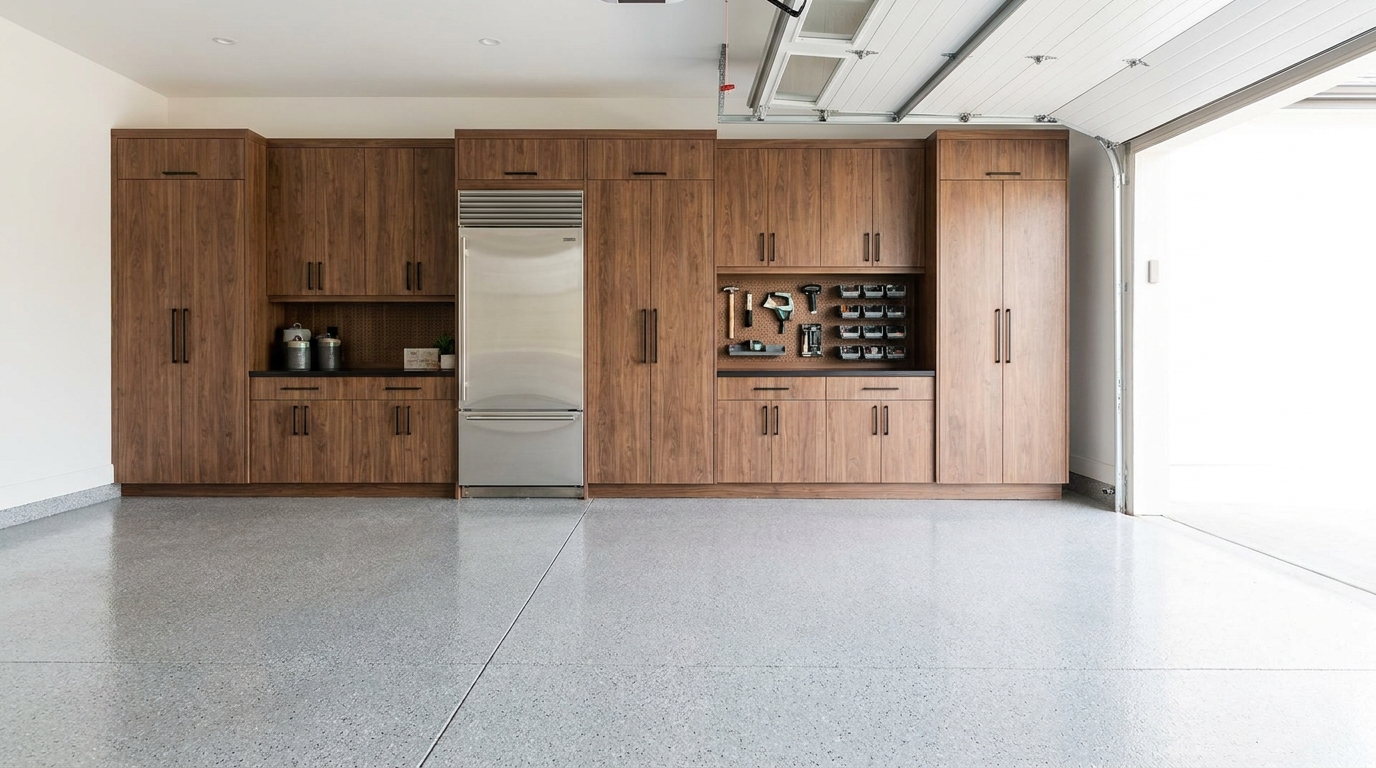
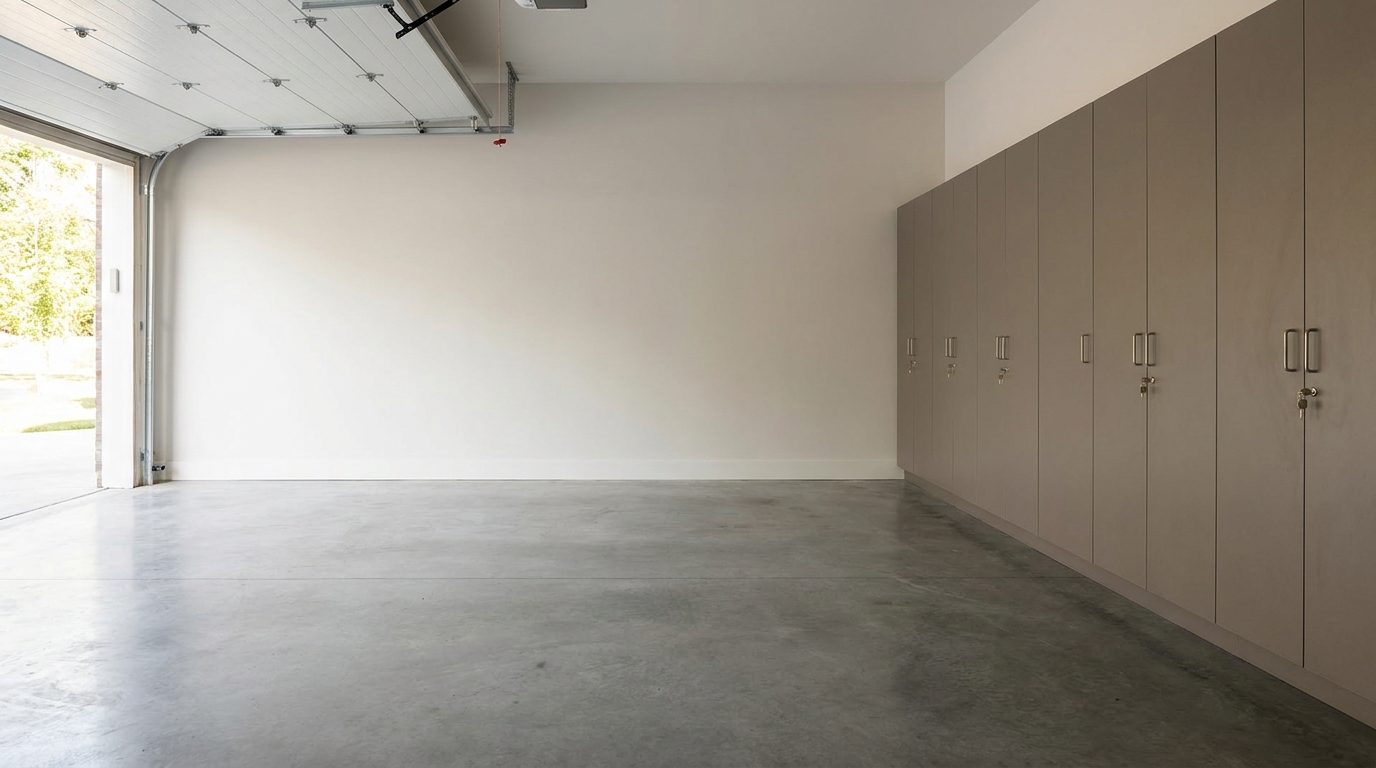
Our team designs those cabinets as closed, lockable wall storage for the chemical inventory, not as sports-equipment walls, workbenches, or overhead racks. Those other garage jobs matter, and we plan them separately. This article is about the one run of doors that should stay shut, locked, and dedicated to paints, auto fluids, and cleaners.
1. What belongs behind a lock (and what does not)
A garage chemical cabinet is a closed wall cabinet with a real lock, sized for original product containers, and placed high enough that a child or a pet cannot treat it as a snack shelf. It is not a pegboard, not a slatwall bay, and not a ceiling platform. Those systems are useful for bulky, non-toxic gear. They are the wrong place for a leaking quart of oil or a bottle of weed killer.
EPA’s household hazardous waste list is a good packing list for this cabinet: paints, cleaners, oils, batteries, and pesticides.[1] The University of Utah Poison Control Center adds the garage-and-shed set most Charlotte-area households actually keep: antifreeze and coolant, motor oil, gasoline, wheel cleaner, windshield washer fluid, fertilizers, herbicides, insecticides, and rodenticides.[12] Mecklenburg County’s household hazardous waste program exists because leftover automotive fluids, paints, and household chemicals cannot simply go out with the trash.[9]
Typical contents we plan for:
- Paints and coatings: leftover latex and oil-based paint, stain, varnish, and primer, kept in original cans with the labels intact.[1]
- Solvents and thinners: mineral spirits, paint thinner, stripper, and similar products that give off vapors and can ignite.[6]
- Automotive fluids: motor oil, antifreeze and coolant, brake fluid, transmission fluid, and windshield washer fluid, stored upright and sealed.[10][12]
- Pesticides and lawn chemicals: insecticides, herbicides, rodent baits, and pool chemicals, kept out of reach of children and pets and never stored near food.[4][15]
- Household cleaners that migrated to the garage: bleach, drain opener, oven cleaner, degreaser, and concentrated detergents, in original child-resistant containers.[2][13]
What does not go in this cabinet:
- Sports gear, bikes, and balls. Those belong on a dedicated wall, not mixed with solvents.
- Hand tools and power tools. Those belong in a workbench or tool chest, not next to flammables.
- Seasonal bins and bulky overflow. Those belong on a ceiling rack or a high, non-chemical shelf.
- Gasoline in bulk, propane cylinders, or anything a product label tells you to keep outdoors and away from living space. EPA advises storing flammable liquids outside the living area and far from ignition sources such as a furnace, car, grill, or lawn mower.[4]
North Carolina DEQ currently reports that the average U.S. household generates about 30 pounds of household hazardous waste per year, and that household maintenance products such as paint, thinners, and glues make up more than a third of the HHW that shows up in daily garbage.[8] That leftover inventory is exactly what a locked wall cabinet is for, until you use it up or take it to a collection site.
2. Kids, pets, and why a lock beats an open shelf
A garage is a play space, a shortcut to the backyard, and a parking bay. It is also where many of the most toxic household products live. In 2024, U.S. poison centers provided telephone guidance for 2,092,689 human exposures. Among children younger than 6 years, 99.2% of those exposures were unintentional.[3] The National Capital Poison Center’s 2024 statistics page lists household cleaning substances as the leading substance category in pediatric exposures among children 5 and under.[3] CPSC estimated 67,000 emergency department-treated injuries in children under 5 in 2023, and it reports that nearly seven out of 10 poisonings occurred in the home.[2]
A child-resistant cap is not a substitute for a locked door. EPA says child-resistant packaging is not child-proof, so the container still has to be closed tightly and kept out of children’s reach.[4] CPSC’s guidance for household cleaning supplies is a locked cabinet or box.[2] Oregon Health & Science University’s Oregon Poison Center says the same when a child is ever in the home: store products up and away after every use, and use a lockable cabinet or a child-resistant lock.[14] National Capital Poison Center adds that one of the most dangerous places to store cleaners is an unlocked, low cabinet.[13]
Height and a lock work together. A wall cabinet puts the inventory above toddler reach. A lock stops a climbing preschooler, a visiting grandchild in Ballantyne, or a curious teen who should not be mixing products. EPA’s pesticide advice is to store products out of reach of children and pets, and, if possible, in a locked cabinet in a well-ventilated utility area or garden shed. Lock the cabinet, install safety latches if needed, and never put poisonous products in containers that could be mistaken for food or drinks.[4][15]
Pets need the same barrier. ASPCA Animal Poison Control Center warns that antifreeze containing ethylene glycol can cause kidney failure or even death, and it tells pet owners to store those products in sealed containers high up where pets cannot reach, then clean spills thoroughly before a pet returns to the garage.[10] The Merck Veterinary Manual, last updated in September 2024, notes that ethylene glycol has a sweet taste and a small lethal dose (only 3 to 4 teaspoons in dogs, 1 to 2 teaspoons in cats), and that it is often stored and disposed of improperly. Its prevention line is simple: store antifreeze securely, discard old product, and clean leaks immediately.[11] Utah Poison Control Center’s 2023 garage-and-shed brief lists windshield washer fluid as a product that can cause blindness or death if swallowed, and it tells families to keep harmful products locked up and away when they are not in use.[12]
For a Fort Mill or Indian Land household with a dog that follows every oil change, an open floor pile of jugs is a hazard, not storage. Closed, lockable wall cabinets take the temptation out of paw range.
3. Fire, vapors, and garage ventilation
Many of the same products that poison also burn. NFPA 30, the Flammable and Combustible Liquids Code, covers gasoline, solvents, alcohols, paints and coatings, fuel oils, hydraulic fluids, lubricants, and waste flammable liquids. The code classifies liquids by flash point because that number drives fire risk, and it sets thresholds where approved storage cabinets or dedicated storage rooms may be required. NFPA 30 is a facility code enforced by fire officials, not a residential how-to pamphlet, but it is the reason listed cabinets exist for paints, solvents, and fuels.[6]
OSHA’s 29 CFR 1910.106 is workplace guidance, not a homeowner mandate. We label it that way on purpose. OSHA’s flammable-liquid rules were originally based on earlier editions of NFPA 30, and they remain the analog most often cited for cabinet construction.[5][6] Under 1910.106(d)(3), a storage cabinet may hold no more than 60 gallons of Category 1, 2, or 3 flammable liquids, or 120 gallons of Category 4. Metal cabinets that meet the standard use at least 18-gauge sheet iron, double walls with 1½-inch air space, a three-point lock, a 2-inch spill sill, a 10-minute fire test capped at 325°F inside, and conspicuous lettering that reads “Flammable - Keep Fire Away.”[5]
University of Pennsylvania Environmental Health & Radiation Safety, summarizing NFPA 30 in a 2022 guidance page, adds a point homeowners often get backward: flammable-liquid storage cabinets do not need to be vented, and any factory vents should be sealed with the bung the manufacturer supplies.[7] Room air is a different issue. EPA wants pesticides in a well-ventilated utility area or shed, and flammable liquids far from ignition sources, including the car itself.[4] When you are using a cleaner, National Capital Poison Center and OHSU both say to ventilate the work area by opening a window or door, and never to mix household cleaning products, because mixing can create poisonous fumes.[13][14]
Practical fire and vapor rules we design around:
- Keep chemical cabinets on an interior garage wall that is not the back of a living-room fireplace, water heater, or furnace chase.
- Keep the cabinet away from the lawn mower, grill, and battery charger.
- Specify closed doors with a lock, not open cubbies, so vapors and spills stay contained and labels stay readable.
- Plan a spill-capable base (a lip or tray) so a leaking can does not run under a parked car.
- Do not treat the cabinet as a mixing station. EPA’s HHW guidance is never to mix leftovers. Incompatible products might react, ignite, or explode.[1]
A closed, lockable wall cabinet will not make a garage a rated flammable-storage room. It does put paint thinner, leftover gasoline mix, and solvent in a contained, labeled, lockable volume instead of on the floor next to a hot exhaust.
4. Keep the parking stalls clear
The second job of these cabinets is spatial. A two-car garage in Wesley Chapel, Waxhaw, or Rock Hill only works if both stalls stay wide enough to open doors and walk around bumpers. Paint cans, oil cases, and five-gallon buckets on the slab steal stall width, get kicked, and leak where you step. Closed wall cabinets pull that inventory onto the wall so the floor can stay a parking floor.
Our custom garage storage work already includes custom cabinetry and closed storage. For chemicals, we keep that cabinetry as a dedicated, lockable run rather than mixing it with sports hooks or a workbench. Ceiling racks are for totes, not for liquids that can drip. A workbench is for projects, not for a row of unlabeled bottles.
Clearance habits that make the cabinets work:
- Mount the run high enough that a bumper cannot strike the doors, with toe space or a shallow kick so the stall still feels full-width.
- Keep the area under the cabinets empty. That floor strip is not bonus storage.
- Group liquids so you are not walking a half-full gallon of stain across the stall every weekend.
- Leave a path from the cabinet to the service door so a spill can be carried out without crossing the parking bay.
Charlotte-area houses with tandem stalls, third-car bays, or a golf-cart slot feel this quickly. One locked wall of cabinets can replace a floor colony of Home Depot leftovers and still leave room to park.
5. How we plan chemical cabinets for Charlotte-area garages
We start with an inventory, not a catalog photo. In a Ballantyne garage we count paint cans, auto fluids, lawn chemicals, and cleaners, then we size a closed, lockable wall run for what you actually keep. We do not stockpile. EPA says not to stockpile pesticides, and to buy only the amount you will need soon. NC DEQ’s advice is similar: buy an amount you think you will use completely.[4][8]
Layout rules our team uses:
- Original containers only. EPA, CPSC, and poison centers all insist on original labeled containers. Never store hazardous products in food or drink bottles. Corroding cans need special handling, not a relabel with a marker.[1][2][4][12]
- Separate families of product. Pesticides stay away from food and pet feed.[4] Flammables stay together, not mixed with pool shock or with strong acids and bases. EPA’s HHW guidance is never to mix leftovers, because incompatible products can react.[1]
- Locks you will actually use. A cabinet lock only works if it gets closed after the oil change. We specify hardware a homeowner will operate with one hand, then we place the cabinet where you already walk with a funnel and a rag.
- Labels facing out. First-aid and disposal directions live on the original label. EPA tells you to follow those instructions so products do not explode, ignite, leak, or mix on the way to a disposal facility.[1]
- A disposal path. Unused product should not live in the cabinet forever. Mecklenburg County offers free household hazardous waste drop-off to county residents at full-service centers, including Compost Central, Foxhole, Hickory Grove, and North Mecklenburg.[9] NC DEQ lists permanent HHW facilities and temporary collection events statewide, which matters for Union County towns such as Waxhaw and Wesley Chapel. South Carolina neighbors in Fort Mill, Rock Hill, and Indian Land should use their own county programs.[8]
Solid doors hide clutter and keep bright bottles out of a child’s line of sight. CPSC’s instruction is to keep hazards out of a child’s sight and reach, not just on a high open shelf.[2] If a garage already has slatwall, a workbench, or overhead racks, we leave those for the jobs they do well. The chemical cabinet is a separate, lockable wall of closed storage.
Practical takeaways
- Put paints, solvents, auto fluids, pesticides, and cleaners in closed, lockable wall cabinets, not on the floor, not on open shelves, and not on a sports wall.
- Treat a lock plus height as the standard. Child-resistant caps are not child-proof.[2][4][14]
- Keep products in original labeled containers. Never pour chemicals into cups, soda bottles, or unmarked jugs.[1][15]
- Do not mix leftovers. Incompatible household products can react, ignite, or explode.[1][13]
- Store flammables away from ignition (furnace, car, grill, mower). Ventilate the room when you open a solvent. Do not vent the cabinet itself into the garage unless a fire official tells you otherwise.[4][7][13]
- Clean antifreeze and oil spills immediately. Ethylene glycol is sweet, and a teaspoon-scale dose can be lethal to a cat or a small dog.[10][11]
- Use Mecklenburg County’s full-service recycling centers (or your county’s HHW program) for products you will not use up.[8][9]
- Leave parking stalls clear. Wall-mounted chemical cabinets exist so cars, not cans, occupy the floor.
Save Poison Help at 1-800-222-1222, and call it if someone is exposed. CPSC, EPA, and poison centers all point to that number.[2][3][15] For a pet, call your veterinarian or ASPCA Animal Poison Control Center at (888) 426-4435.[10]
How we can help
Our team designs lockable garage cabinets as part of a custom garage system that keeps chemicals closed, high, and off the parking slab. We measure the stall, the inventory, and the way your household actually uses the space, then we specify closed, lockable wall storage for paint, auto fluids, and cleaners, without turning that wall into a sports rack or a workbench. Have more questions or want to get in touch? https://theclosetrehab.com/contact-us/ · (704) 604-3870 · design@theclosetrehab.com
Citations
- U.S. Environmental Protection Agency, "Household Hazardous Waste (HHW)" (2026-06-01)
- U.S. Consumer Product Safety Commission, "Poison Prevention" (2025)
- National Capital Poison Center, "National poison center statistics, 2024" (2024)
- U.S. Environmental Protection Agency, "Storing Pesticides Safely" (2025-10-09)
- Occupational Safety and Health Administration, "1910.106 - Flammable liquids" (workplace standard; last amended 2016)
- National Fire Protection Association, "Frequently Asked Questions About NFPA 30" (2026-07-08)
- University of Pennsylvania Environmental Health & Radiation Safety, "What is a Flammable Liquid Storage Cabinet?" (2022-04-25)
- North Carolina Department of Environmental Quality, "Household Hazardous Waste" (undated page, accessed 2026-09-14)
- Mecklenburg County Solid Waste and Recycling, "Household Hazardous Waste Disposal" (accessed 2026-09-14)
- ASPCA, "What Pet Dangers Are in Your Garage?" (2022-08-31)
- Merck Veterinary Manual, "Ethylene Glycol (Antifreeze) Poisoning" (updated 2024-09)
- Utah Poison Control Center, University of Utah Health, "The Poisons in Your Garage and Shed" (2023-07-03)
- National Capital Poison Center, "Top tips for a safe spring cleaning" (accessed 2026-09-14)
- Oregon Health & Science University, Oregon Poison Center, "Household Products" (accessed 2026-09-14)
- U.S. Environmental Protection Agency, "Reduce Your Child's Chances of Pesticide Poisoning" (2025-10-08)