Nursery Closet Storage: Diapers in Reach, Bins Up High
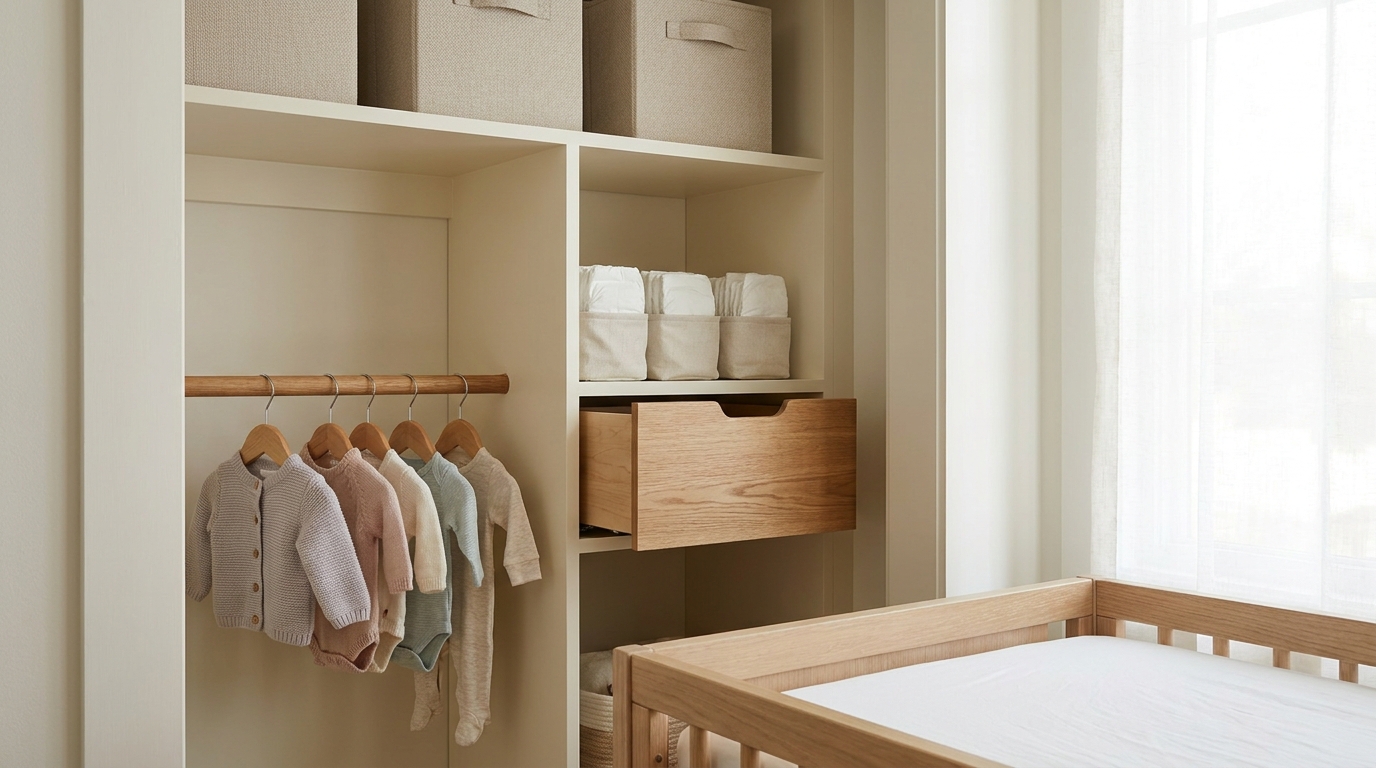
Nursery closet storage works when the closet is planned for an infant, not for a school-age child who already hangs their own clothes. Current-size outfits and the day's diapers live in an easy-reach band. Next-size grow-out bins sit labeled up high. A small fold surface lives in the closet so the changing table stays a changing table. The crib stays empty except for a fitted sheet. The National Institute of Child Health and Human Development's Safe to Sleep campaign is blunt: remove everything from the baby's sleep area except a fitted sheet covering the mattress, with no objects, toys, or other items [1][2].
In Charlotte, Fort Mill, and nearby towns, we still walk into nurseries where newborn onesies share a rod with 2T jackets, open diaper packs sit on the floor, and the changing pad is buried under a laundry pile. That layout slows every change and puts extra stuff next to the crib. Our team designs the closet as the working pantry of the nursery so the crib can stay a sleep surface.
2. This is an infant closet, not a kids closet that grows
This post is about the first year, when a caregiver does almost every grab. It is not a shared two-kid split closet, and it is not a school-age system built around adjustable rods a child will use later.
An infant closet has three daily jobs: dress the baby in the size they wear this month, change them without hunting a diaper, and park the next sizes where they cannot become climb bait. We design custom closets for that workflow. In a Ballantyne reach-in or a Waxhaw walk-in, current size stays in reach, future size stays labeled, and the crib is not overflow storage.
3. Put current-size clothes and diapers in the easy-reach band
The items you use several times a day should sit where an adult can grab them without a stool and without kneeling on the floor. The U.S. Access Board's guide to the ADA Standards uses an unobstructed reach range of 15 to 48 inches for the operable parts of elements [4]. ADA section 308 states the same numbers for unobstructed forward and side reach: 48 inches maximum and 15 inches minimum above the finish floor [5].
That range is a planning analog, not a private-home mandate. Most nurseries in Wesley Chapel or Indian Land are not public facilities. We still use 15 to 48 inches because it matches how a tired parent actually reaches while holding a baby. The Access Board's children's table is advisory and starts at ages 3 and 4 (about 20 to 36 inches) [5]. An infant is not that user. The caregiver is.
Inside that band we typically place:
- Current-size hang for sleepers, onesies, and the few hanging pieces that actually get worn.
- Folded stacks of the size on the baby's body this month, one deep so the stack does not avalanche.
- Diapers and wipes for the next day or two, not the warehouse-club case.
- A small cream and spare-pacifier tray with a lip, so parts cannot roll onto the floor.
Keep the floor visible. A crawling baby will find whatever you leave at ankle height. Federal small-parts rules treat toys and other articles intended for children under 3 as banned hazardous substances if they present a choking, aspiration, or ingestion hazard because of small parts [10]. A small part is any object that fits entirely, without compressing and in any orientation, inside the small-parts cylinder described in 16 CFR 1501.4 [10]. Extra teether pieces, broken rattle bits, and loose clips do not belong on a low open shelf.
4. Label next-size grow-out bins up high
Babies outgrow clothes in weeks. The closet fails when 3-to-6-month sleepers mix with newborn onesies, and you dress the baby in the wrong size at 2 a.m. Grow-out bins solve that if they are labeled and parked above the daily band.
We typically specify:
- One bin per size band (newborn, 0-3, 3-6, 6-9, 9-12, and so on), with a large, readable label on the front.
- A "too small" bin for pieces that just retired, so they leave the daily shelf the same week they stop fitting.
- A "gift holding" bin for outfits that are still too big, still in tissue, and still not in the rotation.
Those bins belong up high, on a shelf an adult can reach with two hands and a crawling infant cannot. When the 3-to-6-month bin becomes the current size, it drops into the easy-reach band and the empty 0-3 bin goes back up.
Do not put toys or stuffed animals on top of those bins. Clothing-storage warning language required under the STURDY standard tells consumers to always install the anti-tip device provided and to never allow children to stand, climb, or hang on any drawers, doors, or shelves [8]. Heavier bulk (unopened diaper cases, extra wipes) belongs on a low, closed shelf or in a deep drawer, not stacked on the high bin row.
5. Give the closet a fold surface that is not the changing table
The changing table is for a diaper change. It is not a laundry counter, not a gift-wrap station, and not a parking pad for tomorrow's outfits. When we use it as all of those things, the pad is occupied when the baby needs it, and stacks of clothes sit next to an infant who should not be left on an elevated surface.
CPSC staff's 2025 nursery-product report estimated 5,400 emergency-department-treated injuries associated with changing tables among children younger than 5 in 2024 [9]. Across all nursery products, CPSC estimated 70,000 ED-treated injuries in that age group in 2024, and falls were the leading cause [9]. Cribs and mattresses were associated with an estimated 11,600 of those injuries [9]. A changing surface covered in clothes is a fall and a clutter problem at the same time.
We put a small fold shelf or pull-out tray in the closet instead. It sits at about mid-torso height, inside the same 15-to-48-inch daily band we use for diapers [4][5]. The day's outfit can land there, then go on the baby, not back onto the changing pad. Restraint straps belong on the changing product, not on a clothes shelf. The fold surface stays in the closet. The changing table stays empty enough to use.
6. Anchor tall cases, even in a nursery that looks "baby-proof"
A free-standing dresser in a nursery is still a clothing storage unit. Under the STURDY law, CPSC adopted ASTM F2057-23 as a mandatory safety standard, now at 16 CFR part 1261, for clothing storage units manufactured after September 1, 2023 [6]. STURDY required tests that simulate the weight of children up to 60 pounds, plus real-world conditions such as carpeted floors, drawers with items in them, multiple open drawers, and dynamic force [6].
That rule covers free-standing bedroom clothing furniture that meets the standard's size and weight thresholds. ASTM F2057-23 does not cover built-in units intended to be permanently attached to the building [6]. A custom closet that is fastened to the structure is a different product than a shop dresser. That is one reason we prefer a built-in nursery system over a tall, free-standing chest that can rock when a drawer is open.
The injury record for free-standing units is not small. In the CPSC staff briefing package that supported the clothing-storage rule, staff identified 199 reported tip-over fatalities to children (under 18) from January 1, 2000 through April 30, 2022, plus 11 adult and 24 senior fatalities in the same window [7]. Of those 199 child deaths, 171 involved children 3 years old or younger [7]. Staff estimated 84,100 clothing-storage-unit tip-over injuries treated in U.S. hospital emergency departments from 2006 through 2021, an annual average of about 5,300, and 72 percent of those injuries (about 60,100) were to children [7]. Those figures are from that 2000-2022 and 2006-2021 data set, not a 2026 snapshot.
Even after STURDY, CPSC still tells households to secure furniture to the wall with an anti-tip device [7][8]. New units in scope must ship with that device. Install it. A Rock Hill nursery with a tall case on carpet and drawers full of onesies is the use pattern the tests try to mimic. Fasten remaining free-standing dressers to studs, keep drawers closed so they cannot become a step, park heavy items low, and skip toys on the crown of the case.
7. Keep closet overflow off the crib
The closet exists so the crib can stay empty. Safe sleep guidance is consistent across the NIH Safe to Sleep campaign and the American Academy of Pediatrics' parent explainer. A safe sleep surface is firm, flat, and level, covered only by a fitted sheet [1][2][3]. AAP's HealthyChildren page says to use a fitted sheet only: nothing else should be in the crib with your baby [3]. Soft objects and loose bedding, including pillows, quilts, comforters, blankets, toys, and bumper pads, raise the risk of entrapment, suffocation, or strangulation [2][3].
That is a closet problem as much as a crib problem. Extra blankets, loveys, bumpers, and stuffed toys have to live somewhere. If they do not have a labeled home in the closet, they land in the crib because it is the open box in the room. We give wearable blankets a current-size cubby in the easy-reach band, extra fitted sheets a thin stack, and stuffed toys a lid bin for awake play.
Room sharing without bed sharing is the recommended layout for at least the first 6 months: the baby sleeps in the same room, in a separate crib, bassinet, or portable play yard [1][3]. AAP notes that room sharing can decrease the risk of SIDS by as much as 50 percent compared with bed sharing [3]. Overflow still cannot migrate onto the mattress.
8. Keep small parts, bulk packs, and "just for now" piles out of the crawl zone
Once the baby crawls, the lower 15 inches of the closet is a hunting ground. ADA's low reach of 15 inches is the bottom of the adult operable band [4][5]. Below that, we keep the floor clear.
16 CFR part 1501 exists because children under 3 are the group at risk for choking, aspiration, or ingestion from small parts, and it lists infant furniture, crib toys, and teethers among the article types in scope [10]. We are not certifying toys in a closet. We are refusing to store loose small parts on a low shelf next to a diaper caddy.
A bulk diaper case on the floor becomes a stool. Put working quantity (a day or two) in the easy-reach band and bulk in a closed cabinet. Gift bags and hospital swag need a holding shelf. If they are still there after two weeks, they go to a labeled bin or out of the room.
9. A layout we specify in Charlotte-area nurseries
Every house is different, but the zones repeat. In a Fort Mill reach-in, a Wesley Chapel walk-in, or a Ballantyne nursery off the primary suite, we still draw the same four bands:
- Floor to about 15 inches: empty, or a closed toe-kick drawer for extra sheets, never open small parts.
- About 15 to 48 inches: current-size hang, current-size folds, diapers, wipes, a lipped tray, and the fold pull-out [4][5].
- Above 48 inches: labeled grow-out bins, extra bulk that is light, and out-of-season pieces. No toys on the crown.
- A separate changing station in the room, kept clear, with the closet fold surface handling clothes so the pad is not a counter [9].
Hardware should work with one hand while you hold the baby. The Access Board's operable-parts guide calls for operation with one hand, without tight grasping, pinching, or twisting of the wrist, and without more than 5 pounds of force [4]. U-shaped pulls beat tiny knobs on a diaper drawer. Built-in carcasses get fastened to the structure so the nursery is not depending on a free-standing chest [6]. When the child is older, the same bones can take a lower rod. That later adjustment is a different project. The first job is diapers in reach, next size labeled up high, and nothing extra in the crib [1][2][3].
10. Practical takeaways
- Treat nursery closet storage as infant workflow: current size and diapers in the easy-reach band, next sizes labeled above.
- Use 15 to 48 inches as a caregiver reach analog from ADA, not as a private-home mandate [4][5].
- Keep grow-out bins labeled by size. Move a bin down when that size becomes current.
- Put a fold pull-out in the closet. Leave the changing table for changes. CPSC associated an estimated 5,400 changing-table injuries with children under 5 in 2024 [9].
- Anchor remaining tall, free-standing cases. STURDY (16 CFR 1261, ASTM F2057-23) took effect for covered units manufactured after September 1, 2023 [6]. CPSC's older file counted 199 child tip-over deaths from 2000 through April 2022 and about 84,100 ED injuries from 2006 through 2021 [7].
- Install the anti-tip device and keep climb bait off the top [8].
- Give extra blankets and stuffed toys a closed closet home. Safe sleep means a fitted sheet only [1][2][3].
- Keep small parts off low open shelves [10], working diapers in reach, and bulk packs behind a door, never as a step.
How we can help
Our team plans infant closets the same way we plan the rest of a home: around the grab you actually make at 2 a.m., with current size in reach, next size labeled, and the crib left empty. If you are setting up a nursery in Charlotte, Fort Mill, Rock Hill, Ballantyne, Waxhaw, Wesley Chapel, or Indian Land, we will measure the closet, map the four bands, and specify a fold surface that is not the changing table.
Have more questions or want to get in touch? https://theclosetrehab.com/contact-us/ · (704) 604-3870 · design@theclosetrehab.com
Citations
- Eunice Kennedy Shriver National Institute of Child Health and Human Development, Safe to Sleep, "What Does a Safe Sleep Environment Look Like? / Safe Sleep for Your Baby" (2022-08)
- Safe to Sleep, NICHD, "Safe Sleep Environment for Baby" (2026-09-14)
- American Academy of Pediatrics, HealthyChildren.org, "How to Keep Your Sleeping Baby Safe: AAP Policy Explained" (2026-09-11)
- U.S. Access Board, "Guide to the ADA Accessibility Standards, Chapter 3: Operable Parts" (2026-02-04)
- U.S. Access Board, "ADA Accessibility Standards, Chapter 3: Building Blocks, Section 308 Reach Ranges" (2026-07-23)
- U.S. Consumer Product Safety Commission / Federal Register, "Safety Standard for Clothing Storage Units, 16 CFR Part 1261 (88 FR 28403)" (2023-05-04)
- U.S. Consumer Product Safety Commission, "Final Rule Briefing Package: Safety Standard for Clothing Storage Units" (2022-09)
- U.S. Consumer Product Safety Commission, Office of Compliance and Field Operations, "Enforcement Policy for Warnings on Clothing Storage Units" (2023-11-15)
- U.S. Consumer Product Safety Commission, "Injuries and Deaths Associated with Nursery Products Among Children Younger than Age Five, 2025 Report" (2026-03)
- U.S. Consumer Product Safety Commission / Code of Federal Regulations, "16 CFR Part 1501, Small Parts" (2025-01-01)