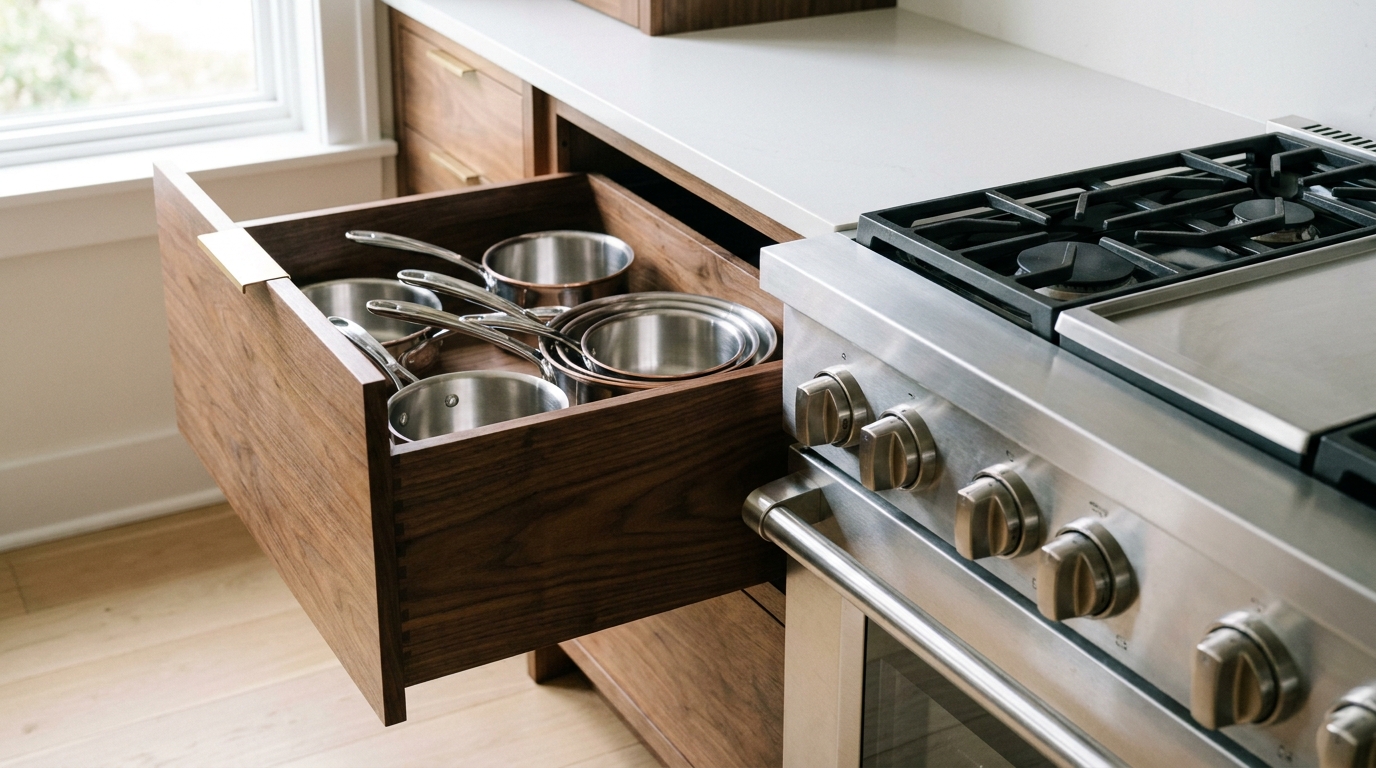
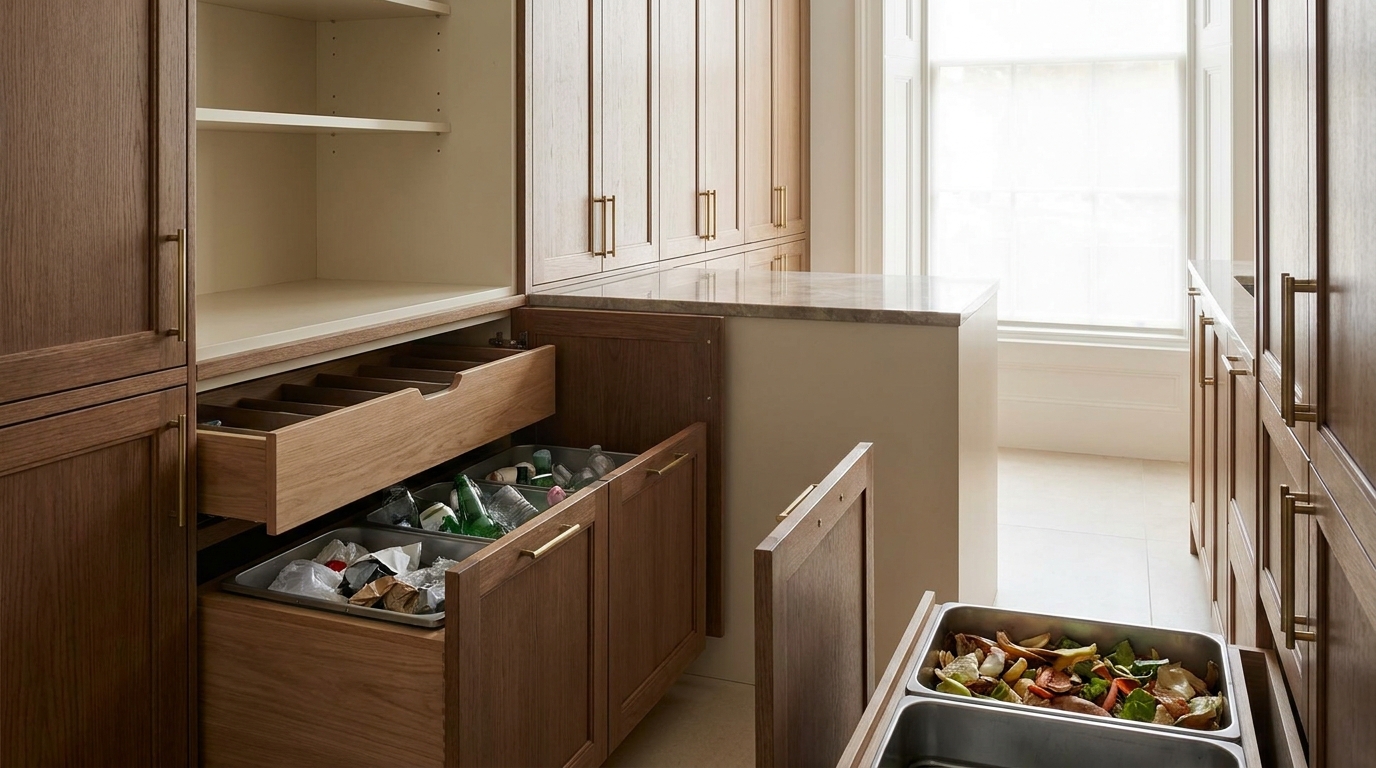
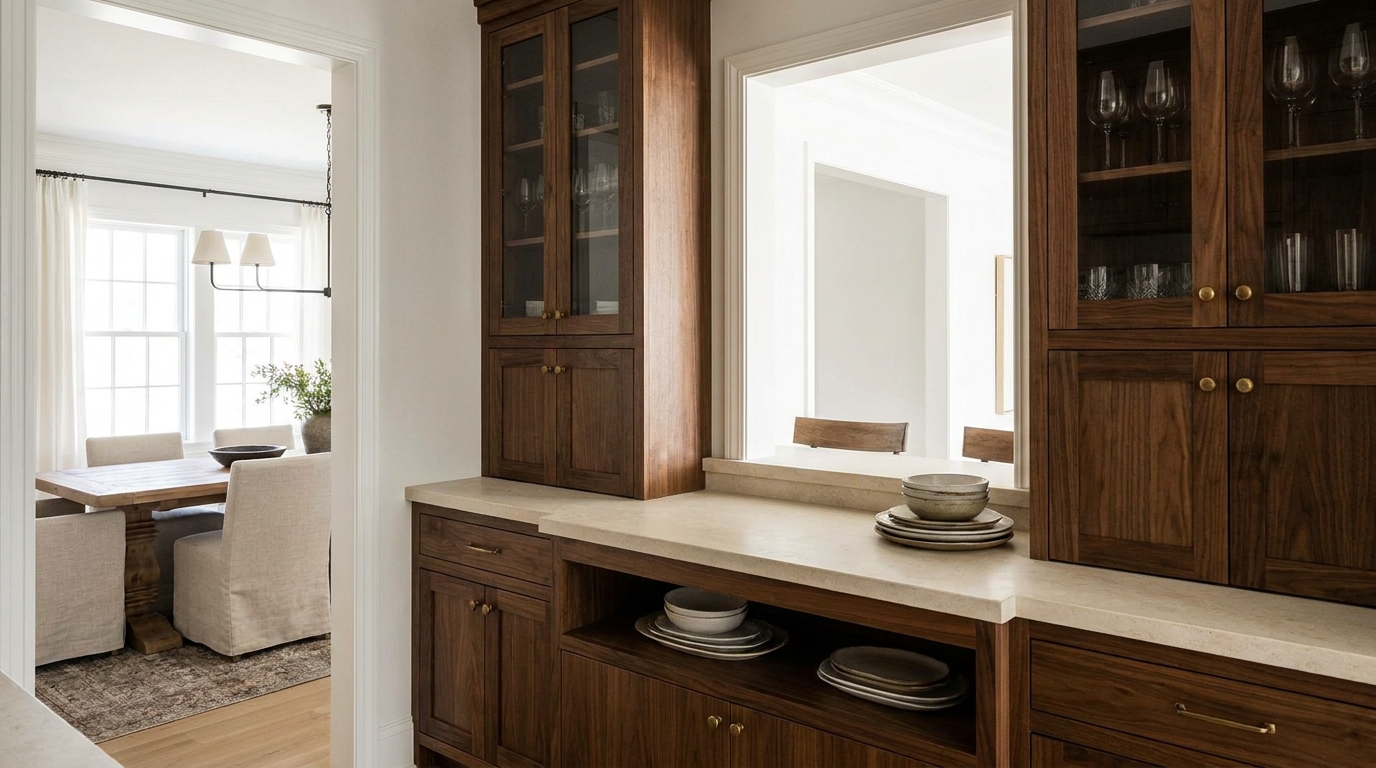
Pantry Appliance Storage: Garages and Work Bays
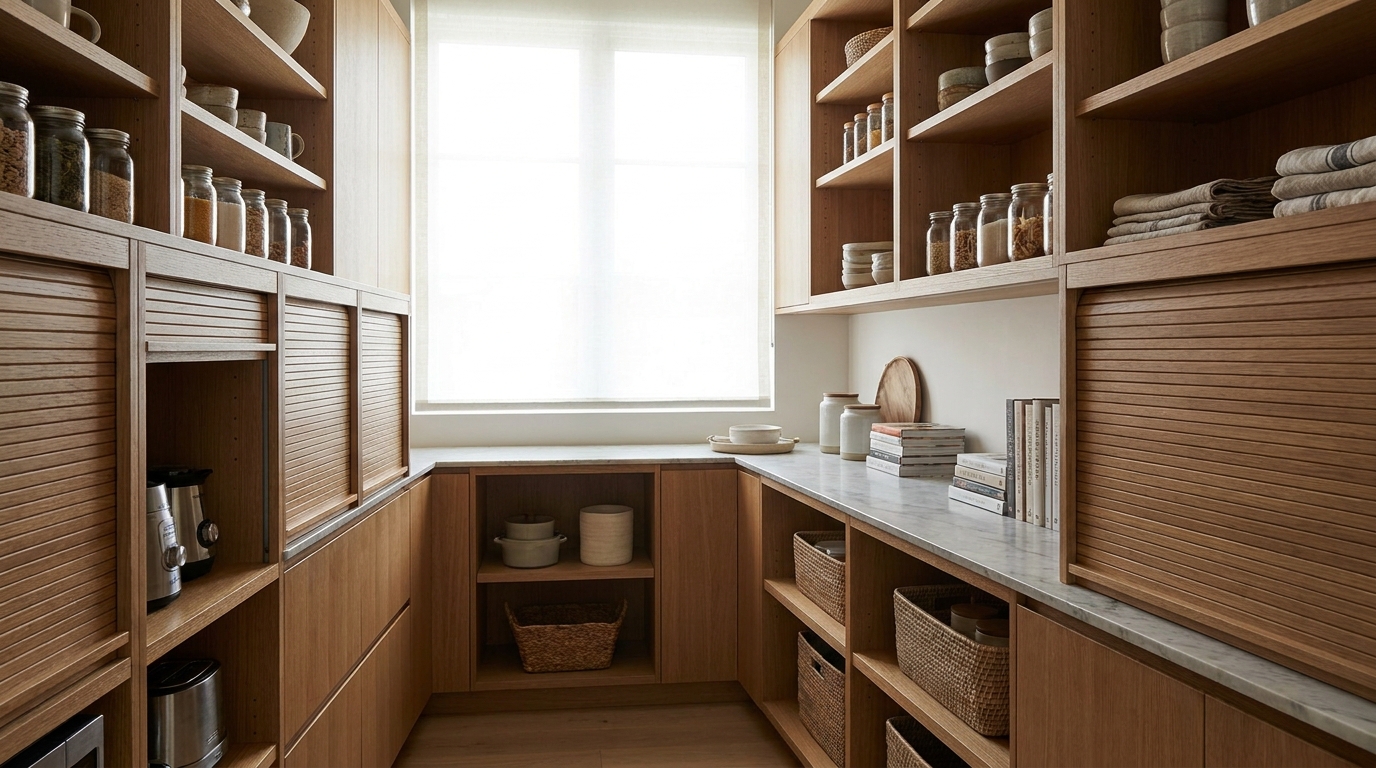
Pantry appliance storage is a closed cabinet plus a counter-height work bay, so mixers, coffee makers, and other small appliances leave the kitchen island. The island stays a landing and serving surface. The pantry holds the machines, their cords, and a short stretch of counter where you actually run them. A University of Missouri Extension kitchen-planning guide, first published in 1993 and reviewed in 2017, treats a pantry as its own work center and recommends at least 36 inches of mixing counter, a different job from a slim pull-out tower of cans and from the family cook triangle around the sink, range, and refrigerator. [3]
1. The island is a landing pad, not a parking lot
Small appliances steal the surface you cook on. A stand mixer, a drip coffee maker, and a toaster oven can eat most of a 36-inch island run before anyone chops an onion. If the island is also the only place those machines can live, the kitchen never resets.
Cooking fire risk belongs at the range. NFPA research on 2020 through 2024 annual averages found that kitchen and cooking equipment were involved in an estimated 48 percent of home structure fires, 35 percent of home fire injuries, and 16 percent of home fire deaths. Ranges or cooktops accounted for 51 percent of home cooking fire incidents, and unattended equipment was a factor in 25 percent of reported home cooking fires and half of the associated deaths. [1] Keep heat work at the cooktop with a clear landing beside it.
Code no longer forces you to power the island like a second kitchen. An NFPA electrical specialist summarizing the 2023 National Electrical Code notes that receptacle outlets are no longer required in kitchen islands or peninsulas, though a provision must still be made so a receptacle could be added later. If an island receptacle is installed, the 2023 rules allow it on or above the surface (not more than 20 inches above) or in a listed work-surface assembly. [6] A pantry work bay with wall outlets is a more honest place to park daily machines.
2. A garage hides the machine. A work bay is where you use it.
The two pieces do different jobs. An appliance garage is a closed cabinet, usually at counter height, with a lift-up, tambour, or hinged door. A work bay is the counter in front of, beside, or inside that cabinet, sized so you can plug in, work, and wipe down without migrating back to the island.
Doors close when the machine is idle. The U.S. Fire Administration tells households to unplug small appliances when they are not in use, to skip extension cords on major appliances, and to replace cracked, damaged, or loose cords rather than keep using them. [2] A garage that only hides a still-plugged toaster with the door shut fights that advice. The cabinet is for storage. The bay is for the few minutes the appliance is actually on.
This is not a family cooking zone, and it is not a slim pull-out. Missouri Extension's basic kitchen centers are mixing, cook-and-serve, sink, and refrigerator. A pantry is listed among other centers you may add, not as a substitute for the cooktop. [3] A slim pull-out tower is a narrow, full-height bay for bottles, spices, oils, and cans. It is a poor home for a mixer or toaster oven that needs counter depth, ventilation, and a receptacle. We keep those two pantry types next to each other when the room allows.
3. Mixing bays need length, not just a shelf
Give the mixer a real counter. Missouri's mix or food-preparation center is ideally between the refrigerator and the sink, and the recommended mixing counter is a minimum of 36 inches long. Packaged foods, baking pans, and the tools used for preparation belong in that same center. [3] A garage door over a shred of leftover counter is not a mix center.
Standing mix height is often lower than a standard 36-inch kitchen counter. The same 2017-reviewed Missouri publication says a lower mixing counter is more comfortable for most standing work, and it tells you how to find it: measure 7 to 8 inches below elbow height, then test that surface long enough to decide. [3] A pantry bay can sit a couple of inches below the main kitchen counters without looking unfinished, because it is its own center.
Seated work has a different number. In residential dwelling units that must comply with ADA Standards section 809, at least one 30-inch-wide kitchen work surface is limited to 34 inches above the finish floor, with an exception for a counter adjustable between 29 and 36 inches. [4] A 1993 Missouri Extension guide for wheelchair kitchens, reviewed in 2017, says a 27-inch-high counter permits easy use of an electric mixer, with about 4 feet of mix counter and 24 inches of knee space desirable. [9] A private Charlotte kitchen is not automatically an ADA dwelling unit, but those numbers still explain why a one-height island fails a household that bakes from a stool. We put mixing bowls, flour, and beaters in drawers beside the mixer so the island does not become the staging table. [3]
4. Coffee and toast need a bay, not the cooktop landing
A coffee maker is a beverage center. Missouri puts coffeemakers among items often stored at the sink center, and it wants 15 inches of counter as a minimum on each side of the range. [3] When the kettle and drip machine colonize that landing, hot pans have nowhere to go. A pantry coffee bay keeps the cooktop clear.
GFCI follows the water. An IAEI Magazine review of the 2023 NEC, by the chair of Code-Making Panel 2, explains that 210.8(A)(6) now simply says "kitchens": all receptacles supplied by a single-phase branch circuit in a dwelling-unit kitchen require GFCI protection. Section 210.8(A)(7) extends the same idea to areas that have a sink and a permanent provision for food or beverage preparation, even if there is no range. [5] If your pantry bay includes a small prep sink, treat the whole bay as a GFCI zone.
Heat appliances still need an audience. NFPA tells you to stay in the kitchen while frying, grilling, boiling, or broiling, to check simmering and baking food regularly, and to keep towels and packaging away from the stovetop. [1] A toaster oven or air fryer in a pantry is still cooking equipment. Do not run it with the garage door down.
5. Plan the power before you hang the doors
Pantry receptacles ride the small-appliance circuits. The 2024 International Residential Code requires a minimum of two 20-ampere-rated small-appliance branch circuits for the receptacle outlets specified by its kitchen and dining rules. The feeder-load table adds 1,500 volt-amperes for each 20-ampere branch circuit serving receptacles in the kitchen, dining room, pantry, breakfast area, and laundry area. [7] "Pantry" is in that sentence on purpose.
One plug-in appliance cannot eat the whole circuit. On a 15- or 20-ampere branch circuit, the 2024 IRC limits any one cord-and-plug-connected appliance that is not fastened in place to 80 percent of the circuit rating. [7] On a 20-amp circuit, that is 16 amperes. A toaster oven and a kettle should not share one duplex if they will run at the same time.
Skip the extension cord. USFA is blunt: never use an extension cord with a major appliance, because the cord can overheat and start a fire. Do not overload outlets or power strips. Replace worn cords. [2] In 2021, an estimated 24,200 residential building electrical fires were reported to U.S. fire departments, with an estimated 295 deaths, 900 injuries, and more than $1.2 billion in property loss. [2] A pantry garage with a hidden power strip is the pattern those numbers describe.
The 2026 NEC is picky about outlets below the counter. The same NFPA summary notes a 2026 addition, 210.52(C)(4): outlets in a cabinet or wall surface below the countertop must not sit on adjacent walls extending from the base cabinets within 24 inches, and must not sit within 24 inches of the countertop or work surface. Drawer outlets are the stated exception. [6] Plan a listed drawer receptacle or a receptacle at the work surface, not a dangling cord to a neighboring wall.
6. Heat, crumbs, and a door that actually closes
Unplug, then close. USFA's appliance message is to unplug small appliances when you are not using them. [2] Use the machine on the bay with the door open. When the cycle ends, unplug it, coil the cord so it is not pinched in the door, and then close the cabinet.
Crumbs are a fire and a food-safety problem. Two-thirds (66 percent) of home cooking fires in the NFPA 2020-2024 averages started with the ignition of food or other cooking materials. [1] A pantry bay with a wipeable counter and a crumb tray you can actually reach is easier to keep empty than an island toaster next to the mail pile.
Do not cook inside a closed box. Manufacturer clearance, steam, and heat all argue for an open door whenever the appliance is on. NFPA's first cooking rule is to stay alert and stay in the kitchen. [1] A closed tambour over a running toaster oven hides both the food and the first sign of smoke. Keep towels in a drawer, not stuffed beside a coffee warmer. [1]
7. The work bay is a food-contact surface
Wash it like a counter, because it is one. FDA's safe-handling steps tell you to wash counter tops with hot, soapy water after preparing each food item, and to wash hands with warm water and soap for at least 20 seconds before and after handling food. [8] Keep the bay for the machine and the bowl, not for yesterday's cooling casserole.
The two-hour clock starts when cooking stops. FDA states that leaving perishable foods out for 2 hours or more allows bacteria to multiply rapidly, and that leftovers need to be refrigerated or frozen within 2 hours (1 hour if the air is above 90 °F). At room temperature, the numbers of bacteria that cause foodborne sickness can double every 20 minutes. The refrigerator should be at 40 °F or below. [8]
Do not thaw on the bay, and do not mix raw work with ready-to-eat work. FDA is explicit: it is unsafe to let food thaw at room temperature, including on the counter top. Safe methods are the refrigerator, cold water, or the microwave. [8] FDA's "separate" step uses one cutting board for produce and another for raw meat, poultry, and seafood. [8] A blender used for a raw-meat marinade and then for a smoothie is the same problem in a jar. Keep raw-protein prep at the kitchen sink center. [3]
8. How we lay out garages and bays
Start with the machines you actually use weekly. Daily coffee and a weekday blender earn a counter-height garage with an outlet in the bay. A stand mixer used on Sundays can sit on a pull-out shelf that locks at counter height. Holiday-only appliances can live higher.
Match door style to the job. A lift-up or tambour door keeps the work surface clear when the garage is open. Hinged doors need a swing that does not hit the pantry door or a pull-out tower. If the bay is in a walk-in, ADA pass-through kitchens need 40 inches between opposing counters or appliances, and U-shaped kitchens need 60 inches, in dwelling units where those kitchen rules apply. [4]
Put the receptacle where the cord is short, and finish the bay so you will wipe it. Follow the 2023 and 2026 outlet-location logic: on or above the work surface, in a listed assembly, or (under the 2026 text) in a drawer. [6] GFCI-protect the bay and split loads across the two small-appliance circuits. [5][7] A closed, smooth counter is easier to wash after each food item than an open wire shelf. [8] Cans, snacks, and paper goods stay on adjustable shelves and slim pull-outs.
Our custom pantry work already treats appliance zones as a pantry essential: dedicated space for stand mixers, blenders, and small appliances, plus built-in counters for prep. The island can go back to being an island.
Practical takeaways
- Park machines in the pantry, work on a bay. Closed storage plus a counter-height work surface is pantry appliance storage. The island stays clear.
- Size the mix counter. Missouri's 2017-reviewed guide still uses 36 inches as a minimum mixing length, and a lower mix height about 7 to 8 inches below your elbow. [3]
- Do not confuse this with a slim pull-out or the cook triangle. Towers hold cans. Dinner stays at the sink, range, and refrigerator. [3]
- Unplug, then close the door. USFA wants small appliances unplugged when idle, and no extension-cord daisy chains. [2]
- Power the bay correctly. GFCI-protect kitchen and beverage-prep receptacles. [5] Put pantry outlets on the two 20-ampere small-appliance circuits. [7] Watch the 2026 below-counter 24-inch rule, with its drawer-outlet exception. [6]
- Treat the bay as a food-contact counter. Wash it after each food item. Get leftovers into a 40 °F refrigerator within 2 hours. Do not thaw on it. [8]
- Stay with heat. NFPA's 2020-2024 averages still put unattended equipment in 25 percent of home cooking fires. [1]
How we can help
We design custom pantries around the machines you actually own, with closed garages, counter-height work bays, and power planned with your electrician so the kitchen island can stay clear. If you are in Charlotte, Ballantyne, Waxhaw, Fort Mill, or a nearby town, we will measure the pantry (or the closet that should become one) and map the zones.
Have more questions or want to get in touch? https://theclosetrehab.com/contact-us/ · (704) 604-3870 · design@theclosetrehab.com
Citations
- National Fire Protection Association, "Safety with cooking equipment" (2020-2024 annual averages; page accessed 2026-08-24)
- U.S. Fire Administration, "Appliance and Electrical Fire Safety" (2021 electrical-fire estimates; accessed 2026-08-24)
- University of Missouri Extension, "Kitchen Planning: Work Centers" (GH5669; published 1993, reviewed September 2017)
- U.S. Access Board, "ADA Accessibility Standards, Chapter 8: Special Rooms, Spaces, and Elements" (2010 Standards, sections 804.2-804.3)
- IAEI Magazine, "Kitchens and Areas for Food or Beverage Preparation and GFCIs" (2024-06-30)
- National Fire Protection Association, "Kitchen Island and Peninsula Outlets and the NEC" (updated 2026-01-27)
- International Code Council, "2024 International Residential Code, Chapter 37: Branch Circuit and Feeder Requirements" (E3702.4, E3703.2, Table E3704.2(1))
- U.S. Food and Drug Administration, "Refrigerator Thermometers: Cold Facts about Food Safety" (accessed 2026-08-24)
- University of Missouri Extension, "Kitchens for Workers in Wheelchairs" (GH5671; published 1993, reviewed September 2017)