Pantry Lighting That Makes Labels Readable
Good pantry lighting puts a clean, even wash on the vertical faces of cans, boxes, and jars so you can read dates, ingredients, and Nutrition Facts without pulling every item into the kitchen. A single ceiling bulb almost never does that job, because deep shelves, your own body, and the tops of stacked goods block the beam before it reaches the labels. Layered LED strips, door-activated switches, and shielded light on pull-outs fix the dark corners without glare. ENERGY STAR notes that under-cabinet and similar task fixtures work when they sit out of sight, point light onto the surface you actually use, and minimize shadowing. [1]
1. Why a single ceiling bulb fails in a pantry
A pantry is a storage room with a visual task. You are lighting print on the front of a can that may sit 18 to 24 inches back on a shelf, behind taller boxes, in a space that often has no window.
Overhead light dies at the first obstruction. The ceiling bulb hits the top of the nearest row, then each shelf casts a hard shadow on everything below. Your shoulders add a second shadow the moment you step in.
Labels live on vertical surfaces. A 2012 U.S. Department of Energy lighting guideline, summarizing Illuminating Engineering Society (IES) residential recommendations for occupants ages 25 to 65, listed only 5 footcandles of vertical illuminance for kitchen cabinets, versus 50 footcandles horizontal on a prep counter and 30 horizontal / 10 vertical in a walk-in closet. [2] Those numbers are not a pantry code. They do show that the light that matters for fronts of stored goods is vertical, not a pool on the floor. A ceiling fixture is aimed at the wrong plane.
Omnidirectional bulbs waste a lot of their output inside the fixture. DOE’s LED basics page notes that fluorescent and “bulb” shaped lamps emit in all directions, so much of the light is lost in the housing or sent the wrong way. For recessed downlights, troffers, and undercabinet fixtures, it is not uncommon for only 50% to 60% of the total light produced to leave the fixture. [5] LEDs, by contrast, emit in a specific direction, which is why they suit shelf and task lighting. [3][5]
Heat and reach make a cheap bulb a poor pantry tool. ENERGY STAR certified LED products use about 70% to 90% less energy than traditional incandescent bulbs, last at least 15 times longer, and produce about 70% to 90% less heat. [1][3] That last point matters next to oils, chocolate, and spices.
If your pantry in Charlotte, Fort Mill, or Ballantyne is a windowless reach-in, one flush-mount is doing the job of a hallway light, not a label reader.
2. What “readable labels” actually require
You need to see dates, dents, and the Nutrition Facts panel. The U.S. Food and Drug Administration’s label-reading guidance exists so shoppers can make quick, informed decisions from serving size, calories, nutrients, and Percent Daily Value. [7] That only works if the print is visible in the place you store the food. Clemson University’s Home & Garden Information Center, in a fact sheet updated in 2024, tells households to inspect cans for dents, cracks, and bulging lids, to treat dusty cans or torn labels as a possible sign of old stock, to check “use by” dates, and to look closely at every can before opening. [6] FIFO (first in, first out) only happens when the date on the back row is as easy to read as the date on the front.
Contrast beats raw brightness. Tiny type on a glossy label fails when a bare diode is bouncing off the can into your eyes. ENERGY STAR’s kitchen lighting guide tells readers to choose a whiter, crisper appearance (about 4100K and up) for activities such as reading or projects, to keep the same shade of white in lights that share a space, and to hang pendant lamps above standing eye level to control glare. [1] The glare lesson transfers to a pantry: hide the source, light the label, keep the diode out of your line of sight.
Color rendering helps you tell paprika from chili. DOE recommends a minimum color rendering index (CRI) of 80 for interior lighting, and notes that 90 or higher indicates excellent color fidelity. [5] ENERGY STAR’s kitchen examples also aim to display the natural colors of foods while giving you the work light you need. [1] In a pantry, that is the difference between grabbing the right can and guessing.
This is a different brief from lighting a cooktop, a slim spice tower, or an appliance garage. Here the task is print on packages, in depth, in shadow.
3. Where LED strips belong on deep shelves
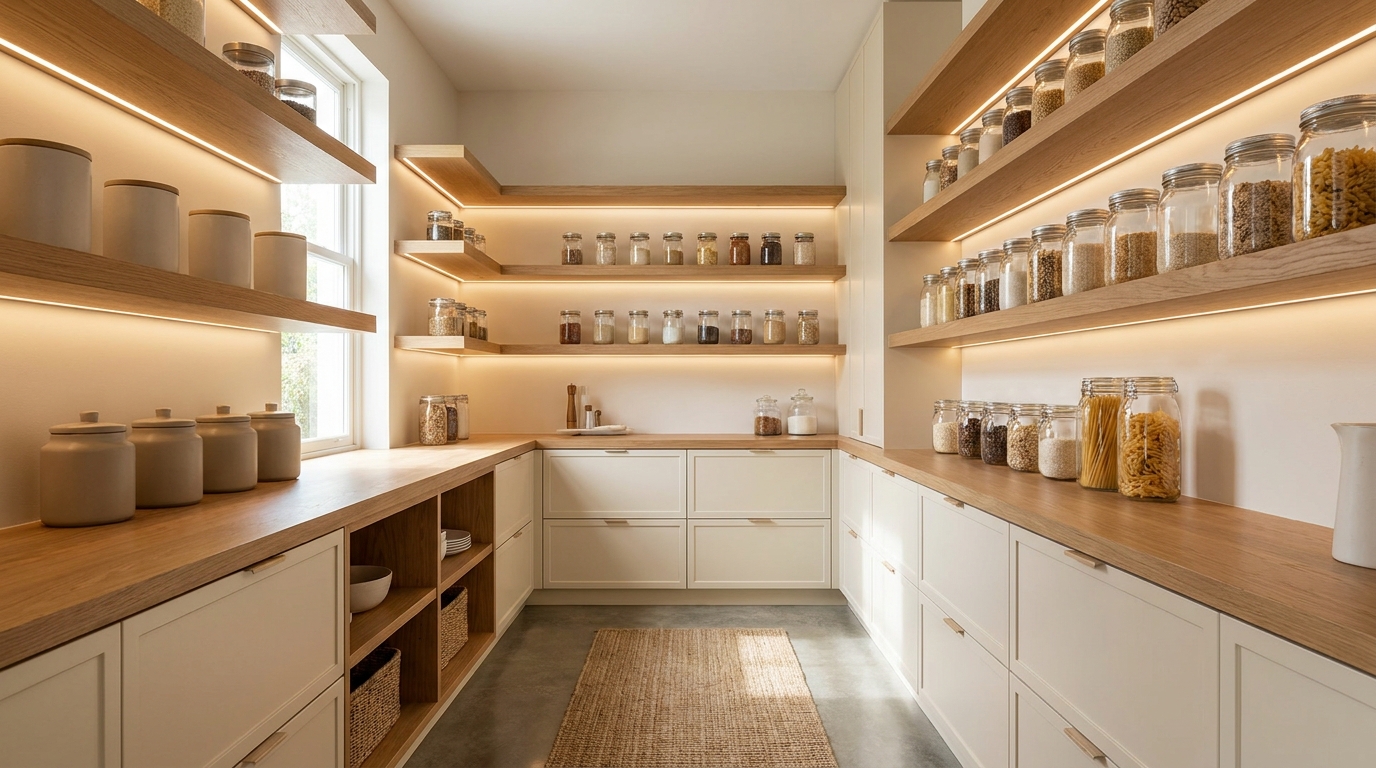
Mount linear LEDs at the front rail, not the back wall. ENERGY STAR describes under-cabinet lighting as direct illumination of work surfaces, with most fixtures out of sight and positioned to minimize shadowing, directing light onto the surface so you can clearly see what is there. [1] The same geometry applies under a pantry shelf. A strip at the back washes the wall and the tops of the rear cans. A strip at the front edge throws light down the faces of the row and into the depth of the shelf.
Run continuous lines, not a few pucks. Discrete spots create bright circles and dark gaps. Linear tape or a slim bar in a diffuser channel gives an even wash, which is what small type needs. Recess the channel behind a light rail or the front lip of the shelf so you see the contents, not a row of diodes.
Light every level, including the dark corners. The bottom shelf and the far corner of a U-shaped walk-in are where “I thought we had two of those” happens. If the ceiling fixture cannot see those surfaces, give them their own run. Lighter interior finishes help. Pacific Northwest National Laboratory’s high-efficiency lighting guide notes that lighter-colored walls, ceilings, floors, furniture, and appliances have a significant impact on how much lighting a room needs. [3] A dark stained pantry will need more delivered lumens at the shelf than a light painted one.
Keep the pantry’s cooking-adjacent surfaces on a separate thought. A small landing counter inside a walk-in can share the same color temperature as the kitchen, but the shelf strips are still task lights for labels, not a substitute for cooktop or prep lighting. Our custom pantry layouts already use deep pull-out drawers, tiered canned-goods rows, and adjustable shelves. Lighting should be designed with those depths, not added as an afterthought.
4. Door-activated lights for full hands
You should not have to set down grocery bags to find a switch.
A contact closure is the pantry version of a refrigerator light. DOE’s Building America Solution Center describes contact closures as physical switches installed in a door, such as a closet, cabinet, or refrigerator door. When the door is closed, contact is made and the light turns off. When the door is open, the connection is broken and the light comes on. [4] That is the right control for a reach-in pantry or for interior cabinet lighting behind opaque doors.
A walk-in can use occupancy sensing, with care. The same guide notes that motion-triggered lighting can be useful in closets or for undercabinet task lighting: sensors turn lights on when the space is in use and off when it is not. [4] Passive-infrared sensors need line of sight and are better at detecting a person walking in than small motions behind a door. Place the sensor so a closing door or a stacked case of water does not block it, and keep it off HVAC drafts that can false-trigger PIR units. [4]
Match the timeout to a short visit. Pantry trips are usually seconds, not hours. A short delay after the last motion, or a true door switch that dies the moment the door latches, keeps ENERGY STAR-class LEDs from running in an empty room. Lighting already accounts for about 7% of electricity use in U.S. residential buildings, per EIA 2024 figures cited by PNNL, so automatic off is not a gimmick. [4]
The light should already be on when the door swings. You are often carrying glass, bags, or a heavy mixer.
5. How to light pull-outs without glare
Pull-out drawers and pantry pull-outs solve the “lost in the back” problem only if you can see into them when they are open. Bare LEDs aimed at eye height will make you squint instead.
Shield the source. ENERGY STAR’s glare advice for pendants is simple: hang the lamp above standing eye level. [1] On a pull-out, that means the diode sits in a profile, behind a diffuser, along the side rail or under the drawer front, so the open drawer presents a lit interior rather than a strip of bright points. You should see the bags of flour, not the hardware.
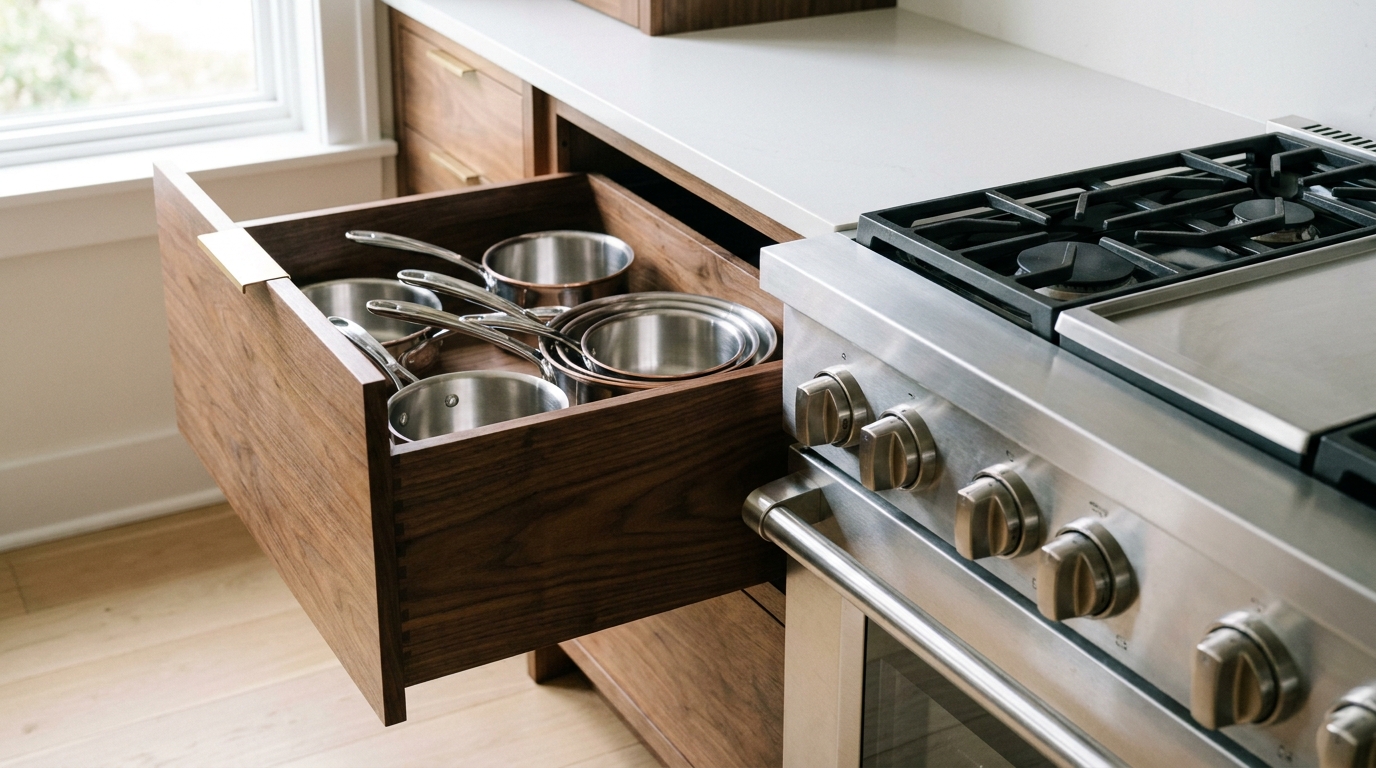
Light the interior, not the aisle. A strip along the spine of a tall pull-out pantry lights every shelf as the unit comes out. A shallow linear LED at the back of a deep drawer lights lids and labels from behind the front rail. Avoid a puck at the top of a tall pull-out that stares you in the face at standing height.
Keep heat and wiring in the millwork, not in the food. ENERGY STAR reminds renovators to pair dimmable LEDs with compatible dimmers if you dim at all. [1] Even coverage matters more than mood. LEDs emit very little radiated heat compared with incandescent sources. [3][5] Still, drivers belong in a ventilated void, not taped under a shelf that holds chocolate or oils. Have an electrician hardwire runs behind finished interiors. Battery pucks are a patch, not a custom pantry.
6. Color, output, and efficiency that belong in food storage
Stay in one white family. ENERGY STAR tells you to pick a light appearance number that fits the use (for example 2700K for a soft, warm glow, 4100K and up for whiter, crisper light for reading) and to use the same shade in lights that share a space. [1] PNNL’s bands are similar: 2700K to 3000K for warmer light, 3500K to 4100K for a whiter light, 5000K to 6500K for cooler white. [3] For labels, a neutral white in the 3500K to 4100K range is usually easier to read than a very warm 2700K wash. Match it to the kitchen so the pantry does not look like a different house when the door opens.
Aim for quality LEDs, not the cheapest tape. DOE reports that good-quality white LED products are expected to last 30,000 to 50,000 hours or longer, compared with about 1,000 hours for a typical incandescent and 8,000 to 10,000 for a comparable CFL. [5] ENERGY STAR certified LED products use at least 75% less energy and can last up to 25 times longer than traditional incandescent lighting. [3] In a pantry, that is fewer ladder trips into a tight, tall space.
Do not treat this as a strip-light weekend. Custom interiors need planned channels, consistent color, a door switch aligned to the hinge, and drivers that will still be serviceable in ten years. That is millwork and electrical work, planned together.
Practical takeaways
- Treat pantry lighting as task lighting for print. You are lighting labels, dates, and can condition, not the floor.
- Skip the single ceiling bulb as your only source. Shelves, stacked goods, and your body will block it.
- Put linear LEDs at the front underside of each shelf, hidden behind a rail, with a diffuser so the diode is not in your eyes. [1]
- Use a door contact switch on reach-ins and a well-aimed occupancy sensor on walk-ins so the light is on when your hands are full. [4]
- Shield pull-out lighting so an open drawer shows food, not glare. Keep sources above or beside the line of sight. [1]
- Choose a consistent, slightly crisp white (about 3500K to 4100K) and a CRI of 80 or higher, ideally 90, so spices and produce colors read true. [1][5]
- Specify ENERGY STAR class LEDs for lower energy, less heat next to food, and a long life in a hard-to-reach box. [1][3]
- Design light with the interiors. Deep drawers, tiered can rows, and tall pull-outs need their own runs. A leftover can light will not cover them.
How we can help
Have more questions or want to get in touch? Visit our contact page, call (704) 604-3870, or email design@theclosetrehab.com. We design custom pantries for homeowners who want high-quality storage, including the lighting that makes every label readable, from Wesley Chapel and Waxhaw to Indian Land and Rock Hill.
Citations
- ENERGY STAR / U.S. EPA, "The Bright Choice: Renovate with ENERGY STAR LED Lighting" (2023)
- U.S. Department of Energy, Building America, "Strategy Guideline: High Performance Residential Lighting" (2012)
- Pacific Northwest National Laboratory, Building America Solution Center, "High-Efficiency Lighting" (2022)
- Pacific Northwest National Laboratory, Building America Solution Center, "Lighting Controls for Multifamily Buildings" (2024)
- U.S. Department of Energy, "LED Basics" (2026)
- Clemson University Cooperative Extension, Home & Garden Information Center, "Safe Handling of Canned Goods" (2024-06-12)
- U.S. Food and Drug Administration, "How to Understand and Use the Nutrition Facts Label" (2024-03-05)