Pantry Organization for Lunchboxes and Bottles
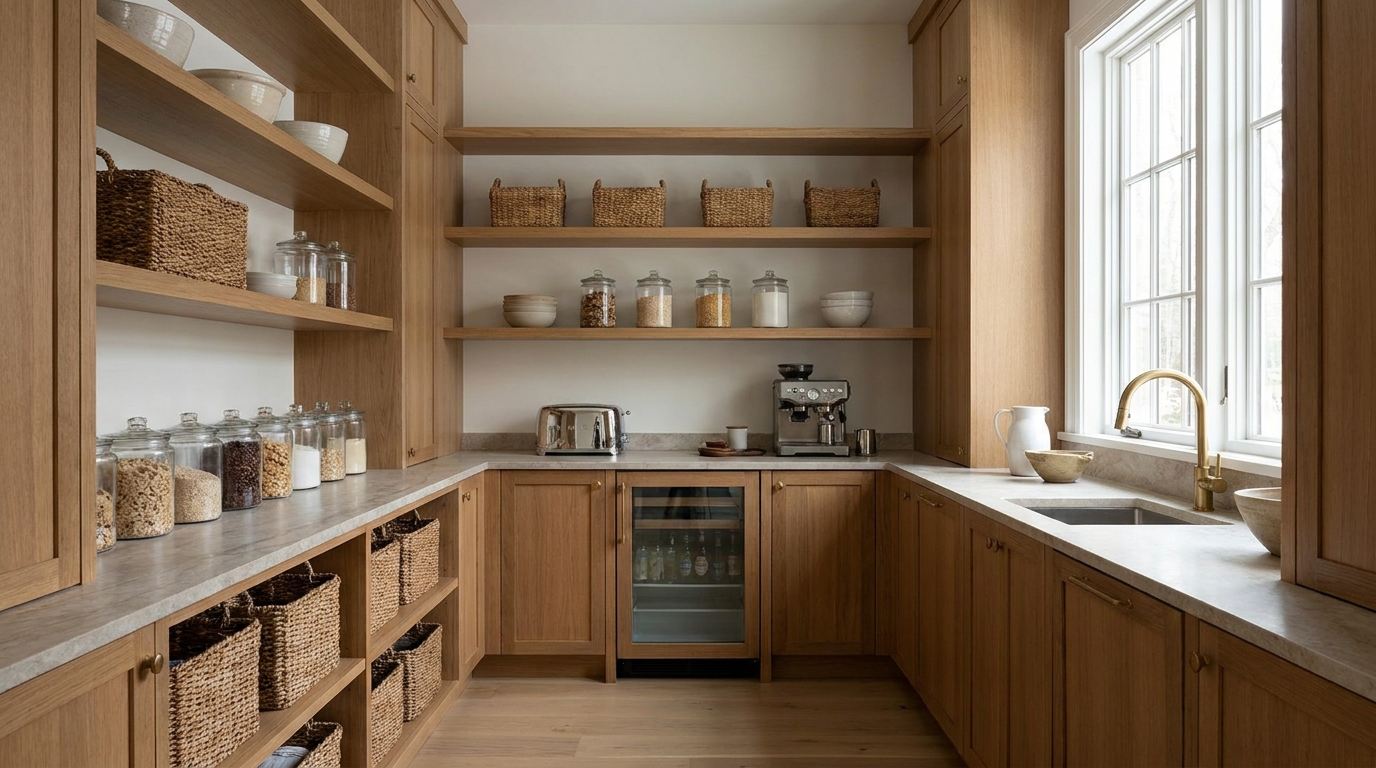
A pantry lunch station is a morning bay for empty lunchboxes, matching lids, and clean water bottles, kept off the shelves where snacks live. Thoughtful pantry organization gives that gear one obvious home, so packing is a reach instead of a search through cracker boxes. The bay holds containers, not the meal. Perishable food stays in the refrigerator until you pack, because the FDA notes that, at room temperature, the numbers of bacteria that cause foodborne sickness can double every 20 minutes [2].
1. Take lunch gear off the snack shelf
The snack band earns its mess. It sits where children can reach it without climbing, and it gets opened, poured, and pinched shut all afternoon. That is a sensible place for crackers, sealed bars, and the fruit pouch someone will ask for after school. It is a poor place for a lunchbox lid, a straw cap, and a bottle that should leave the house clean.
When lunch gear shares that shelf, the morning starts with a scavenger hunt. Lids wander into the cracker bin. Bottles tip into open bags and come back dusty. A box that still holds yesterday's container starts to look like food storage, which it is not. We see this in pantries around Charlotte and Fort Mill: the snacks are easy to find, and the packing tools are buried inside them.
There is a safety reason to split the two, not only a neatness reason. Clemson Cooperative Extension warns that bacteria grow and multiply rapidly in the danger zone between 40 and 140 degrees F, and it tells families to keep packed lunches out of direct sunlight and away from radiators or other heat [1]. A pantry shelf is room temperature. It is not a refrigerator, and it is not an insulated bag with frozen packs. A sandwich that "just sits in the box until morning" spends the night in that danger zone.
The CDC puts a limit on the wait. Never leave perishable food out for more than 2 hours, or for more than 1 hour if it is exposed to temperatures above 90 degrees F [3]. A lunchbox parked on a snack shelf from bedtime until the bus is far past either limit. The built-in fix is a split in the pantry itself. Snacks stay on the kid-height band. Lunchboxes, lids, and clean bottles move to their own bay. The food stays cold until the bag is actually packed.
2. Give the morning its own shelf or pull-out
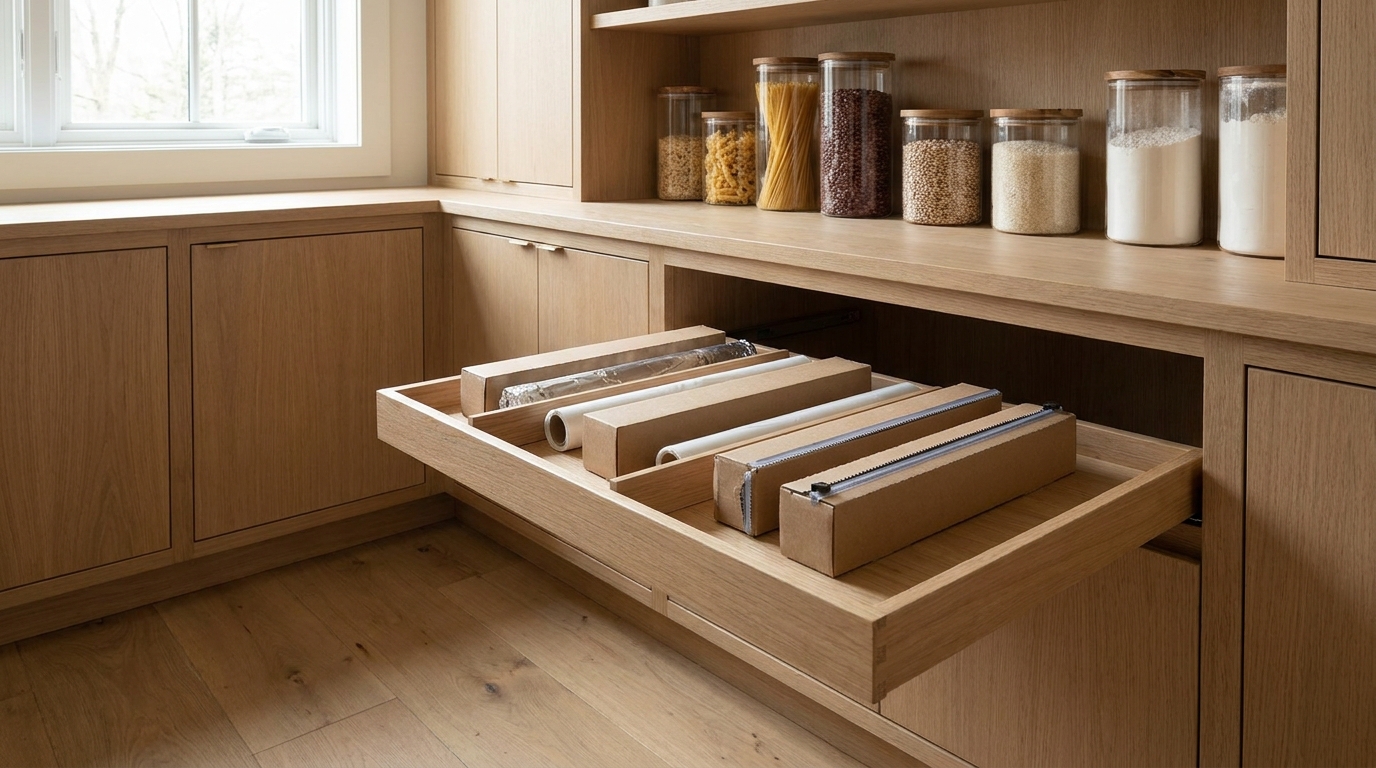
We design the lunch bay as one zone, usually a mid-height shelf or a full-extension pull-out near the pantry door. The height is for the person who packs, not for the child hunting a snack. In the custom pantry systems we build, pull-out drawers and adjustable shelves already sort a kitchen into zones. A lunch bay uses that same idea for a narrower job: gear in, food out.
One landing spot. Empty lunchboxes stand upright, or they nest only when they are dry and the lids are off. A divided pull-out keeps a small box from sliding behind a taller one. If the box has a name, the name faces out. Nobody should have to unstack the whole bay to find one child's kit.
A lid bin with a front lip. Lids, straw pieces, and small insert cups get a shallow bin, not a loose pile. If a lid has no mate, it does not earn a permanent spot. That rule is what keeps the bay from turning into a junk drawer.
A bottle row that can dry. Clean water bottles stand open until they are dry. University of Minnesota Extension, in guidance reviewed in 2023, says to clean a reusable bottle daily with dish soap and water, rinse it thoroughly, and let it air dry [5]. A shelf that forces bottles into a heap works against that. We leave enough height for bottles to stand, with a small gap so air can move. Lids stay in the bin until the bottle is dry.
No food in the gear bay. If a child can treat the pull-out like another snack shelf, the split fails within a week. We do not assign pouches, crackers, or fruit to that bay. In walk-in pantries we measure in Ballantyne, the bay that stays empty of food is the one that still works months later. A reach-in pantry can do the same job with one pull-out tray. On a school morning you should not have to decide where the gear lives.
3. Pack the food in the morning, from the refrigerator
Cooking ahead is fine. Staging the finished lunch on a pantry shelf is not. A September 2022 Purdue Extension article, drawing on USDA guidance, says it is fine to prepare the food the night before, but to pack lunch bags right before leaving home [4]. Cooked foods such as turkey, ham, chicken, and pasta or vegetable salad should be chilled thoroughly in a refrigerator at 40 degrees F or below, and they should stay there until it is time to go [4].
That is the habit the bay is built to support. The lunchbox waits empty on the pull-out. The sandwich, the yogurt, and the cut fruit wait in the refrigerator. In the morning the box comes down, the cold food goes in, and the box leaves the house. It does not go back onto a shelf half packed.
Clemson Cooperative Extension draws the same line. Sandwiches can be made ahead and kept refrigerated, or frozen, before they go into the lunch box [1]. For quality, mayonnaise, lettuce, and tomatoes should not be frozen, and those pieces should be added later [1]. A frozen plain sandwich can help the bag stay cold. The same sandwich left on an open pantry shelf does not. The shelf never gets cold.
Some foods can ride without an ice pack. The 2022 Purdue article lists whole fruits and vegetables, hard cheese, canned meat and fish, chips, breads, crackers, popcorn, peanut butter, jelly, mustard, and pickles as items that do not require refrigeration for the trip [4]. A whole apple can go in the bag beside the cold food. Cut fruit is a different case. The CDC lists cut melon among riskier foods, and it groups cut fruit with meat, seafood, dairy, and cooked leftovers as perishable food to refrigerate within 2 hours, or within 1 hour if the food is exposed to temperatures above 90 degrees F [3]. A tub of cut melon is not a resident of the lunch bay, even when a whole piece of fruit can travel without ice.
The FDA uses the same clock. Do not leave perishable food at room temperature for more than 2 hours, and shorten that to 1 hour when the air is above 90 degrees F [2]. Keep the refrigerator at 40 degrees F or below and the freezer at 0 degrees F [2]. The dial on the door is a setting, not a reading. An appliance thermometer shows whether the food is actually cold [2]. If the refrigerator is running warm, packing from it does not protect the lunch.
4. Send cold sources with the food, not on the shelf
Once perishable food is in the box, the box has to stay cold until lunch. Clemson Cooperative Extension recommends an insulated box or bag, with at least two cold sources whenever the lunch includes perishable food [1]. Place one cold source on the bottom, the food in the middle, and the second cold source on top [1]. Frozen gel packs, small frozen juice packs, or frozen bottles of water can serve as those sources [1].
Those cold sources do not live on the pantry shelf. Gel packs, and any bottle you intend to freeze, belong in the freezer overnight, at 0 degrees F [2]. The pantry bay holds the clean, dry spares and the empty lunchbox. The freezer holds the ice. In the morning you move the frozen pieces into the bag while you pack. Shelf for gear. Freezer for cold. Refrigerator for food.
Gel packs have a limit. Clemson notes that they can keep cold foods cold until lunchtime, but they generally will not hold for all-day storage [1]. A box left in a warm car or a sunny window is not rescued by a pack that has already thawed. If a refrigerator is available at school or work, store the perishable items there, and leave the lid of an insulated box open so cold air can circulate [1]. Perishable leftovers that were not kept cold should be thrown out, not carried home [1]. The bay is for the empty box after it is washed, not for a half-eaten sandwich.
Hot food should not cool off on that shelf either. For soup, chili, or stew, Clemson describes an insulated bottle kept in the lunch box. Fill the bottle with boiling water, let it stand a few minutes, empty it, add the piping hot food, and keep it closed until lunch so the food stays at or above 140 degrees F [1]. If the meal will be reheated in a microwave, cover it so it heats evenly and bring it to at least 165 degrees F [1]. Fill that container at the counter. Do not park it, full, in the pantry overnight.
A warm ride changes the clock. The FDA notes that a car is probably hotter than typical room temperature, and that food should not stay in the car more than 2 hours, or 1 hour on a hot day [2]. Packing at the door, with cold sources already frozen, beats packing at bedtime. On a late-summer morning heading out of Indian Land or Waxhaw, that is the difference between a cold lunch and food that spent the night in the danger zone.
The FDA's picnic guidance makes a related point. Cold food should be held at 40 degrees F or below, and the agency suggests packing beverages in one cooler and perishable foods in another, so opening the drinks does not warm the meal [7]. In a pantry we use the same idea without a cooler. Water bottles and snack bags do not share one shelf that everyone opens all day. The bottles have a row. The snacks have a band. The perishable food stays in the refrigerator until the bag is zipped.
5. Wash the bottle and the box before they come back
The bay only stays useful if what returns to it is clean and dry. A lunchbox that carried yogurt, meat, cheese, or cut fruit is a food container. The CDC's prevention steps say to wash utensils, cutting boards, and countertops with hot, soapy water after preparing each food item, and to wash hands for at least 20 seconds with soap before, during, and after preparing food and before eating [3]. Clemson Cooperative Extension calls washing your hands for at least 20 seconds before you prepare or eat the first step in keeping a packed lunch clean, and it recommends hot, soapy water on preparation surfaces [1]. We hold the box to that same standard. It is washed, rinsed, and dried before it goes back on the pull-out. A damp box nested inside another box is how a clean-looking shelf smells by the end of the week.
Hands matter as much as the bin. In a 2023 observational study by USDA, summarized by the CDC, participants failed to wash their hands correctly 97% of the time, and nearly half cross-contaminated spice containers because they did not wash adequately [6]. That study was about cooking, not lunchboxes. The lesson still fits. Containers people touch with unwashed hands pick up germs. A separate pull-out does not replace soap and water. It does keep clean bottles out of the crumb zone while the sandwich is finished. Clemson also suggests packing sanitary wipes for children to use before and after they eat, and keeping pets off the counters while you pack [1].
Water bottles need a daily wash, not a quick rinse on the way to the car. The same 2023 University of Minnesota Extension guidance says to use dish soap and water, rinse thoroughly, and air dry, and it describes an optional step after cleaning: fill the bottle with water plus 3 to 4 drops of household bleach, leave it about 10 seconds, pour it out, and air dry [5]. Follow the maker's instructions before a dishwasher cycle or a bleach rinse, and do not leave bleach solution where a child can drink it. Bottles join the row only after they have aired. Wash straws and caps separately so the seam is not skipped.
A short tray at the end of the pull-out can hold pieces that are still drying, so putting them away does not mean putting them away wet. The evening routine is small. Empty the box. Wash the box and the bottle. Set both out to dry. In the morning they are already in the bay, and the food comes from the refrigerator at the last minute.
If you freeze bottles as cold sources, keep a second set. One set is clean and ready to fill for drinking. The other can live in the freezer as ice, marked so nobody drinks a bottle that rode against perishable food and was only rinsed. Clemson's frozen-bottle tip is about keeping food cold, not about refilling that bottle later without a wash [1]. Drinking bottles stand in the row. Freezer bottles stay off that shelf until they are washed and dried.
Practical takeaways
- Give empty lunchboxes, lids, and clean water bottles their own shelf or pull-out, separate from the kid-height snack band.
- Prepare food ahead if you want, but pack perishable items right before you leave, from a refrigerator held at 40 degrees F or below [4].
- Do not leave perishable food out more than 2 hours, or more than 1 hour if the air is above 90 degrees F, and remember that bacteria can multiply quickly at room temperature [2][3].
- Use an insulated bag with at least two cold sources, one under the food and one on top, and store gel packs in the freezer until morning [1].
- Whole fruits and vegetables can ride without ice. Cut fruit, including cut melon, is perishable and does not live overnight in the lunchbox [3][4].
- Wash and air-dry bottles and lunchboxes before they return to the bay. In a 2023 USDA study summarized by the CDC, participants failed to wash their hands correctly 97% of the time [6].
How we can help
Have more questions or want to get in touch? Our team can plan a morning lunch bay as part of a custom pantry, and a designer will come to your home for a free, no-obligation in-home design consultation. Call (704) 604-3870, email design@theclosetrehab.com, or visit the page https://theclosetrehab.com/contact-us/.
Citations
- Clemson Cooperative Extension, Home & Garden Information Center, "Bag Lunch Safety" (revised 2024-09-26)
- U.S. Food and Drug Administration, "Refrigerator Thermometers - Cold Facts about Food Safety" (content current 2024-03-05)
- Centers for Disease Control and Prevention, "Preventing Food Poisoning" (2025-11-24)
- Purdue Extension, "Keeping \"Bagged\" Lunches Safe" (2022-09-14)
- University of Minnesota Extension, "Healthy and fit on the go: Better beverages" (reviewed 2023)
- Centers for Disease Control and Prevention, "About Handwashing as a Healthy Habit in the Kitchen" (2024-02-17)
- U.S. Food and Drug Administration, "Handling Food Safely While Eating Outdoors" (content current 2024-03-05)