Pantry Produce Storage: Onions, Potatoes, and Bread
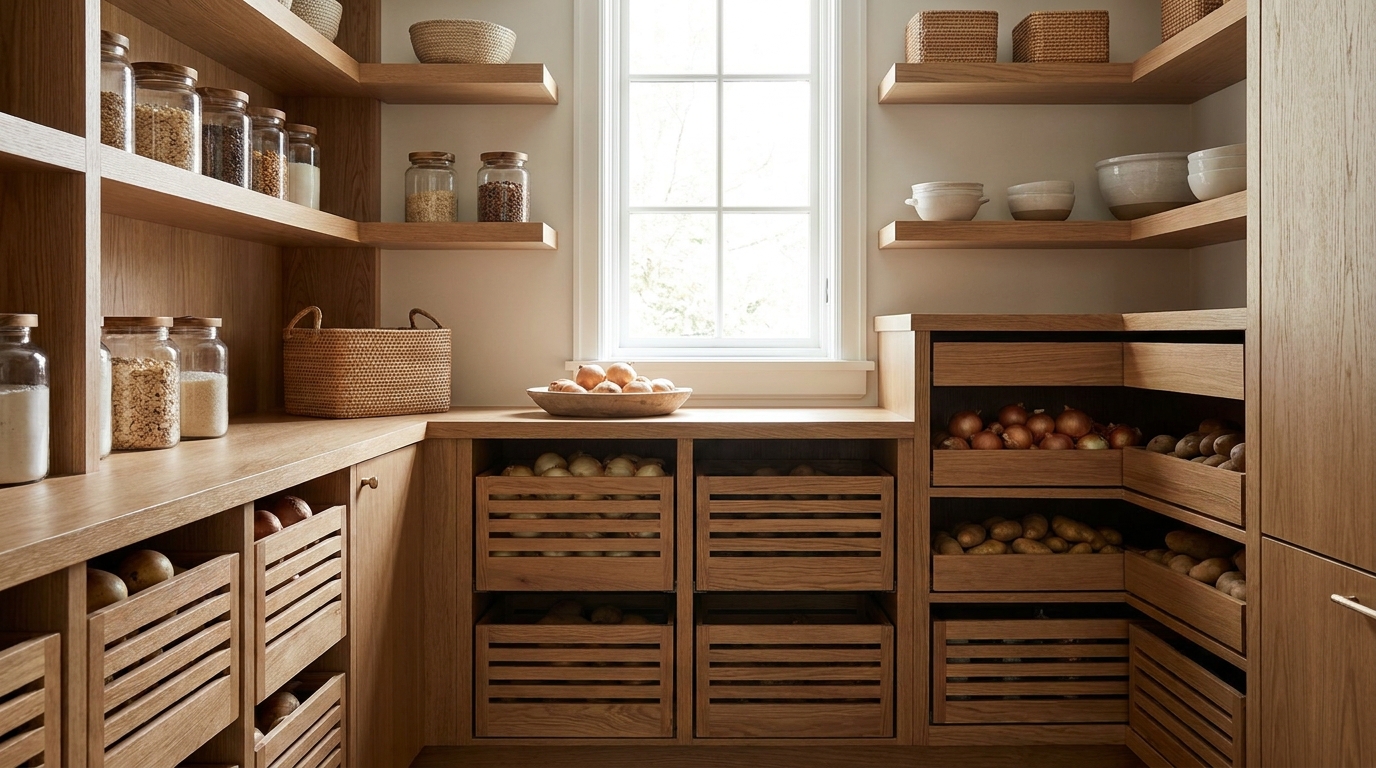
Onions, potatoes, and the loaf you are eating this week do not belong on a sealed bulk shelf. The FDA tells households to keep potatoes in a dark, cool place such as a closet or pantry, and outside the refrigerator, because refrigerator storage can raise acrylamide when those potatoes are later cooked with high heat [1]. Dry onions need a container that lets air pass through them, which is why Iowa State University Extension names mesh bags, wire baskets, and crates rather than a closed box [2]. Pantry produce storage, in our work, means ventilated bays for those crops plus a separate bread spot, kept off the sealed warehouse shelves and off the spice and oil pull-outs.
1. Sealed shelves work against living produce
The problem starts with the container, not the crop. A tight tote is fine for cans and paper goods. Onions and potatoes are different. University of Minnesota Extension notes that harvested vegetables are not dead. They still breathe and need oxygen if you want them to hold quality, and a storage room should give them ventilation [4]. A September 2020 produce-safety note from University of Nevada, Reno Extension is direct about onions. Do not wrap them in plastic or store them in plastic bags, because a lack of air circulation will reduce shelf life and encourage pathogen growth [6].
A Charlotte pantry is not a root cellar. Minnesota's storage guide, reviewed in 2026, puts long cold storage near 32 to 40 F, either drier (about 65 percent relative humidity) or moister (about 95 percent), and says shelf life can shorten by up to 25 percent for every 10 F increase in temperature [4]. An everyday pantry in greater Charlotte runs warmer than that. Darkness, airflow, and separation are what a cabinet can still deliver.
2. Potatoes want darkness and moving air
Light is the first thing to block. Iowa State's January 2025 guide says to store potatoes in a dark location because they turn green when exposed to light [2]. Oregon State University Extension, in a guide reviewed in 2025, ties that green color to chlorophyll, which it calls harmless, and says the color often signals solanine, a toxic compound [3]. The same page says to discard potatoes with excessive greening [3]. The potato bay can still breathe behind a solid door or a lid that blocks light.
Cool is real, and the guides do not all agree. The FDA page, current as of March 2024, says refrigerator storage can increase acrylamide during cooking, so keep potatoes outside the refrigerator in a dark, cool place such as a closet or pantry [1]. Oregon State, reviewed in 2025, instead lists refrigerators set to 40 to 46 F, insulated garages, or cool basements, and says to avoid temperatures below 38 F because sugar builds up and fried potatoes can turn darker and oilier [3]. Minnesota's 2026 review calls for dark, cold, moist storage at 32 to 40 F and 95 percent relative humidity, "such as in the refrigerator," and 40 to 50 F for potatoes you plan to fry [4]. Follow the FDA page and the pantry bin wins. Follow Oregon State or Minnesota and a controlled cold spot can fit, as long as it does not go too cold.
Air has to move while the skins stay shaded. Oregon State notes that tubers are about 80 percent water, so humidity helps limit shriveling, and it recommends perforated bags or well-ventilated containers [3]. Iowa State, after curing, calls for about 40 F and 90 to 95 percent relative humidity [2]. A sealed grocery bag is not that setup. A ventilated bin inside a dark cabinet is closer.
Do not expect cellar time from a warm cabinet. With proper cold storage, Oregon State says mature late-season potatoes can hold for seven to eight months, but above 46 F that window drops to two to three months, with more risk of sprouting and shriveling [3]. Iowa State says sprouting may start in two to three months above 50 F, and that below 40 F the tubers taste sugary [2]. A Charlotte pantry bay can give darkness and air. It cannot copy a cellar. Oregon State also says to discard injured tubers before long storage and to use cut or spotted potatoes within the first month, because damage spreads decay [3]. A pull-out makes that check possible. A deep sealed tote does not.
3. Onions need a drier bay with air on every side
Air is not optional. Iowa State says the onion container must allow air to circulate, and it lists a mesh bag, an old nylon stocking, a wire basket, or a crate [2]. Store them cool and moderately dry, at 32 to 40 F with 65 to 70 percent relative humidity [2]. When stored well, Iowa State puts average onion life at 5 to 8 months [2]. Minnesota's 2026 page lists an expected shelf life of four months in cold, dry conditions, and says not to freeze them [4]. Those windows assume cold, airy storage, not a warm cupboard.
Warmth wakes them up. The University of Minnesota onion guide, reviewed in 2024, says to store onions in a cool, dry area, not to let them freeze, and that they will start to sprout if kept above 40 F [5]. Homegrown bulbs need a cure first. That page says a warm, well-ventilated cure at 75 to 90 F for two to four weeks, until the outer scales are dry and the neck is tight, and that poor curing leads to decay later [5]. Keep the layer shallow so air reaches the bulbs in the middle, which is the point of those open containers [2].
Temperature targets differ by source. The September 2020 Nevada note, written for growers, says to keep onions cool, dry, and well ventilated at 45 to 55 F, out of direct sunlight [6]. That band is warmer than the 32 to 40 F target in the Iowa and Minnesota home guides [2][4]. Penn State Extension, updated in May 2025, stays broader. Properly cured onions in a cool, dark, well-ventilated place will keep a long time, and many homes lack space for true long storage [7]. We design around the shared points: moving air, no damp sealed box, and no direct sun. A Charlotte cabinet will not hold one perfect degree setting.
4. Separate the bins from each other and from the spice drawers
Potatoes and onions are poor roommates. The 2020 Nevada note says not to store onions with potatoes or with other produce that releases moisture [6]. Potato holding advice from Iowa State wants high humidity, about 90 to 95 percent [2]. Onion advice in that same article wants a moderately dry room, about 65 to 70 percent relative humidity [2]. One closed box cannot be both. Separate bays on the same wall match the instruction better than a shared tub.
Fruit is a different problem for potatoes. Iowa State says not to store potatoes with apples or other fruit, because ripening fruit gives off ethylene gas, which promotes sprouting [2].
Spices, oils, and flour want the opposite container. An August 2024 Penn State Extension guide stores spices and herbs in airtight containers, dry and away from sunlight and heat [8]. Opened vegetable oil keeps 1 to 6 months, and unopened oil 6 to 12 months, in a cool, dark place [8]. Flour absorbs odors and should not sit near onions [8]. Produce bays stay out of those pull-outs, and the loaf stays a little distance from the alliums.
5. Bread gets a spot, not a sealed bulk bin
A plain loaf is not stored like meat or leftovers. In a December 2025 Penn State Extension article on power outages, perishable foods such as meat, poultry, eggs, dairy, and leftovers should be discarded after the refrigerator has been off for four hours [9]. That same paragraph lists bread among foods that can be kept, with items such as uncut fruit and some condiments, citing FoodSafety.gov [9]. A bread shelf fits that distinction. It is a room-temperature place for a plain loaf, not a claim that every loaf should sit out for days.
Mold advice is older, and it points some loaves to the refrigerator. A 2020 North Dakota State University Extension food storage guide says refrigeration is recommended for baked breads with no preservatives, to inhibit mold growth [10]. We will not tell you the counter always wins. Use the pantry spot for the loaf you are eating now. If you bake without preservatives, or if bread molds quickly in your kitchen, follow that 2020 refrigeration note instead of leaving the whole loaf out [10]. Either way, do not seal the loaf into a damp tote with potatoes, and do not set it against the onion bin. Penn State already flags onion odor as a problem for nearby flour [8]. A shallow tray or open shelf keeps the loaf visible. Follow the package if it says to refrigerate or freeze.
6. How we build the bay
Two bays, one bread shelf, and light kept off the potatoes. At The Closet Rehab, we can give potatoes a ventilated pull-out inside the cabinet, so the tubers stay dark while air still moves. Onions get a separate wire or mesh bay, shallow enough that bulbs are not buried. Bread sits on its own shelf or in a shallow pull-out, not in either produce bin and not in the oil drawer. Our custom pantry work already uses pull-out baskets, adjustable shelves, and separate zones in walk-in and reach-in pantries.
Check the bin the way the crop guides say to check the crop. Pull the potato bin and remove anything soft, cut, or heavily green before it sits on the rest [3]. Do the same for onions that feel soft or show decay. Iowa State says to discard onions with decay, and to use thick-necked bulbs soon because they do not store well [2]. A basket will not chill the cabinet to cellar temperature. If the room is warmer than the targets above, use the bay for access and darkness, and use a cooler closet when you have one [1].
Practical takeaways
- Store potatoes in a dark pantry or closet rather than a bright bin [1]. Use a ventilated container, not a sealed bag [3].
- Give onions a mesh or wire bay so air can circulate [2]. Do not store them in plastic or in the same bin as potatoes [6].
- Keep potatoes away from apples and other ripening fruit, which Iowa State links to ethylene and faster sprouting [2].
- Use the bread shelf for the loaf you are eating now. A 2020 NDSU guide still recommends the refrigerator for preservative-free bread, to slow mold [10].
- Keep spices, oils, and flour in closed dry storage. Flour picks up onion odor [8]. Above 46 F, Oregon State expects potato life to fall to two to three months [3].
How we can help
Have more questions or want to get in touch? Visit our contact page, call (704) 604-3870, or email design@theclosetrehab.com. We design pantries for homeowners in greater Charlotte, and we can plan ventilated produce bays and a separate bread spot as part of a custom pantry layout. Tell us how you shop and which foods spoil first, and we will measure the space and draw the zones.
Citations
- U.S. Food and Drug Administration, "Acrylamide and Diet, Food Storage, and Food Preparation" (2024-03-05)
- Iowa State University Extension and Outreach, "Storing Winter Storage Vegetables" (2025-01)
- Oregon State University Extension Service, "Best practices for harvesting and storing homegrown potatoes" (2025)
- University of Minnesota Extension, "Harvesting and storing home garden vegetables" (2026)
- University of Minnesota Extension, "Growing onions in home gardens" (2024)
- University of Nevada, Reno Extension, "Alliums and Produce Safety" (2020-09)
- Penn State Extension, "The Well-Preserved Onion" (2025-05-02)
- Penn State Extension, "Storing Staple Ingredients in the Kitchen" (2024-08-09)
- Penn State Extension, "Lights Out, Pantry Full: The Security of Food Preservation" (2025-12-19)
- North Dakota State University Extension, "Food Storage Guide FN579" (2020-05-12)