Pantry Recycling Storage: Three Pull-Out Bays
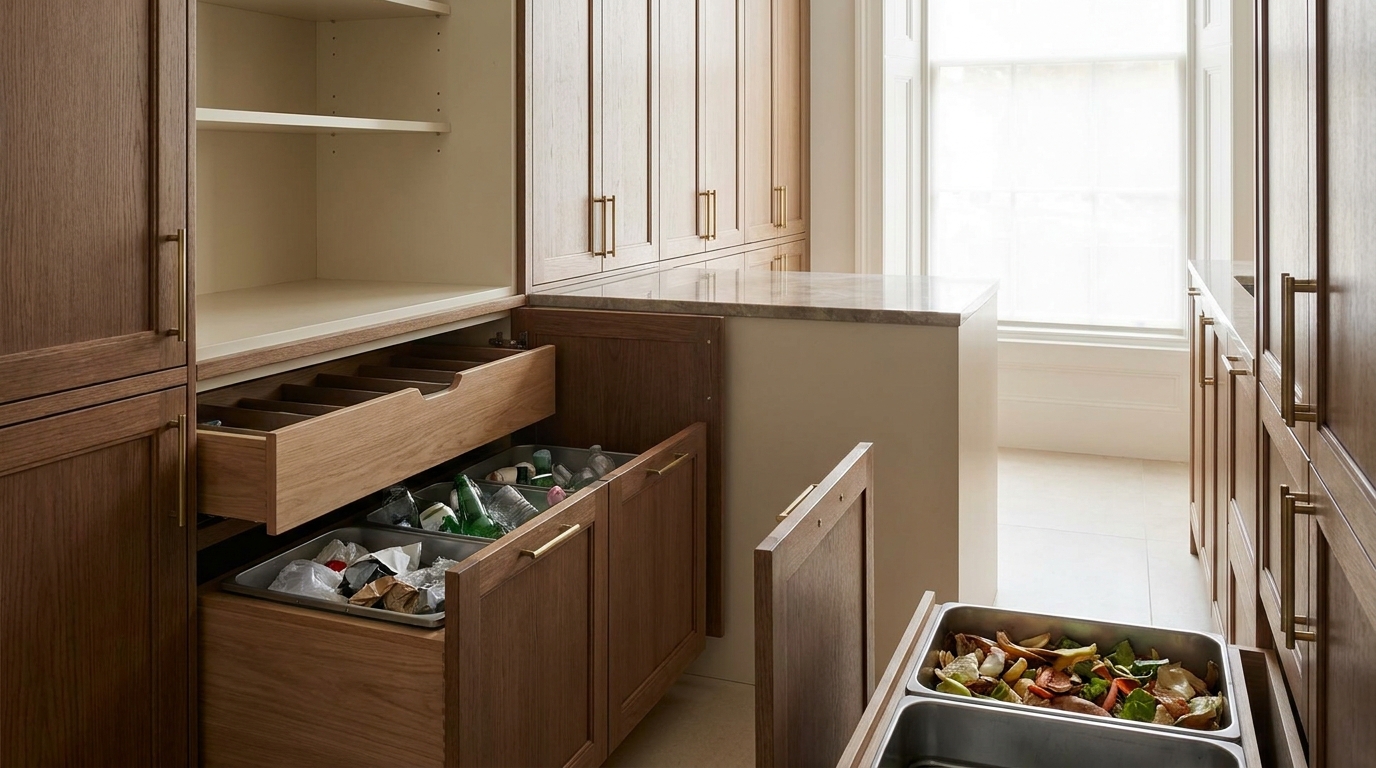
The kitchen island is a poor place for a trash can, a recycling bag, and a compost crock. Dedicated pantry recycling storage, built as pull-out bays for landfill waste, recyclables, and food scraps, keeps those bins behind a closed door and leaves the island for seating, serving, and prep. In 2019, 66.2 million tons of wasted food were generated in U.S. food retail, food service, and residential sectors, and only 5 percent of that wasted food was composted. Food remains the single most common material sent to landfills, at 24.1 percent of municipal solid waste, and wasted food accounts for 58 percent of landfill methane emissions.[1][2] Our team designs those three streams as hardware in the pantry or a tall cabinet, not as open cans parked under the overhang.
1. Why bags and bins should leave the island
An island trash pull-out looks convenient until a guest kicks it, a bag leaks on the floor, and dinner smells like yesterday's leftovers. The island is a gathering surface. Waste is a dirty job that wants a closed cabinet, a short walk to the outdoor carts, and labels that match what the hauler will actually take.
Mixing streams in one island bin is how recyclables get rejected. EPA warns that non-recyclable items can contaminate a whole load of recyclables, causing them to all be thrown out.[4] Mecklenburg County, which processes curbside material from Charlotte and the towns, says the same thing in local language: unacceptable items contaminate the recyclables and can make whole loads unacceptable to end users.[7]
What we move off the island:
- Landfill trash in a lined, washable bin
- Recycling in a second bin that dumps loose into the cart, never in a plastic bag
- Compost or food-scrap collection in a lidded pail that goes to a backyard pile or a county drop-off
Those three jobs live together as pull-out waste bays. They do not share space with spices, bulk warehouse-club totes, or a stand mixer. Those other pantry jobs belong in other cabinets.
A Waxhaw or Fort Mill kitchen with an open island bin trains the household to toss everything in one place. A labeled pantry pull-out trains the opposite habit: sort at the source, then walk the bags to the curb or the garage carts in one trip.
2. Three streams, three labeled pull-outs
Pantry recycling storage works when each stream has its own bay, its own liner or washable bucket, and a label a visiting teenager can read. One wide drawer with three buckets is better than one island can that pretends to be everything.
EPA's common curbside list is a useful starting point: cardboard, paper, food boxes, mail, beverage cans, food cans, glass bottles, jars, jugs, and plastic bottles and caps. Confirm locally first, because acceptance depends on the program.[4] In Mecklenburg County, the Recycle Right list is tighter and more specific: plastic containers with necks, cartons and juice boxes, empty aerosol cans, aluminum cans, cereal boxes, flat cardboard, clean pizza boxes, glass bottles and jars, tin and steel cans, brown bags and high-grade paper, junk mail, magazines, and newspapers. If it is not on that list, it is not curbside recycling here.[5]
Recycling bay rules we design around:
- Do not bag recyclables. Mecklenburg County is blunt: do not bag recyclables in plastic bags, and bagged items cannot be recycled.[5]
- Empty and rinse. EPA's general guidance is that plastic, metal, and glass must be empty and rinsed of food debris, and paper must be empty, clean, and dry.[4]
- No food in the recycling stream. Food is on both EPA's "never put this in the recycling bin" list and Mecklenburg's do-not-place list.[4][5]
- When in doubt, leave it out. That is Mecklenburg's line, and it is the right label for the inside of the door.[5]
North Carolina also bans certain materials from landfill disposal, including plastic bottles, aluminum cans, and yard trash.[8] A recycling pull-out is not a legal lecture. It is a place to put the bottles and cans that should not go in the trash bay.
The trash bay takes what is left: food-soiled paper that is not composted, plastic film that does not belong curbside, and the rest of the household waste that is not a recyclable or a food scrap. EPA notes that plastic bags and wraps generally cannot go in a curbside recycling bin, and many grocery and department stores will take them separately.[4] Mecklenburg accepts plastic bags and wraps at full-service centers, not in the cart.[5][6]
The compost bay is the third stream. It is not a second trash can. It is a closed container for food scraps on their way to a backyard pile, a worm bin, or a drop-off.
3. Compost bays that match backyard piles and county drop-off
EPA's home-composting guidance is to collect fruit and vegetable scraps in a closed container on the kitchen counter, under the sink, or in the fridge or freezer.[3] NC State Extension's 2017 backyard composting publication (still the live Extension page) says the same: store scraps in a container until you are ready to add them to the pile, freeze them, reuse a lidded plastic container, or use a purchased kitchen compost container under the sink or on the counter.[10]
That closed container is what we build a pull-out around. A crock on the island lid gets left open. A pull-out pail with a lid gets emptied on a schedule.
Two compost destinations, two slightly different packing lists:
- Backyard pile or home bin: EPA and NC State Extension both tell homeowners to keep meat, fish, bones, fats, oils, and dairy out of a typical backyard pile because those materials attract animals and often fail to break down at backyard temperatures.[3][10] Cover food scraps with browns. EPA wants food scraps covered by four to eight inches of dry leaves or other carbon-rich material. Extension wants scraps buried in the pile and the pile topped with four or five inches of browns to discourage flies and filter odor.[3][10]
- Mecklenburg food-scrap drop-off: The county currently accepts residential food scraps at no cost at Compost Central, Hickory Grove, Foxhole, and the William R. Davie staffed center. The local rule is "if it's edible, it's acceptable," including meat, as long as packaging is removed. Plastic-coated plates, to-go cups and containers, paper towels and napkins, compostable utensils and plates, plastic bags, zip-lock bags, and snack wrappers stay out.[6]
That difference matters for the pantry. A Ballantyne household dropping scraps at Compost Central can put meat and dairy in the compost pull-out. A Wesley Chapel household running a backyard pile should keep those items in the trash bay instead. We label the bay for the actual destination, not for a generic "green" sticker.
NC DEQ currently reports that households are the largest producer of food waste, accounting for 48 percent of total surplus food (about 42 million tons), more than restaurants, grocery stores, farms, and manufacturing combined. The same page reports that a family of four wastes $1,500 on uneaten food every year, and that composting is one of the best uses of the food waste that remains after prevention.[9] EPA's 2023 methane report found that while total municipal solid waste landfill emissions are decreasing, methane from landfilled food waste is increasing, and diverting food waste from landfills is an effective way to cut that methane.[2] Municipal solid waste landfills are the third-largest source of methane emissions from human activities in the United States, and food waste comprises about 24 percent of municipal solid waste disposed of in landfills.[2]
A compost pull-out does not compost. It is a holding bay. EPA is explicit that indoor collection is storage until the scraps go into a real composting system.[3] Empty it often.
4. Bag hooks, washable liners, odor, and a little air
Hardware decides whether the bays stay in use.
Bag hooks and liners:
- The trash bay wants a hook or ring that holds a bag open so you are not fishing for the rim with wet hands.
- The recycling bay should be a washable bin with no bag. Mecklenburg cannot recycle bagged items, and plastic bags are a contamination problem at the sorting facility.[5]
- The compost bay wants a washable pail. If you line it, match the destination. Mecklenburg food-scrap drop-off does not accept plastic bags or zip-lock bags with the scraps.[6] A backyard pile can take a paper liner or no liner at all.
Washable bins matter because food residue is the odor source. EPA's general recycling rule is rinse first.[4] A bin you can lift out and wash is easier to keep than a sticky island can.
Odor and ventilation:
A compost pail that sits for days will smell. NC State Extension's troubleshooting table is about the outdoor pile, but the chemistry is the same indoors: anaerobic (lacking oxygen) material smells like rancid butter, vinegar, or rotten eggs when it is too wet, starved of air, or overloaded with nitrogen-rich scraps.[10] EPA's home-composting page says a pile with a bad odor may be too wet or need more air, and the fix is more browns and a turn.[3] For the kitchen pull-out, that translates to a tight lid, frequent emptying, a washable liner, and the option EPA already names: store scraps in the fridge or freezer until drop-off or pile day.[3][10]
We do not pretend a pantry cabinet is a compost reactor. A small toe-kick gap or a louvered kick can keep the cabinet from trapping humidity. That is cabinet air, not a range hood. Do not park the waste bays next to a heat source.
The walk to the cart:
Mecklenburg County does not collect curbside trash or recycling. The City of Charlotte or one of the towns does the pickup. County residents still follow the same Recycle Right list because the county processes the material.[7] For a Charlotte, Matthews, or Huntersville household, the pantry pull-outs are the indoor half of that trip. Fill the bays during the week. On collection eve, dump the recycling loose into the green cart, tie the trash bag, and carry the compost pail to the backyard bin or the car for a drop-off run.
A Rock Hill or Indian Land household has a different hauler, but the indoor layout is the same: three streams, one cabinet, one walk. Keep the path from pantry to garage or side door clear. Do not stage bags on the island overnight.
5. Kid-height versus lockable
A waste pull-out at kid height lets an older child put a rinsed bottle in the right bay. The same height is a problem for a toddler who treats every low door as a toy chest.
National Capital Poison Center tells families to store cleaning products in cabinets with child-resistant latches, and it names an unlocked, low kitchen cabinet as one of the most dangerous places to store cleaners.[11] That is not an argument for putting bleach in the trash pull-out. It is an argument for keeping cleaners out of these bays entirely, and for locking a low waste cabinet in a house with crawlers.
How we split height and locks:
- Kid-height recycling bay (about the height of a school-age child's reach) with a simple latch and a picture label, when the household wants kids to help sort bottles and cans.
- Lockable pull-outs on the same run when toddlers, visiting grandchildren, or pets can open doors. Glass jars, compost food, and bag ties do not belong in small hands.
- Cleaners stay elsewhere, in a locked cabinet, not in the waste, recycle, or compost bays.[11] Poison Center also warns never to mix household cleaning products, because mixing can create poisonous fumes, and to ventilate when using strong cleaners.[11] The waste cabinet is not a cleaning caddy.
A Ballantyne family with a preschooler gets locks on the waste run. A Waxhaw household of adults can skip the lock and keep the pull-outs easy to open with an elbow. We ask who uses the kitchen before we pick hardware.
6. What this pantry run is not
This article is about waste, recycle, and compost pull-outs. It is not a cooking-food zone, not a warehouse-club bulk wall, not a spice drawer, and not an appliance garage.
- Family cooking-food zones belong on shelves and drawers sized for daily ingredients.
- Bulk storage belongs on deep, high shelves or a separate pantry wall.
- Spice and oil pull-outs are one-deep racks near the stove.
- Appliance garages hide mixers and toasters behind doors with outlets.
Those four jobs fight the waste bays for the same floor space if you mix them. Food on a shelf over an open compost pail picks up odor. A mixer garage next to a trash bag gets splashed. Our custom pantry plans keep pull-out drawers, spice organization, canned-goods rows, and appliance zones as their own modules. The recycling run is a dedicated cabinet, often on the pantry's room-side or on a tall kitchen cabinet near the back door, so the walk to the carts is short.
Practical takeaways
- Move landfill trash, recycling, and compost off the kitchen island and into labeled pantry or cabinet pull-outs.
- Give each stream its own washable bin. Do not bag recyclables. Match compost packing to backyard rules or Mecklenburg drop-off rules.[5][6]
- Rinse bottles, cans, and jars. Keep food out of the recycling bay.[4][5]
- Empty the compost pail often, or freeze scraps, so the cabinet does not go anaerobic and smell.[3][10]
- Use bag hooks on trash only. Use a lock on low bays if young children use the kitchen. Keep cleaners out of the waste run.[11]
- Plan the walk from pantry to outdoor carts as part of the layout, not as an afterthought.
How we can help
Our team designs pantry recycling storage as part of a custom pantry: three pull-out bays, bag hardware, washable bins, and a lock when the household needs one, without turning that cabinet into a spice rack or an appliance garage. We measure the room, the path to the garage or side door, and the way you actually sort waste in Charlotte, Ballantyne, Waxhaw, Wesley Chapel, Fort Mill, Rock Hill, and Indian Land.
Have more questions or want to get in touch?
https://theclosetrehab.com/contact-us/ · (704) 604-3870 · design@theclosetrehab.com
Citations
- U.S. Environmental Protection Agency, "Composting" (last updated 2026-05-18; 2019 wasted-food tonnage and 2022 methane share)
- U.S. Environmental Protection Agency, "Quantifying Methane Emissions from Landfilled Food Waste" (report October 2023; page last updated 2026-03-04)
- U.S. Environmental Protection Agency, "Composting At Home" (last updated 2025-12-08)
- U.S. Environmental Protection Agency, "Frequent Questions on Recycling" (last updated 2026-01-22)
- Mecklenburg County Solid Waste and Recycling, "Recycle Right Curbside Pickup" (accessed 2026-09-14)
- Mecklenburg County Solid Waste and Recycling, "Enhanced Recycling" (accessed 2026-09-14)
- Mecklenburg County Solid Waste and Recycling, "Municipal Curbside Collection" (accessed 2026-09-14)
- North Carolina Department of Environmental Quality, "North Carolina Landfill Disposal Bans" (accessed 2026-09-14)
- North Carolina Department of Environmental Quality, "Use the Food NC for Consumers" (accessed 2026-09-14)
- NC State Extension, "Backyard Composting of Yard, Garden, and Food Discards" (AG-791, publication date 2017-04-07)
- National Capital Poison Center, "Top tips for a safe spring cleaning" (accessed 2026-09-14)