Pantry Spice Pull-Out Storage in One Layer
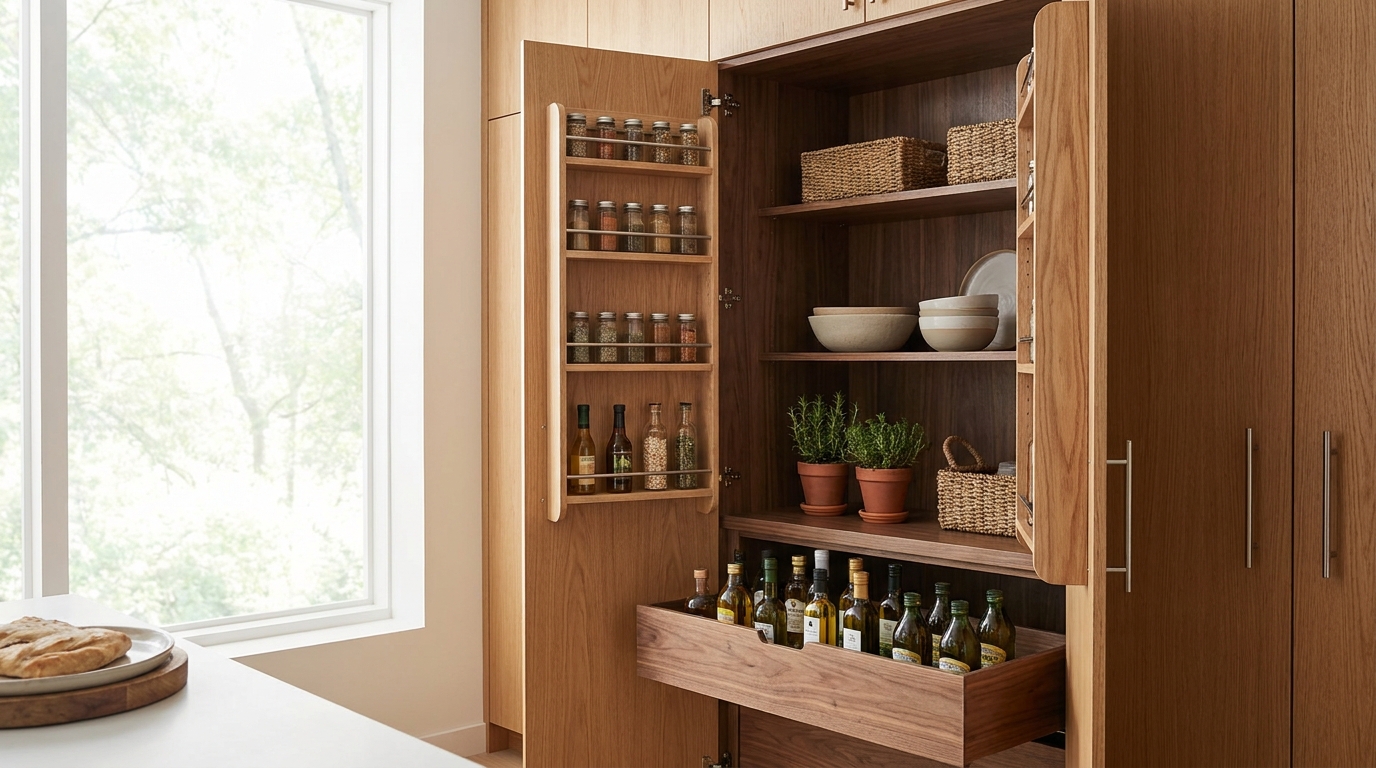
Pantry spice pull-out storage works when every spice jar and cooking-oil bottle sits one-deep at cooking height, so you can read every label without moving a second row. Heat, light, and air strip flavor from spices and push oils toward rancidity, which is why university extension guides tell cooks to keep these items in airtight containers in a cool, dark, dry cabinet, not on a rack above the range.[1][2][3] Our team designs closed pull-outs and shallow oil drawers in that working band so weeknight bottles stay visible, cooler, and a few steps from the pan, without hiding behind each other.
1. The problem is a second row, not a shortage of jars
A deep pantry shelf looks generous until cumin, smoked paprika, and the sesame oil disappear behind whatever you bought last. You buy a duplicate. You cook with a faded jar. You leave olive oil on the counter because the pantry bottle is too hard to find.
That is a one-layer problem. Spices and cooking oils are small, frequent, and sensitive to heat, light, and oxygen.[1][2] They belong in a dedicated, one-deep run you can scan in a glance, not in a bulk bay or a tall filler cabinet.
What fails in a typical pantry
- Two or three rows of jars on a fixed shelf, with the back row forgotten
- A countertop lazy Susan that sits in daylight and range heat
- A door rack so crowded that bottles knock each other over
- Oil bottles parked beside the cooktop because "that is where we use them"
- Clear glass lined up in a sunlit niche that looks tidy and ages the contents
The fix is hardware that brings the whole row to you: a full-extension spice pull-out or a shallow drawer, sized to the bottle, at the height you already cook.
2. Heat, light, and air are the real enemies
Penn State Extension is direct: placing a spice rack above the stove quickly reduces the quality of those flavorings, and spices and herbs should sit in airtight containers in dry places away from sunlight and heat.[1] Texas A&M AgriLife Extension says the same in plainer terms. Store dried herbs and spices in tightly covered containers, in a dark place such as a cabinet or drawer, and avoid storage above the dishwasher, microwave, stove, or refrigerator, or near a sink or heating vent.[2]
Kansas State Extension's June 2026 cupboard guide repeats the location rule: store foods in a cool, dry, dark place away from heat sources like appliances and the sun.[3] A 2015 National Center for Home Food Preservation note on dried herbs matches that advice. Pack them in airtight containers and store them in a cool, dry, dark area to protect color and fragrance.[4]
What those rules mean for a spice pull-out
- Closed cabinet, not an open rack. Darkness is the point. A pull-out behind a door or drawer front blocks light between uses.[2][4]
- Airtight jars, lids on. Volatile oils escape when containers sit open. Check aroma; if it has faded, replace the jar.[1][3]
- Away from heat-producing appliances. The bay can be near the kitchen, even in the pantry next to the range wall. It should not sit above the stove, dishwasher, or a heating vent.[1][2][3]
- Dry. A location near a sink or a steamy dishwasher invites caking. UF/IFAS Extension (2021) advises discarding caked spices rather than trying to rescue them, and storing herbs and spices in a cool, dry, dark place to prevent that moisture damage.[8]
Iowa State University Extension's 2024 update notes that herbs and spices do not spoil the way fresh food does, but they lose flavor and potency. A typical window is about two to three years. Check aroma, flavor, and color; they should be strong, potent, and vibrant rather than dull.[10] Kansas State's 70°F chart splits that further: whole spices about three to four years, ground spices about two to three years, always in airtight containers away from sunlight and heat.[3] Texas A&M's home-cook ranges are close: whole spices three to four years, ground spices two to four years, leafy herbs and most blends one to three years.[2]
Date labels are mostly quality, not a safety cliff. Except for infant formula, federal rules do not require manufacturers to put quality-based dates on packaged food. FDA supports "Best if Used By" as the phrase for peak flavor and quality, and it estimates that confusion over date labels accounts for about 20 percent of consumer food waste.[7] UF/IFAS makes the same distinction for spice jars: after the use-by date, flavor, texture, and color may fade. Unless you see rancid smells or insects, the product is generally still safe, even if it no longer earns a place in the weeknight pull-out.[8]
3. Cooking height is a reach band, not a shelf over the burners
"At cooking height" does not mean on the splash of the range. It means in the band you can reach while you cook, without a stool and without a deep crouch, in a cabinet that stays cooler and darker than the stove surround.
The U.S. Access Board's ADA Standards are written for covered facilities, not as a private-home building code. Even so, the adult unobstructed reach range they publish is a useful planning band for frequently used pantry hardware. Unobstructed forward reach and unobstructed side reach both run from 15 inches minimum to 48 inches maximum above the finish floor.[5] Operable parts (pulls, latches, the hardware you actually grab) belong inside that range. Non-operable structure can sit outside it.[5][11]
When a counter sits in the way, the high reach drops. An obstructed high forward reach over more than 20 inches of depth is limited to 44 inches. An obstructed high side reach over more than 10 inches of depth is limited to 46 inches, and the obstruction itself is capped at 34 inches high.[5] Those numbers are not a Charlotte kitchen code. They are a reminder that a spice pull-out at 60 inches, or an oil bottle at the back of a 24-inch-deep cabinet, works against the body.
How we translate that into a pantry
- Put the everyday spice pull-out in the middle of the 15-to-48-inch band, roughly counter adjacent, so a standing cook can open it without stretching.
- Put heavier oil bottles toward the lower half of that same band. Weight belongs closer to the floor. Light still stays out because the drawer closes.
- Keep backup tins and rarely used extracts higher or lower. The one-layer bay is for what you grab while the pan is hot.
- Specify pulls you can operate with one hand, without a tight pinch or a twist. Access Board operable-part criteria cap activating force at 5 pounds and forbid tight grasping, pinching, or twisting of the wrist on covered hardware.[11]
A home in Ballantyne or Fort Mill does not have to be an ADA project for those dimensions to be kind to weeknight cooking.
4. Spice pull-outs you can scan in one layer
The discipline is one bottle deep.
Full-extension spice pull-outs
- Vertical trays that slide all the way out, with each jar standing in a single file
- Shallow drawers with a single row of tins, labels facing up
- Narrow pull-out columns inside a standard pantry run, used as a one-deep spice file, not as the whole pantry thesis
What we size to
- Standard 2-ounce and 4-ounce spice jars, plus the taller grinders you actually own
- Headroom so a lid can come off without lifting the bottle out of a tight cubby
- A rail or lip so jars do not walk forward when the slide stops
- Full-extension slides, so the back of the tray is as visible as the front
Label rules
- One facing direction. Caps or sides, not a mix.
- Names you can read from the cook's stance, not only from above.
- A dated piece of tape when you open a jar. The printed date is a quality cue, not a substitute for your nose.[7][8][10]
Door-mounted racks can work on a full-height pantry door if every bottle is still one-deep and the door does not bake beside the range. The moment you double-stack, you are back to hunting. Our custom pantry work uses dedicated spice organization and pull-out drawers for this reason: visibility is the product.
Whole spices last longer than ground ones because less surface area is exposed.[1][3] Keep peppercorns, cinnamon sticks, or nutmeg whole in their own slot so you are not grinding a year's supply into a jar that sits waiting.
5. Oil drawers that stay cooler and darker
Cooking oil is a different object from a spice tin, and it needs its own one-deep drawer.
Kansas State Extension's June 2026 chart, timed at 70°F, lists vegetable oils at about six months unopened and three to five months opened. Refrigeration is not required. Store the bottle in a cool, dark place in a tightly closed container.[3] Penn State Extension's 2024 staple guide is in the same family: vegetable oil about one to six months opened and six to twelve months unopened in a cool, dark place. Oils stored too long go rancid. Almond, walnut, sesame, and hazelnut oils have a shorter storage life. Refrigeration can extend life; some oils cloud in the fridge and clear again at room temperature.[1]
What that asks of the drawer
- Opaque or closed storage. A dark drawer front is doing food-science work, not just hiding clutter.[1][3]
- One bottle deep. Olive, avocado, canola, toasted sesame, and the bottle you actually reach for should each have a face. No second rank behind the first.
- Tight caps. Headspace and a loose pour spout invite oxygen.
- Distance from the range. Convenient is a few steps. Convenient is not the cabinet that sits over the cooktop or dishwasher.[2][3]
- A lower slot in the cooking-height band. Heavy glass belongs where you can lift it without a high reach.[5]
Keep cooking oil and infused oil in different stories. Research at the National Center for Home Food Preservation confirmed that garlic-in-oil mixtures stored at room temperature are at risk for botulism. Make those mixtures fresh, refrigerate at 40°F or lower for no more than four days, or freeze for longer storage.[9] A pantry oil drawer is for commercial cooking oils with the cap on. Homemade garlic or herb oil is a refrigerator (or freezer) product, not a shelf bottle.
Fire is the other oil rule, and it is about the stove, not the drawer. NFPA's 2020 to 2024 averages put kitchen and cooking equipment in an estimated 48 percent of home structure fires, 35 percent of home fire injuries, and 16 percent of home fire deaths. About two-thirds of home cooking fires start with the ignition of food or other cooking materials. Unattended equipment is a factor in about a quarter of those fires.[6] Stay in the kitchen while you fry, treat smoke or a hot-oil smell as a sign to kill the burner, keep a lid beside the pan, and never throw water on a grease fire. Keep oven mitts, wooden utensils, food packaging, towels, and curtains away from the stovetop.[6] A closed pantry oil drawer, off the range surround, is the storage half of that habit.
6. What this bay is not
Keep this run's job separate from other pantry work.
- Not a family cooking zone. This bay is only spices and cooking oils.
- Not a warehouse-club FIFO wall. Backup tins can live higher or deeper. The one-layer drawer is the working set.
- Not a lighting project. A closed pull-out is dark on purpose.
- Not a slim 6-to-12-inch tower as the whole thesis. A narrow pull-out can hold the one-deep file. The point is still one layer at cooking height.
- Not an appliance garage. Mixers and toasters are a different door and a different heat story.
When those jobs share a shelf, the spice you need is behind the air fryer, and the oil is warm from the dishwasher vent.
7. How we lay out the one-layer spice and oil run
In Charlotte, Wesley Chapel, Waxhaw, Rock Hill, and Indian Land kitchens, we start with the bottles you already own, not a catalog tray.
Measure first
- Line up every spice you use in a month. Count the jars. Note the tallest grinder.
- Line up cooking oils, vinegars you grab with oil, and anything with a pour spout.
- Mark the cook's comfortable reach on the pantry wall, inside that 15-to-48-inch planning band.[5]
- Note heat sources: range, wall oven, dishwasher, fridge exhaust, a sunny glass door.
Then assign hardware
- One spice pull-out (or two, if the household cooks from two cuisines) for the working set
- One oil drawer, deeper and stronger, with a peg or divider so bottles cannot rattle
- A higher or lower backup slot for unopened extras, still dark and cool[3]
- Full-extension slides and a pull you can open with a hip or a free hand[11]
Household habits we design around
- The cook who seasons from the pantry, then returns the jar before the next step
- Two cooks who need the same tray to face the aisle
- A household that buys large oil bottles and decants a working bottle into the dark drawer
- A reach-in pantry that still gets one-deep trays instead of a second row of jars
We put pantry spice pull-out storage where food science and reach agree: closed, one-deep, and at the height your hands already work.
Practical takeaways
- Store spices and cooking oils one-deep so every label faces you. A second row is how jars go stale while you buy duplicates.
- Keep the working set in a closed cabinet or drawer, airtight, away from sunlight and away from the stove, dishwasher, microwave, and heating vents.[1][2][3]
- Use cooking height as a reach band (about 15 to 48 inches for frequent grabs), not as permission to park bottles over the burners.[5]
- Treat printed dates as quality cues. Smell, taste, and color still decide whether a spice earns its slot. FDA frames most date labels as flavor and quality, not a universal safety cutoff.[7][8][10]
- Give oils their own dark, cool drawer. Kansas State's June 2026 70°F chart is about six months unopened and three to five months opened for vegetable oil in a tightly closed container.[3] Nut and sesame oils fade faster.[1]
- Keep homemade garlic- or herb-in-oil in the refrigerator (no more than four days at 40°F or below) or the freezer. It is not a pantry oil.[9]
- Keep flammables and extra oil off the stovetop. Stay with oil while it heats. A lid, not water, is the grease-fire response.[6]
How we can help
Have more questions or want to get in touch? Our team will measure your jars and bottles, pick a cool dark run at cooking height, and build spice pull-outs and oil drawers you can scan in one layer. See our custom pantry work, then start on our contact page, call (704) 604-3870, or email design@theclosetrehab.com.
Citations
- Penn State Extension, "Storing Staple Ingredients in the Kitchen" (2024-08-09)
- Texas A&M AgriLife Extension, "Storing Dried Herbs & Spices" (2025)
- K-State Research and Extension, "Safe Food Storage: The Cupboard" (MF3131, revised June 2026)
- National Center for Home Food Preservation, "The Heat Is On" (2015-01-05)
- U.S. Access Board, "ADA Chapter 3: Building Blocks, 308 Reach Ranges" (standards text)
- National Fire Protection Association, "Safety with cooking equipment" (2020-2024 averages)
- U.S. Food and Drug Administration, "How to Cut Food Waste and Maintain Food Safety" (content current as of 2024-03-05)
- UF/IFAS, "Herbs and spices explained: 'Use-by' dates, how to extend shelf life, and more to boost your holiday feast" (2021-11-22)
- National Center for Home Food Preservation, "Freezing Garlic-In-Oil"
- Iowa State University Extension and Outreach, "Herbs and Spices Have an Expiration Date" (updated 2024-11-07)
- U.S. Access Board, "Guide to the ADA Accessibility Standards: Chapter 3 Operable Parts"