Reach-In Closet Shelving for Folded Stacks You Can Grab
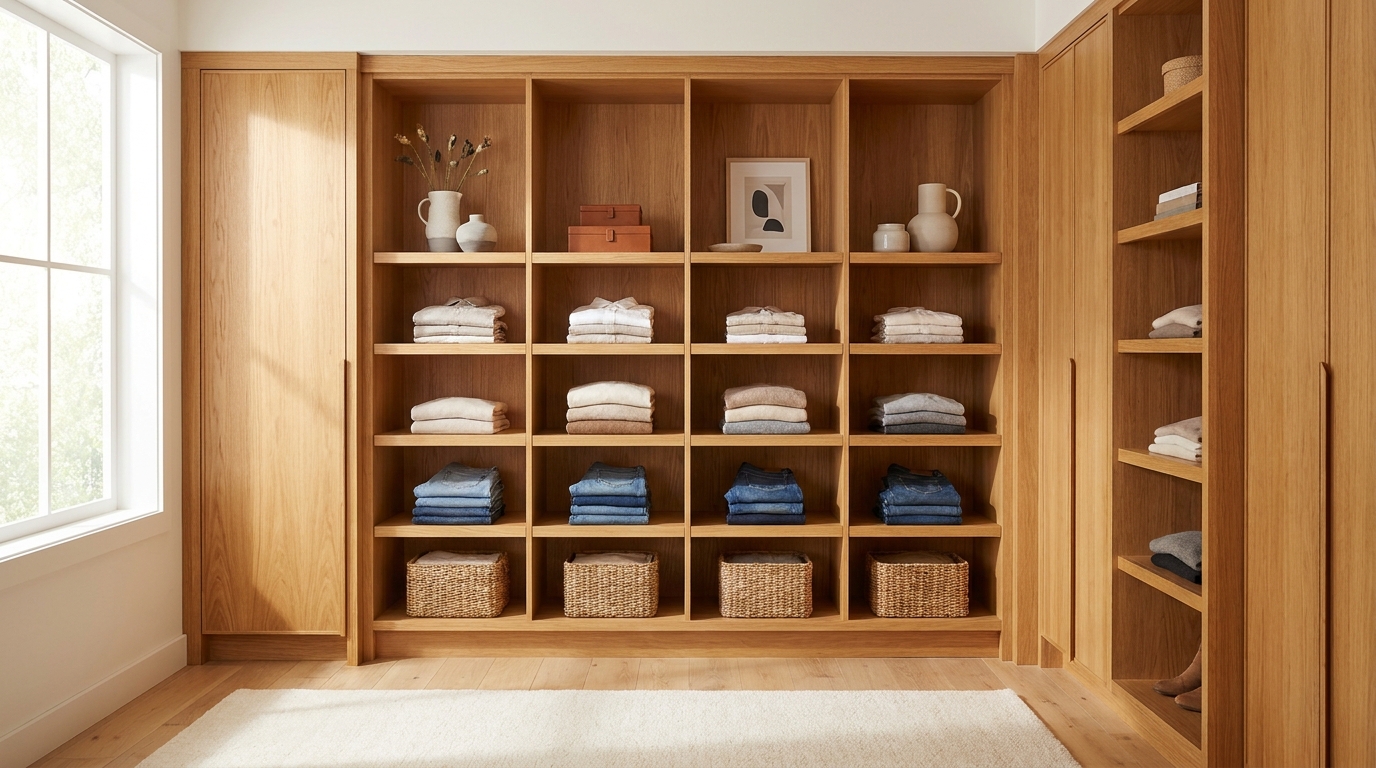
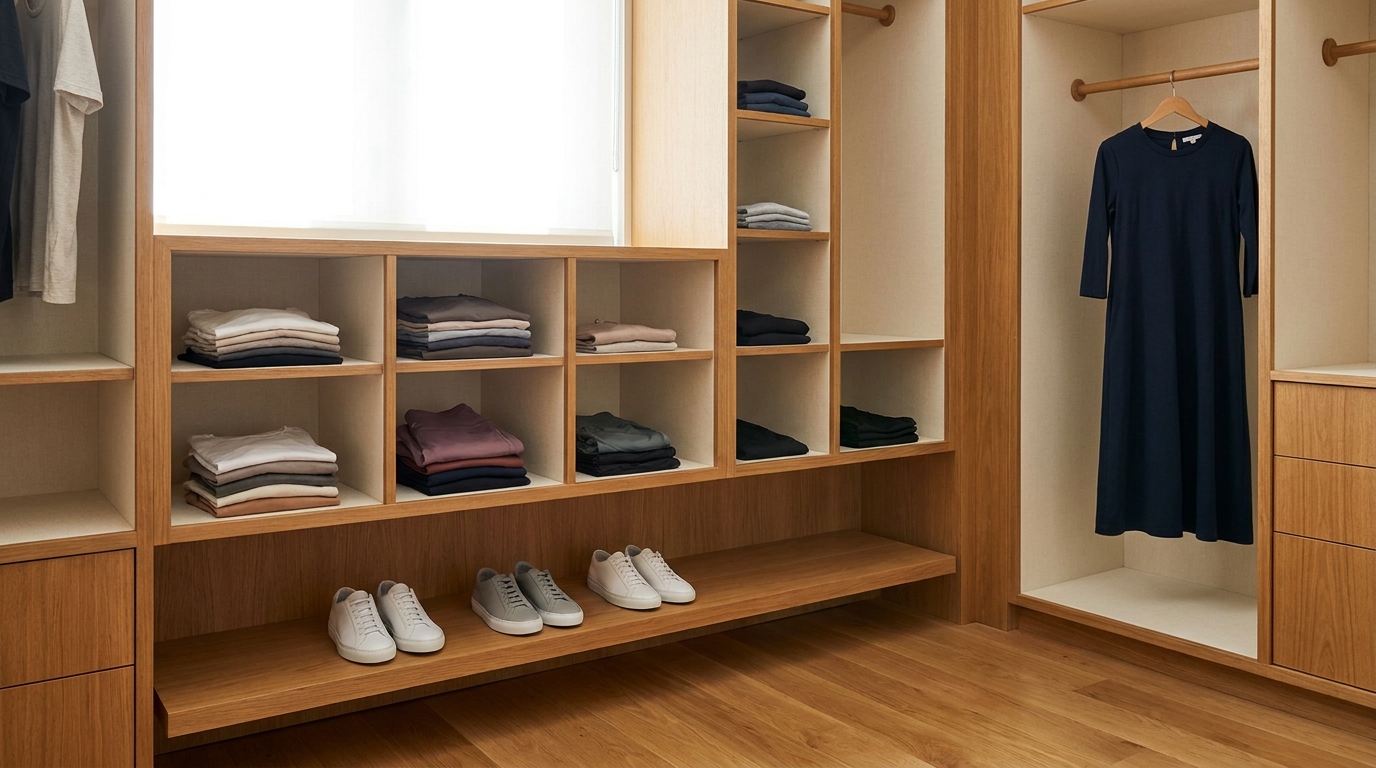
Reach-in closet shelving for folded stacks has one job: keep sweaters, tees, and jeans in short piles you can take with one hand without the rest of the stack sliding off the board. Shelf height and shelf depth decide that, not the hanging rods and not the door hardware. In a Charlotte or Fort Mill reach-in, a gap that is too tall invites a tower that avalanches. A board that is too deep hides a second row you cannot see. We plan the folded bay as a set of short, front-facing stacks in the band where an adult can actually reach.
This is not a hanging-zone layout, and it is not a linen-closet brief. Long-hang and double-hang rods belong on a different wall. Hall towels and bath towels belong in a different room. Here we are talking about folded clothing on shelves you face from the bedroom, so the top item comes off cleanly and the high shelves still earn their keep.
1. Why stacks fail in a reach-in
A reach-in is a shallow box. You stand in the room and work the opening. You do not walk in and square up to a wall the way you would in a walk-in. That changes how a pile behaves.
What we see in Ballantyne and Rock Hill bedrooms:
- A single builder shelf high on the back wall, with folded knits shoved on top of hanging clothes.
- Tall empty gaps between shelves, so people stack until the pile leans.
- Deep boards that hide a second row of jeans behind the tees.
- High shelves loaded with the heavy stuff because the low shelves filled first.
The pile fails in two ways. First, compression. The American Institute for Conservation’s Textile Specialty Group, in storage-method guidance last revised in 1998 and still published on its conservation wiki, notes that folding stresses, creases, strains, compresses, and bends textiles, and that folded objects should not be stacked inside a storage container. Layering of objects contributes to compaction. [8] A bedroom closet is not a conservation lab. The physics still apply. A tall stack of sweaters is a weight on the bottom fold.
Second, reach. You cannot take the top item with one hand if you have to lean past a deep edge and catch the rest of the pile with the other hand. The Access Board’s ADA Standards say operable parts shall be operable with one hand, without tight grasping, pinching, or twisting of the wrist, and with 5 pounds of force maximum. [1] Those rules apply to covered public facilities, not to a typical private home. We still use the one-hand test as a planning check: if you need two hands to free a tee, the shelf is wrong.
Our custom closets page treats folded storage as its own category, space for folded clothing, sweaters, jeans, and items that are better stored flat on shelves or in drawers. That split is the start of a usable reach-in. Hanging does not fix a stack problem. Extra depth does not fix it either.
2. Set shelf spacing to the stack, not the wall
Equal gaps look tidy on a drawing. They waste a reach-in. We space each shelf to the finished height of a short stack, plus room for fingers.
How we set the gap:
- Fold the actual garments the way the household already folds them.
- Measure the stack you want to live with (a few tees, a couple of jeans, two or three sweaters).
- Add about 2 inches of finger clearance above the pile so the top item can lift without scraping the shelf above.
- Repeat for each category. Sweaters need more air than tees.
In our shop drawings, that usually lands here:
- Tees and thin knits: about 10 to 12 inches of clear space, shelf face to the underside of the next shelf.
- Jeans and chinos: about 11 to 13 inches.
- Sweaters and heavy knits: about 12 to 14 inches, so the pile stays square.
Those numbers are our field practice, not a code table. The conservation point is the reason they stay short. If folds are inadequately supported, damage can result, and folding already compresses the cloth. [8] A 16- or 18-inch gap does not give sweaters room. It invites a taller pile.
A 1999 Fine Homebuilding closet article describes the common American closet as a single shelf and pole, then notes that other arrangements include banks of shelves for shoes and sweaters. [9] Several short landings beat one tall cube. Date that article as 1999. The span note still matters: for any span greater than 44 inches, the author installs a midspan shelf-and-pole bracket. [9] Folded stacks are not light. A long, unsupported board sags, and a sagging board dumps the front of the pile.
Adjustable pins are the practical fix. Wardrobes in Wesley Chapel and Waxhaw change by season. Pins let us open a sweater bay in November and tighten a tee bay in April without rebuilding the run.
3. Keep shelf depth inside a one-hand reach
Depth is the other half of the grab. If the board is deeper than a comfortable arm, people park a second row behind the first. The back row is not storage. It is lost inventory.
The Access Board’s ADA Standards, used here as a private-home planning analog, set an unobstructed high forward reach at 48 inches maximum and a low forward reach at 15 inches minimum above the finish floor. When the reach is over an obstruction, the high forward reach stays 48 inches only where the reach depth is 20 inches maximum. Where the reach depth exceeds 20 inches, the high forward reach drops to 44 inches maximum and the reach depth is 25 inches maximum. Side reach over an obstruction allows 24 inches of depth maximum, with the high side reach dropping to 46 inches once depth exceeds 10 inches. [1] A 16-inch board already eats a large share of that 20-inch window. A 24-inch board is at the far edge, and anything parked at the back is a stretch.
The 1991 ADA Standards (in effect for new construction until March 2012) put a closet-specific figure on that idea. Figure 38a states that shelves can be adjustable and that the maximum distance from the user to the middle of the shelf shall be 21 inches. [2] Date that figure as 1991. We still treat it as a depth cap for a reach-in you use from the doorway.
NIOSH’s March 2024 warehousing evaluation (field work in 2019, cited as NIOSH 2023) is a workplace analog, not a closet code. Reach distances should range 11 to 22 inches, and standing parts bins should sit with a reaching distance of less than 16 inches. [6] A folded sweater on a 14-inch shelf is inside that window. A second row on a 24-inch shelf is not.
Cornell University’s 2013 anthropometry notes from Professor Alan Hedge make the geometry plain. The zone of convenient reach is a radius from the shoulder to the grip. As the horizontal distance to the surface grows, that radius shrinks. Weight in the hands decreases reach. An obstacle behind the person decreases reach. Most-used items should be closest. [5] A reach-in already puts a wall at your back. Deep shelves add distance you cannot spend.
Our depth rules for folded stacks:
- 12 to 14 inches for tees, athletic knits, and most jeans, one row only.
- 14 to 16 inches for bulky sweaters, still one row.
- No 24-inch-deep folded shelf in a standard reach-in. If the closet box is 24 inches to the back wall, leave air in front of the shelf for elbows and for seeing the pile.
High shelves get shallower, not deeper. Once you are reaching up, extra depth is extra miss.
4. Put daily folded clothes in the reachable band
The useful band in a reach-in is the band you can work without a stool and without a deep squat. We park weekday stacks there.
The Access Board’s 15-to-48-inch unobstructed reach range is the analog we start with for standing adults in a private home. [1] Architectural Barriers Act standards say storage elements shall comply with at least one of those reach ranges. In dressing, fitting, and locker rooms, shelves sit 40 inches minimum and 48 inches maximum above the finish floor. [3] A bedroom reach-in is not a locker room. The 40-to-48-inch band is still a good home for the stacks you grab every morning.
NIOSH’s standing-work analog puts parts bins between 24 and 70 inches high. [6] We do not treat 70 inches as a daily folded-clothes line. A 2022 NIOSH-supported paper in Ergonomics states that above-shoulder work is associated with increased risk for shoulder fatigue and injuries. [7] Pulling a sweater off a shelf above the shoulder is a small version of that task. Daily stacks belong below that line.
NASA’s human-system standard is written for spacecraft, not closets. The principle still holds: physical interfaces need to sit within the functional reach of the most limited user in the working posture, and the intent is to accommodate the entire user population. [4] In a shared reach-in in Indian Land or Wesley Chapel, we design the daily folded bay for the shorter adult in the house.
How we zone a folded run:
- About 24 to 48 inches: weekday tees, jeans, and the sweaters in rotation. This is the one-hand band.
- About 15 to 24 inches: extra jeans or off-rotation knits, high enough to clear floor dust.
- Above 48 inches: bins and off-season. Not the hoodie you wear three days a week.
- Kids’ reach, if they dress themselves: the Access Board’s advisory table puts a high reach of 36 inches for ages 3 and 4, 40 inches for ages 5 through 8, and 44 inches for ages 9 through 12. [1] That is guidance for elements used primarily by children, not a private-home mandate. If a child uses the reach-in, we drop at least one folded shelf into their band.
Drawers can take the same inventory. A drawer brings the stack to you, which solves depth. Shelves win when you want to see the pile. We mix them: shelves in the 24-to-48-inch band for stacks you scan, drawers below for stacks you rummage.
5. Keep high shelves reachable, and honest about what belongs there
High shelves in a reach-in fail in a specific way. The door header sits in your sight line. The shelf sits behind it. You reach up, then forward, then hope the bin comes out. That is obstructed high reach, not a simple lift.
ADA’s obstructed-forward-reach rule is the analog: once depth passes 20 inches, the high point drops from 48 to 44 inches, and depth stops at 25 inches. [1] We keep high folded shelves shallow (12 inches is common) and put the contents in a bin with a front lip you can hook with fingers.
What belongs up high: off-season knits in a labeled bin, one bin deep, and items used a few times a year.
What does not belong up high: the sweater you wear to the office, heavy denim, or anything a child would climb for. CPSC’s Anchor It! campaign, marking ten years in 2025, still tells households to store heavier items on lower shelves and to avoid storing appealing items where kids may be tempted to climb. [12] CPSC’s Anchor It! page says to remove items that might tempt kids to climb, such as toys and remote controls, from the top of furniture. [13]
If the shorter adult cannot take the bin down without a stool, it is overflow, not a daily shelf. A pull-down mechanism can bring a high shelf into the 48-inch band. We use that when the closet is short on width and long on height, not as an excuse to put weekday tees over the door header.
NASA’s accommodation rule is useful here too: design for the most limited user in the working posture. [4] A person in socks on a bedroom rug, reaching over a door swing, is a constrained posture. The high shelf has to respect that.
6. Stop piles from avalanching
Spacing and depth get you most of the way. The last inch is how the pile sits on the board.
We treat a folded stack as a short column, not a cube:
- One garment category per stack. Mixed piles lean because the footprints do not match.
- A stack no taller than the clearance we set in section 2. If you need more capacity, we add a shelf.
- Shelf dividers on long boards so a 36-inch run becomes three or four bays.
- Fold to the depth of the shelf. A 14-inch fold on a 12-inch board hangs over the edge. A 10-inch fold on a 16-inch board leaves a lip you will fill with a second row.
The conservation guidance is blunt: placing textiles on top of one another is not recommended, and folded objects should not be stacked within the storage container. [8] In a working closet we still stack, because a household cannot give every tee its own tray. We keep the stack short enough that the top item is the only item you have to move.
Support the board so it does not become part of the avalanche. Fine Homebuilding’s 1999 layout used a midspan bracket on spans greater than 44 inches. [9] We still break long folded runs with a vertical panel or a bracket. If a 60-inch shelf dips, the front of every stack walks off the edge.
Do not use the high shelf as a catch-all for items that did not fit. Loose items on a high board are climb bait, and they are the first things to slide when someone tugs a bin. [13]
7. Fasten tall cases and keep weight low
A reach-in system is often a set of vertical panels, shelves, and a drawer tower. If that tower is tall, treat it as furniture that can tip until it is fastened to the structure.
CPSC, in April 2023, adopted ASTM F2057-23 as a mandatory standard under the STURDY law to address tip-overs of dressers, armoires, wardrobes, and other clothing storage units. From January 2000 through April 2022, CPSC staff were aware of 234 fatalities from clothing storage unit tip-overs, including 199 child fatalities, and from 2006 through 2021 estimated 84,100 related emergency-department injuries (about 5,300 per year). CPSC recommends that consumers anchor furniture, including dressers, securely to the wall. [10]
The federal rule at 16 CFR part 1261 applies to clothing storage units manufactured after September 1, 2023. Covered units are free-standing, at least 27 inches high, at least 30 pounds, and at least 3.2 cubic feet of enclosed storage. Built-in units intended to be permanently attached to the building are outside the scope. [11] A custom reach-in fastened to the studs is not a free-standing dresser. We still fasten tall panels and put the heavy folded inventory low. In July 2025, CPSC said Anchor It! campaign efforts contributed to a nearly 50-percent decline in tip-over-related injuries and deaths, and still urged households to anchor bookcases and dressers and to store heavier items on lower shelves. [12]
Practical fastening and loading for a folded bay:
- Screw tall gables into studs, not only into drywall.
- Put jeans and stacked knits on mid and low shelves. Put empty bins and light off-season up high.
- Keep the top of a drawer tower clear of toys and other climb objects. [13]
- If a free-standing dresser sits in the same room, anchor that dresser too.
A reach-in in Charlotte or Fort Mill is often in a child’s room or a shared primary. The folded shelves should be easy to use with one hand. They should not be a ladder.
Practical takeaways
- Space shelves to a short stack, not to an even grid. Tees need less air than sweaters. Leave finger clearance above the pile.
- Keep folded boards about 12 to 16 inches deep, one row only. If you cannot reach the back with one hand, the board is too deep.
- Park weekday stacks between about 24 and 48 inches off the floor. That is the band we treat as one-hand reachable for most standing adults. [1][3]
- High shelves stay shallow, hold bins, and take light, rare items. Heavy denim and daily knits stay lower. [12]
- Stop avalanches with short stacks, matched footprints, and dividers. Add a shelf before you add height to the pile. [8]
- Support long spans and fasten tall cases to the wall. A sagging board and a free-standing tower both dump clothes, and the tower can do worse. [9][10][11]
Measure the household, not a catalog. The shorter adult who dresses in that room is the user the daily shelves have to serve. [4][5]
How we can help
Our team designs reach-in closet shelving around the actual fold, the actual arm, and the actual opening. We measure the stacks you already live with, set shelf spacing and depth so those stacks stay short and front-facing, and put the weekday tees and jeans in the band you can work without a stool. Hanging stays on its own wall. Folded storage gets its own landings. If you want that layout in Charlotte, Ballantyne, Waxhaw, Wesley Chapel, Fort Mill, Rock Hill, or Indian Land, we will draw the folded bay first, then the rest of the closet around it.
Have more questions or want to get in touch?
https://theclosetrehab.com/contact-us/
(704) 604-3870
design@theclosetrehab.com
Citations
- U.S. Access Board, ADA Accessibility Standards, Chapter 3: Building Blocks (sections 308 reach ranges and 309.4 operable parts). https://www.access-board.gov/ada/chapter/ch03/
- U.S. Department of Justice, 1991 ADA Standards for Accessible Design, section 4.25.3 Height (clothes rods or shelves; Figure 38a maximum 21 inches to the middle of the shelf). https://www.ada.gov/law-and-regs/design-standards/1991-design-standards/
- U.S. Access Board, ABA Accessibility Standards, Chapter 8 (section 803.5 coat hooks and shelves; section 811 Storage). https://www.access-board.gov/aba/chapter/ch08/
- NASA, NASA-STD-3001 Volume 2, section 4.0 Physical Characteristics and Capabilities (V2 4102 functional anthropometric accommodation: locate interfaces within the reach of the most limited user; accommodate the entire user population). https://www.nasa.gov/reference/4-0-physical-characteristics-and-capabilities-vol-2/
- Alan Hedge, Cornell University, Anthropometry and Workspace Design (DEA 3250/6510), August 2013 (zones of convenient reach; frequency-of-use layout). https://ergo.human.cornell.edu/studentdownloads/DEA3250pdfs/AnthroDesign.pdf
- NIOSH, Health Hazard Evaluation Report 2018-0195-3395, Ergonomic and Musculoskeletal Evaluation of Warehousing Tasks at a Logistics Agency in Georgia (March 2024; recommended citation NIOSH 2023). https://www.cdc.gov/niosh/hhe/reports/pdfs/2018-0195-3395.pdf
- Potvin J, Rempel D, “A design tool to estimate maximum acceptable manual arm forces for above-shoulder work,” Ergonomics, October 2022, archived on CDC STACKS. https://stacks.cdc.gov/view/cdc/248561
- American Institute for Conservation, Textile Specialty Group Conservation Wiki, Storage of Textiles, Section D. Storage Methods (flat storage: do not layer; folded storage: do not stack; folding compresses). https://conservation-wiki.com/wiki/TSG_Chapter_VIII._Storage_of_Textiles:_Issues_and_Methods_Textile_Conservators_Face_when_Planning_for_Textile_Storage_-_Section_D._Storage_Methods
- Fine Homebuilding, “Outfitting a Clothes Closet,” July 1, 1999 (single shelf-and-pole as the common layout; banks of shelves for shoes and sweaters; midspan bracket on spans greater than 44 inches). https://www.finehomebuilding.com/1999/07/01/outfitting-a-clothes-closet
- U.S. Consumer Product Safety Commission, “CPSC Adopts Final Consumer Product Safety Standard to Prevent Tip-overs of Dressers and Other Clothing Storage Units,” April 19, 2023. https://www.cpsc.gov/Newsroom/News-Releases/2023/CPSC-Adopts-Final-Consumer-Product-Safety-Standard-to-Prevent-Tip-overs-of-Dressers-and-Other-Clothing-Storage-Units
- U.S. Consumer Product Safety Commission, Clothing Storage Units business guidance (16 CFR part 1261; built-in units permanently attached to the building are out of scope). https://www.cpsc.gov/Business--Manufacturing/Business-Education/Business-Guidance/Clothing-Storage-Units
- U.S. Consumer Product Safety Commission, “CPSC Anchor It! Campaign Marks 10 Years,” July 29, 2025. https://www.cpsc.gov/Newsroom/News-Releases/2025/CPSC-AnchorIt-Campaign-Marks-10-Years-Fewer-Furniture-Tip-Overs-Lead-to-Safer-American-Households
- U.S. Consumer Product Safety Commission, AnchorIt.gov education page (secure top-heavy furniture; remove tempting objects from the tops of TVs and furniture). https://www.cpsc.gov/Safety-Education/Safety-Education-Centers/AnchorItgov