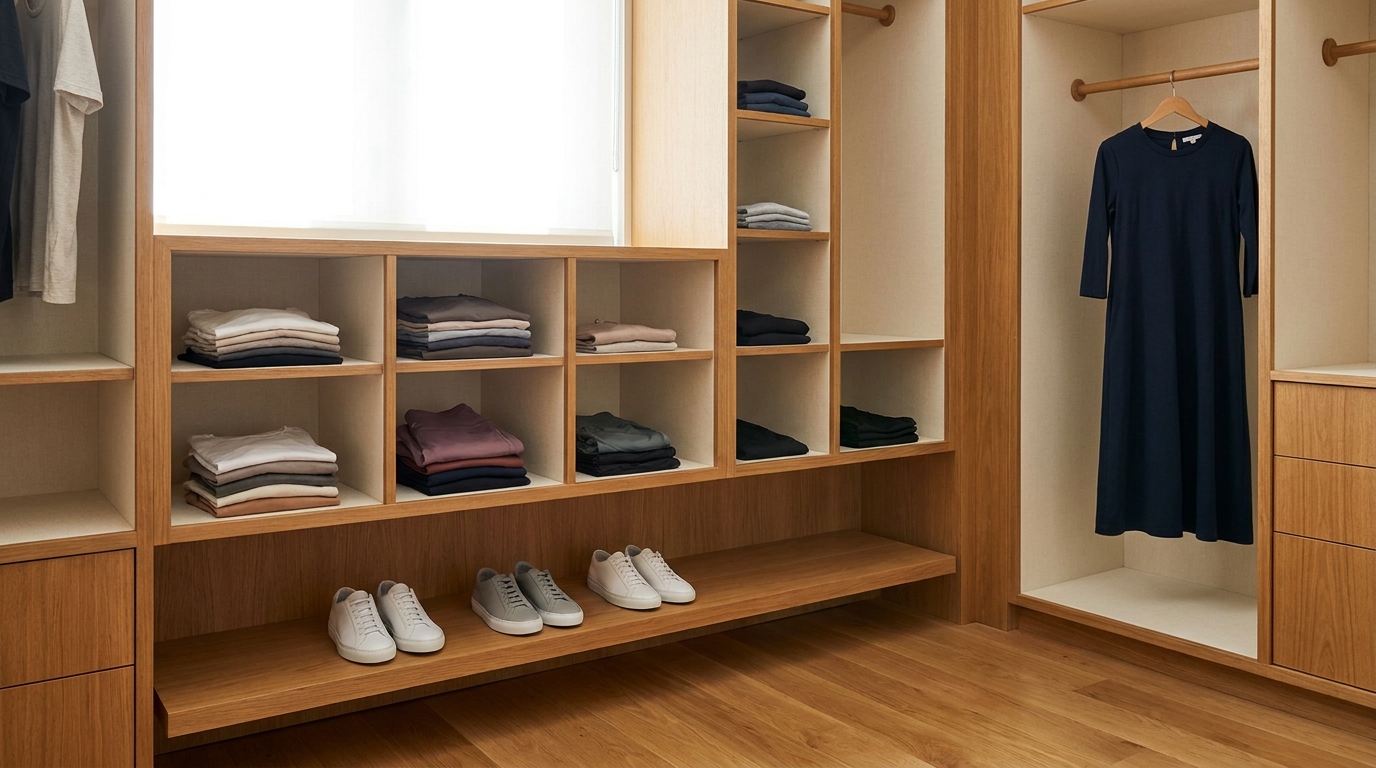
Seasonal Closet Storage: Upper Zones and Deep Drawers
Seasonal closet storage works in Charlotte when off-season clothes live in planned upper zones, deep drawers, and labeled capacity inside the home, not in guest-room piles or garage bins. Our team designs rotation-friendly closets with airflow, clear access, and humidity-aware habits so wool, cotton, and outerwear stay clean, dry, and easy to swap when the weather shifts. The goal is simple: keep this season within arm’s reach and give next season a stable, ventilated home you can trust.
Why humid climates change how we store clothes
Charlotte sits in a warm, moisture-rich part of the Southeast. That climate is part of daily life here, and it shapes how textiles behave indoors. A NOAA Climate.gov note on recent research describes the Southeast United States as a warm and moist climate that has seen increases in the frequency, intensity, and duration of humid heat, alongside similar patterns in other humid regions.[1] We do not invent local humidity percentages for this article, and we do not need them to plan storage well. What matters for households is the practical result: damp air, cooler closet corners, and packed fabrics can team up in ways that dry climates rarely force you to notice.
Natural-fiber clothing absorbs and holds moisture more readily than many people expect. Museum conservation guidance on textiles explains that natural fibers are hygroscopic: they take up moisture quickly and release it slowly, and high humidity, warm temperatures, and poor ventilation encourage mold growth on those materials.[2] Stagnant air above roughly 80 percent relative humidity can support mold on cotton or linen, with wool and silk affected at still higher relative humidity levels, while soil and organic residues make growth easier even when humidity is not extreme.[2] Synthetic fibers absorb less moisture, but dirty synthetics can still host problems when residue and damp air combine.[2][3]
That is why seasonal closet storage in our market is a moisture and access problem as much as a space problem. Stuffing winter coats into sealed bags in an unconditioned garage, or jamming summer linens into a cool exterior-wall closet without airflow, fights the climate instead of working with it.
Indoor humidity targets that protect textiles
Mold control starts with moisture control. The U.S. Environmental Protection Agency states that the key to mold control is moisture control, and that mold spores will not grow if moisture is not present.[4] EPA home guidance and training materials both recommend keeping indoor humidity low: below 60 percent relative humidity if possible, ideally between 30 and 50 percent.[4][5] Relative humidity above 60 percent is more likely to support condensation and mold-friendly conditions in buildings.[5] When water damage does occur, drying affected areas and items within 24 to 48 hours is an important step toward preventing mold growth.[4]
For closet design, those targets translate into habits and hardware, not slogans:
- Keep the whole home in a healthy humidity band with air conditioning, dehumidification where needed, and exhaust fans that vent outdoors for baths, laundry, and cooking-related moisture.[4][5]
- Do not treat the closet as a sealed box that ignores room conditions. Closets share the house’s air, and cooler exterior walls can still create local moisture risk.
- Store only clean, fully dry garments. Damp hems, gym clothes, and rain-soaked outerwear do not belong in an off-season zone “to dry later.”
- Prefer systems that leave a little air movement around stored textiles rather than compressing every cubic inch against a cold wall.
North Dakota State University Extension notes that closets, especially those on exterior walls, can favor mold growth, that the relative humidity inside a cooler closet can be problematic even when the rest of the house feels fine, and that stored clothes should be clean and dry, with space away from outside walls so air can circulate.[6] That advice travels well to any humid market: cool, tight, exterior-facing storage needs extra care.
Stop parking off-season clothes in the wrong rooms
We see the same workarounds across Charlotte homes every season:
- Guest room beds buried under bins.
- Hall closets so packed that hangers cannot move.
- Cardboard boxes in the garage or attic “just until next year.”
- Vacuum bags stacked where no one can reach the label.
Those tactics reclaim a little floor space for a week and then create a second mess. Attics, basements, and closets against exterior walls are among the places textile conservators flag as more susceptible to temperature and humidity swings, and such spaces are not recommended for textile storage when conditions are unstable.[2] Garage air is rarely a friend to natural fibers either. Seasonal closet storage should keep off-season inventory inside conditioned living space, in furniture-grade zones you planned for rotation.
University of Missouri Extension guidance on mildew prevention is blunt on the basics that still fail most households: keep storage areas clean, store clean clothing rather than soiled pieces, dry fabrics thoroughly, improve circulation by opening doors or adding airflow, and hang clothes loosely so air can move around them.[3] Cooking, laundering, and bathing can add substantial moisture to a home unless ventilation keeps up, which is another reason off-season zones need to live in well-managed interior air rather than forgotten corners.[3]
Design pattern 1: upper zones for true off-season capacity
High shelves and double-hang configurations do more than look organized. They create a vertical calendar for the wardrobe.
What belongs up high
- Bulky winter coats in summer
- Heavy sweaters and wool layers
- Holiday outfits and special-occasion pieces
- Seasonal sports gear that still belongs with clothing
- Luggage-ready travel layers you only need a few times a year
How we build the upper zone
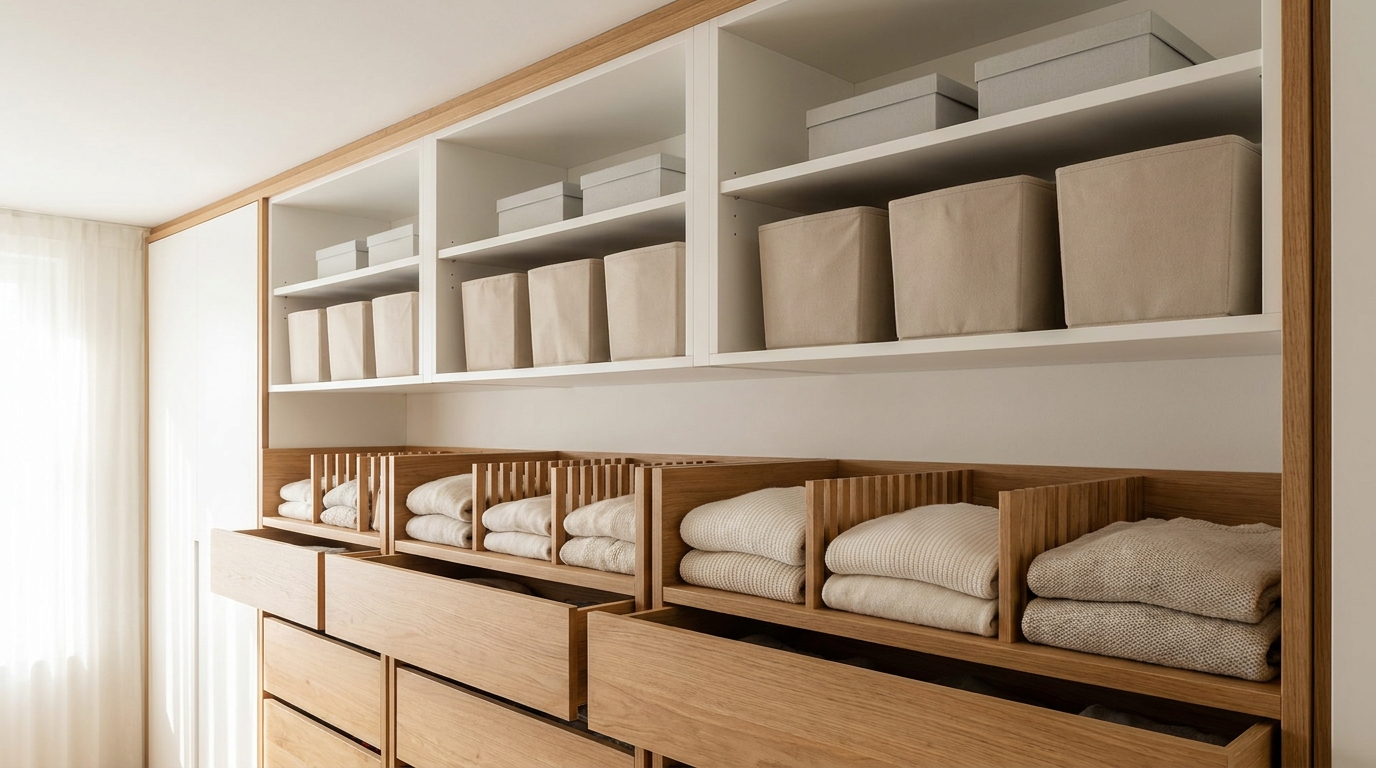
We measure clear height to the ceiling, not only rod height, and we plan shelf depths that fit folded knits without a deep dark void behind them. A single sky-high shelf that is 24 inches deep often becomes a black hole. Shallower shelves, or a front row of labeled bins with a second row only for rarely used items, keep seasonal closet storage honest.
For hanging capacity above daily wear, a second rod for shorter items can free lower rods for current-season length. Long coats need a dedicated tall bay; forcing them to share a double-hang section is how collars crush and hems drag. We leave breathing room at the top of tall cabinets so air is not trapped against the ceiling plane, and we avoid packing soft goods tight against exterior drywall when the layout allows an interior bay instead.[2][6]
Access matters as much as volume. If the only way to reach winter storage is a wobbly step stool jammed between doors, the system will fail by November. We plan a safe reach path: sturdy step stool parking, pull-down rods where appropriate, or mid-height landing shelves that stage bins on rotation day.
Design pattern 2: deep drawers that rotate without the chaos
Drawers are the quiet workhorses of seasonal closet storage. They hide visual clutter, protect folded goods from dust, and make rotation a pull-out task instead of a floor-pile event.
Drawer jobs that fit humid climates
- Sweater drawers: wide, not too deep front-to-back if possible, so stacks stay short and air can move when the drawer is open for inspection.
- Accessory drawers: gloves, hats, scarves, and cold-weather tech in labeled dividers.
- Off-season undergarments and base layers: only when fully dry and clean.
- Kids’ size-hold drawers: next-size-up clothing staged without invading the guest room.
Deep drawers fail when they become dump bins. We size heights to real stacks, add dividers where categories mix, and keep the heaviest seasonal goods at a comfortable lift height. Full-extension slides mean you see the back of the drawer. That visibility is moisture management in disguise: you notice a musty item early, not six months later.
Missouri Extension’s fabric guidance still applies inside drawers: clean before storing, and do not leave damp or soiled pieces resting in a closed space.[3] We also discourage packing drawers so full that fabrics compress into a solid block. A little free volume at the top of a drawer stack is not wasted space; it is airflow and inspection room.
Design pattern 3: labeled off-season capacity you will actually use
Labels turn architecture into a habit. Without them, upper shelves become mystery boxes and drawers become mixed seasons again by spring.
Useful label systems we install or recommend with clients:
- Season tags: “Current,” “Next,” “Hold / Archive.”
- Category tags: “Wool knits,” “Rain gear,” “Formal,” “Kids 5 to 6 hold.”
- Date or rotation notes: month you last aired or checked the bin.
- Household owner tags: in shared closets, so rotation does not become a family scavenger hunt.
Clear or translucent bins help when you want a quick visual check, but they still need labels. Opaque bins look calmer on open shelves and work well behind doors. Either way, we prefer breathable fabric bins or lidded systems used thoughtfully inside conditioned space over long-term cardboard pressed against cool walls. Extension guidance warns that boxed articles that become damp can stay wet and support mold growth.[6] Cardboard also absorbs moisture and can hold a musty smell that transfers to fabric.
Vacuum-compression bags can reduce bulk for synthetics and some bedding, but they are not a cure for garage humidity, and they should not be the only plan for natural-fiber pieces you care about. Clean, dry, cool, and inspectable still wins. If you use sealed containers, store them in conditioned rooms and open them periodically on dry days to check for odor or moisture.
Airflow: the detail that makes seasonal closet storage last
A beautiful closet that is packed wall to wall will still smell wrong after a wet summer. Conservation guidance for textiles in cool, humid climates notes that warm humid air meeting cooler surfaces can condense, that hygroscopic fabrics may dampen enough to support microbial activity, and that overpacked conditions work against fabric stability. More air relative to the number of textiles in a drawer or cabinet is beneficial.[7] Exterior walls are more susceptible than interior walls, and musty odor can signal building moisture issues that storage alone will not fix.[7]
Practical airflow moves we use in layouts:
- Leave space off exterior walls when the closet sits on an outside plane: a few inches behind hanging clothes, or an interior-facing stack of drawers instead of fabric pressed to cold drywall.[6][7]
- Avoid stuffing rods until hangers lock. If hangers cannot slide, air cannot move and rotation becomes a fight.
- Mix open and closed storage. Closed doors calm a bedroom; louvered or slightly gapped designs, or periodic door-open hours, can help in stubbornly still closets when home humidity is already under control.
- Do not block HVAC returns or supply paths with tall cabinets in a way that starves the closet of conditioned air.
- Inspect seasonally. On a dry day, open upper bins, refold knits, and check corners and baseboards the way Extension guidance suggests before you store gear for the next cycle.[6]
If a closet already has active mold, stop packing more clothes into it. Clean up mold and fix the moisture source; cleaning without fixing water problems invites return growth.[4] Our work assumes a structurally sound, dry envelope. Cabinets organize a healthy closet; they do not replace leak repair.
Access patterns that make rotation day short
Seasonal closet storage fails when rotation takes a whole weekend. We design so a household can swap seasons in a few focused hours.
Zoning that matches real behavior
- Front and center: this week’s outfits, workwear, and frequent shoes.
- Mid zone: shoulder-season pieces that bridge heat and cool snaps.
- Upper and deep rear: true off-season, labeled and complete.
- Low drawers: items you still need monthly even off peak (a light jacket in winter, a warm layer in summer for restaurants).
Rotation day checklist we share with clients
- Confirm home humidity is in a sensible range and the closet does not smell musty.[4][5]
- Launder or dry clean outgoing pieces; never store soiled clothes.[3][6]
- Dry everything fully, including linings, cuffs, and shoe interiors.[3]
- Inspect for spots on walls, baseboards, and shelf corners before reloading.[6]
- Move current season to prime rods and eye-level shelves.
- Load off-season into upper zones and drawers with updated labels.
- Leave slight spacing on rods and in stacks for air.[3][7]
- Return step stools and bins to their parking spots so the next rotation is not a hunt.
When kids share a closet, we often stage a small “swap shelf” at adult height for outgrown clothes headed to donation or the next sibling. That keeps growth spurts from overflowing into guest rooms.
Materials, finishes, and humidity-aware choices
Custom closet materials should be stable, cleanable, and appropriate for bedroom humidity, not outdoor sheds. We favor finished cabinet surfaces that wipe clean, quality hardware that still glides after humid summers, and cabinet and shelf finishes that match the room so the storage feels permanent rather than temporary. Soft-close drawers help when late-night rotation happens without waking the house.
Lighting is part of moisture awareness. A dark upper shelf hides problems. LED lighting in closets improves inspection and makes people more willing to put items back correctly. We place lights so they illuminate shelves and rods without heating soft goods in an unsafe way.
Shoe storage deserves a special note in humid climates. Wet soles and damp leather need dry-out space before they join an enclosed seasonal bay. Open shoe shelves near the closet entry, with closed storage only for fully dry pairs, reduces odor and surface growth risk.
How our team plans seasonal closet storage with you
At The Closet Rehab, we design for Charlotte homes and the way families actually dress through the year. Our spaces work includes primary closets, kids’ closets, and reach-ins that often carry the whole household’s seasonal load. We start with inventory and climate reality, not a generic catalog wall.
A typical planning path:
- Walk the current overflow. Guest room, garage bins, hall closet, and under-bed storage tell us what the closet failed to hold.
- Map seasons and categories. We separate true off-season bulk from items you still touch monthly.
- Assign zones. Upper shelves, deep drawers, double hang, long hang, and labeled bin rows each get a job.
- Protect airflow and access. Exterior walls, door swings, and safe reach heights are part of the drawing, not afterthoughts.
- Select finishes and hardware that fit the room and stand up to daily use.
- Install and fine-tune so labels, lighting, and clearances work on day one.
If you want a clear view of the client journey from first conversation to finished install, see how it works. When you are ready to plan seasonal closet storage for a humid-climate home in the Charlotte area, contact us and we will design off-season capacity that stays inside the closet system instead of migrating across the house.
Habits that keep the system honest after install
Built-ins buy you structure. Habits keep textiles healthy.
- Store clean and dry only. Soil feeds mildew; dampness invites it.[3][6]
- Watch whole-home humidity. Aim for the EPA’s low indoor range, ideally about 30 to 50 percent relative humidity when possible, and stay below 60 percent.[4][5]
- Air things out on dry days. Brief airing of stored knits can release musty smells before they settle in.
- Do not use the closet as a laundry buffer. Wet towels and damp gym clothes belong in the laundry path, not on an off-season shelf.
- Fix leaks fast. Moisture control is mold control; delayed drying raises risk.[4]
- Edit once per season. Donation bags leave the house; they do not become a fourth “season” on the top shelf.
- Keep garage and attic as last resorts for textiles you care about, especially natural fibers in humid weather.[2][7]
Closing thought
Seasonal closet storage in a humid climate is not about hiding more boxes. It is about upper zones, deep drawers, and labeled off-season capacity inside conditioned space, with airflow and clean-dry habits protecting the clothes you already own. Charlotte households do not need guest rooms full of bins or garage stacks that smell wrong by August. They need a closet planned for rotation: current season easy to reach, next season stable and inspectable, and humidity treated as a design input rather than a surprise. Build the zones, leave the air a path, and the wardrobe can change with the weather without taking over the rest of the house.
Citations
[1] NOAA Climate.gov, “New article on humid heat trends in the Southeast United States” (published March 25, 2025; summarizes Carolinas CAP / C3HE research on humid heat in the warm, moist Southeast): https://www.climate.gov/news-features/feed/new-article-humid-heat-trends-southeast-united-states
[2] Smithsonian Museum Conservation Institute, “Mold and Mildew on Textiles” (natural fibers hygroscopic; high humidity, warmth, and poor ventilation encourage mold; RH thresholds for cellulosics and protein fibers; exterior-wall closets and similar spaces not recommended for textile storage): https://mci.si.edu/mold-and-mildew-textiles
[3] University of Missouri Extension, “How to Prevent and Remove Mildew - Home Methods” (GH5928; clean storage areas; store clean, dry fabrics; improve circulation; hang clothes loosely; household moisture from daily activities): https://extension.missouri.edu/publications/gh5928
[4] U.S. EPA, “A Brief Guide to Mold, Moisture and Your Home” (moisture control is key to mold control; dry within 24 to 48 hours; keep indoor humidity below 60%, ideally 30 to 50% RH): https://www.epa.gov/mold/brief-guide-mold-moisture-and-your-home
[5] U.S. EPA, Mold Course Chapter 9 (maintain low indoor humidity below 60% RH, ideally 30 to 50%; RH greater than 60% more likely associated with condensation and mold risk): https://www.epa.gov/mold/mold-course-chapter-9
[6] North Dakota State University Extension, “Care Required in Closets and Storage Areas to Prevent Mold Growth” (exterior-wall closets; clean, dry stored clothes; allow air circulation away from outside walls; boxed damp items stay wet): https://www.ndsu.edu/agriculture/extension/care-required-closets-and-storage-areas-prevent-mold-growth
[7] Smithsonian Museum Conservation Institute, “Climate and Textiles Storage” (cool/humid climates and condensation risk; exterior walls more susceptible; avoid overpacked storage; more air relative to textiles is beneficial): https://mci.si.edu/climate-and-textiles-storage