Shared Kids Closet: Two Labeled Zones That Grow
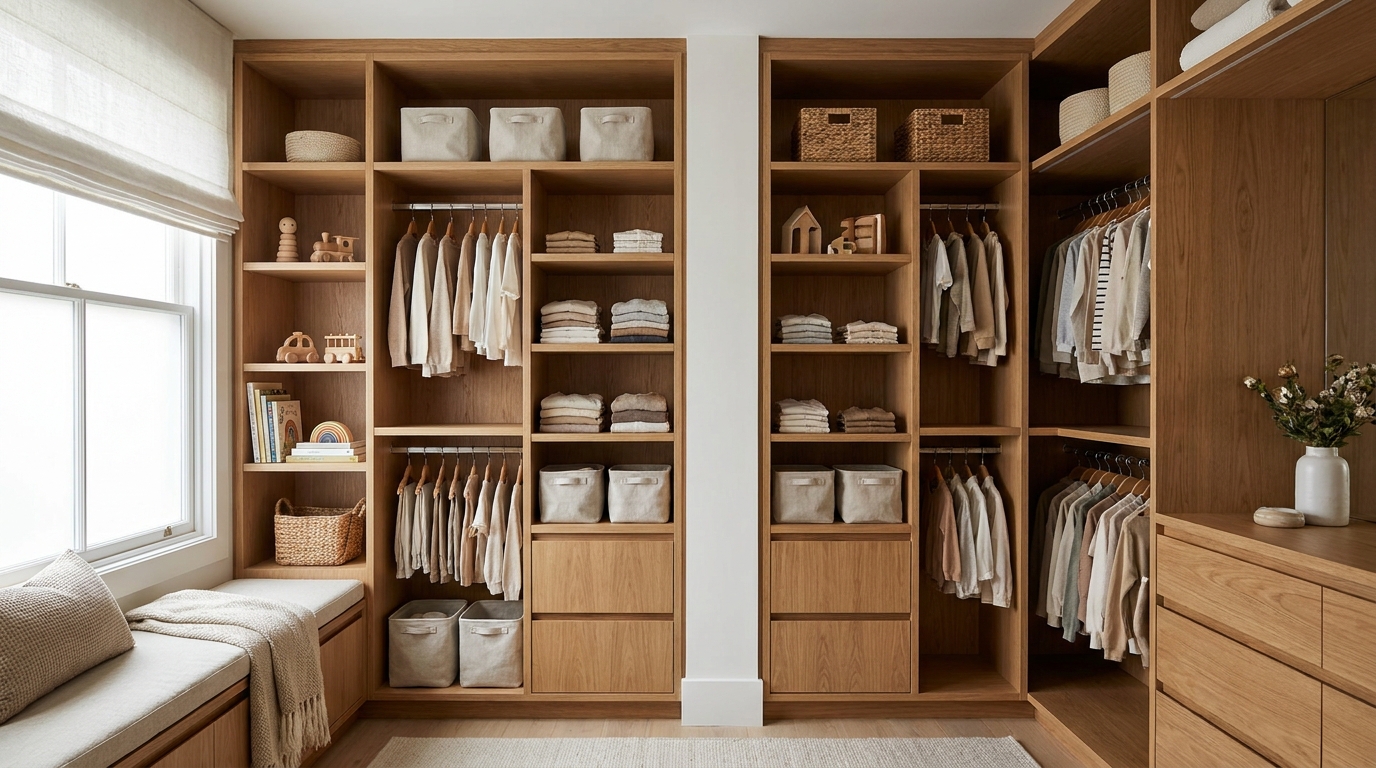
A shared kids closet works when two children each get a true half of the same opening: side-by-side hanging, labeled drawers they can reach, and shelves that can move as they grow. That is a different job than a single-child closet that simply rises over time. Fairness, two reach heights, and two wardrobes have to live in one footprint. If a freestanding dresser sits in that room, it is still a tip-over hazard. CPSC's 2023 report found an estimated 17,800 emergency-department visits a year from furniture, TV, and appliance tip-overs (2020 to 2022), and 44 percent of those injuries were to children under 18. [1]
1. Sharing one closet is not a copy-and-paste of a single-kid layout
A grow-with-them closet for one child can keep one rod, one stack of drawers, and one identity. Two children sharing the same box need two identities from day one. If the older child's shirts claim the only rod, the younger child is left with a floor pile.
Each child still needs a place that is clearly theirs. A 2011 New Mexico State University Extension guide on small-home storage puts the social rule plainly: each person in the home needs a space of their own, no matter how small. [9] That is the brief for a shared closet. The architecture is one opening. The ownership is two.
Preschool development backs the same idea. American Academy of Pediatrics materials updated in 2023 note that many 3- to 4-year-olds dress and undress themselves (coat, jacket, shirt) and begin to cooperate and share with other children. [7] By 4 to 5, many dress and undress without much help, unbutton and button medium-size buttons, and show more independence. [8] The closet has to match those skills, twice, at two heights.
2. Split hanging side by side, not in one mixed row
Start with the rod. Give each child a vertical column, left and right, instead of one mixed hang bar. A visual split (a panel, a color change, or a labeled divider) does more than a spoken rule. When two kids reach into the same row, clothes migrate.
Build two hanging stacks, then adjust them separately. Double-hang (two rods, one over the other) is the usual pattern for school shirts, pants, and jackets. Long hang is only worth the width if someone actually owns dresses, coats, or uniforms that need it. New Mexico State University Extension's storage notes still recommend dividing a bedroom closet into sections with bi-level clothes bars, drawers for small items, and dedicated spots for shoes. [9] In a two-child plan, those sections are assigned, not pooled.
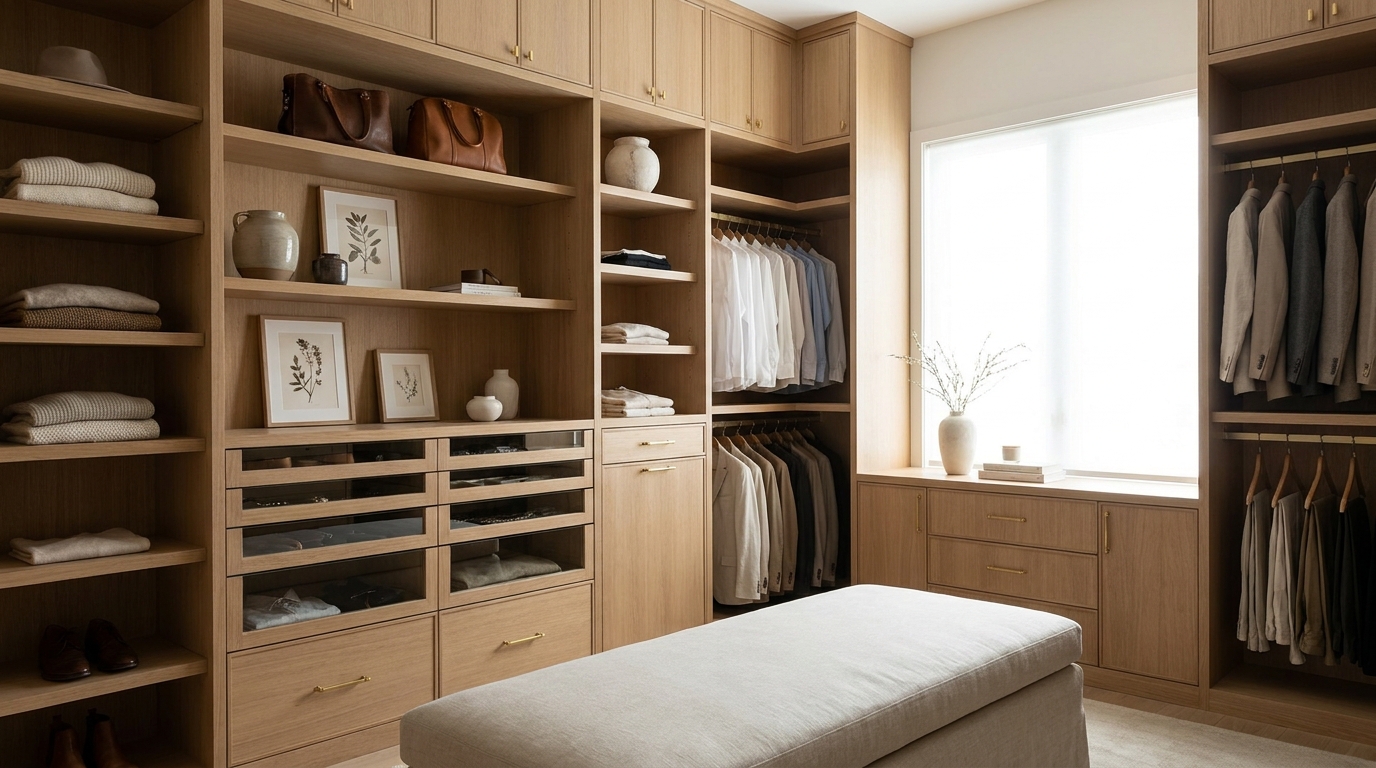
Raise each column on its own schedule. The 6-year-old's upper rod can move up this year. The 3-year-old's lower rod can stay at jacket height. That is the growth story in a shared closet: two tracks, not one average height that serves neither child. Our custom closet work in Charlotte-area reach-ins often starts with that left-and-right split because a standard 6-foot opening can hold two double-hang stacks with a slim center for drawers.
Keep daily hang at child reach. Off-season hang and extra hangers can sit higher, under adult control. If only one child can reach the "good" shirts, mornings become a fight.
3. Labeled drawers beat a shared jumble
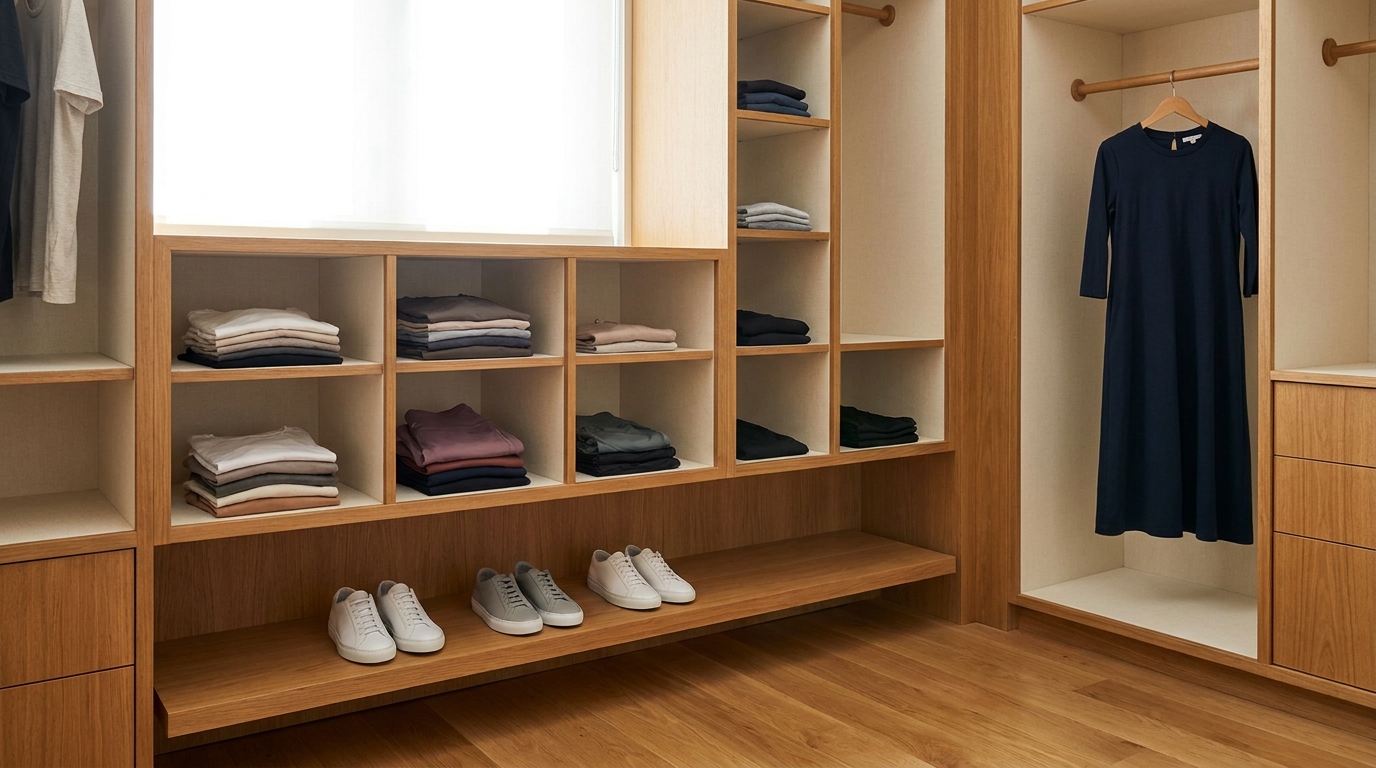
Kids' clothes fold more than they hang: tees, shorts, pajamas, underwear, socks. Two children multiply that. Drawers (or pull-out trays) should be labeled by child and by category, not by a vague "kids" tag.
Pair a word with a picture. A 1998 joint NAEYC and International Reading Association position statement, still circulated by Reading Rockets, notes that children learn a lot about reading from the labels, signs, and other print they see around them, and that highly visible print labels on objects demonstrate the practical uses of written language. [10] A shirt icon plus the child's name is enough. Color-coding the hardware (one child's pulls in one finish, the other in another) helps a pre-reader who is not yet tracking letters.
Count drawers by fairness, not by who currently owns more clothes. The older child may need more hanging. The younger child may need more low drawers. That can still look even from the door if each column has the same footprint.
Keep daily pieces in the lowest drawers. AAP guidance on 4- to 5-year-olds lists dressing and undressing without assistance, plus buttons, as typical hand-and-finger skills. [8] If underwear lives on a high shelf, an adult still has to fetch it. If it lives in a labeled low drawer, the child can finish the job.
A 2009 AAP "Growing Independence" page (treat it as the vintage it is) still gives a useful morning sequence: get clothes ready the night before so morning is only getting dressed, then walk the child through the steps. [13] Labeled drawers make that possible for two kids in one closet.
4. Adjustable shelves that can change jobs without mixing identities
Hanging and drawers take the daily wardrobe. Shelves take shoes, bins, backpacks, and the extras that do not belong on the floor.
Assign cubbies the same way you assign rods. Left column, Child A. Right column, Child B. A bin can change contents (blocks this year, shin guards next year) without changing owner. Shared bulk (extra beach towels, spare sheets) can live on a high center shelf labeled as family, not as either child.
Adjustable shelf pins are the growth hardware. A toddler cubby can become a shoe cubby later without a rebuild. A single open shelf both kids dump into will always belong to whoever dumped last.
Put weight low. That is a safety rule as well as a tidy-closet rule. North Carolina's Department of Insurance, in a February 2023 family-safety release, tells households to store heavy objects on lower shelves or in lower drawers and to avoid placing toys or other tempting items where kids might climb. [5] A shared closet with two climbers is a poor place for a prize on a high ledge.
5. Fairness: two zones, one shared middle, fewer referees
AAP's 2024 social-development guidance for preschoolers notes that around age 3 many children become less dependent, start playing with (not just beside) other children, and can learn to take turns and share in small groups, though they still need coaching. [11] "Mine" and "yours" have to be visible in the closet.
Give each child a complete kit. Rod, drawers, shoe cubbies, one hook, one hamper bag. Then add a thin shared middle: two hooks for backpacks, a bench or pull-out for sitting to put on shoes, and a hamper that is either two bags or two clearly marked sides. One unmarked hamper trains nobody.
Do not make the younger child climb through the older child's zone. If the only path to a backpack is over a sibling's shoes, you have designed a fight. If the older child's long hang eats the younger child's light, you have designed a dark, unused half. Lighting, reach, and floor clearance should be even even when the clothing mix is not.
When two kids want the same hoodie, the closet cannot settle the argument. What it can do is make "that's hers" obvious at 7 a.m. AAP's sharing tips include using words, taking equal turns, and having an adult nearby while children practice. [11] Labels and color do that job in wood and laminate.
6. Tip-over safety: freestanding dressers are not the same as built-ins
Tip-over rules for clothing storage units apply to free-standing furniture, not to built-in systems meant to stay attached to the building.
What the federal rule actually covers. 16 CFR part 1261 defines a clothing storage unit as any free-standing furniture item intended for the storage of clothing, typical of bedroom furniture. Units manufactured after September 1, 2023, must meet the rule. The purpose is to protect children up to 72 months of age from tip-over death or injury. [2] CPSC adopted ASTM F2057-23 as that standard. The ASTM scope, quoted in CPSC's May 4, 2023 Federal Register notice, covers free-standing chests, dressers, armoires, bureaus, and similar pieces at least 27 inches high, 30 pounds, and 3.2 cubic feet of enclosed storage. It does not cover built-in units intended to be permanently attached to the building. [3]
CPSC staff's August 2023 webinar lists the same in-scope pieces (chests, dressers, armoires) and the same outs, including built-in units. The mandatory package also requires an anti-tip device with the product. [4]
What that means in a shared bedroom closet. A wall-hung, stud-fastened closet system is a built-in. Its safety case is that it is actually attached to the building, not that it is "exempt so we skip fasteners." If it is not fastened, it is just another tall object two children can climb. A freestanding dresser parked inside the closet is still a clothing storage unit. Consumer Federation of America's February 2024 summary is blunt: the mandatory STURDY requirements only cover clothing storage furniture made after September 1, 2023, older non-compliant pieces can still be sold, and the rule does not cover other unstable furniture or TVs. [12] Anchor the old dresser anyway.
The injury picture is still a kids' problem, and a bedroom problem. CPSC's February 2024 tip-over report (injuries 2020 to 2022, deaths January 2013 through July 2023) counted 217 reported fatalities. Children under 18 accounted for 155 of those deaths (71 percent). Furniture was involved in 82 percent of the estimated emergency visits. Among children, an estimated 6,400 furniture-related injuries a year included about 1,800 (28 percent) involving a chest, bureau, or dresser. Of the 155 child fatalities, 78 (50 percent) happened in bedrooms. Where furniture-related fatal scenarios were known, climbing was the action in 56 of 72 child deaths (78 percent). [1] CFA, citing that report, notes that 55 percent of reported tip-over fatalities from 2013 through July 2023 involved children between 1 and 3. [12]
Practical steps in a two-child closet. Safe Kids Worldwide tells families to look for STURDY-compliant pieces when they buy new, to install stops on dresser drawers because children often use drawers as stairs, and to secure furniture to the wall with brackets, braces, or straps. [6] NCDOI's 2023 checklist is the same list we use in kids' rooms: attach furniture to the wall, put stops on drawers so they cannot pull all the way out, store heavy objects low, and keep remotes, toys, and other climb bait off the top. [5] CFA adds: do not place TVs on dressers children can climb, and do not put toys or remotes on top. [12]
Two children sharing one closet raise the odds that a drawer is open or a sibling is boosting the other. Built-in drawers should still have stops. Freestanding chests should still be anchored to a stud, even if they passed a new stability test.
7. What stays at kid height as both children grow
Reach is not a compromise between two ages. It is two settings.
At kid height (each child's own zone): school clothes on the lower rod, daily foldables in the lowest drawers, shoes in cubbies, one hook for tomorrow's outfit, one bag of the hamper.
At adult height (still in the same closet): off-season bins, extra hangers, keepsake clothes, anything small enough to choke, and anything you do not want used as a ladder prize. NCDOI's rearrange-the-house tip is the design rule: heavy low, tempting items not up high. [5]
Revisit the layout on a birthday, not on a crisis. When one child outgrows double-hang, raise that column only. The zones stay split. The hardware moves.
Charlotte, Fort Mill, and Rock Hill reach-ins are often shallow. A shallow box still supports two columns if you do not waste the back wall on a single adult-height rod. Walk-ins have more room for a center drawer stack both kids can stand at, which is the fairest shared piece because it is not in either child's hanging lane.
Practical takeaways
- Split the closet into two labeled columns (hang + drawers + shoes) instead of one mixed rod and a pile of "ours."
- Give each child a complete kit: rod, drawers, cubbies, hook, and hamper side. Keep one thin shared middle for backpacks.
- Use picture-and-word labels and different hardware colors so a pre-reader can put clothes back.
- Adjust each child's hanging height on its own schedule. Do not set one average rod.
- Treat a freestanding dresser as a clothing storage unit: STURDY if it is new, anchored either way. Treat a built-in as a built-in only if it is actually fastened to the structure. [2][3][4]
- Drawer stops, weight on the bottom, and nothing tempting on top. Two kids will climb. [5][6]
- Keep daily clothes at the height each child can dress from. Park extras up high.
How we can help
Our team designs shared kids closets as two zones in one opening, with adjustable rods, labeled drawers, and fastening that matches the product (built-in to the wall, freestanding pieces anchored). We measure reach for both children, not an average.
Have more questions or want to get in touch? https://theclosetrehab.com/contact-us/ · (704) 604-3870 · design@theclosetrehab.com
Citations
- U.S. Consumer Product Safety Commission, "Product Instability or Tip-Over Injuries and Fatalities Associated with Televisions, Furniture, and Appliances: 2023 Report" (2024-02)
- eCFR / CPSC, "16 CFR Part 1261, Safety Standard for Clothing Storage Units" (effective 2023-09-01)
- Federal Register / CPSC, "Safety Standard for Clothing Storage Units, 88 FR 28403" (2023-05-04)
- U.S. Consumer Product Safety Commission, "Requirements for Clothing Storage Units (CSUs) Webinar" (2023-08-17)
- North Carolina Department of Insurance, "Commissioner Causey urges television safety during Super Bowl weekend" (2023-02-08)
- Safe Kids Worldwide, "TV and Furniture Tip-Overs" (accessed 2026-08-24)
- American Academy of Pediatrics / HealthyChildren.org, "Developmental Milestones: 3 to 4 Year Olds" (updated 2023-04-04; source 2019)
- American Academy of Pediatrics / HealthyChildren.org, "Developmental Milestones: 4 to 5 Year Olds" (updated 2023-04-04; source 2019)
- New Mexico State University Cooperative Extension, "Buying or Remodeling a Small Home, Guide G-411" (revised 2011-10)
- Reading Rockets (NAEYC / IRA position statement), "Learning to Read and Write: What Research Reveals" (1998 position, page accessed 2026-08-24)
- American Academy of Pediatrics / HealthyChildren.org, "Social Development in Preschoolers: Learning How to Share & Cooperate" (updated 2024-12-05)
- Consumer Federation of America, "TV Tip-Overs Pose Fatal Risk to Children" (2024-02-09)
- American Academy of Pediatrics / HealthyChildren.org, "Growing Independence: Tips for Parents of Young Children" (updated 2009-11-02; source 2006)