Pantry Pull-Out Storage When You Have No Walk-In
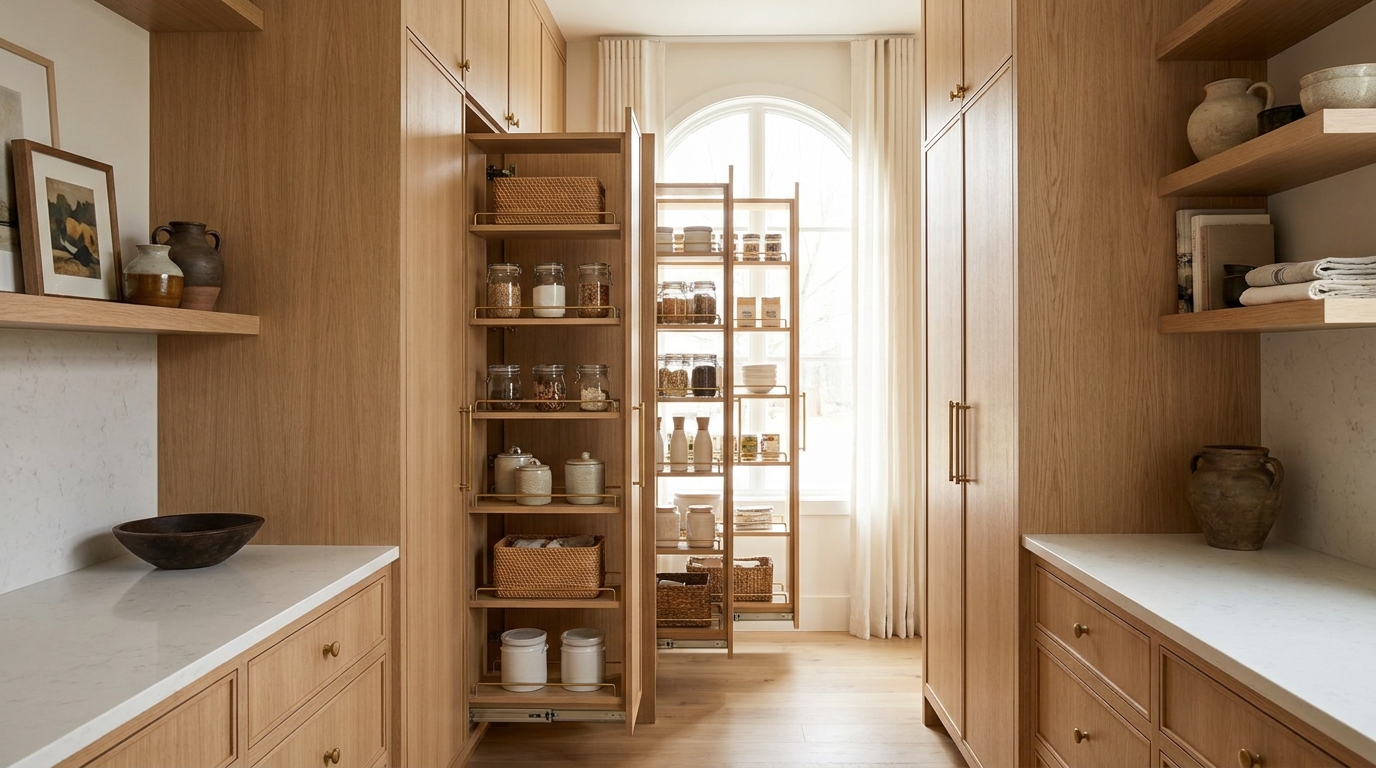
If your Charlotte kitchen cannot spare a walk-in, a tall pantry pull-out in a 6- to 12-inch bay can hold a working week of dry goods you can actually see. The goal is not more cubic inches. The goal is one-deep rows, a full-extension pull, and a cool, dry cabinet away from the range and the fridge exhaust. New Mexico State University's April 2025 food-storage guide still puts quality first at about 50°F, with 60 to 70°F acceptable, and it tells you to keep food in the coolest kitchen cabinets, not next to the oven, stove, or refrigerator exhaust. [1]
1. When the floor plan has no pantry room
South End condos, Plaza Midwood bungalows, and galley kitchens in Fort Mill or Waxhaw share a floor-plan fact: there is no spare closet for a walk-in pantry. The leftover space is a stud bay, a filler next to the fridge, or a sliver at the end of a cabinet run.
A walk-in is a room. A slim tower is a cabinet that comes to you. We design custom pantry systems for both, and they are not interchangeable. A room can hold a case of paper, a stand mixer, and a 25-pound bag of rice. A 9-inch pull-out holds what you cook with this week, in a single visible row.
If you force the slim bay to do the room's job, you stack a second row and lose the back cans. If you leave it as a catch-all filler, you waste the only food storage you have.
2. What pantry pull-out storage actually is
A pantry pull-out is a tall, full-height cabinet on heavy slides. You take the handle and the whole interior rolls into the aisle. Every tray is one row deep. Nothing lives behind anything else.
Width is the first decision, and it is stricter than it looks.
- A 6-inch bay fits oils, vinegars, tall boxes of wrap, and a single file of spice jars. It will not take a cereal box or a wide canister.
- An 8- to 9-inch bay is the everyday canned-goods tower. Most 15-ounce cans, boxed broth, and tomato paste tubes sit in one row with a finger of clearance.
- A 12-inch bay can take pasta boxes, smaller cereal cartons, and a few sealed grain canisters, still one-deep.
- Past about 12 to 14 inches you start parking a second row. At that point you have built a regular cabinet with extra hardware, and the visibility argument starts to fade.
Depth follows the cabinet box, not a catalog number. In a standard 24-inch-deep kitchen run, the tray is a bit shallower than the box so the door, slides, and back panel clear. We measure the finished interior, then set tray depth so a can or jar sits fully on the tray instead of hanging off the back rail.
Height is floor-to-soffit or floor-to-ceiling. The usual home for a tower is the tall opening next to the refrigerator. That location is also a heat source, which matters more than the finish color.
3. Visibility is the real capacity
Illinois Extension's pantry advice is simple: no matter the size of the space, you organize so you can see what you already have. [4] University of Florida IFAS, in an April 2025 home-management note, adds that the items you reach for most should sit where they are visible and easy to grab, and that a pantry stuffed with craft leftovers or party supplies is wasted food space. [5]
That is why pantry pull-out storage beats a deep static shelf in a small kitchen. A 24-inch-deep cabinet with two rows of cans hides the back row. You buy a third can of black beans because you cannot see the first two. A 9-inch pull-out shows every label the moment the unit is out.
First-in, first-out only works if you can rotate. NMSU, Illinois Extension, and UF/IFAS all teach the same restock rule: oldest in front, newest in back. [1] [4] [5] On a slim pull-out, "front" is the only row. When groceries come home, you slide older cans toward the handle and park the new ones at the back of the tray. On a walk-in shelf you need risers, a can rack, or a weekly shuffle to get the same result.
Clear canisters finish the job. We specify jars and bins that match the tray width, with lids that actually seal.
4. What belongs in a 6- to 12-inch bay versus a pantry room
A slim tower is a working inventory. A pantry room is reserve storage. Mixing those jobs is how a 9-inch bay becomes a leaning stack.
Put this in the slim tower:
- Everyday oils and vinegars (on the cool side of the box)
- Single-row canned tomatoes, beans, and broth
- Pasta, rice, and grains in sealed canisters
- Everyday spices and baking extracts
- Boxed stock, coconut milk, and tomato paste tubes
- Wrap, foil, and other tall, skinny boxes you grab while you cook
Leave this for a walk-in, a deeper reach-in, or another room:
- Warehouse-club flats and 25-pound bags
- Small appliances (mixer, air fryer, extra blender)
- Paper goods and extra cleaning products
- Large bags of pet food or bird seed
- Anything you will not use in the next couple of months
NC State Extension's 2022 pantry-pest guide tells households to use dried foods within two to four months of purchase, store them in airtight sealed containers, and inspect incoming packages. [7] A slim tower that turns over on that schedule stays useful. A slim tower used as a storm bunker does not.
NMSU's April 2025 dry-storage list (canned proteins, grains, sauces, baking staples) is a good edit for a 9-inch bay: keep what you actually cook. [1] The FDA draws a hard line between food and household chemicals. Check cans for swelling, leaks, rust, or dents that break a seam, and do not store food next to cleaning products. [3]
5. Heat, light, and where the tower should sit
Temperature is the quiet limit on a kitchen pantry. The University of Georgia's National Center for Home Food Preservation publishes a temperature table adapted from USDA's 2015 Complete Guide to Home Canning. That table lists 50 to 70°F as the best storage range for canned and dried foods, and 95°F as the maximum storage temperature for canned foods. [2]
NMSU is more specific about kitchen geography. Keep stored food off the floor (shelving at least 6 inches up in a dedicated storeroom), choose a dry area with little humidity if you can, and park food in the coolest cabinets, not near the oven, stove, or refrigerator exhaust. Oils go rancid faster next to heat. Dark storage holds quality longer because light can degrade nutrition and appearance. [1]
So we do not treat "next to the fridge" as automatic. It is the most common tall opening, and it often works. The compressor can still warm the adjacent box. When that side runs hot, we leave a filler, vent the side, or put oils and chocolate on the trays farthest from the compressor.
A closed door is doing work. Food wants darkness, not a glass-front display. Do not hide the tower over the range or against an uninsulated wall that bakes in August. If the only leftover bay is a warm one, we use it for dishes, not olive oil.
6. Sealed containers, crumbs, and pests
A pull-out you can empty in ten seconds is easier to keep clean than a deep closet you dread.
The EPA's pest-prevention page (updated May 5, 2026) starts with the basics: store food in sealed plastic or glass, get rid of clutter that gives pests places to hide, caulk cracks around cabinets, and check packages before they come inside. [6] NC State's 2022 guide repeats the same rules in pantry language: inspect incoming items, vacuum crumbs out of cracks, replace torn bags, store foods in airtight sealed containers, and rotate oldest product first. [7]
A slim pull-out helps those rules stick. One-deep trays wipe down without moving a second row. A torn bag or leaking can is obvious the next time the unit comes out. There are fewer dead corners for flour dust.
Do not treat the tower as a junk drawer. Non-food clutter wastes the only food bay you have and gives insects cover. [5] [6] Pet food, bird seed, and odd grain items (rice heating pads, bean-bag filler) are regular pest sources in the NC State guidance. [7] Those belong in sealed bins, often outside the kitchen tower.
7. Height, reach, and anchoring a tall unit
A floor-to-ceiling tower is a tall, loaded piece of furniture. When the unit is fully extended, a lot of that weight is in the aisle, hanging off the slides.
North Carolina's insurance commissioner, in 2022 Safe Kids guidance, repeats furniture rules that fit a pantry tower as well as a dresser: attach the unit to the wall with anti-tip hardware, store heavy objects on lower shelves or in lower drawers, and do not park tempting grab items where a child would climb. [8]
The 2010 ADA Standards (written for public and commercial facilities, not as a private-home code) still give a useful household reach band. Where a forward reach is unobstructed, the high reach is 48 inches maximum and the low reach is 15 inches minimum. [9] We use that band as a design target for the trays you use every day, not as a claim that your bungalow must be an ADA kitchen.
Reach map we use on a slim tower:
- Heaviest cans and jars sit from about waist to mid-chest, well inside that 15- to 48-inch band.
- Everyday oils, grains, and the cans you cook with this week sit at eye level for the people who cook.
- Lightweight wrap, backup spices, and rare extracts go high.
- Nothing tempting (a child's favorite snack, a toy, a remote) lives at the very top in a house with kids. That is how climbing starts. [8]
We specify anti-tip hardware into studs. A full-extension pantry pull-out that is not anchored is a lever. If someone in the house has a limited reach, we drop the daily trays and leave the top bay nearly empty. A 7-foot tower of cans you cannot lift is not extra storage.
8. Fitting towers into Charlotte condos, bungalows, and galleys
Condos and townhomes (South End, Ballantyne, uptown) often give us a 6- or 9-inch filler next to the fridge and nothing else. One tall pull-out plus a shallow spice pull can replace the pantry the floor plan never had. We check the fridge door swing before we pick the width.
Older bungalows (Dilworth, Plaza Midwood, Wesley Chapel cottages) sometimes have a former broom closet or a 12-inch end-of-run. Two slim towers, one for cans and one for grains and oils, often beat a single deep closet you cannot stand in.
Galley kitchens (common in Fort Mill, Rock Hill, and many 1970s ranches) live or die on the aisle. A pull-out needs clear space to come fully out. If a 12-inch unit would pinch the walkway, we spec 9 inches and a second narrow bay elsewhere.
The design visit is where those measurements happen. We look at how you cook, what you actually buy, and which wall stays cool. Then we draw the tower to that bay, not to a showroom width. Full-extension slides get sized for a loaded food cabinet, and the box gets fastened so the wall, not the toe-kick, takes the tip load.
Practical takeaways
- Use pantry pull-out storage as a working inventory, not as a walk-in in disguise. A 6- to 12-inch bay is one-deep food you cook this month.
- Pick width from the package, not from leftover filler. Six inches for oils and spices, 8 to 9 inches for cans, 12 inches if cereal boxes must live there.
- See every label. If you need a flashlight to find the beans, the bay is too deep or the trays do not pull far enough. [4] [5]
- Rotate on restock day. Oldest toward the handle, newest toward the back. [1] [4]
- Keep the tower cool and dark. Aim for the 50 to 70°F quality band, stay well under 95°F, and keep food off the range wall and the fridge exhaust. [1] [2]
- Seal dry goods and wipe the trays. Airtight containers, no crumbs in the corners, no pet food bags left open. [6] [7]
- Put daily food between about 15 and 48 inches, heavy cans low, and tempting climb-bait off the top shelf. Anchor the tower to the wall. [8] [9]
- Send bulk, appliances, paper, and cleaners somewhere else. The FDA's split is the right one: food away from household chemicals. [3]
How we can help
Have more questions or want to get in touch? We design slim pantry towers and full pantry rooms for Charlotte-area kitchens that cannot (or should not) spare a walk-in. Book a free in-home visit at https://theclosetrehab.com/contact-us/ · (704) 604-3870 · design@theclosetrehab.com
Citations
- New Mexico State University Extension, "E-118: Storing Food Safely" (2025-04)
- National Center for Home Food Preservation / University of Georgia, "Temperatures for Food Preservation" (table adapted from USDA Complete Guide to Home Canning, 2015)
- U.S. Food and Drug Administration, "Are You Storing Food Safely?" (2023-01-18)
- University of Illinois Extension, "Prep Your Pantry" (n.d.)
- UF/IFAS Extension Sarasota County, "Save Money By Organizing Your Pantry" (2025-04-29)
- U.S. Environmental Protection Agency, "Do's and Don'ts of Pest Control" (2026-05-05)
- NC State Extension, "Common Pantry Pests and their Management" (2022-07-15)
- North Carolina Department of Insurance, "Kids killed every year by TV tip-overs: Commissioner Causey urges safety ahead of Super Bowl weekend" (2022-02-09)
- U.S. Access Board, "ADA Accessibility Standards, Section 308 Reach Ranges" (2010)