Teen Closet Organization: Long Hang and One Bag Shelf
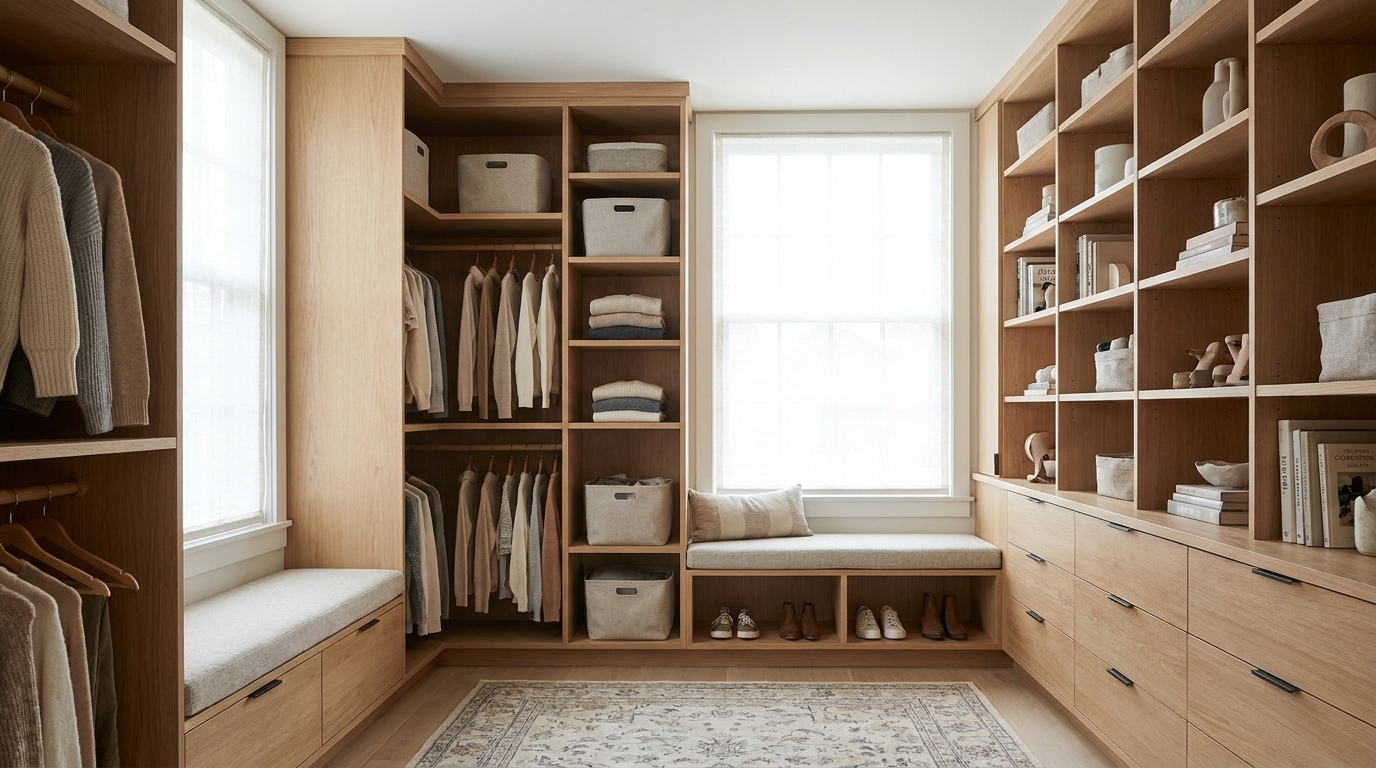
Teen closet organization means retiring the toddler bin wall and the short little-kid split. In their place, plan a long-hang section for longer garments, one open shelf for a single backpack and sports bag, and a few shallow drawers for small accessories. Leave the floor clear. The EPA's closet guidance, on a page updated September 8, 2026, says high room humidity can grow mold on clothing, and it asks households to keep indoor humidity below 60 percent, ideally between 30 and 50 percent [1].
1. Longer clothes need a real hang
The closet that worked for short shirts often fails once the clothes get longer. Hems rest on a low shelf, or coats get folded into a bin because the rod was set for a child.
Measure the garment, not a catalog. Pull the longest coat, the longest dress or jumpsuit, and the longest hoodie. Hang each one on the hanger your teen actually uses. If the hem touches a shelf, the floor, or the rod below it, that zone is still a child hang. You need one run of hanging that is longer than a child double-hang, with a gap under the hem.
Let the care label decide hang, fold, or flat. In July 2021 the Federal Trade Commission voted to keep the Care Labeling Rule, which has required care instructions on garments since 1971 [2]. The FTC's 2014 care-labeling guide says a clothing label must include a washing or drycleaning instruction, and it must say whether the item should be dried by machine or by another method [3]. If a label says "dry flat," that piece needs a shelf, not a hook [3]. Sort a jersey, a coated jacket, and a hoodie before anyone draws a layout.
Use three piles:
- Hang: coats, longer dresses, and anything the label treats as a hanging garment.
- Fold or shelf: tees and other pieces that do not need the long drop.
- Dry flat: anything the label tells you not to hang while it dries.
The long-hang section is for the first pile only. A shorter rod or shelf holds the everyday pile. Our team sizes that split to the clothes in the closet, the same way we look at hang space on a custom closet project.
2. Retire the bin wall and the little-kid split
A wall of open bins made sense for blocks, stuffed animals, and tiny outfits. Those bins now hold outgrown clothes and steal the vertical room longer garments need. A little-kid split has the same problem. Two short hanging zones and a bin tower were a fair map for two small wardrobes, and the wrong map once one person needs a long hang and a bag shelf.
Empty the bins before you buy more of them. Sort into keep, donate, and trash. Keepsakes can leave this closet in one labeled box. Everyday clothing stays. Toys do not get a new bin wall here.
If the closet used to be divided down the middle for two younger children, retire that split. This layout is one teen's clothing, one bag, and a few drawers. It is not a plan for housing two kids in one closet.
A freestanding dresser is not the same product as a built-in closet. The clothing-storage rule published in the Federal Register on May 4, 2023, and effective September 1, 2023, is intended to protect children up to 72 months of age from tip-over death or injury [4]. It defines a clothing storage unit as any free-standing furniture item, made in or imported into the United States, for storing clothing typical of bedroom furniture [4].
The ASTM standard adopted in that rule does not cover built-in units intended to be permanently attached to the building [4]. A closet system fastened to the wall is that kind of built-in. An old chest of drawers standing in the bedroom is not.
If that dresser or a bookcase is staying, use the consumer warning. In a July 29, 2025 release, the CPSC said to anchor furniture such as bookcases and dressers securely to the wall, to avoid storing toys and remotes on top where kids may climb, and to store heavier items on lower shelves [5].
That advice is about freestanding furniture, not a reach chart for a private closet. The 2023 stability rule was written for children up to 72 months, not for teens as a group [4]. It still matters if a younger child uses the room. Take toys off the top, keep heavier clothes low, and anchor the piece or remove it once the closet can hold the clothes [5].
3. One shelf for the backpack and the sports bag
Bags are what turn a decent closet back into a floor pile. The backpack lands under the hang, and the sports bag lands on a chair, then beside a second bag from last season. Hooks for every old bag make the mess look organized while the floor stays full.
Give both bags one open shelf. Size it to the bag your teen carries this season, not to a bigger bag you might buy later. One school backpack and one sports bag live there. A second sports bag waits somewhere else until the first one is put away.
Keep the shelf open at the front. A sealed cubby traps a bag that is still damp. Put the shelf where your teen can lift the bag off without standing on a drawer.
The American Academy of Pediatrics' HealthyChildren.org page, updated August 27, 2026, says backpacks should not weigh more than 15 percent of a child's body weight, so a child who weighs 100 pounds should not carry more than 15 pounds [6]. The same page says to clean the backpack weekly and take out unneeded items, and that a bigger pack is not automatically better because extra room tends to get filled [6]. One shelf makes that weekly empty-out obvious.
Do not put a damp bag back on the shelf. North Dakota State University Extension's closet guide, updated in March 2025, says to dry items thoroughly before storage, and that stored clothes should be clean and dry [7]. Boxed articles that become damp stay wet [7]. A 2023 NDSU review says closets often grow mold when clothing is stored damp or dirty, and that mold can grow on a damp surface within a couple of days at normal temperatures [8].
University of Missouri Extension, reviewed in 2017, says to dry clothing wet from rain or perspiration before it goes into the closet, and to hang clothes loosely so air can move [9]. Dry soiled clothes before they go into the hamper, and do not let clothing lie around damp [9].
A closed bag, dampness, and hot summer weather are ideal conditions for mold [9]. Soil on dirty fabric can feed mildew when moisture and temperature are right, and clean clothing is less likely to mildew than soiled clothing [9]. Empty the bag, dry the sweaty clothes, air the bag, and only then put it back.
4. A few drawers, not a drawer tower
Hair ties, a belt, a watch, earbuds, and a thin jewelry tray still need a home. The fix is not a tall bank of empty drawers left from a younger child's room.
Use two or three shallow drawers. One can hold daily accessories. One can hold belts or a small folded stack. One can stay as a spare. A deep drawer packed with mixed leftovers becomes the bin wall again, only with a front on it.
If a freestanding drawer unit is still in the room, keep heavier items in the lower drawers [5]. Once the built-in drawers are in, that chest is often the piece you can move out. This closet is clothing, one bag, and a short run of drawers, not a wall of specialty racks.
5. Leave the floor clear and let air move
Bins and the sports bag end up under the hanging clothes, so you cannot see the hem. Keep the floor under the long hang empty. You can check the hem, find the bag, and let air move. Missouri Extension's 2017 review says poorly ventilated closets get damp and musty in continued wet weather, and that opening the doors or using a fan improves circulation [9].
The EPA mold guide, updated February 18, 2026, says the key to mold control is moisture control, with indoor humidity below 60 percent and ideally 30 to 50 percent [10]. Drying wet materials within 24 to 48 hours after a leak or spill usually keeps mold from growing [10]. That clock is for a leak or spill. A sweaty jersey should simply be dry before it is stored [7] [9].
Another EPA page, updated the same day, says to open doors to closets that may be colder than the rooms, and to use an air conditioner or dehumidifier in a hot, humid climate [11]. During winter, if the closet is cooler than the house, often near an outside wall, NDSU says the closet air can favor mold even when the house is less humid [7]. Store items off that wall, and leave the door open in very cold weather [7].
Families in Charlotte, Ballantyne, Waxhaw, Wesley Chapel, Fort Mill, Indian Land, and Rock Hill feel the humid season first. Still leave a gap at an exterior wall, including on a cold snap, and do not pack the bag shelf against that wall [7].
6. What to ask for before we measure
A reach-in or a walk-in can hold this short list.
- One long-hang section, set from the longest garment you measured, with the hem clear of the floor and of any shelf below.
- A shorter hang or an open shelf for tees and other pieces that do not need that drop.
- One open shelf for one backpack and one sports bag.
- Two or three shallow drawers for small accessories.
- A clear floor under the long hang, and open space along an exterior wall.
Have the longest garments in the closet when we visit, and keep the care labels where we can read them, so "dry flat" is not treated like "hang it up." Our design visit is where we measure the room and talk through that list before anything is built. In this closet, the useful move is often taking the bin wall away.
Practical takeaways
- Measure the longest coat, dress, and hoodie on their real hangers, and give those pieces a hang longer than the old child double-hang.
- Read the care label. A "dry flat" instruction means a shelf, not a rod [3].
- Retire the toy-bin wall and the little-kid split. This closet is one teen's clothes, not a second playroom.
- Use one open shelf for one backpack and one sports bag, and empty the backpack weekly [6].
- Dry sweaty clothes and bags before they go back into the closet [7] [9].
- Keep the floor clear, hang clothes loosely, and leave air space on an exterior wall [7] [9].
- If a freestanding dresser stays, anchor it and keep toys off the top. A built-in closet is not that dresser [4] [5].
How we can help
Have more questions or want to get in touch? Visit our contact page, call (704) 604-3870, or email design@theclosetrehab.com.
Citations
- U.S. Environmental Protection Agency, "Text Version of the Mold House Tour" (2026-09-08)
- Federal Trade Commission, "FTC Votes to Reverse Course on Repeal of Fabric Care Labels" (2021-07-21)
- Federal Trade Commission, "Clothes Captioning: Complying with the Care Labeling Rule" (2014-05-02)
- Federal Register, "Safety Standard for Clothing Storage Units" (2023-05-04)
- U.S. Consumer Product Safety Commission, "CPSC Anchor It! Campaign Marks 10 Years: Fewer Furniture Tip-Overs Lead to Safer American Households" (2025-07-29)
- American Academy of Pediatrics, HealthyChildren.org, "School Backpack Safety: Proper Fit, Smart Packing & Preventing Back Pain" (2026-08-27)
- North Dakota State University Agriculture, "Care Required in Closets and Storage Areas to Prevent Mold Growth" (2025-03-10)
- North Dakota State University Extension, "Molds in Your Home" (2023-04)
- University of Missouri Extension, "How to Prevent and Remove Mildew, Home Methods" (2017-09)
- U.S. Environmental Protection Agency, "A Brief Guide to Mold, Moisture and Your Home" (2026-02-18)
- U.S. Environmental Protection Agency, "What are the main ways to control moisture in your home?" (2026-02-18)