Work Uniform Closet: Scrubs, Badges, Tomorrow's Set
A work uniform closet is a dedicated bay for scrubs, service uniforms, badges, and tomorrow's clean set so those pieces never share a rod with weekend clothes. Healthcare and service workers in Charlotte, Fort Mill, and Rock Hill typically come home with three piles: the set just worn, the set that needs to go in the wash, and the set already ready for the next shift. CDC's 2003 Guidelines for Environmental Infection Control in Health-Care Facilities (still posted on CDC's site) describe partitioning dirty handling from clean processing in facility laundry rooms, which is a useful analog for a home bay even though that document is workplace and healthcare-facility guidance, not a home mandate [1].
1. Why a work uniform closet belongs in its own bay
Uniforms live on a different schedule than the rest of the wardrobe. A nurse heading to Atrium or Novant, a dental assistant in Ballantyne, a restaurant manager in Rock Hill, or a Fort Mill first responder does not need Saturday denim mixed into Monday's stack. When the two mix, the next-day set gets wrinkled, a badge disappears into a sweater drawer, and the worn set sits on a chair until someone trips over it.
The point of a dedicated bay is separation, not medical sterilization. CDC's facility laundry guidance notes that uniforms without blood or body-substance contamination presumably do not differ much from street clothes in soil, and that home laundering would be expected to remove that level of soil [1]. That is facility language about ordinary uniforms, not a claim that a closet prevents infection. What it does support at home is a simple split: clean hanging on one side, a ventilated hamper on the other, and a labeled hook for the set you will grab at 5:30 a.m.
A dedicated bay also keeps smalls from scattering. Badges, lanyards, pens, hair ties, compression socks, and spare shoe covers do not belong in a jewelry tray with weekend accessories. They belong next to the uniforms they serve.
What a work uniform closet is not:
- A hospital laundry room, and we will not design it as one.
- A substitute for your employer's PPE or contaminated-item rules.
- A catch-all for gym clothes, kids' sports gear, and guest overflow.
Keep those other categories elsewhere. The uniform bay stays short, labeled, and easy to reset after every shift.
2. Double-hang for tops and pants
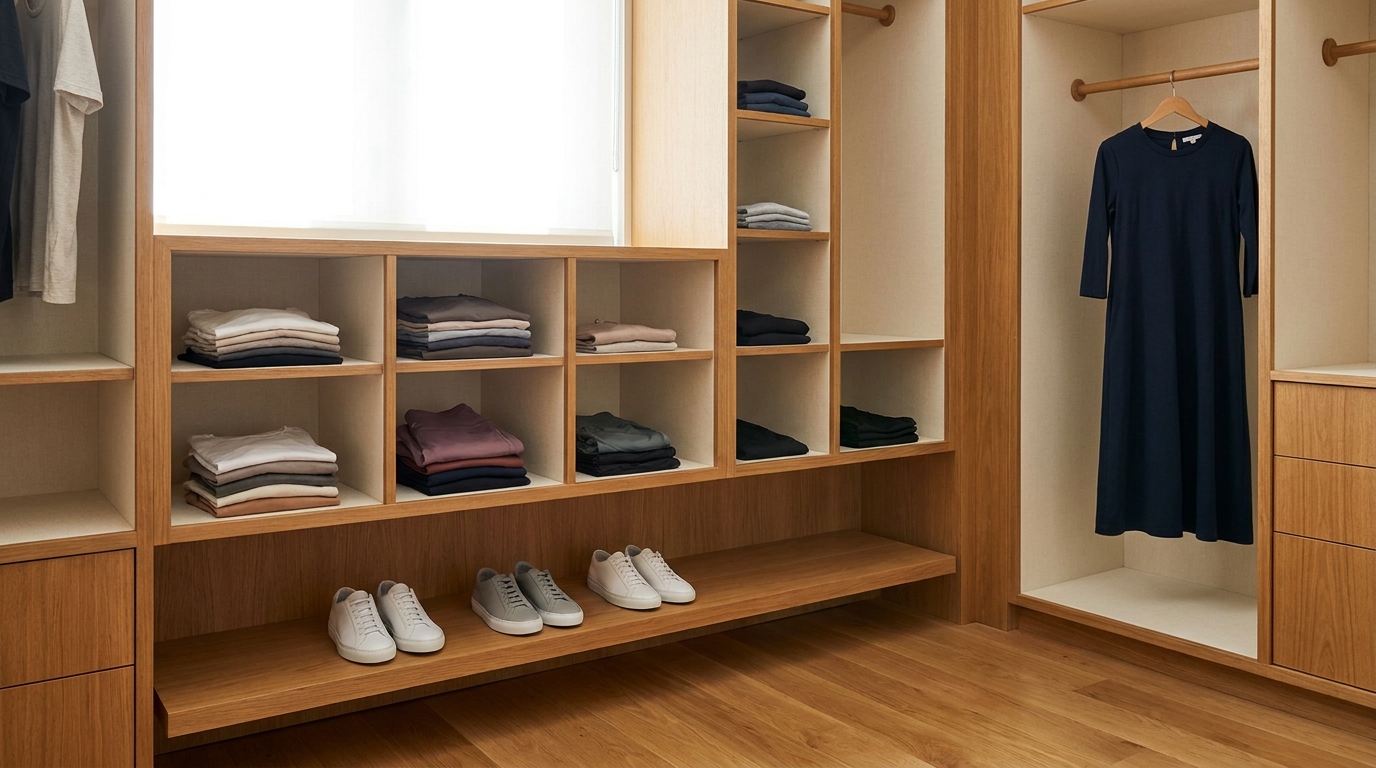
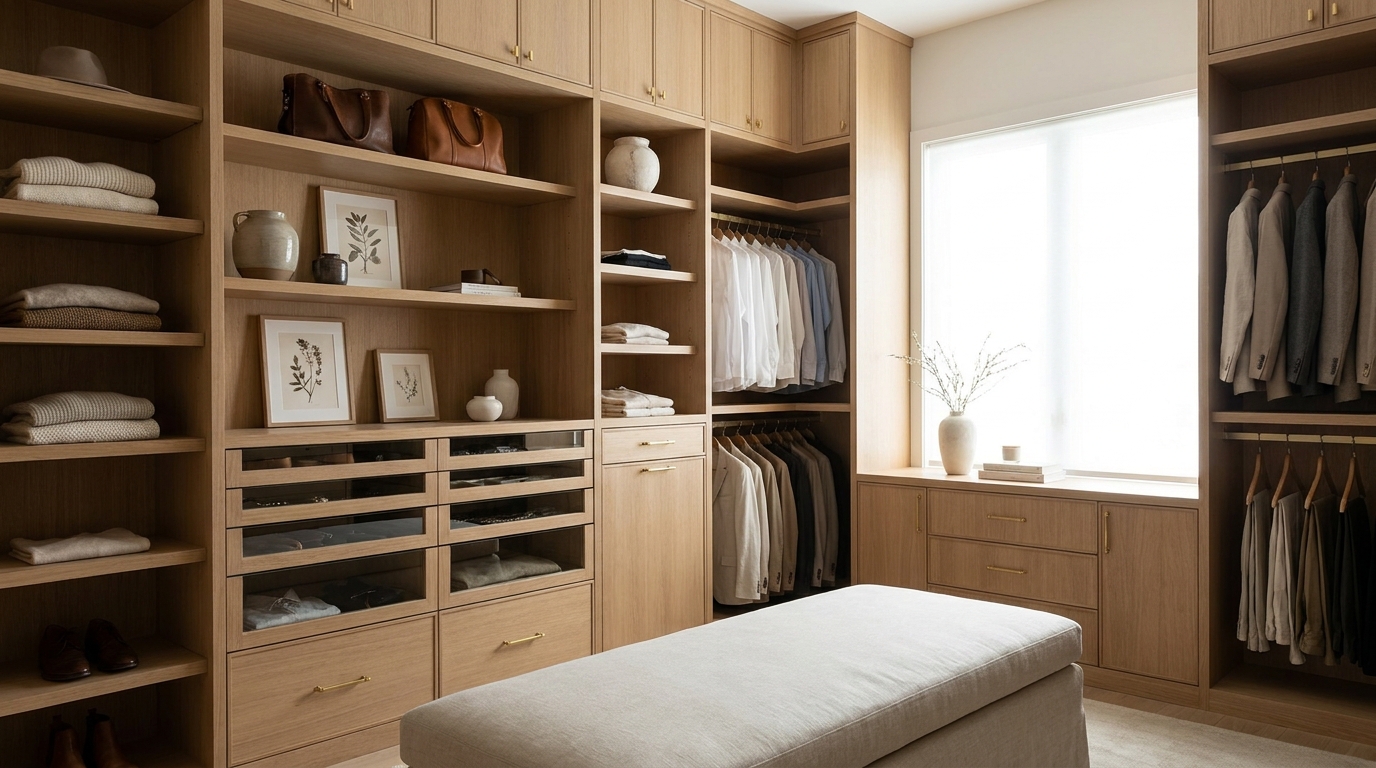
Most scrub sets and many service uniforms are two-piece. A single long rod wastes the vertical space that two shorter rods can use twice. Double-hang (one rod over another) holds tops on the upper bar and pants, skirts, or cargo bottoms on the lower bar so a matching set stays in sight.
We size the bay to the actual count, not a guess. Count how many clean sets you keep at home, how many sit in rotation, and whether you also hang a light jacket, a cardigan, or a fleece. Then add one extra slot so tomorrow's set has a home even when the rest of the rod is full.
Practical layout notes we use in custom closets around Charlotte:
- Upper rod: scrub tops, polo shirts, or service shirts, hung on matching hangers so the line stays even.
- Lower rod: pants, cargo bottoms, or skirts. Leave a little space between hangers so fabric can air after a dryer cycle.
- Long-hang only if you need it: a lab coat, a chef's coat, or a dress uniform can take a short long-hang section at one end. Do not give the whole bay to long-hang if most of the wardrobe is two-piece.
- Hanger standard: one hanger style for work, a different style for weekend clothes. That visual cue stops a hoodie from migrating onto the work rod.
This is not a lecture on generic rod heights. Those belong in a hanging-zone article. Here the job is matching the bay to sets: top plus bottom, ready as a pair.
If two people in the household wear uniforms, split the double-hang with a vertical divider and label each side. Shared rods are how one person's tomorrow set becomes the other person's "I thought that was mine" at dawn.
3. A labeled tomorrow hook you can actually reach
The most useful inch of a work uniform closet is the tomorrow valet: one hook or valet rod with a small label, reserved for the set that goes on next. Not the whole week's rotation. Not the dirty pile. One complete, dry, ready outfit.
Reach matters when you are tired, carrying a bag, and dressing in low light. The U.S. Access Board's ADA Standards set an unobstructed forward and side reach of 15 inches minimum to 48 inches maximum above the floor for operable parts, and the same chapter's advisory table lists coat hooks and lockers among the building elements those ranges were written to inform [3]. Private bedroom closets are not public ADA facilities. We still use that 15 to 48 inch band as a practical analog so a tomorrow hook sits where a standing adult can grab it without a stool and without dropping the hanger on the floor.
How we spec the tomorrow spot:
- One hook or a short valet rod, labeled "Tomorrow" or with the next shift day.
- Height inside the 15 to 48 inch analog, usually toward the middle of that band so a top and pants can hang without dragging.
- Clear floor under it, so shoes for that set can sit on a low shelf or a tray instead of the walking path.
- No overflow. If tomorrow's hook starts collecting extras, the bay is undersized.
A valet rod that pulls forward is helpful in a reach-in. In a walk-in, a wall hook beside the double-hang works just as well. The rule is the same: that hook is sacred. Everything else has another home.
4. A smalls tray for badges, pens, and lanyards
Uniforms fail at the door when the shirt is ready and the badge is not. A smalls tray (a shallow drawer, a divided valet tray, or a wall-mounted cubby) holds the items that never go in a pants pocket overnight.
Typical contents for Charlotte-area healthcare and service workers:
- Badge, clip, and spare lanyard
- Pens, highlighter, and a small notepad
- Hair ties, bobby pins, and a spare mask if your workplace still issues them
- Watch, ring dish, and a clip for keys
- Compression socks, rolled, if they are part of the kit
- Spare shoe insoles or heel grips
Keep the tray at a height you can see into without crouching. Access Board guidance for coat hooks points back to the same reach ranges in section 308, which is again an analog, not a residential code requirement [3]. A tray at about waist to chest height is easier to reset at night than a high shelf you cannot see.
Do not store liquids, bleach pens, or stain spray in the same tray as a badge. Those belong with laundry supplies. The smalls tray is dry, shallow, and emptied into a work bag in one motion.
If two people share the closet, give each person a labeled tray. Shared dishes are how a night-shift badge ends up in a day-shift pocket.
5. A ventilated hamper that stays off the clean rod
Dirty uniforms need a hamper split, not a chair. The hamper belongs in the same closet zone only if it is ventilated, easy to pull out, and physically separated from clean hanging. CDC's home-cleaning guidance (updated January 31, 2025) tells households to dry laundry items completely, clean clothes hampers or baskets the way they would clean other surfaces, and wash hands after handling dirty laundry [2]. That is home guidance, and it is the right tone for this bay.
What we avoid:
- A solid plastic bin with a tight lid parked against hanging scrubs
- A floor pile at the closet threshold
- Damp items sealed in a bag "until Sunday"
CDC's facility laundry section also notes that damp textiles should not be left in machines overnight [1]. We treat that as a common-sense moisture point, not a home infection rule: do not park damp scrubs in a closed hamper beside clean ones.
Moisture is the closet's real enemy. EPA mold guidance asks households to keep indoor humidity below 60 percent, ideally between 30 and 50 percent relative humidity, and to vent moisture-producing appliances such as clothes dryers to the outside [5]. EPA's mold house tour is even more specific: high room humidity can cause mold to grow on furnishings or clothing in a bedroom closet, and clothes dryers must be vented outdoors [6]. University of Minnesota Extension adds that drying clothes on an indoor clothesline makes more moisture for molds to grow, and it recommends drying on an outdoor line or in a dryer that vents outdoors [7]. The same extension service lists mold in the corner of a closet as a symptom of excess home moisture [8].
So the hamper design is simple:
- Ventilated sides or an open mesh bag on a pull-out so air can move.
- A gap between the hamper face and the clean rod. Do not let dirty fabric lean on clean fabric.
- A labeled split if you sort lights and darks, or work clothes versus household laundry. Two slim bags beat one stuffed bin.
- A short path to the laundry room. If the hamper lives in the closet, it should roll or lift out without dumping on the floor.
This is not a claim that a ventilated hamper disinfects anything. It keeps worn uniforms off the floor, off the clean rod, and on the way to the washer.
Tie the closet to laundry room storage when the house allows it. A hamper that leaves the closet and docks under a folding counter is easier to keep empty than a hamper that never moves.
6. Shoes, bags, and a clear floor
Work shoes and bags are the items that land on the floor first. CDC's 2017 STEADI "Check for Safety" checklist asks whether papers, shoes, books, or other objects are on the floor, then answers: pick them up and always keep objects off the floor [4]. That brochure is written for older adults, but the hazard is the same for anyone walking into a dark closet at the end of a 12-hour shift.
Give shoes a low shelf, cubby, or tray at the front of the bay. Work sneakers, clogs, or kitchen shoes do not belong under hanging pants, where they scuff hems and wait to be kicked into the hallway. If you keep a spare pair, stack no more than two deep so you can see both.
Bags need a hook of their own, separate from the tomorrow valet:
- Work tote or backpack on a hook at the side wall
- Lunch bag on a small open shelf, not on the floor
- A catch-all for the items you empty from pockets at the door
Leave a clear walking strip. In a reach-in, that means the hamper pulls out instead of sitting in the opening. In a walk-in, that means the uniform bay does not spill into the center aisle.
Lighting helps more than most people expect. A motion light or a simple switched LED over the uniform bay makes the tomorrow hook, the smalls tray, and the shoe shelf visible at 5 a.m. without waking the rest of the room.
7. How we plan a work uniform closet in Charlotte-area homes
Homes in Charlotte, Ballantyne, Wesley Chapel, Waxhaw, Fort Mill, Rock Hill, and Indian Land were not all built with a spare locker. We usually carve the bay from an existing reach-in, the back of a walk-in, or a mudroom locker that already sits near the door you actually use.
Questions we ask in a design visit:
- How many clean sets do you keep at home, and how many people wear uniforms?
- Do you change at work, at home, or both?
- Do shoes come in the bedroom, or should they stop at a mudroom?
- Where does laundry actually happen, and how far is that from this closet?
- Do you need a sitting ledge to change shoes, or is a standing bay enough?
Typical configurations:
- Bedroom reach-in: double-hang on two-thirds of the rod, tomorrow hook on the end panel, smalls tray in a shallow drawer, ventilated hamper on a bottom pull-out, shoes on a low shelf.
- Walk-in zone: a 24 to 36 inch bay with a vertical divider so weekend clothes stay on the other side of the panel.
- Mudroom or hall locker: useful when you do not want work shoes in the bedroom. Pair it with a bedroom double-hang for clean sets only, and keep the dirty hamper near the laundry room.
Finish and hardware should match the rest of the closet so the bay looks intentional, not like a locker bolted into a bedroom. Matching hangers, a small label, and one extra hook for a jacket are enough visual structure.
We do not promise that a closet will meet a hospital policy, and we do not write infection-control protocols. We do promise a place for the clean set, a place for the worn set, and a place for the badge so tomorrow morning is one grab, not a search.
Practical takeaways
- Give uniforms their own bay so clean sets, dirty sets, and weekend clothes do not share a rod.
- Use double-hang for two-piece scrubs and service uniforms, and save long-hang for the few pieces that need it.
- Reserve one labeled tomorrow hook at a reachable height (we use the Access Board's 15 to 48 inch range as an analog) [3].
- Park badges, pens, and lanyards in a smalls tray, not in a junk dish across the room.
- Choose a ventilated hamper that does not sit against clean hanging, then dry laundry completely and wash hands after you handle the dirty pile [2].
- Keep shoes and bags off the floor. A 2017 CDC STEADI checklist treats objects on the floor as a home fall hazard to fix, not to step around [4].
- Watch closet moisture. EPA guidance calls for indoor humidity below 60 percent, ideally 30 to 50 percent, and outdoor venting for dryers [5] [6].
- Connect the bay to how you actually do laundry. Indoor hanging of wet clothes adds moisture that closets do not need [7].
How we can help
Have more questions or want to get in touch? Our team designs custom closet bays for Charlotte, Fort Mill, Rock Hill, and nearby neighborhoods, including dedicated uniform storage that fits the way you actually get out the door. Start at our contact page, call (704) 604-3870, or email design@theclosetrehab.com.
Citations
- CDC, "G. Laundry and Bedding" (2003 guideline; page dated 2024-01-08)
- CDC, "When and How to Clean and Disinfect Your Home" (2025-01-31)
- U.S. Access Board, "ADA Accessibility Standards, Chapter 3: Building Blocks" (§308 reach ranges; advisory notes coat hooks and lockers)
- CDC STEADI, "Check for Safety: A Home Fall Prevention Checklist for Older Adults" (2017)
- U.S. EPA, "A Brief Guide to Mold, Moisture and Your Home"
- U.S. EPA, "Text Version of the Mold House Tour"
- University of Minnesota Extension, "Dealing with and preventing mold in your home" (reviewed 2018)
- University of Minnesota Extension, "Controlling moisture problems in your home"