Hair Tool Storage in Bathroom Cabinets
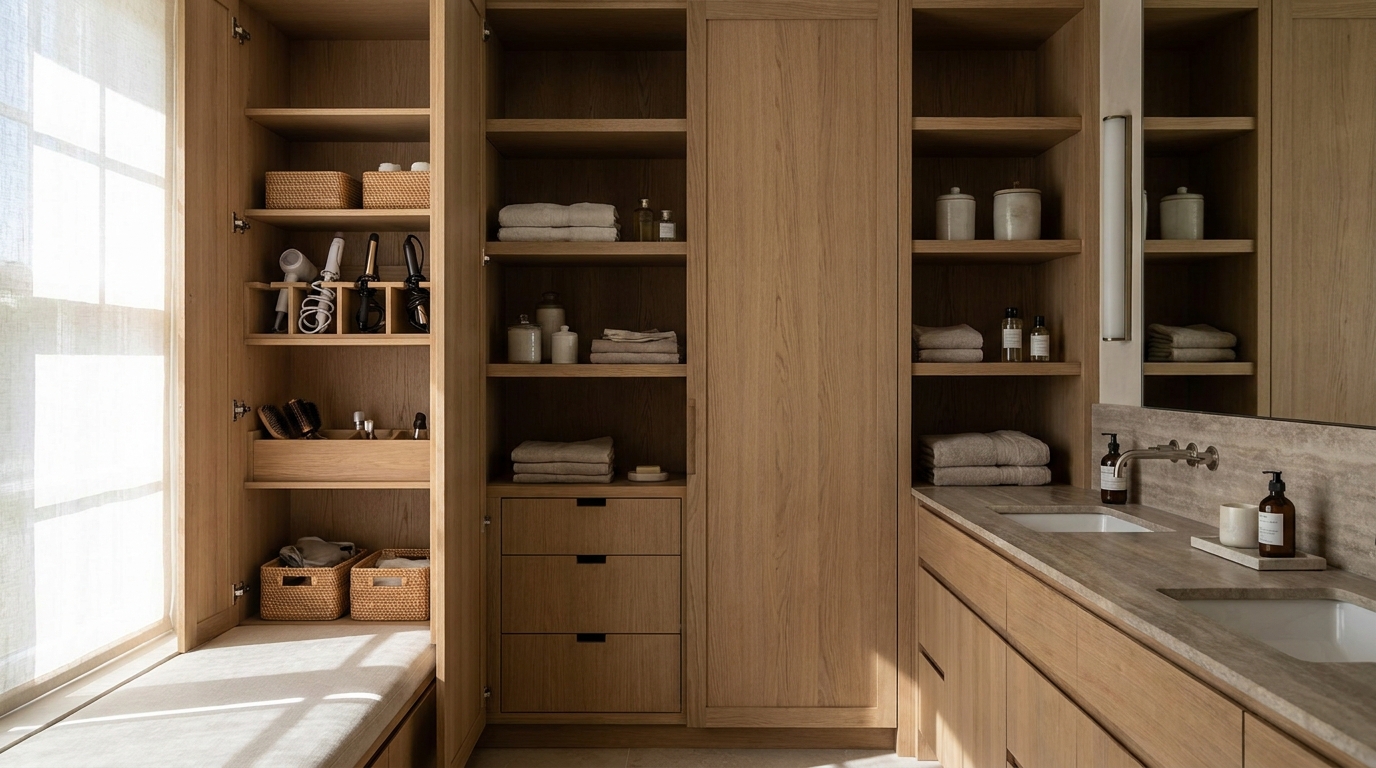
Hair tool storage in a bathroom works when a ventilated cabinet, or one open bay in a linen tower, holds the dryer, flattener, and their cords only after the tools are unplugged and cool. Hair tongs and straighteners can reach 220°C and can take up to 40 minutes to cool after they are switched off, so the first stop is a heat-resistant surface, not a towel or a closed drawer. [1] The bay should stay dry, leave room for air, and sit where a tug on the cord cannot pull the tool into the tub or sink. [2]
1. Why dryers and irons do not belong on the counter
A dryer on its side and a flat iron on a hand towel feel temporary, then they become the routine.
The heat is real. Research presented at the 2023 American Academy of Pediatrics National Conference, using U.S. emergency department data from 2013 to 2022, estimated 30,839 burn injuries from hair styling tools among people age 24 and younger (95 percent confidence interval 24,761 to 36,918), from 1,050 visits. [3] About 68 percent of those injured were younger than 10, 72.3 percent of the injuries happened at home, and hair curlers and curling irons accounted for 97.4 percent of the burns. [3] The same report said 98.6 percent did not require a hospital stay, and the lead author said these tools can reach 450°F within minutes. [3]
Soft materials make the heat worse. Electrical Safety First, a UK electrical safety charity, says not to put a tong or straightener on a soft surface while you use it, and not to put it in a heat-proof pouch until it has cooled. [1] In December 2021, the London Fire Brigade described a flat fire it believed started when a hair dryer was left on a bed and covered by a duvet. [8] The brigade said dryers, tongs, and straighteners should be switched off, left to cool on a heat-proof surface, and never covered with bedding or clothes, because those materials can catch light. [8]
Off is not the same as unplugged. The 2023 instructions for Conair's ArteBella dryer, model 995, state that any hair dryer is electrically live even when the switch is off, and they say to always unplug it immediately after using. [2]
2. What a hair tool cabinet has to do
The cabinet, or one bay in a linen tower, has four jobs.
Cool before it is enclosed. Electrical Safety First says to unplug a tong or straightener and let it cool on a heat-resistant surface, and not to use a heat-proof pouch until then. [1] The Conair manual says the dryer, when not in use, should be disconnected, allowed to cool, and stored in a safe, dry location, out of reach of children. [2]
Keep the bay dry, with air moving. Showers add moisture. The EPA says bathroom fans should send that moisture outside, not into the attic, and that the way to limit mold is to control moisture. [4] [5]
Give the cord a loose path. Do not wrap the cord around the tool for storage. [1] [2] A bay that closes only if you kink the cord is the wrong bay.
Keep the tool out of the splash and out of little hands. Do not store it where it can fall or be pulled into a tub or sink. [2]
3. Give the tool a heat-safe rest before it goes away
Most bathrooms are missing a rest for the minutes when the tool is unplugged and still hot. London Fire Brigade says hair straighteners can get extremely hot, so switch them off and let them cool on a heatproof surface. [7] A 2025 HuffPost report said not to put tools in a drawer or on towels while they are still hot. Use a heat-safe mat or stand, and store them only after they have cooled. [6]
That rest can be a small tray or the mat that came with the tool. If the mat is buried under bottles, the iron goes back on the towel. When the barrel or plates are cool, the tool goes into the cabinet and the counter is clear again.
Automatic shut-off helps, but it is not a substitute for unplugging. Models with shut-off are safer, and tongs and straighteners can still take up to 40 minutes to cool. [1] Unplug as soon as you finish, and do not leave a dryer unattended while it is plugged in. [2] [6]
Do not mix two clocks. Blocked air intakes can make that Conair dryer overheat, and a safety device may shut the dryer or the heat off. [2] If that happens, unplug it, let it cool for 10 to 15 minutes before restarting, and clean the vents. [2] That 10 to 15 minutes is a restart warning for that dryer. It is not the "up to 40 minutes" figure for tongs and straighteners. [1] Follow the booklet for the tool you own.
4. Keep the bay dry, ventilated, and separate from towels
A linen tower works for hair tool storage when one bay is only for tools. Towels are soft, they hold water, and they block the air a dryer needs. The Conair manual says never to block the air openings or set the dryer on a soft surface, such as a bed or couch, where those openings may be blocked, and to keep them free of lint and hair. [2]
The EPA also says to keep indoor humidity below 60 percent if possible, ideally between 30 and 50 percent, and to dry wet materials within 24 to 48 hours after a leak or spill. [4] A cabinet is not a leak, but it stays damp if you shut the door on wet towels and shower steam. Run the fan you already have, or open a window, when you shower. [4]
Moisture also condenses on cold surfaces. The EPA suggests opening doors, especially to closets that may be colder than the rooms, so air can move. [5] A door that can stand open after a shower, with empty space so air can move, fits that advice better than a bay packed with damp cloth.
Split the tower by job. Cooled tools in one bay, towels in the next. A damp towel does not go in beside the dryer. The manual's "safe, dry location" and the EPA's moisture advice point the same way. [2] [4]
Believe a humidity warning. In the HuffPost report, an electrical specialist said tools kept in a bathroom after hot showers can take in moisture, which can lead to corrosion, a short, or overheating. [6] If your booklet says not to store the tool in a humid room, use a linen closet outside the steam, with the same rest and the same loose cord.
5. Cords, water, and the reach of children
Never pull, twist, or severely bend the cord, and never wrap it tightly around the dryer. Damage shows up where the cord enters the housing and can lead to a short. [2] Let it hang or lie loose and straight, and inspect it often. [2] Do not wrap the cable around tongs either. If you notice an odd smell, sparking, or cracks, unplug and contact the retailer or manufacturer. [1] Repeated wrapping can also break the jacket and expose wires, a sharper risk in a humid bathroom. [6]
Skip the home repair and the extension cord. The consumer should not attempt repairs. A damaged cord or dryer goes to an authorized service center, not a roll of tape. [2] Do not run the dryer on an extension cord. [2] A bathroom is a poor place for one, including a cord added so several tools can reach a mirror. [6]
Keep water and the tool apart. Do not use a tong or straightener in the bath, close to a shower, or near a sink full of water. [1] Do not store a dryer where it can fall or be pulled into a tub or sink. [2] If it falls in, unplug it immediately and do not reach into the water. [2] If you are not sure the device is on a protected outlet, do not retrieve it. Turn off the breaker and call 911. [6]
An interrupter is a backup, not a storage plan. Federal rules list hand-supported hair dryers that do not provide integral immersion protection as a substantial product hazard. [9] The Conair manual describes an appliance leakage circuit interrupter, or ALCI, in the plug as protection if the dryer is immersed, and it says to test that feature every time you use it. [2] Do not park the dryer over the tub because the plug has a test button.
Outlets stay with an electrician. That booklet tells owners who use a dryer in a bathroom to have a GFCI installed by an electrician. [2] It rates that model at 1875 watts and warns that sharing a circuit with other appliances may trip a breaker. [2] Our team does not rewire bathrooms, add outlets, or choose a breaker.
Store cooled tools out of a child's reach, and do not leave the cool-down rest at toddler height with the cord hanging down. [1] [2]
6. A cabinet plan that leaves the wiring alone
A typical plan is a linen tower or a wall cabinet beside the vanity, with one bay that fits your dryer and irons without the door pinching the cord. We measure the tools you own rather than publishing one shelf size for every iron. The cord gets a loose loop or a simple hook. The air intake faces open space. The heat-safe rest stays outside the closed door, and the counter is empty once the tool is cool.
Homeowners around Charlotte, and in Fort Mill, Rock Hill, Ballantyne, Waxhaw, Wesley Chapel, and Indian Land, describe the same morning clutter. The answer is custom cabinetry and linen storage planned around the room you already have. Outlets stay put unless an electrician says otherwise. We do not move plumbing, and we do not spec a new circuit on a cabinet drawing.
Our spaces page shows closets, pantries, laundry rooms, and the other storage we design. A bathroom linen tower uses that same approach, with one bay reserved for tools. An in-home look, measurements, and a design you review before we build are the steps on our how it works page. Many installations are completed in a day once that design is approved. Bring the tools to the visit, including any manual that says "dry location."
Practical takeaways
- Unplug immediately. A dryer can still be live with the switch off. [2]
- Cool on a heat-resistant mat or stand, not on a towel or under bedding. Straighteners can take up to 40 minutes to cool. [1] [8]
- Stow only after the tool is cool, intake uncovered, cord loose rather than wrapped. [1] [2]
- Separate towels from tools, and run the bathroom fan you already have. [4] [5]
- Keep a cooling iron out of a child's reach, away from the tub and sink. [2] [3]
- Do not tape a damaged cord. Ask a licensed electrician about outlets. [2]
How we can help
Have more questions or want to get in touch? Visit https://theclosetrehab.com/contact-us/, call (704) 604-3870, or email design@theclosetrehab.com.
Citations
- Electrical Safety First, "Electrical Safety Advice for Hair Straighteners and Tongs" (2026)
- Conair, "ArteBella Model 995 Instruction and Styling Guide" (2023)
- American Academy of Pediatrics, "Electric Hair Styling Products Common Cause of Burn Injuries in Children" (2023-10-20)
- U.S. Environmental Protection Agency, "A Brief Guide to Mold, Moisture and Your Home" (2026-02-18)
- U.S. Environmental Protection Agency, "What are the main ways to control moisture in your home?" (2026-02-18)
- HuffPost, "Is It Safe To Use Electrical Hair Tools In The Bathroom? Experts Weigh In" (2025-06-05)
- London Fire Brigade, "Electrical items - Fire safety at home" (2026)
- London Fire Brigade, "Flat fire - Newbury Park" (2021-12-09)
- Legal Information Institute, Cornell Law School, "16 CFR 1120.3 Products deemed to be substantial product hazards" (2022-11-28)