Bookcase built-in storage for a room without a TV
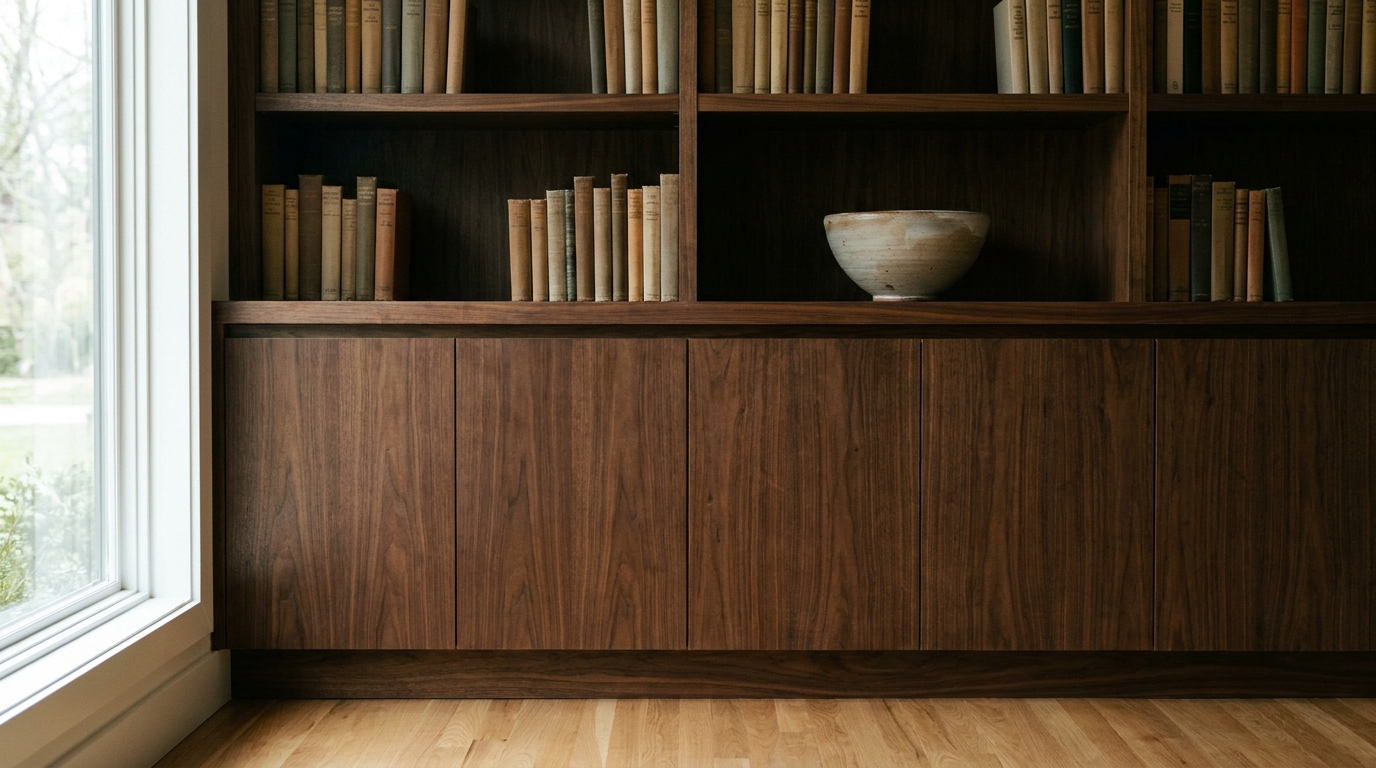
Bookcase built-in storage is a wall for a living room or study that is not organized around a television: closed cabinets below for games and blankets, a limited run of open shelves above for books, and a floor left clear. We plan that wall the way we plan a closet, so bulky things have a cabinet, books have a shelf, and neither ends up in the walkway. The Library of Congress describes a cool setting, 70 degrees Fahrenheit or below, and a relatively dry range of 30 to 55 percent relative humidity as safe for most books, along with solid flat shelves and books kept upright rather than leaning [1]. A screen wall, cabinets flanking a fireplace, and a piece whose only job is the family game collection are different projects.
1. What this wall is, and what it is not
The room is for people, not for a screen. Some living rooms are arranged around a chair, a window, and a place to read. Some studies hold a desk and one reading chair and were never meant to become a second family room. Homeowners in Charlotte, NC, and in Waxhaw ask for this when the room is for sitting and reading, not for watching.
Closed below, open above. The base is a run of doors or drawers for throws, extra pillows, puzzles, and the games that would otherwise live in a basket. The shelves above hold the books you want to see, in a run short enough to dust and to put a book back. Similar sizes stand together so the covers support one another, and a bookend keeps a short row from leaning [1].
Three projects we are not building here. We are not centering the wall on a television, a soundbar, or a stack of components. We are not designing a pair of narrow cabinets on either side of a fireplace. Games may sit in the base, but we are not turning the case into a game room. If the screen, the hearth, or the game collection is the real subject, that is a different drawing.
2. Why the floor has to stay clear
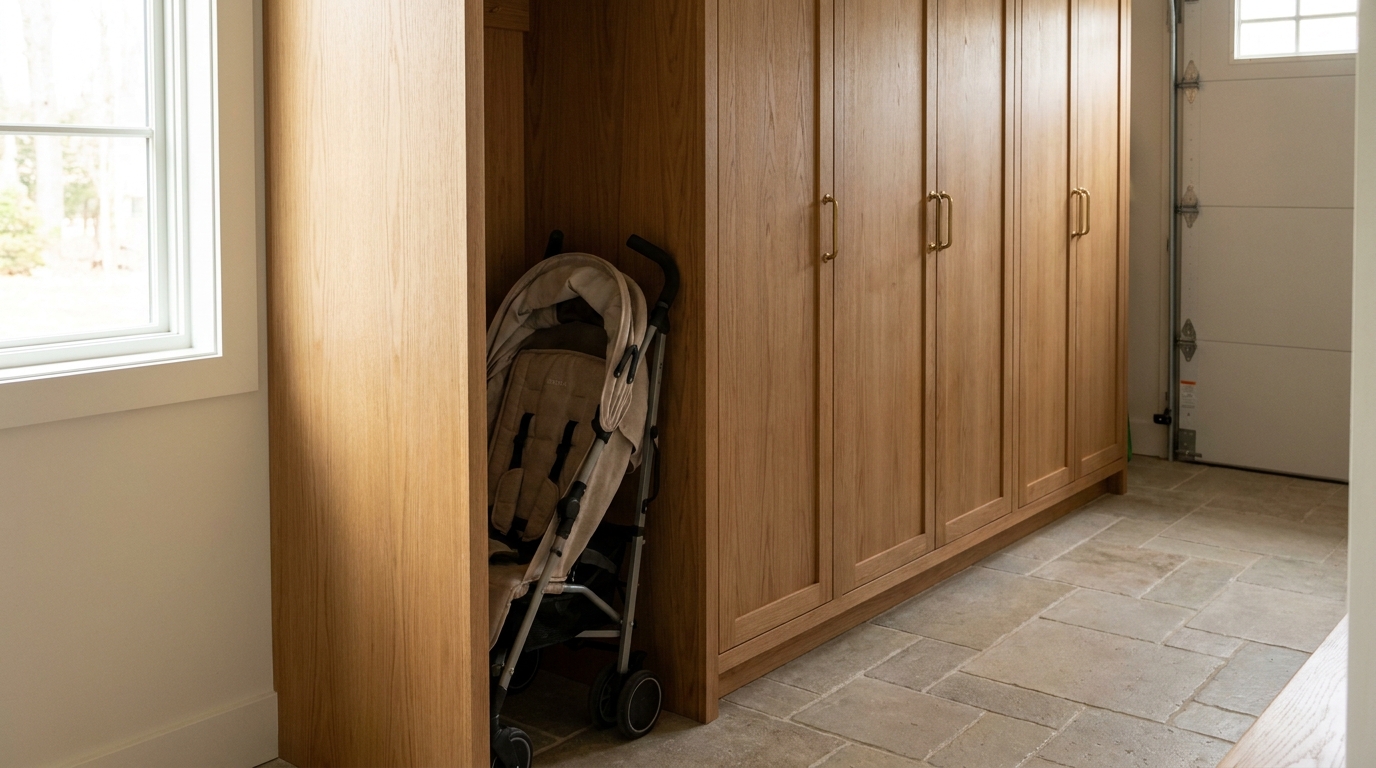
A floor pile means the system failed. When the shelves are full, the next blanket and the next stack of paperbacks land on the carpet. The path past the chair narrows, the vacuum stops, and the base doors cannot open if a basket is parked in front of them. The cabinet exists so those things have a home that is not the floor.
Dust settles where people walk. EPA describes indoor dust as settled particles that walking, crawling, vacuuming, and cleaning easily kick back into the air [6]. Children are exposed to more of that dust than adults because they crawl and play closer to the floor [6]. Clearing that strip gets the basket, the book stack, and the blanket heap out of the way.
Books pick up what the pile collects. The Library of Congress notes that dust can hold particles that discolor books, that it attracts pests, and that it absorbs moisture from the air, which can help mold grow [1]. Books stay on open shelves you can dust, soft goods stay in a dry cabinet, and the floor stays open.
Leave a path you can use. We keep the case on the wall and recess a toe space, so you can stand close enough to read a spine. The swing of a door, the roll of a desk chair, and the route across the room stay in the plan. If a basket has to live in front of the doors for the wall to work, the base is the wrong size.
3. The closed base: blankets, games, and what stays out
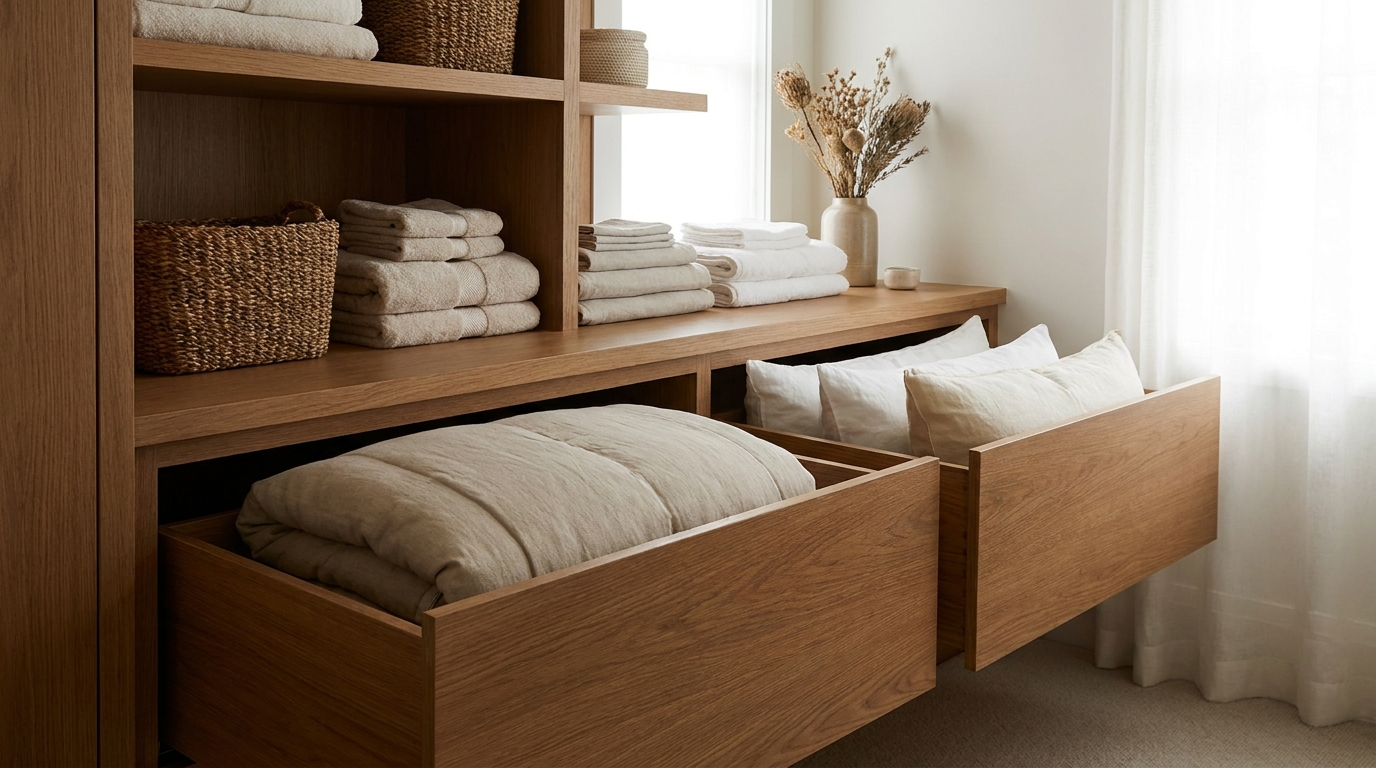
Throws need a real shelf, not a shove. Fold them, and do not cram them until the door springs back. A wide shelf behind a door, or a deep drawer, holds a few throws and a spare pillow without turning the cabinet into a hamper. The cabinet is only a dry place between uses.
Wash the blankets that actually get used. EPA's Care for Your Air guide, in its discussion of asthma triggers, says a home may have dust mites, pillows, blankets, or stuffed animals, and it lists washing sheets and blankets weekly in hot water among steps for those triggers [8]. Hiding a throw behind a door does not replace that step.
Damp does not go in and get forgotten. EPA's mold guide states that the key to mold control is moisture control, that mold will not grow without water or moisture, and that water-damaged items should be dried within 24 to 48 hours [7]. A throw from a wet chair, or a book that was rained on, stays out of the closed base until it is dry. The same guide asks households to keep indoor humidity below 60 percent when possible, ideally between 30 and 50 percent [7].
A musty cabinet is a moisture clue. EPA lists areas where books, shoes, or other items become moldy among the signs that can indicate a home may not have enough ventilation [5]. House dust mites grow in damp, warm environments [5]. If the base smells stale, look for moisture before you add another shelf. A tighter door only hides the problem.
Games stay one row deep. Stand the boxes so the title faces you, on a shelf tall enough for the boxes you own. A second row behind the first is how a game disappears for a year. This is still a bookcase wall. The games are in the base so the open shelves can stay books.
A few things do not belong in the base.
- Clothing that belongs in a closet. This base is not a dresser.
- Damp towels, wet boots, or anything that still feels cool.
- Open cans of paint, varnish, or solvent. EPA notes that paints, varnishes, and wax can release organic compounds while you use them and, to some degree, when they are stored, and it lists increased ventilation when you use products that emit those compounds [9].
- A basket of unnamed miscellaneous. It will fill the shelf and push the blankets back onto the floor.
4. Open shelves that books can live on
Use a solid shelf. The Library of Congress wants every shelf completely flat, with no splinters or nails sticking up, and a solid surface rather than a lattice or slats [1]. Slats let a thin paperback tip and collect dust in the gaps. We build a solid shelf deep enough that a standard hardcover sits fully on the board.
Stand similar books together. Shelve books of a similar size so the covers support their neighbors, keep the row upright, and use a bookend when the row does not fill the bay [1]. A 2015 National Archives Prologue article says volumes of about the same size should stand together, or they distort and the covers lose their shape, and that large volumes such as atlases should be stored flat [4].
Never store a book spine up. If a book is too tall to stand, store it flat and horizontal, fully supported by the shelf under it. If it must stand vertically, the spine goes down, never up, because gravity can loosen the text block from the cover over time [1].
Leave room to take a book out. Remove a book by gripping both sides of the spine at the middle, after pushing the neighboring books in a little, instead of tugging the top of the spine [3]. A row packed so tight that you cannot push the neighbors gets torn on the way out. We leave a little free space at the end of each shelf for the bookend and for your hand.
Keep heavy books low. Atlases and other large books belong on a shelf you can reach without tipping the stack, and the high shelf is for lighter books, not a basket. A 2015 National Archives article notes that storing a large volume flat helps keep the covers flat and the text from separating from the covers [4].
Keep snacks off the page, and do not crank a book flat. The same article notes that food and drink can stain paper, and that the stain is permanent [4]. Do not force an open book to lie completely flat. Prop the covers and reduce the opening angle [3].
5. Light, heat, and the air in a room you use
Keep direct sun off the spines. Books should have minimal exposure to light, and ideally none that is direct or intense. Shades, curtains, or a box for a sensitive volume are the options the Library of Congress names [1]. A 2015 National Archives article says light can fade covers, especially spines left in sunlight for years, and it says to position the bookcase so sunlight does not fall on books you want to preserve [4]. If the only long wall is the window wall, the shades are part of the plan.
Do not park the books on a vent or a radiator. The Library of Congress ties the life of a book to avoiding extreme temperature, including vents and radiators, avoiding long periods of warmth with high humidity, and avoiding frequent swings [1]. We do not set a book row in the blast of a supply register. We do not seal a radiator or a return into a cabinet with nowhere for air to move.
Humidity has a band, and the pages do not quote one identical number. Most books are best held at a stable relative humidity no higher than 55 percent [2]. Relative humidity above 60 percent risks warping and mold growth on books [2]. Relative humidity below approximately 30 percent can also warp a book by contraction, and rapidly changing humidity is its own concern [2].
A lived-in room is the right target, not a vault. For the house, EPA's mold guide asks you to keep indoor humidity below 60 percent when you can, ideally between 30 and 50 percent [7]. A living room will not match a special-collections room. Use the room people already find comfortable, and keep the books out of the damp extremes.
Attics, basements, and garages are the wrong backup. Do not store books you care about in poorly insulated basements, attics, or garages, where temperature and humidity are often unsuitable and leaks are more likely [1]. A 2015 National Archives article adds that heat, water, and high humidity in attics and garages can leave paper brittle, and that moisture can attract insects [4].
Open the base on a schedule you will keep. If the air smells off, or a throw feels damp, deal with the water before you refill the shelf. EPA's point is moisture control [7]. A tighter door is not the fix.
6. How we divide the wall
Count the books before the elevation. We sort what you own into paperbacks, standard hardcovers, and anything too tall or too heavy to stand, and we count the throws and game boxes for the base. Those counts set the openings. A drawing that ignores them fills up with leaning rows.
Three zones, and they do not share a job.
- Base. Doors or a deep drawer for soft goods and games, one row, nothing you are trying to display.
- Middle. Books you pull often, where you can read the spine without a stool.
- Top. Lighter books you use a few times a year, still upright and supported. A basket on top of the case is a floor pile that moved up.
Break long spans where the books are heavy. A long unsupported shelf full of hardcovers will dish over time, so we place uprights instead of asking a thin board to carry a reference row. Thickness follows the span, the material, and the books you own, and it is decided at the house.
Fix the base, and let the open shelves adjust. A fixed shelf or a solid top on the base stiffens the run. Adjustable shelves above let tall art books sit beside novels without forcing one opening on both, while similar sizes still share a shelf [1].
Look at the whole room. On the visit we note the window, the supply vent, the door swing, the chair, and the outlet a lamp already uses. The case should not cover that plug or land in the sun or the airstream described above. We are not wiring the wall, and a cord across the floor is another way the clear path gets lost.
The path matches a closet project. We measure, draw, and build to that drawing. The sequence is on our how it works page. Living rooms, studies, and the other rooms we fit are on our spaces page.
7. Habits that keep the wall working
- Dust books and shelves with a duster that has no fragrance and no other chemical [1]. A small soft brush on a vacuum is acceptable if the suction can be reduced [1].
- For floors and other surfaces, use a damp cloth so settled dust does not go straight back into the air [6]. EPA suggests vacuuming carpets and furniture every week, or more often, and says people with asthma or allergies should leave the area while the vacuum runs [6].
- Wash the sheets and blankets you use on the weekly hot-water step EPA lists, even after a door hides the throw [8].
- If a book's structure is unstable, a container or a simple support is more appropriate than a tight row [1]. We build the case. We are not book conservators, and household tape is not a stand-in for one.
Practical takeaways
- Plan closed cabinets below and a limited run of open shelves above, in a room that is not organized around a television.
- Keep games, throws, and extra pillows in the dry base, one row or one folded stack, and keep them off the floor.
- Use solid, flat shelves, stand similar books upright with bookends, store oversized books flat, and never store a book spine up [1].
- Keep direct sun, supply vents, and radiators off the book row [1][4].
- Treat books that have gone moldy as one sign the room may not have enough ventilation [5]. Dry wet items within 24 to 48 hours, and do not shut them into the base while they are damp [7].
- Count the books and the base contents before the elevation is drawn. If something has to sit in front of the doors, the base is too small.
How we can help
Our team measures the wall, the books, the light, and the walk path, then builds the case for that room. The rooms we work in are listed on our spaces page.
Have more questions or want to get in touch?
Contact The Closet Rehab, call (704) 604-3870, or email design@theclosetrehab.com.
Citations
- Library of Congress, "Storing Your Books" (2026-07-23)
- Library of Congress, "Introduction - Preserving Your Books" (2026-07-23)
- Library of Congress, "Handling Your Books" (2026-07-23)
- National Archives, "Preserving Books" (2015)
- U.S. Environmental Protection Agency, "The Inside Story: A Guide to Indoor Air Quality" (2026-05-26)
- U.S. Environmental Protection Agency, "Sources of Indoor Particulate Matter (PM)" (2026-03-10)
- U.S. Environmental Protection Agency, "A Brief Guide to Mold, Moisture and Your Home" (2026-02-18)
- U.S. Environmental Protection Agency, "Care for Your Air: A Guide to Indoor Air Quality" (2026-08-17)
- U.S. Environmental Protection Agency, "Volatile Organic Compounds' Impact on Indoor Air Quality" (2026-06-23)