Dining Room Hutch Built-Ins Keep Plates in Reach
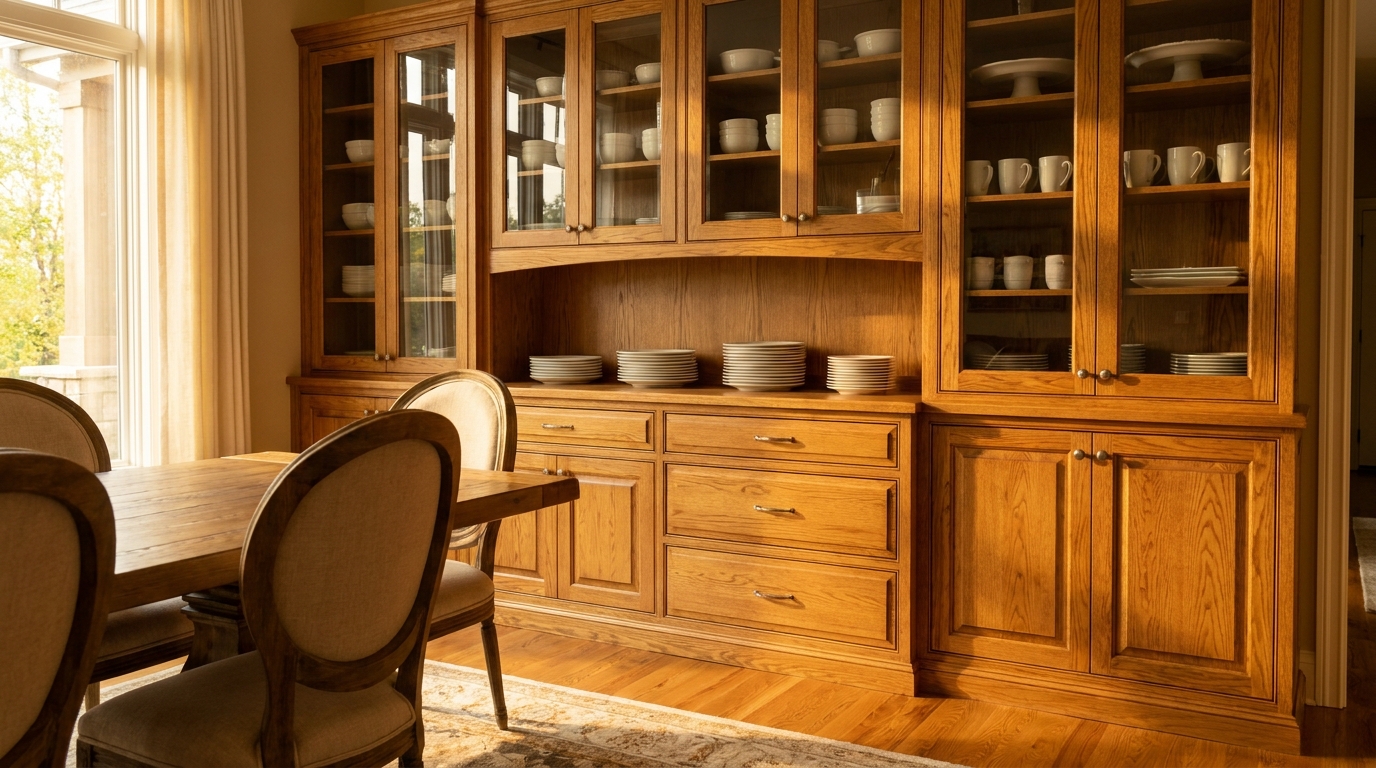
A dining room hutch built-in should keep tonight's plates in an open band you can reach, and keep the good china, extra crystal, and silver behind doors. That split follows how often a piece is handled, not a rule that every dish must hide from daylight. The National Park Service Museum Handbook (2000) notes that visible or ultraviolet light will not damage most ceramics, glass, and stone. [4] Open shelves still collect dust and invite bumps, so the pieces you use a few times a year belong in a closed section.
1. One wall, two kinds of dishes
The usual problem is a single cabinet asked to be a closet. Holiday platters, weekday bowls, and gilt-edge plates land on the same shelf. The door stays open because you cannot find the Tuesday plates, or it stays shut because the whole wall looks like storage.
Dining room hutch built-ins work when the wall has two jobs. The open band holds what you set out most nights, and the closed band holds what comes down for a holiday or a guest. Frequency decides the shelf. The door is only the tool.
This is dining-room casework next to the table, not a butler's pantry and not a pass-through. A custom pantry is a different room, built for food, bulk goods, and small appliances, while a living-room media wall is a different job. The hutch does not hide a television.
In houses we measure around Charlotte, from Ballantyne toward Indian Land, the dining wall is rarely blank. A window, a sideboard you want to keep, or a doorway to the kitchen sets the height. The built-in has to fit that wall and still leave a clear path around the table.
2. Keep tonight's plates in the easy band
Setting the table is a lift, even when the load is a stack of plates. OSHA describes a power zone for lifting: close to the body, between about mid-thigh and mid-chest, where the arms and back can lift with the least effort. [3] That guidance is written for job sites, not as a cabinet code. It still tells us where everyday dishes should live.
Put the dinner plates, the bowls you use all week, and the platter you actually reach for in that band. You should not crouch to the toe-kick or stretch to the crown to set a weeknight table. The open shelf makes the band obvious, so you can see the piece and put it back.
How you pick the piece up matters as much as the height. The Park Service handbook says to handle glass and ceramic objects as little as possible, and not to lift them by handles, knobs, rims, or decorative motifs. [4] The University of Illinois preservation guide says to pick an object up under its center of gravity, never by a protruding part, even when that part is a handle. [5] A cup handle is for drinking, not for a one-finger yank off a shelf.
Stacking is the other quiet source of chips. The 2000 handbook says not to stack plates, cups, and bowls if you can avoid it, and if space forces a stack it calls for a soft layer, such as washed cotton flannel or polyethylene foam, between pieces. [4] The Illinois guide agrees that you should not stack unless you must, and that inert foam or acid-free tissue belongs between objects when you do. [5]
On an open everyday shelf, a groove or upright divider lets plates stand so you can slide one out instead of prying it from a tower. Keep that shelf shallower than your forearm so the back row does not disappear.
A few habits keep the open band honest:
- Store only what you used in the last month on the open shelves. If it has not come down since spring, it is not an everyday piece.
- Leave a little air between rows so a sleeve does not take two plates with it.
- Do not park loose serving spoons on the front lip, where they fall when someone brushes past.
3. Put the occasional pieces behind doors
Closed doors earn their place on pieces you touch a few times a year. Every extra handling is a chance to chip a rim, drop a lid, or rub a gilt edge. The Illinois guide treats handling itself as a risk, and it treats objects on exhibit as needing a barrier from dust and casual contact. [5]
A working dining room is not a museum gallery. A plain factory dinner plate is being used, not exhibited, so it can live in the open band. The gilt rim, the repaired heirloom, and the crystal you unwrap twice a year should follow the stricter habit and stay behind a door.
The Park Service handbook recommends cabinets that close tightly to limit dust. It also says oils and acids from bare hands can disrupt and eventually etch lustreware, iridescent glass, and gilded ceramics. [4] Those surfaces are a poor fit for a grab shelf. Behind a door, you handle them when you mean to.
Dust is not only a look. The Illinois guide notes that dust holds moisture, and that moisture on metal may carry sulphur compounds or chlorides that tarnish or speed corrosion. [5] Dust can also stain porous ceramics, while porcelain and other high-fired ware are harder and more brittle, so a bump costs more. [5]
Silver flatware needs one more step, because the same guide says uncoated wood can release acetic acid that corrodes metals over time, and it says to avoid oil-based and alkyd paints when metal sits near painted wood. [5] That is collection-care guidance, not a ban on a wood hutch. We still build dining casework in finished wood, with a cured interior plus a tray or cloth wrap so flatware does not sit on a raw shelf.
Glass doors and solid doors are both legitimate. The handbook points to clear doors when you want to see a piece without handling it, as long as the cabinet still closes tightly. [4] We use glass when you like to see the china, and solid doors when the set is truly occasional. The same handbook says infrared heat can change the humidity around an object, so we do not aim a spotlight into the shelves. [4]
One caution belongs with heirloom pottery, and it is narrower than people fear. In a November 2010 questions-and-answers page, the FDA reported that some traditional pottery, including pieces labeled lead free, contained extractable lead. [8] The page flags handmade ware with a crude or irregular look, antiques, damaged or heavily worn pieces, flea-market finds, and bright orange, red, or yellow decoration when the maker is unknown. [8]
The same page says pottery made in commercial factories for everyday use is much less likely to have lead problems. [8] If a home test finds leachable lead, the FDA strongly advises against cooking, serving, or storing food or drinks in that piece, and washing or boiling will not remove the lead. [8] Those pieces can sit behind a door as decoration, not on the everyday food shelf.
4. Order the shelves by weight and by hand
Height and weight should agree. The Park Service handbook says to store the heaviest objects on the bottom shelves. [4] The Illinois guide says heavy objects belong where you can reach them easily, ideally around waist or cart height. [5] A turkey platter belongs on that low shelf.
Lighter pieces can sit higher, behind a door, because you are not repeating that reach every night. If you need a chair, it is not storage you will use safely. We stop the usable shelves where a standing adult in that house can reach with both feet on the floor.
Inside the closed section, give each set a named home: holiday plates together, cups with lids beside them rather than balanced on top, and silver in a shallow tray. The Illinois guide says to carry lids separately, which is easier when the shelf is already sorted. [5]
A few layout choices prevent the slow damage:
- Put the heaviest serving pieces on the lowest solid shelf, not on the open display lip.
- Stand plates when you can. Nest them only with a soft separator, and keep the stack short.
- Set mugs on a shelf and lift from underneath. Do not hang them by the handle from a hook you have to tug.
- Leave the top of the hutch clear. A bowl or a toy on the crown is a reason for a child to climb.
5. Fasten the hutch so it cannot become a climb
Tall casework is furniture, even when we build it to the wall. CPSC staff's February 2024 tip-over report covers televisions, furniture, and appliances. For 2020 through 2022, staff estimated an annual average of about 3,100 emergency-department-treated injuries involving shelving, shelving units, or bookcases (22 percent of furniture-related tip-over injuries) and about 1,700 involving cabinets (12 percent). [1]
Those categories are not labeled "dining hutches." They are the closest public groupings, and they are large enough that we do not treat a tall dining piece as exempt. For children under 18, the same report estimated an annual average of 6,400 furniture-related injuries, of which about 1,000 (16 percent) involved shelving, a shelving unit, or a bookcase. [1]
The report lists what makes a piece more likely to tip: an unstable or top-heavy design, a soft surface such as carpet, a missing or failed tip restraint, heavy objects on top, or several drawers open at once. [1] Among reported child deaths from January 1, 2013 through July 31, 2023, staff could classify 72 furniture-related scenarios, and in 56 of those deaths (78 percent) the victim or another child was climbing on the television or furniture. [1]
Fatality counts for 2021 through 2023 should be read as incomplete, because the report says reporting lags. [1] Children still climb, and drawers, a lower door used as a step, or a toy on top all invite that climb.
A 2011 CPSC safety sheet, written for homes where children live or visit, says to anchor furniture to the wall or the floor and to keep toys and other attractive items off furniture. [2] We fasten the hutch into the wall structure as part of installation, and the crown stays empty.
This is not the clothing-storage rule. The February 2024 report notes a separate rule for clothing storage units, codified as 16 CFR part 1261, which took effect on September 1, 2023, and it cautions that the report's counts are a different scope. [1] A dining hutch is not a dresser, so that standard does not lay out your plate shelves or replace a wall attachment.
The report also says CPSC's Anchor It campaign, started in 2015, continues, with the aim of cutting deaths and injuries from tipping televisions, furniture, and appliances. [1] The 2011 sheet does not limit its tips to full-time residents, so the same habits apply when children only visit. [2]
6. Choose panels and a finish that behave in a dining room
Two quiet problems show up after the doors are hung. One is moisture trapped in a closed box. The other is the material the box is made of.
EPA's mold guidance says to keep indoor humidity below 60 percent if possible, ideally between 30 and 50 percent, and to dry wet materials within 24 to 48 hours so mold is unlikely to grow. [7] Use an exhaust fan or an open window when you cook, run the dishwasher, or wash dishes. [7] The Illinois guide adds that high humidity can promote mold even on inorganic objects. [5]
A dining room in a humid stretch of the year, including summers around Fort Mill and Waxhaw, is not a vault. Do not shut dripping plates into the closed section to dry later. Let them dry, then put them away. If a spill reaches the shelf, wipe it and let the box air before you latch the door for a long weekend.
Composite wood is a separate question from the paint color. EPA's consumer FAQ says hardwood plywood, medium-density fiberboard, and particleboard are commonly used in furniture and kitchen cabinets, and that formaldehyde in those resins can irritate skin, eyes, nose, and throat. [6] High levels of exposure may cause some cancers. [6]
The same FAQ says regulated composite wood products, and finished goods containing them, must be labeled TSCA Title VI compliant if they were manufactured in or imported into the United States after March 22, 2019. [6] When a hutch uses those panels, we want that label. Solid lumber is not on that three-product list. Either way, the interior should be a cured finish you would accept near dishes.
Our cabinet and shelf finishes are chosen for shelves that see plates and the occasional drip. Tell us if the closed section will hold silver. That detail changes the interior finish and the shelf lining.
Practical takeaways
- Give the hutch two zones: an open everyday band in the easy reach range, and closed doors for pieces you use a few times a year.
- Keep weeknight plates between about mid-thigh and mid-chest, close to the front of the shelf. Stand them when you can instead of stacking them bare. [3] [4]
- Do not lift china by the handle. Keep gilt, lustre, and repaired pieces off the grab shelf. [4] [5]
- Put heavy platters low. Leave the top of the hutch clear so it is not a climb. [4] [5]
- Fasten the casework to the wall. A clothing-storage rule is not a substitute for that attachment. [1] [2]
- Dry dishes before they go behind a door. Ask for TSCA Title VI labeling when shelves are hardwood plywood, MDF, or particleboard. [6] [7]
- Keep factory everyday dishes and untested flea-market pottery in different categories. A November 2010 FDA page says commercial factory ware is much less likely to leach lead, and a piece that tests positive should not hold food. [8]
How we can help
Have more questions or want to get in touch?
We design dining room hutch built-ins for homeowners who want weeknight dishes in reach and occasional pieces protected, and a free in-home design consultation is the way to start. A designer comes to the house, looks at the dining wall, and sorts what you use from what you store. You can see other built-in rooms on the spaces page, then reach our team at https://theclosetrehab.com/contact-us/ , call (704) 604-3870 , or email design@theclosetrehab.com .
Citations
- U.S. Consumer Product Safety Commission, "Product Instability or Tip-Over Injuries and Fatalities Associated with Televisions, Furniture, and Appliances: 2023 Report" (2024-02-07)
- U.S. Consumer Product Safety Commission, "Anchor It and Protect a Child" (2011-09)
- Occupational Safety and Health Administration, "eTools : Solutions for Electrical Contractors - Supplemental Information - Ergonomic Principles | Occupational Safety and Health Administration" (n.d.)
- National Park Service, "Appendix P: Curatorial Care of Ceramic, Glass, and Stone Objects" (2000)
- University of Illinois Preservation Self-Assessment Program, "Preservation Self-Assessment Program (PSAP) | Ceramic" (n.d.)
- U.S. Environmental Protection Agency, "Frequent Questions for Consumers about the Formaldehyde Standards for Composite Wood Products Act | US EPA" (2026-03-30)
- U.S. Environmental Protection Agency, "A Brief Guide to Mold, Moisture and Your Home | US EPA" (2026-02-18)
- U.S. Food and Drug Administration, "Questions and Answers on Lead-Glazed Traditional Pottery | FDA" (2010-11)