Dining Linen Storage: Shallow Drawers, Napkin Tray
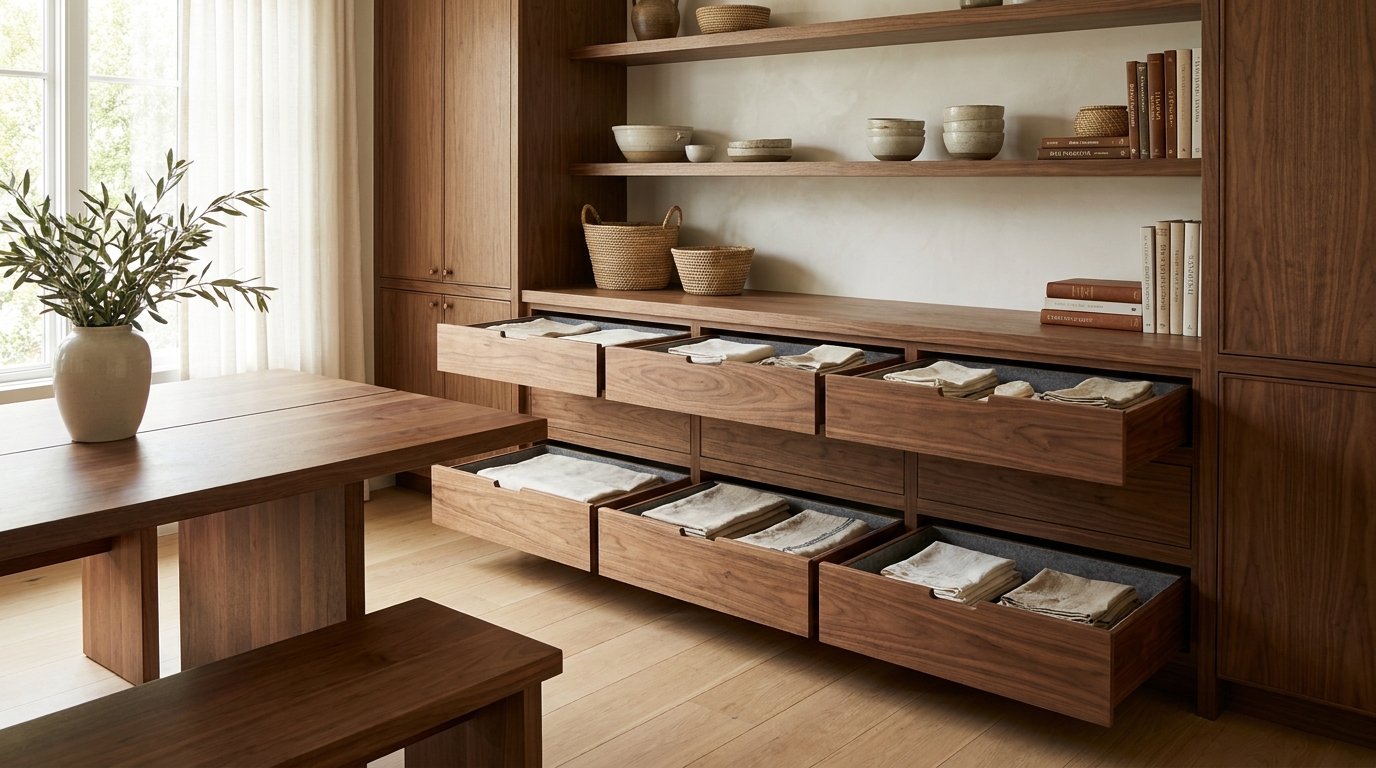
Dining linen storage works best as its own shallow drawer bank: tablecloths lie as flat as the drawer allows, runners stay in a separate drawer, and napkins sit in a tray instead of on the cloths. Museum guidance favors that flat layout for household linens because the whole piece is supported and nothing heavy is piled on top.[4] Every cloth goes in clean and fully dry, in a closed drawer away from dishwashing steam, so folds do not become breaks and moisture does not feed mildew.[1][2]
1. Why dining linens need a drawer bank of their own
A sideboard that holds plates, china, and every cloth you own will favor the plates. Tablecloths get jammed in a corner, and the twice-a-year cloth sits under chargers.
Weight and food residue are the two problems. The National Park Service Museum Handbook (2002) says flat storage should support a textile and that stacking should be avoided as much as possible.[4] Dirt particles can cut fibers, and soiled storage raises the chance of insects, mold, and mildew.[5] Starch left on cotton or linen can yellow the cloth and attract insects and rodents.[5]
Keep the linens out of the dish cabinet. Everyday plates and the good china stay on their own shelves. These drawers do not share that space, so crumbs, wet rims, and ceramic weight never land on a fold. The U.S. Environmental Protection Agency says to use exhaust fans or an open window whenever you cook, run the dishwasher, or wash dishes, because those tasks add moisture.[1] University of Georgia Extension says to store textiles away from the kitchen and the laundry.[5] A closed drawer on the dining side of the room follows that advice.
2. What flat storage asks of a dining drawer
A banquet cloth will not lie in one open piece inside a furniture drawer. Flat, at home, means as few folds as the drawer allows, with nothing piled on the cloth.
Shallow is the point. The Park Service handbook (2002) says shallow drawers, like flat files, suit flat textile storage, and that some household linens should be stored flat rather than hung.[4] A drawer deep enough for one folded cloth, not a tall stack, is the right scale.
Give each group its own drawer.
- Best tablecloths go on top, alone or with one companion, so nothing heavier sits on embroidery or lace.[4][5]
- Everyday tablecloths get the next drawer, still a light layer.
- Runners get their own drawer, rolled or laid out.
- Napkins live in a tray in the last drawer.
Lift the cloth. Do not drag it. For a delicate piece, the Park Service handbook (2002) describes a board covered with washed muslin, so you lift the textile instead of pulling it across the drawer edge.[4]
3. Tablecloths stored with soft folds
Lay the cloth on a clean table, smooth it, and fold only as many times as you must.
Soften every crease you cannot avoid. The National Archives, in a 2016 guide, says to store antique textiles flat, with as few folds as possible, and to keep those folds from becoming hard creases. Acid-free tissue, or washed undyed cotton, can be tucked into each fold.[3][5] The Park Service handbook (2002) likes unbuffered archival tissue between sturdy textiles.[4] Skip colored paper and newsprint. University of Georgia Extension warns that newspaper and ordinary boxes become acidic, and that colored paper does not belong next to a textile.[5]
Move the fold line. Reposition folds several times a year. Textiles tend to split where the same crease and the same pressure sit for a long time.[5]
Do not put away a damp ironing job. Spread a warm cloth until it is dry through the folds. The EPA says that if wet or damp materials are dried within 24 to 48 hours after a leak or spill, mold will not grow in most cases.[1] Natural-fiber textiles absorb moisture quickly and dry out slowly, so a hem can feel fine while a folded center is still damp.[2]
Treat heirlooms differently from the Sunday cloth. The National Archives (2016) advises against casual washing or mending of textiles with antique or monetary value, or that are already weak, because colors can bleed and agitation can cause structural damage.[3] A cloth you still use should follow its care label. A fragile family cloth should be cleared of loose dust, fully dry, and left alone.
4. Runners, without a hard center crease
A runner folded in half, then in half again, memorizes a crease down the middle. That crease is what shows on the table.
Roll a long runner instead of packing it. The National Archives (2016) recommends rolling large flat textiles around the outside of a large-diameter acid-free tube, then covering the roll with muslin so dust and light stay off the cloth.[3] Use a tube long enough that the runner does not hang off the ends, cover it with washed muslin, and roll loosely.
Lay it flat when one loose fold is enough. The Park Service handbook (2002) calls flat storage ideal for most textiles because the whole object is supported.[4] Keep the runner out of the tablecloth drawer either way. A closed drawer also limits light, which the National Archives (2016) says fades color and weakens fibers, with sunlight and fluorescent light of particular concern.[3]
5. Napkins in a tray
Napkins either disappear into a jumble or become a dense brick on the good cloth. A shallow tray, or a divided insert that fills their drawer, stops both habits. You can take a set for dinner without unfolding a tablecloth, and the napkins are not a weight on the cloths.
If you must layer, order it. University of Georgia Extension says never to place a larger or heavier textile on a smaller or more fragile one, and to separate pieces with tissue or washed muslin.[5] The Park Service handbook (2002) makes the broader point: avoid stacking textiles as much as possible.[4]
Sort the tray the way you set the table.
- By size, so cocktail napkins do not hide under dinner napkins.
- By fiber, so a linen napkin that is still cool and damp does not sit against a dry cotton stack.
- By set, when a border or monogram always goes together.
The National Archives (2016) says to handle textiles with clean hands, and to stop if unfolding seems to be causing damage.[3]
6. Clean, dry, and out of the damp
Put linens away only when they are clean. Soil left on a textile abrades fibers and raises the chance of insects, mold, and mildew.[5] Soiling, organic residues, and stains also let mildew grow at a lower humidity than on a clean cloth.[2] Shake off crumbs, deal with fresh spots, and follow the care label before the cloth goes back.
Dry means dry in the folds. Cotton and linen take on water quickly and give it up slowly.[2] In stagnant air above 80 percent relative humidity, the Smithsonian Museum Conservation Institute (2023) says mold can be supported on cotton or linen.[2]
Do not seal linens in plastic. University of Georgia Extension says plastic blocks air movement, can cause mold and mildew, builds static that attracts dust, and does not stop light if it is clear.[5] A washed cotton pillowcase or muslin cover, inside a drawer you can still open, is the better wrap.
Watch the room, not only the drawer. EPA guidance, last updated on epa.gov in February 2026, says to keep indoor humidity below 60 percent when possible, ideally between 30 and 50 percent, using a small meter and air conditioning or a dehumidifier as needed.[1] For textiles, the Park Service handbook (2002) aims for 65 to 75 degrees Fahrenheit and relative humidity near 50 percent. Humidity under 35 percent can make textiles brittle, and high temperature with high humidity promotes biological activity.[4] Stay under 60 percent, and steer nearer 50 percent rather than the driest end of that EPA range.
Place the bank on a steady wall, not in a cedar chest. The Park Service handbook (2002) says never to store textiles in attics or basements, against exterior walls, near heating or cooling vents, or under water pipes.[4] The 2023 Smithsonian note agrees, because temperature swings change relative humidity and humidity spikes can damage cloth.[2] University of Georgia Extension also says acid from cedar is harmful to cotton, linen, and rayon, and that textiles should not sit on bare wood, newspaper, or ordinary boxes.[5] A finished drawer with a washed muslin liner keeps the cloth off that surface.
7. Light, pests, and a look inside a few times a year
Closed fronts are part of the care. The National Archives (2016) says to store textiles in the dark and to limit long-term display.[3]
Damp storage also invites pests. Textiles can attract rodents, moths, and insects, especially in damp conditions, so look for holes, staining, webbing, and dead insects.[3] Soil and leftover starch raise that same risk.[5]
Use the refold as the inspection. Several times a year, look and smell before you close the drawer. A musty odor comes from fungi or bacteria, and warm, dry airing helps it fade.[2] Take that cloth out, and do not set it on the clean pieces.
If growth is obvious, or the cloth is old and weak, ask a conservator before you scrub or wash it. The EPA notes that mold can be hard to remove from porous materials, and that an expensive or sentimental item is a reason to consult a specialist.[1] If you clean mold and leave the water problem in place, the mold will most likely come back.[1]
8. How our team plans the bank
We size the drawer bank around the linens you own. On the first visit we look at the largest cloth, how often you set the table, and whether the wall is a steady place for textiles. Homeowners in Charlotte, Ballantyne, Waxhaw, and Wesley Chapel, and in Fort Mill, Indian Land, and Rock Hill, often call when a sideboard has become a catch-all.
The layout stays simple on purpose.
- Start with the largest cloth, and make the drawer wide enough for only one or two loose folds.
- Keep the box shallow, one layer, not a storage cube.
- Fit the napkin tray into its own drawer, not on top of the cloths.
- Line with washed muslin, and keep unbuffered acid-free tissue for folds you cannot avoid.
- Leave plates and china out. These drawers are for fiber only.
You can read how a project moves from that visit to a finished install on our how it works page.
Practical takeaways
- Give tablecloths, runners, and napkins their own shallow drawers, away from dishes and china.
- Pad any fold with washed muslin or unbuffered acid-free tissue, and refold along a new line several times a year.
- Keep napkins in a tray so they do not press the cloths.
- Store linens only when clean and fully dry, never in sealed plastic, and not on an exterior wall or in a cedar chest.
- Keep indoor humidity under 60 percent, nearer 50 percent for the textiles, and keep the drawers dark.
How we can help
Have more questions or want to get in touch? Visit our contact page, call (704) 604-3870, or email design@theclosetrehab.com.
Citations
- U.S. Environmental Protection Agency, "A Brief Guide to Mold, Moisture, and Your Home" (2026-02-18)
- Smithsonian Museum Conservation Institute, "Mold and Mildew on Textiles" (2023-09)
- National Archives, "Preserving Textiles" (2016)
- National Park Service, "Museum Handbook, Part I, Appendix K: Curatorial Care of Textile Objects" (2002)
- University of Georgia Cooperative Extension, "Heirlooms" (n.d.)