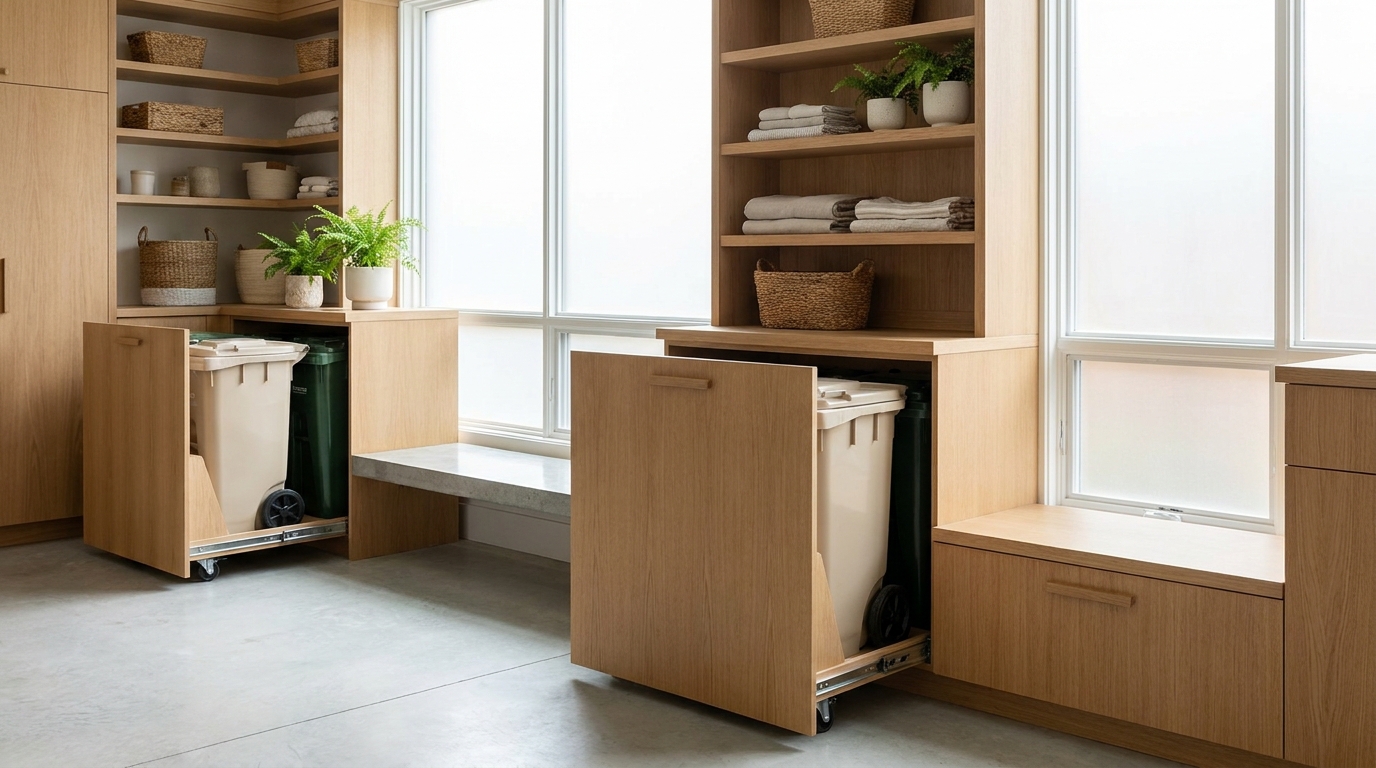
Entryway Storage Lockers for a Foyer With No Mudroom
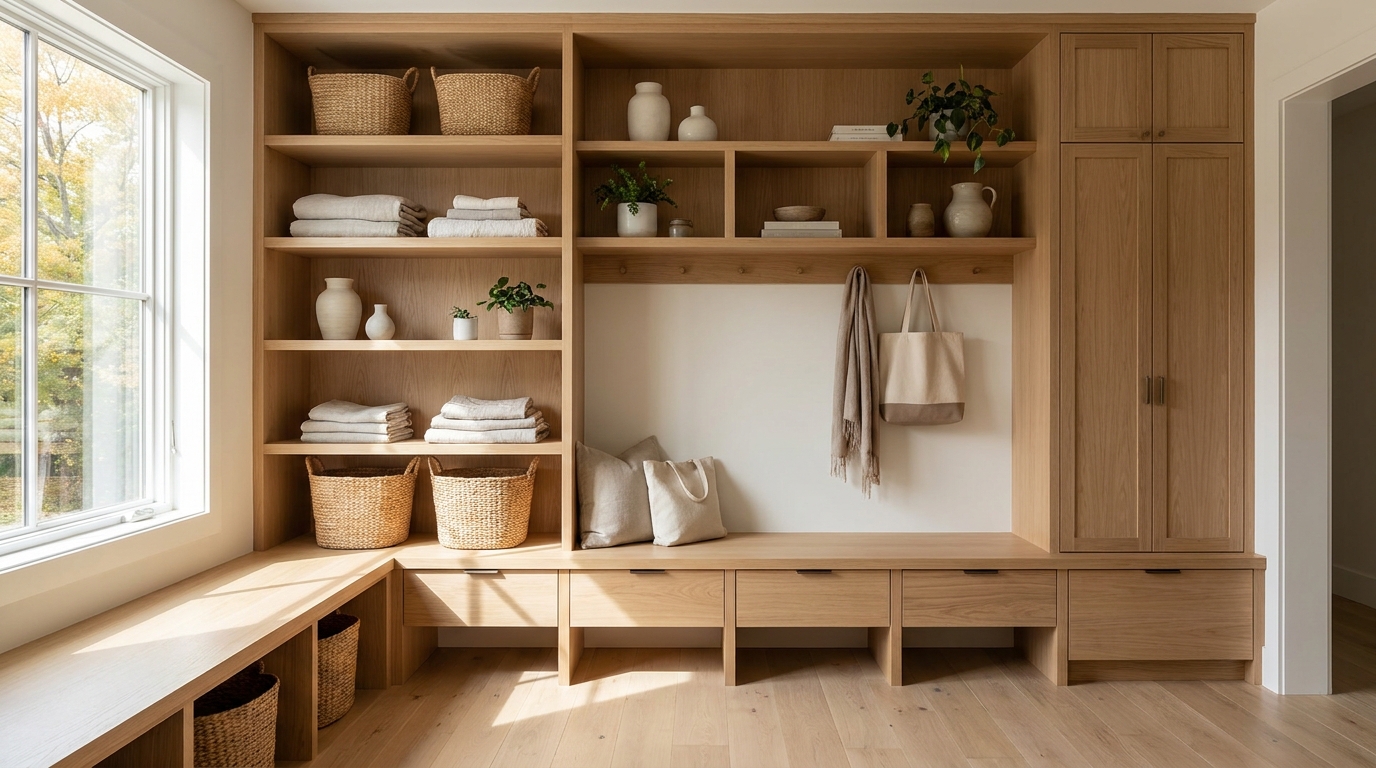
A lot of Charlotte, Fort Mill, and Ballantyne houses have a front hall and no mudroom. Entryway storage lockers (a shallow locker bank, a short row of hooks, and a boot tray) can still make a working drop zone in that hall. The lockers catch backpacks and dry coats. The hooks take the wet jacket. The tray holds wet soles. This is not a coat closet with a hanging rod behind a door, and it is not a full mudroom with one cubby per person plus a wet-gear room. It is a thin wall of storage that leaves the path open. Tall cases still need to be fastened so they cannot tip, and wet items still need to stay off dry packs. [5][3]
1. Build a foyer drop zone, not a closet and not a mudroom
The problem in many Waxhaw, Wesley Chapel, and Indian Land plans is simple. The front door opens into a hall that is also the route to the stairs and the kitchen. There is no side mudroom. Coats land on a chair. Boots sit on the rug. A hanging coat closet nearby does not fix that. A closet is a closed wardrobe: you open a door, find a hanger, and hope the wet sleeve is not dripping on the dry one behind it.
A locker bank on one wall is a different job. Each column is a named drop, not a shared hanging rod. A hook, a shelf, and a floor tray do the daily cycle. You put the bag down, hang the jacket, kick the boots onto the tray, and keep walking.
When a house actually has a mudroom, we plan cubbies, benches, and backpack zones on our mud room and drop zone page. That page is for a dedicated landing room. This post is for the foyer that never got that room.
What a foyer locker bank is:
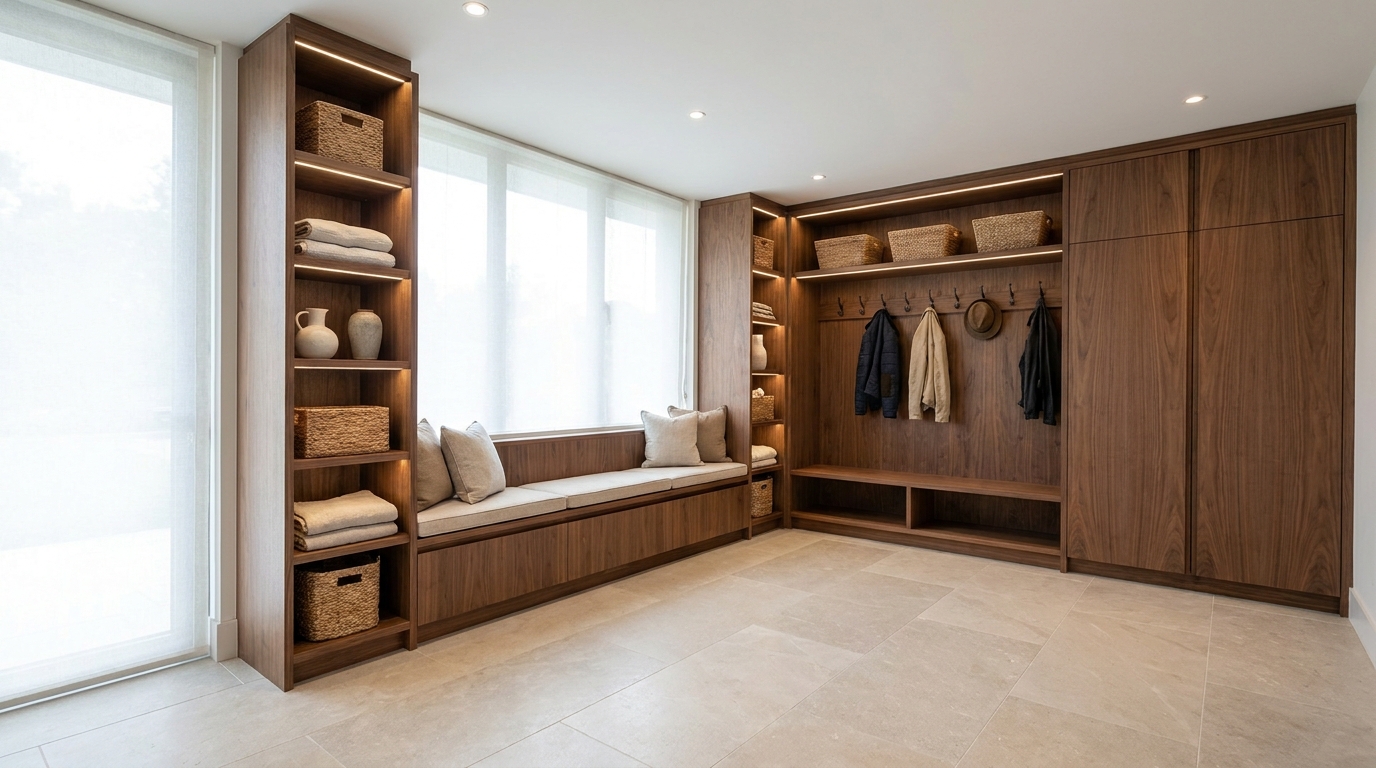
- A shallow run along one wall, usually 12 to 16 inches deep, so the hall still functions as a hall.
- Open faces or simple doors, not a single closet door that hides a jumble.
- Hooks in the adult band and the kid band, so a first grader can hang a raincoat without climbing.
- One boot tray or wipeable floor insert at the base, not a second laundry for wet gear.
- A slim shelf for keys, mail, and a charger, not a dresser full of off-season clothes.
It is not a full-depth cubby wall with a bench and a drying rack, and it is not a coat closet we relabeled. If the hall is the only path from the door, keep the lockers thin and the wet zone tiny. Save the one-cubby-per-person layout for a true mudroom.
2. Leave a clear path. Lockers are not a hallway code.
The front hall is often the route from the door to the rest of the dwelling. North Carolina's residential egress rule, as quoted in a 2023 Office of the State Fire Marshal interpretation of the 2018 NC Residential Code, requires a continuous and unobstructed path of vertical and horizontal egress travel from all portions of the dwelling to the required exterior egress door. [11] A locker bank that pinches that path, or locker doors that swing into it, works against that idea.
The International Residential Code hallway rule is a planning analog, not a locker code. A 2021 IRC means-of-egress training used by Montana building officials states that hallway width shall be not less than 3 feet. [12] We use that number as a floor for the remaining clear width in a foyer: after the locker depth, the door swings, and the boot tray, at least three feet of hall should still be open. If the existing hall is 48 inches wall to wall, a 16-inch locker leaves about 32 inches. That is too tight. We would rather specify a 12-inch-deep locker and a floor tray than steal the walk.
The Access Board's ADA Standards are another analog. They apply to public accommodations and other covered facilities, not to a typical private home. Section 403.5.1 still sets a useful picture: the clear width of walking surfaces shall be 36 inches minimum. [9] We treat 36 inches of remaining hall as the target so a stroller or a suitcase can still pass a Rock Hill foyer.
Check these measurements on the floor, not only on an elevation:
- Wall to opposite wall, then subtract locker depth and base trim.
- Door swing. A 12-inch locker door that opens into the hall can erase the last bit of clearance.
- Tray projection. A boot tray that sits proud of the lockers is a trip line.
- Console leftover. If a table stays on the opposite wall, measure the gap between the table and the locker face, not the wall.
Hooks need the same honesty. ADA section 307.2 (again a public-facility rule we use as a private-home guide) limits objects with leading edges between 27 and 80 inches above the floor to a 4-inch horizontal protrusion into a circulation path. [10] Long coat hooks that stick into the walk are a shoulder catch. We set hooks inside the locker opening, or we use short, closed-loop hooks that stay within the case.
If the hall cannot keep three feet after a locker run, the answer is a shorter run, a shallower case, or a hook rail with a tray and no tall towers. Do not force a mudroom into a four-foot foyer.
3. Keep wet gear off dry backpacks
The foyer is where rain, field mud, and gym sweat enter the house. CDC notes that mold in outdoor air can ride in on clothing, shoes, bags, and pets. [3] Once those items sit against a dry backpack or a stack of mail, the moisture has a new home.
EPA's long-standing mold guide, still current on the agency site, puts the control point on moisture, not on a special cleaner. Keep indoor humidity below 60 percent, ideally between 30 and 50 percent relative humidity. Dry wet or damp materials within 24 to 48 hours, or mold will often start. [1] CDC is a bit tighter for homes: keep humidity no higher than 50 percent all day. [3] A closed locker full of wet jackets is a small, still pocket of air. That is the opposite of those targets.
Smithsonian Museum Conservation Institute guidance, updated in September 2023, explains why fabric is the weak link. Natural-fiber textiles are hygroscopic. They take on water quickly and give it back slowly. Stagnant air above about 80 percent relative humidity will support mold on cotton or linen. Soiling helps mildew start at lower humidity. The first treatment is not a spray. It is to spread the wet textile on a clean, dry surface and let air move. [4]
That is why a foyer locker needs a wet column and a dry column, even in a two-person house:
- Wet side: rain jacket, umbrella, hat, and gloves on an open hook or an open-face locker so air can move.
- Dry side: backpack, lunch bag, library books, and a dry sweater on a shelf or in a closed cubby that never sees the dripping coat.
- Floor: boots and wet soles on the tray, never under the dry pack.
- Overnight rule: if a jacket is still wet at bedtime, it does not go into a closed locker. Hang it open in the hall or move it to a bath with an exhaust fan.
EPA's "ten things" list is blunt. There is no practical way to eliminate all indoor mold spores. The way to control growth is to control moisture. Molds can grow on virtually any substance if moisture is present, including wood, paper, and carpet. [2] A closed locker with a wet soccer kit is a food source plus a moisture source. Separate them. Design the wet hook to be open. Keep closed storage for things that arrive dry. Charlotte summers are humid, and a Ballantyne foyer will not dry a soaked parka overnight if that parka is zipped inside a tall box.
4. Use a boot tray as a small wet zone, not a wet room
A full mudroom can hide a drain and a drying rack. A foyer cannot. The boot tray is the entire wet floor.
EPA says that in areas with a perpetual moisture problem, you should not install carpeting (sinks, drinking fountains, and concrete floors with leaks or frequent condensation are the examples). [2] CDC makes a parallel home point: do not use carpet in places like bathrooms or basements that may have a lot of moisture, and remove soaked carpet that cannot be dried right away. [3] A plush runner under the boot pile is that mistake in a hall.
The Access Board requires floor surfaces on accessible routes to be stable, firm, and slip resistant. [10] That standard is for covered facilities. We still use it as a finish check for the two square feet in front of the lockers. Hard tile, luxury vinyl, or a wipeable tray insert beats a thick rug that holds Saturday's mud until Tuesday.
A working foyer wet zone is small and specific:
- A lip-edged tray wide enough for the household's wet-day boot count, not a cookie sheet that overflows.
- A hard floor under and around the tray, with the hall runner stopping short of the drop.
- A tray you can lift, dump, and wipe in one minute.
- No standing water left overnight. EPA's 24 to 48 hour drying window applies to wet materials and wet areas. [1] A tray of meltwater is a wet area.
The tray is not off-season boot storage, and it is not a catch-all for balls and leashes that never dry. If the family comes in from Fort Mill youth soccer twice a week, we often add a second, smaller tray or a pull-out bin that can go outside to dry. Backpacks stay on the shelf above the tray, not on it.
5. Fasten tall lockers. A foyer is a climb zone.
Kids hang on hooks. They climb a locker to reach a hat. A tall, narrow case in a hall is top-heavy the moment a door is open.
From January 2000 through April 2022, CPSC staff were aware of 234 fatalities from clothing storage unit tip-overs, including 199 child fatalities. For the 2006 through 2021 window, CPSC estimated 84,100 tip-over-related injuries involving clothing storage units treated in U.S. hospital emergency departments, about 5,300 a year. CPSC still tells households to anchor furniture, including dressers, securely to the wall. [5]
The federal STURDY rule (16 CFR part 1261, for units manufactured after September 1, 2023) covers free-standing clothing storage that is at least 27 inches high, at least 30 pounds, and at least 3.2 cubic feet of enclosed storage. Built-in units intended to be permanently attached to the building are outside that scope. [6] A locker bank we fasten to the studs is the built-in case. A tall, free-standing locker bought for the hall is not. Either way, we treat wall attachment as part of the design, not as an extra kit in a drawer.
CPSC's Anchor It! campaign, marking ten years in 2025, still tells households to store heavier items on lower shelves and to keep toys, remotes, and other climb bait off the tops of tall furniture. Campaign work contributed to a nearly 50 percent decline in tip-over-related injuries and deaths in the United States, and the agency still urges people to anchor bookcases and dressers. [7] The education page is the same: existing furniture can be anchored with inexpensive anti-tip brackets, new dressers ship with anti-tip devices that should be installed right away, and tempting objects should come off the top. [8]
For a foyer locker bank, that list is practical:
- Screw the case to wall studs, even when it is a built-in run.
- Put boots, balls, and dense bins on the lowest shelf or in the tray zone.
- Keep the crown of the locker empty. A basket of hats on top of a 72-inch tower is climb bait. [7][8]
- Use lower hooks for kids. The Access Board's ADA reach table (a public-facility guide, not a private-home mandate) even names coat hooks and lockers for children: ages 3 to 4, about 20 to 36 inches; ages 5 to 8, about 18 to 40 inches; ages 9 to 12, about 16 to 44 inches. Adult unobstructed reach is 15 to 48 inches. [10] We set the daily hook in that band so a child does not climb.
A 30-inch-high hook rail with no tall doors avoids most of the tip-over geometry. If the hall can take height, we still fasten every tall stile.
6. Stock lockers for a two-minute drop
The inventory should match a school-day or workday exit, not a wardrobe. If you cannot name what each opening holds before we draw it, the locker is too deep or too vague.
A practical kit for a four-person Charlotte household with no mudroom:
- One locker or hook column per person who leaves through that door, plus one guest hook.
- One backpack or work bag per dry shelf.
- One rain layer per wet hook.
- One pair of in-season shoes or boots on the tray, not five pairs stacked.
- A narrow shelf or cubby for keys, a badge, and outgoing mail.
- A small bin for hats and gloves that is easy to pull out and empty.
Put daily-use items in the 15-to-48-inch band so nobody needs a stool in the hall. [10] Seasonal coats, team uniforms, and bulk shopping bags do not belong here. Those go to a bedroom closet, a hall coat closet, or a garage cabinet.
Hardware that helps a shallow locker work: closed-loop hooks that hold a backpack strap, a shelf lip so mail does not slide onto wet boots, and doors only where you need to hide clutter. Open faces dry faster. [1][4] Two adults who work from home in Ballantyne may need only two hooks and a tray. Three school-age kids in Wesley Chapel need named columns and a tray that fits three pairs. The depth stays shallow either way. The count of openings is what scales.
Practical takeaways
- Use entryway storage lockers as a thin drop zone when the house has a foyer and no mudroom. Do not stretch them into a cubby room, and do not confuse them with a hanging coat closet.
- After the lockers are in, keep about 36 inches of clear hall. That figure is an IRC hallway analog and an ADA walking-surface analog, not a locker code. [12][9]
- Keep the path continuous and unobstructed toward the exterior door. [11]
- Split wet hooks from dry shelves. Wet jackets and boots do not share a closed box with backpacks. [3][4]
- Dry wet gear within 24 to 48 hours, and keep indoor humidity in the EPA 30 to 50 percent band (below 60 percent at the high end; CDC uses a 50 percent ceiling). [1][3]
- Put a wipeable boot tray on a hard floor. Do not park standing wet on a hall rug. [2]
- Anchor tall lockers to the wall. Store heavy items low. Keep climb bait off the top. [5][7][8]
- Set kid hooks in a reachable band so nobody climbs a 72-inch case. [10]
How we can help
Our team measures the actual hall, not a catalog page. We will tell you if a shallow locker bank, a hook rail, and a boot tray will fit. We design the wet side and the dry side as two jobs, fasten tall cases, and leave the walk open.
Have more questions or want to get in touch?
https://theclosetrehab.com/contact-us/
(704) 604-3870
design@theclosetrehab.com
Citations
- U.S. Environmental Protection Agency, "A Brief Guide to Mold, Moisture and Your Home." https://www.epa.gov/mold/brief-guide-mold-moisture-and-your-home
- U.S. Environmental Protection Agency, "What are ten things I need to know about mold?" https://www.epa.gov/mold/what-are-ten-things-i-need-know-about-mold
- Centers for Disease Control and Prevention, "Mold." https://www.cdc.gov/mold-health/about/
- Smithsonian Museum Conservation Institute, "Mold and Mildew on Textiles." https://mci.si.edu/mold-and-mildew-textiles
- U.S. Consumer Product Safety Commission, "CPSC Adopts Final Consumer Product Safety Standard to Prevent Tip-overs of Dressers and Other Clothing Storage Units" (April 19, 2023). https://www.cpsc.gov/Newsroom/News-Releases/2023/CPSC-Adopts-Final-Consumer-Product-Safety-Standard-to-Prevent-Tip-overs-of-Dressers-and-Other-Clothing-Storage-Units
- U.S. Consumer Product Safety Commission, "Clothing Storage Units" (business guidance). https://www.cpsc.gov/Business--Manufacturing/Business-Education/Business-Guidance/Clothing-Storage-Units
- U.S. Consumer Product Safety Commission, "CPSC Anchor It! Campaign Marks 10 Years: Fewer Furniture Tip-Overs Lead to Safer American Households" (July 29, 2025). https://www.cpsc.gov/Newsroom/News-Releases/2025/CPSC-AnchorIt-Campaign-Marks-10-Years-Fewer-Furniture-Tip-Overs-Lead-to-Safer-American-Households
- U.S. Consumer Product Safety Commission, "AnchorIt.gov." https://www.cpsc.gov/Safety-Education/Safety-Education-Centers/AnchorItgov
- U.S. Access Board, ADA Accessibility Standards, Chapter 4: Accessible Routes (section 403.5.1). https://www.access-board.gov/ada/chapter/ch04/
- U.S. Access Board, ADA Accessibility Standards, Chapter 3: Building Blocks (sections 302, 307, 308). https://www.access-board.gov/ada/chapter/ch03/
- North Carolina Office of the State Fire Marshal, 2018 NC Residential Code Section R311 Means of Egress (formal interpretation, October 18, 2023). https://www.ncosfm.gov/formal-interpretations/2023-1018-lavalle-2018-ncrc-r311-means-egress/open
- Montana Department of Labor and Industry, Building and Safety Division, "IRC Means of Egress 2021 IRC" (training quoting IRC R311.6). https://bsd.dli.mt.gov/_docs/Training/IRC-Means-of-Egress-2021-IRC.pdf