family room game storage for boards and puzzles
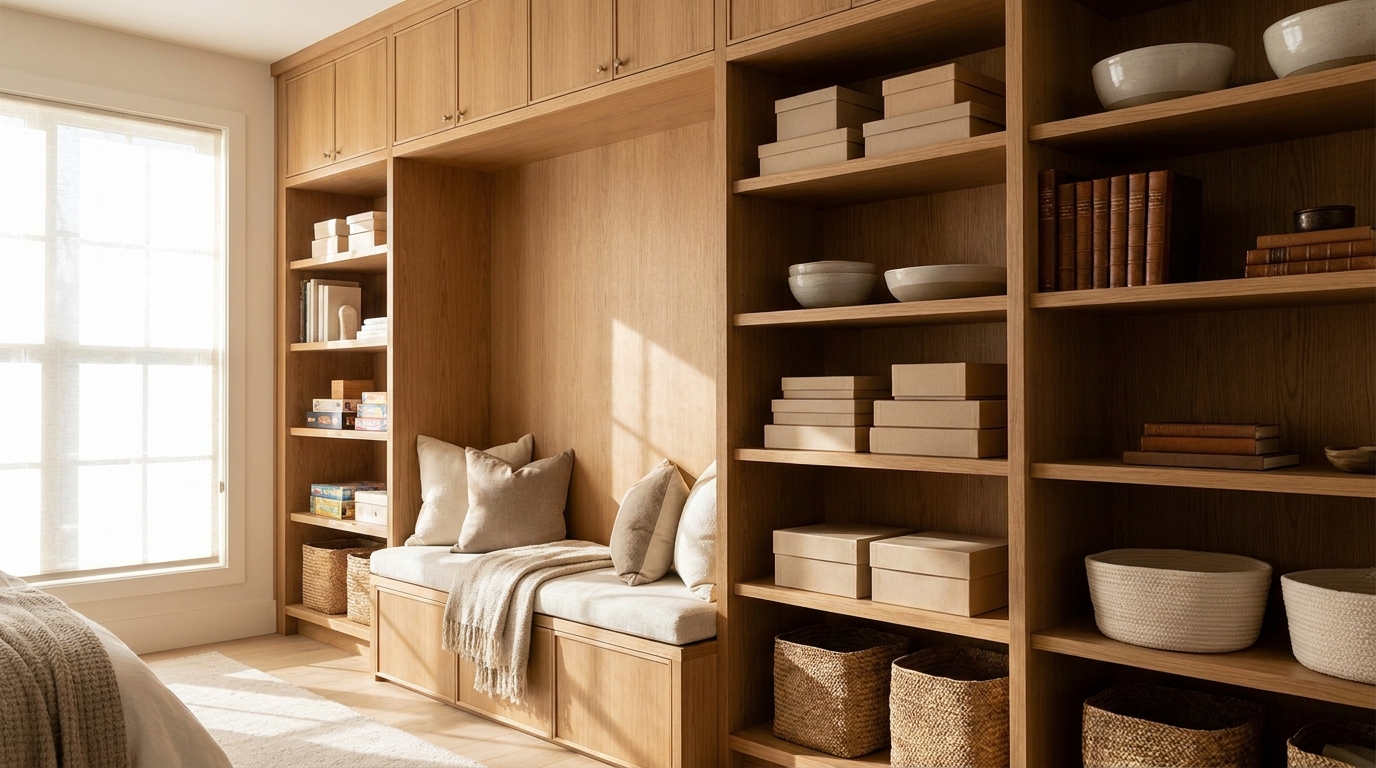
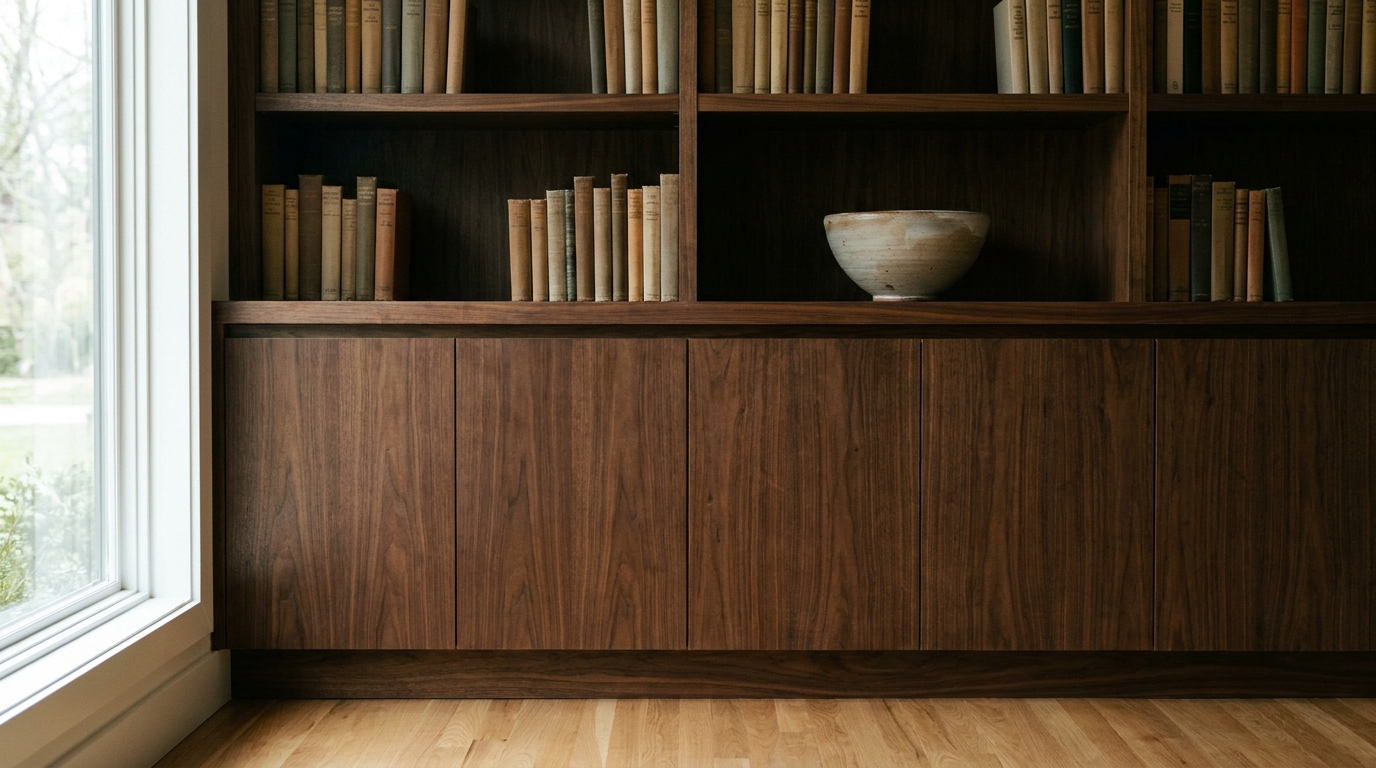
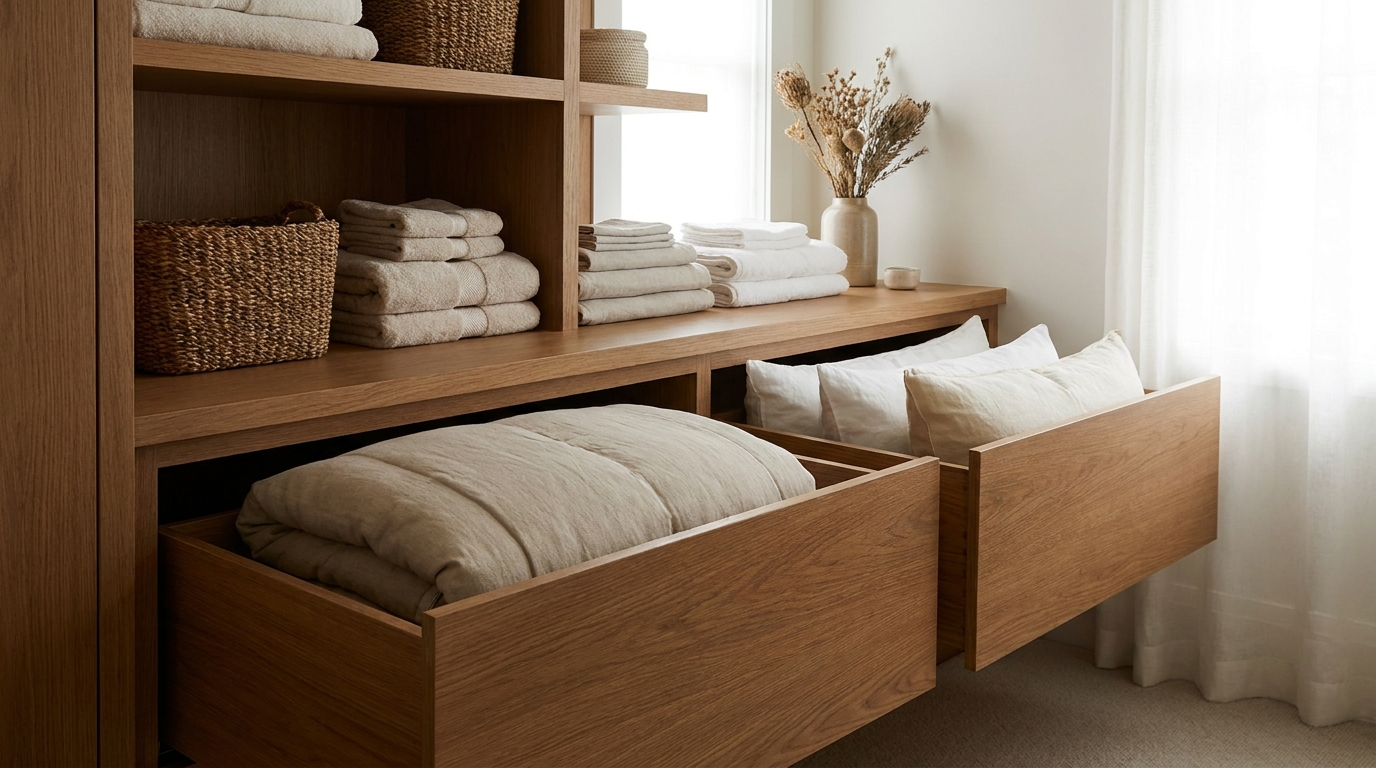
Family room game storage works when closed base cabinets are sized to the board-game boxes and puzzle stacks you own, and the coffee table stays clear for play. The Library of Congress describes good paper storage as room temperature or cooler, about 35 to 50 percent relative humidity, with little light, distance from heat vents, and flat support inside a protective enclosure [1]. Doors on a low cabinet do that job, and they give the walking path back to the room.
1. Give the coffee table back to the game
The problem is not that your family likes games. The problem is that the coffee table became the shelf. Lids, rule sheets, and a half-sorted puzzle turn the one flat surface into a landing spot, and the rest ends up on the floor.
The Centers for Disease Control and Prevention, in a 2017 home fall-prevention checklist for older adults, says to keep papers, shoes, books, and other objects off the floor and off the stairs [2]. The same checklist says to move furniture so the walking path is clear, and to coil or tape cords and wires next to the wall so you cannot trip over them [2].
Treat the table as a playing surface, not as storage. The board can sit there while you play. When the game is over, the box goes back before the table holds mail. That habit keeps family room game storage off the rug.
Keep the path around the table open. If someone sidesteps a puzzle box to reach a chair, the cabinet is not finished. The 2017 CDC checklist is written for older adults, and it still fits this room: keep things you use often on lower shelves, about waist high, and never use a chair as a step stool [2].
This is storage for boxed boards and puzzles, not open toy bins.
2. Use closed base cabinets, not a screen wall
Open shelves look friendly until dust and sun do their work. Cornell University's library preservation tutorial says small dust particles are especially damaging, and that all direct light harms paper to some degree, including sunlight and fluorescent ultraviolet [3]. The Library of Congress says paper needs minimal light, and no direct or intense light [1].
A 2018 National Park Service article on paper archives says light weakens and discolors cellulose fibers, that ultraviolet is the harshest part, and that paper should not sit in direct sun [4].
Put the collection behind doors. Cornell's housing guidance says enclosures protect contents from particulates and can form a more stable space around what is inside, and that opaque board blocks light [5]. A door that closes, a level shelf, and a spot out of glare are enough.
Keep this project off the television wall. These are base cabinets for boards and puzzles, not a screen stand, a cable hide, or towers beside a fireplace. Give the games their own run, along a side wall, under a window seat, or at the end of the sofa.
Doors are not a dehumidifier. Cornell's mold page says mold usually comes from high humidity and poor air circulation, and that it can grow on moist paper [6]. A closed cabinet helps in a comfortable room and can hold damp in a wet one.
If a drink soaks a box, take it out. The U.S. Environmental Protection Agency tells homeowners to dry wet materials within 24 to 48 hours, because in most cases mold will not grow if drying is that fast [7].
3. Size the shelves to the boxes you own
Even shelf spacing still misses a height that matches the box. Too tall, and a short box rattles and leans. Too short, and the lid will not close, or the box goes in sideways and gets crushed.
Start with the boxes, not a catalog opening. Group the games and puzzles for this room by height. Separate weekly sets from seasonal ones. Our team uses that stack to set adjustable shelves or a few fixed openings.
Bring the boxes to the in-home visit on our how it works page so the layout follows real lids.
Store each box one deep, lid on, label out. You can pull the game you want without unstacking heavier ones, and the lid carries no extra weight. The National Archives, in family-paper guidance last reviewed on September 18, 2025, says a container should be big enough for contents to lie flat or stand upright without bending, and the right size so items do not shift [8].
If a row stands upright, leave no empty gap for it to slump, and do not overstuff the opening [5][8].
Put weight where the lift is short. Heavy boxes go low. Weeknight games go at about waist height, matching the CDC checklist advice to keep often-used things on lower shelves and never to use a chair as a step stool [2]. Box heights are not universal, so adjustable pins, or a few heights taken from your boxes, are the heart of family room game storage.
4. Keep puzzle boxes supported, one deep
Puzzles fail in storage in two quiet ways. Pieces slide to one corner of a loose box. Lids cave when a tall stack sits on them.
The Library of Congress lists flat storage among the basic protections for paper [1]. Large sheets such as maps and posters are stored flat whenever possible, according to Cornell's housing guidance [5]. One box deep, lid on, label out, is the practical version of that support for a puzzle box.
Fill any upright row. A half-empty opening lets boxes lean. That is the slump Cornell and the National Archives both warn against for paper in boxes [5][8]. A spacer board cut to the opening keeps the row upright.
Do not tip a tall puzzle box onto a corner to jam it into a short shelf.
Keep cardboard off the room floor. The National Archives tells families to store papers on a shelf so they do not get wet [8]. A 2018 technical report from the Fibre Box Association and the Packaging Machinery Manufacturers Institute covers corrugated packaging, not home shelves. It says humidity above 70 percent, or direct water, can warp corrugated board, soften or dissolve the adhesive, and in extreme cases pull the layers apart [10].
The same 2018 report says corrugated packaging should not sit directly on the floor, and should stay indoors, away from moisture [10]. A raised cabinet bottom keeps boxes off the rug, where spills pool. Its advice to store unused cartons flat is about empty sheets in a plant, not filled puzzle boxes, so we do not copy it.
5. Hold the room in a steady, moderate climate
Cardboard takes water from the air and gives it back. The 2018 National Park Service article on paper archives calls this hygroscopic: materials expand and contract as humidity swings, and that movement speeds damage such as wrinkling [4]. Written for historic archives, not game night, it targets about 60 to 70 degrees Fahrenheit and about 30 to 50 percent relative humidity [4].
Cornell's climate page, for paper library collections, puts ideal relative humidity between 30 and 50 percent, preferably closer to 30 percent, with temperature near 68 to 70 degrees Fahrenheit [3]. A fast temperature drop can also condense vapor onto absorbent paper [3].
The EPA home mold guide, updated on February 18, 2026, says to keep indoor humidity below 60 percent if possible, ideally 30 to 50 percent, and notes a small meter commonly costs about $10 to $50 [7]. The EPA mold course, updated on December 1, 2025, says mold can grow on paper and wood when moisture and oxygen are present, and lists 60 percent relative humidity as a common moisture problem [9]. The National Archives page reviewed in 2025 says to keep family papers and photographs below 75 degrees Fahrenheit and below 65 percent relative humidity to limit mold and insects, and to avoid air below 15 percent, which can make materials brittle [8].
Aim for a steady reading in the 30s to 50s, in the room you live in. The Library of Congress says to avoid attics, basements, and leak-prone spots, and to keep paper away from radiators and vents [1]. The National Archives says not to use a damp basement, a garage, or a hot attic for family papers [8].
Cornell warns that a basement with low temperature, high humidity, little light, and very little air movement favors mold on paper [6]. Doors help with dust and sun. They are a poor choice for a damp corner you never check.
Watch the wall behind the cabinet. The EPA mold course notes that mold is frequently found in cold corners behind furniture, where condensation forms [9]. Leave a gap or choose an interior wall, and do not blow a supply vent into the shelf.
Cornell describes a closed case on a wet carpet: the open carpet dried, but trapped damp drove humidity inside the case high enough for mold [5]. Pull soaked boxes out and dry the area.
Our team designs this storage for homes in Charlotte, Fort Mill, Rock Hill, Ballantyne, Waxhaw, Wesley Chapel, and Indian Land.
6. Leave a path and a short reset
Measure the walk from the door to the seats, and from the seats to the cabinet, with the coffee table in its real spot. If a door hits a chair, change the door or the chair. Do not leave boxes on the floor to solve it. If a lamp cord crosses that walk, coil or tape it next to the wall so nobody trips on it, which is what the CDC checklist says to do with lamp cords [2].
Give the game in play one landing spot off the floor. One shelf clear of the walk can hold tonight's box. Everything else stays behind doors. The reset is lid on, label out, and the box back in its opening.
Turn the printed box end out, or label the shelf rail. People return what they can name. Skip a second set of bins unless a broken box needs a same-size replacement.
If this room is part of a larger plan, our spaces page shows the other rooms we design. This cabinet should still look like furniture and leave the coffee table clear.
Practical takeaways
- Clear the table on purpose. Play on it, then put the box away so objects stay off the floor [2].
- Close the doors. Dust and direct light are hard on paper and printed cardboard [1][3][4].
- Measure your boxes. One box deep, lid on, label out, with the shelf set to each group.
- Stop the slump. Upright rows should be full, or spaced, so boxes do not lean [5][8].
- Keep cardboard off the floor and out of damp rooms. Dry a soaked box within a day or two [7][8][10].
- Hold humidity steady. Use a meter and aim for the 30 to 50 percent band [3][7].
- Skip the screen wall. This cabinet is for boards and puzzles, not cables, a TV stand, or fireplace flanks.
How we can help
Have more questions or want to get in touch? Visit our contact page, call (704) 604-3870, or email design@theclosetrehab.com. We will look at the wall, the boxes, and the path around the coffee table, then design closed cabinets that fit this room.
Citations
- Library of Congress, Ask a Librarian, "How do I preserve my letters or paper documents?" (2026-08-04)
- Centers for Disease Control and Prevention, "Check for Safety: A Home Fall Prevention Checklist for Older Adults" (2017)
- Cornell University Library, "Climate Control" (2026-05-29)
- National Park Service, "\"Mission Critical\" Tips for Archives Managment" (2018-06-22)
- Cornell University Library, "Stabilization and Housing" (2026-05-29)
- Cornell University Library, "Mold" (2026-05-29)
- U.S. Environmental Protection Agency, "A Brief Guide to Mold, Moisture and Your Home" (2026-02-18)
- National Archives, "How to Preserve Family Archives (papers and photographs)" (2025-09-18)
- U.S. Environmental Protection Agency, "Mold Course Chapter 2: Why and Where Mold Grows" (2025-12-01)
- Fibre Box Association and Packaging Machinery Manufacturers Institute, "Storage and Handling of Corrugated Board Packaging, 2018 Edition" (2018)