Fireplace Built-In Cabinets for a Clear Mantel
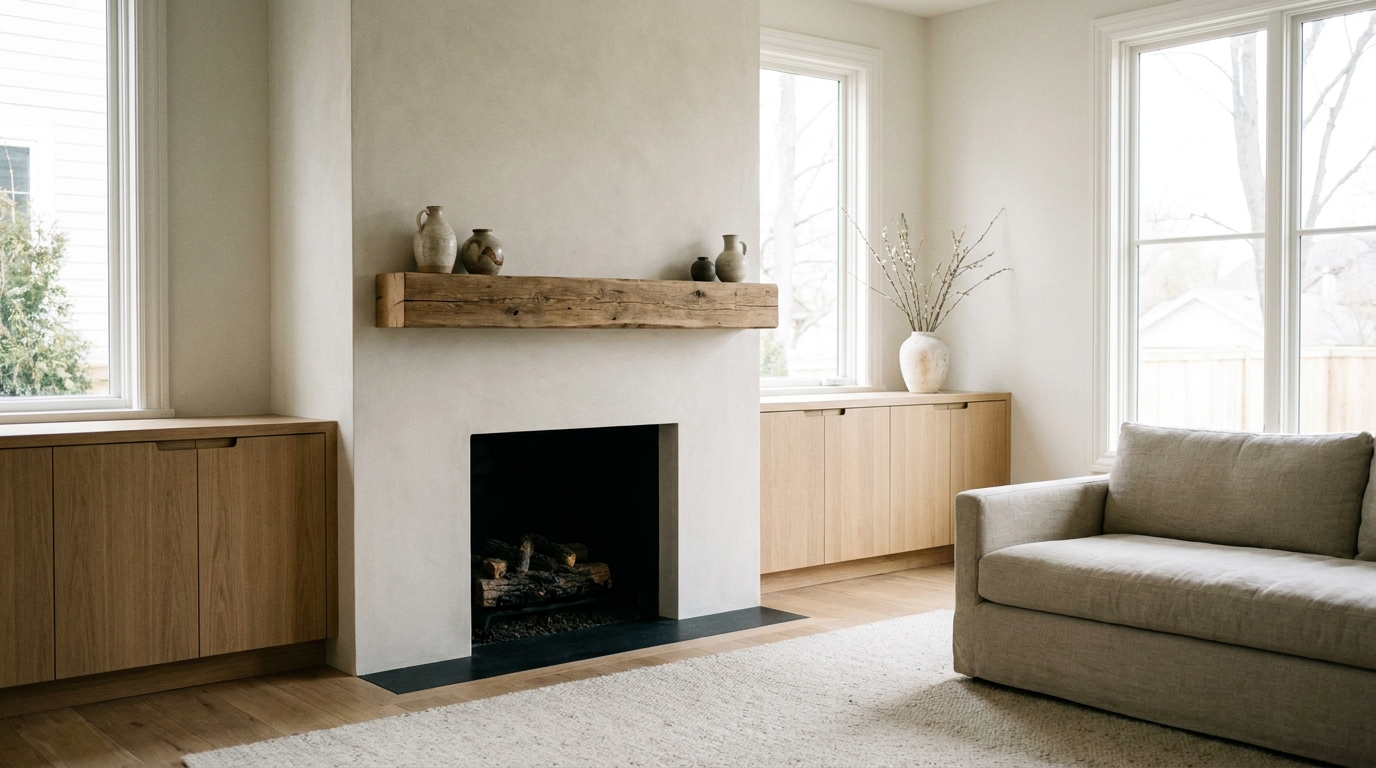
A clear mantel is mostly a storage decision. Blankets, board games, and the bins of seasonal decor do not need to live on the shelf above the fire. A pair of fireplace built-in cabinets, one on each side of the hearth, can hold those things behind doors and leave the mantel for almost nothing.
The cabinets are not a television wall, and they are not a place to dry towels against a live fire. They are closed storage set beside the fireplace, sized to the room, and kept outside the clearance that applies to the fireplace you actually have. Masonry, factory-built, and gas units do not share one set of inches. We only use a number after we know which appliance is in the wall.
1. Why the mantel fills up
The mantel is the one horizontal surface everyone can see, so it collects what has nowhere else to go. Frames walk up after a holiday. Candles stay because they looked right in December. A throw lands on one end because the basket on the hearth is already full. Within a season the shelf is busy, and the opening is framed by clutter.
Open baskets have the same problem lower down. They are easy to fill and just as easy to see. Sparks and radiant heat meet that basket before they meet a closed door. The look of the room and the safety of the room start in the same habit: storage left in the open because the room never got a real place for it. Closed doors keep those things in the living room without asking the mantel to work as a closet.
2. Closed cabinets beside the hearth
Flanking cabinets are a matched pair, or a near pair, built on the wall at either side of the fireplace. The mantel stays a mantel. It might hold one object, or nothing. Storage sits at cabinet height, behind doors, where blankets and games actually fit.
This is not a media console. If the room has a television, that is a different project. The job here is hearth storage: throws, puzzles, off-season garland in a bin, and the games that used to live on the shelf. We are not hiding a soundbar, and we are not turning the fireplace into a niche in an entertainment wall.
A door slows a spark on its way to a blanket. It does not cancel a clearance. Wood and the goods inside can still burn. The next section separates the construction rule from the housekeeping rule.
In Charlotte, and in nearby towns such as Waxhaw and Ballantyne, we see both older masonry fireplaces and newer factory-built or gas units. The cabinet can look the same from across the room. The setback behind it cannot.
3. Clearance follows the fireplace you have
A flanking cabinet is combustible once it is fastened to the wall. Where it can sit depends on the fireplace. The masonry inch figures below are from the 2024 North Carolina Residential Code for one- and two-family dwellings. [1] Homes in Fort Mill, Rock Hill, and Indian Land are in South Carolina, outside that North Carolina code. We do not paste a North Carolina inch onto a fireplace there. We name the appliance, read the code in force, and read the listing when there is one.
Masonry fireplaces. In that North Carolina code, combustible material needs a clearance of not less than 2 inches from the front faces and sides of a masonry fireplace and not less than 4 inches from the back faces. The airspace is not filled, except to provide fireblocking. [1] A cabinet back or a row of stored baskets does not belong in that gap.
Exposed combustible mantels or trim may sit on the masonry front only when they are not placed within 6 inches of the opening. Combustible material within 12 inches of the opening may not project more than 1/8 inch for each 1 inch of distance from the opening. [1] A deep cabinet is a large projection, not thin trim, so it does not belong in that near zone. Exposed combustible trim may abut the sidewalls and hearth extension only when it stays not less than 12 inches from the inside surface of the nearest firebox lining. [1]
The hearth extension is separate. For a masonry fireplace, the code calls for not less than 16 inches in front of the opening and not less than 8 inches beyond each side. When the opening is 6 square feet or larger, those minimums become 20 inches in front and 12 inches beyond each side. [1] The cabinet should not cover that noncombustible surface or stand in for it.
These numbers are not a universal cabinet setback, and they are not the rule for factory-built or gas units. A masonry fireplace listed for contact with combustibles is an exception only when it is installed to the manufacturer's instructions. [1]
Factory-built fireplaces. That chapter requires factory-built fireplaces to be listed and labeled, installed to the conditions of the listing, and tested to UL 127. [1] Their hearth extensions follow the listing, not the masonry table. [1] "Zero-clearance" is a nickname, not a measurement we will guess. A mantel distance printed for one tested model does not transfer to another unit.
An unvented gas log heater does not go into a factory-built fireplace unless that system was specifically tested, listed, and labeled for the use under UL 127. [1]
Gas fireplaces and heaters. In the fuel-gas chapter of the same North Carolina code, vented gas fireplaces are tested to ANSI Z21.50 and installed to the manufacturer's instructions. Vented gas fireplace heaters are installed to the manufacturer's instructions and tested to ANSI Z21.88. [2] Clearances for heat-producing equipment and appliances are the clearances in the listing and the instructions. They include door swing, drawer pull, overhead projections or shelving, and window swing. Door stops, limits, and closers are not allowed to create the required clearance. [2] We draw the open door and the pull outside that clearance before we build the box.
Housekeeping distance is a different rule. The U.S. Fire Administration says to keep anything that can burn at least 3 feet from heat sources including fireplaces and wood stoves, and to have heating equipment and chimneys cleaned and inspected each year by a professional. [3] A closed door does not make a blanket noncombustible. We still keep everyday burnable goods out of that 3-foot zone, even when a masonry framing clearance is a smaller number. [3] That housekeeping distance does not replace a factory-built or gas listing. The masonry framing clearance does not replace it either.
Ashes do not go in the cabinet. A U.S. Fire Administration fireplace note says to put ashes in a metal container with a lid, outside, at least 10 feet from the home, and to keep a glass or metal screen in front of the fireplace. [4]
In a U.S. Fire Administration review of residential building heating fires from 2017 to 2019, the heat source was too close to combustibles in 27% of the nonconfined fires. [5] That is not a share of all fireplace fires. It is still a reason not to leave a basket of throws on the hearth.
For scale, 2024 national estimates from the U.S. Fire Administration put residential building heating fires at 27,200 fires, 145 deaths, 475 injuries, and $445,900,000 in dollar loss. [6] Those totals are heating fires in residential buildings, not fireplace fires alone.
Wood-burning storage limits. EPA says to keep flammable items such as curtains, furniture, newspapers, and books away from a wood-burning appliance, to season wood for at least six months, and to store it outdoors, off the ground, with only the top covered. [7] Keep the appliance doors closed except when loading or stoking, because carbon monoxide can be released into the home. [7] Ashes go into a covered metal container stored outdoors on a nonflammable surface. [7] EPA also says to confirm proper clearances between the appliance, the vent, and combustible materials. Fire officials recommend a professional inspection of the appliance, chimney, and vent each year, because a faulty install may stay invisible until there is a home fire. [8] No source above gives one cabinet setback for every fireplace. Use the sentence that matches the appliance.
4. What belongs behind the doors
Once the cabinet is outside the clearance that applies, the inside can stay simple. Most households need three kinds of space next to a living-room fire.
- Folded throws on a shelf tall enough that you do not cram them.
- Games, puzzles, and cards on adjustable shelves.
- Seasonal decor in labeled bins, including candles that should not sit on the mantel while a fire is burning.
A shallow drawer holds matches and coasters. A pull-out helps when blankets are deep in the box. We size those parts to the inventory you list.
What stays out matters as much as what goes in.
- No firewood. Seasoned wood belongs outdoors, off the ground, with only the top covered. [7]
- No ash bucket. Ashes go in a lidded metal container outside, at least 10 feet from the home. [4]
- No newspapers or a loose stack of books used as kindling. EPA says to keep those away from a wood-burning appliance. [7]
- No aerosols, solvents, or anything labeled keep-away-from-heat. A door is not a fire rating.
- No wet towels or mittens pressed against the surround.
A few books belong only where the listing and the 3-foot guidance both allow combustible material. [3] Solid doors are the better default beside a working hearth. They hide the off-season bin and give a spark one more barrier before a blanket.
5. Fitting the pair to the wall
Symmetry is a starting picture, not a rule. One side of a fireplace often meets a window, a doorway, or a short return. Two identical wide boxes make one door hit trim. We would rather build a wider cabinet on the open side and a narrower one on the tight side, in the same finish and door style, so the pair still reads as one idea.
Height works the same way. Cabinets that stop near the mantel, or just below a window, leave the mantel as the only shelf. Taller cabinets can work on a clear wall if the tops do not become a second clutter ledge and the projection limits near a masonry opening are still met. [1]
Depth is about the walk in front of the hearth. A box deep enough for a folded throw and a game is usually enough. A deeper box steals floor, and its open door can cross the path to the fire. On a gas unit, that swing is part of the clearance check. [2]
A few conditions show up on almost every visit.
- Floor registers near the hearth stay open. The cabinet is not a cover for them.
- The screen still swings, and any panel you must reach for normal service stays reachable.
- Baseboard and hearth tile meet the cabinet with a planned scribe, so the box does not rock on a raised hearth.
- An outlet inside a cabinet gets a proper box and a plan. A power strip buried behind blankets is not a feature.
On a raised hearth in Wesley Chapel, or where brick projects past the drywall in Waxhaw, those conditions decide the toe-kick before finish samples do.
6. Doors, finishes, and everyday use
Solid doors do the quiet work. Slab fronts suit a newer room. A shaker door sits with the trim in a lot of Charlotte-area houses. Either one can make the pair feel built in, rather than like two bookcases pushed against the brick. Glass is only for a shelf you will keep edited, and only where combustible contents are allowed. It is a poor face for a bin of holiday decor.
Soft-close hinges are a courtesy where people walk past with drinks. They are not a door stop used to satisfy a gas-appliance clearance, which the fuel-gas text does not allow. [2] Pulls should not project into the zone the listing cares about.
Finish is how the pair joins the house. We bring samples on the free in-home visit so a white, a maple, or a deeper wood tone can be judged against the mantel and the light in that room. The path from the first conversation to a measured layout is on our how it works page. Other rooms we design are on our spaces page. A hearth pair uses that same custom approach. It is still its own layout, because of the fire.
Day to day, open a door, take the throw, and close the door. When the season changes, swap the bins. Once a year, have the chimney and heating equipment cleaned and inspected by a professional. The U.S. Fire Administration recommends that, and fire officials cited by EPA recommend the same yearly look at a wood-burning appliance, chimney, and vent. [3] [8] The cabinet does not replace that visit.
Practical takeaways
- Use fireplace built-in cabinets for blankets, games, and seasonal decor, and leave the mantel mostly clear. This is not a TV wall, a wood box, or an ash cabinet.
- Masonry inches in the 2024 North Carolina Residential Code are not the factory-built listing and not the gas listing. Confirm the code in force outside North Carolina. [1] [2]
- On masonry, keep the airspace, respect the projection limit near the opening, and do not cover the hearth extension. [1]
- On a factory-built unit, follow the listing and UL 127. On vented gas fireplaces and gas fireplace heaters, follow the manufacturer's instructions. [1] [2]
- Count the open door, the pull, and any shelf in a gas clearance. A door stop does not create that clearance. [2]
- Keep anything that can burn at least 3 feet from a fireplace or wood stove. [3] Store firewood outdoors. Put ashes in a lidded metal container outside, at least 10 feet from the home, and keep a screen up. [4] [7]
- Have the chimney and heating equipment inspected each year by a professional. [3] [8]
How we can help
Our team designs the pair around the fireplace you have and the things you want off the mantel. We measure the opening, note whether the unit is masonry, factory-built, or gas, and check the listing or manual before the cabinets are drawn. Interior shelves and drawers follow the blankets, games, and bins you actually own. Finish samples come to the house during a free in-home design consultation.
Have more questions or want to get in touch? You can reach us at https://theclosetrehab.com/contact-us/ , call (704) 604-3870 , or email design@theclosetrehab.com .
Citations
- North Carolina Residential Code, "Chapter 10 Chimneys and Fireplaces: North Carolina Residential Code for One- and Two-Family Dwellings 2024" (2024)
- North Carolina Residential Code, "Chapter 24 Fuel Gas: North Carolina Residential Code for One- and Two-Family Dwellings 2024" (2024)
- U.S. Fire Administration, "Heating Fire Safety" (2023)
- U.S. Fire Administration, "Heating Fire Safety" (2021)
- U.S. Fire Administration, "Heating Fires in Residential Buildings (2017-2019)" (2021)
- U.S. Fire Administration, "Residential Building Heating Fire Trends (2015-2024)" (2024)
- U.S. Environmental Protection Agency, "Best Wood-Burning Practices" (2025)
- U.S. Environmental Protection Agency, "Wood-Burning Installation and Maintenance" (2025)