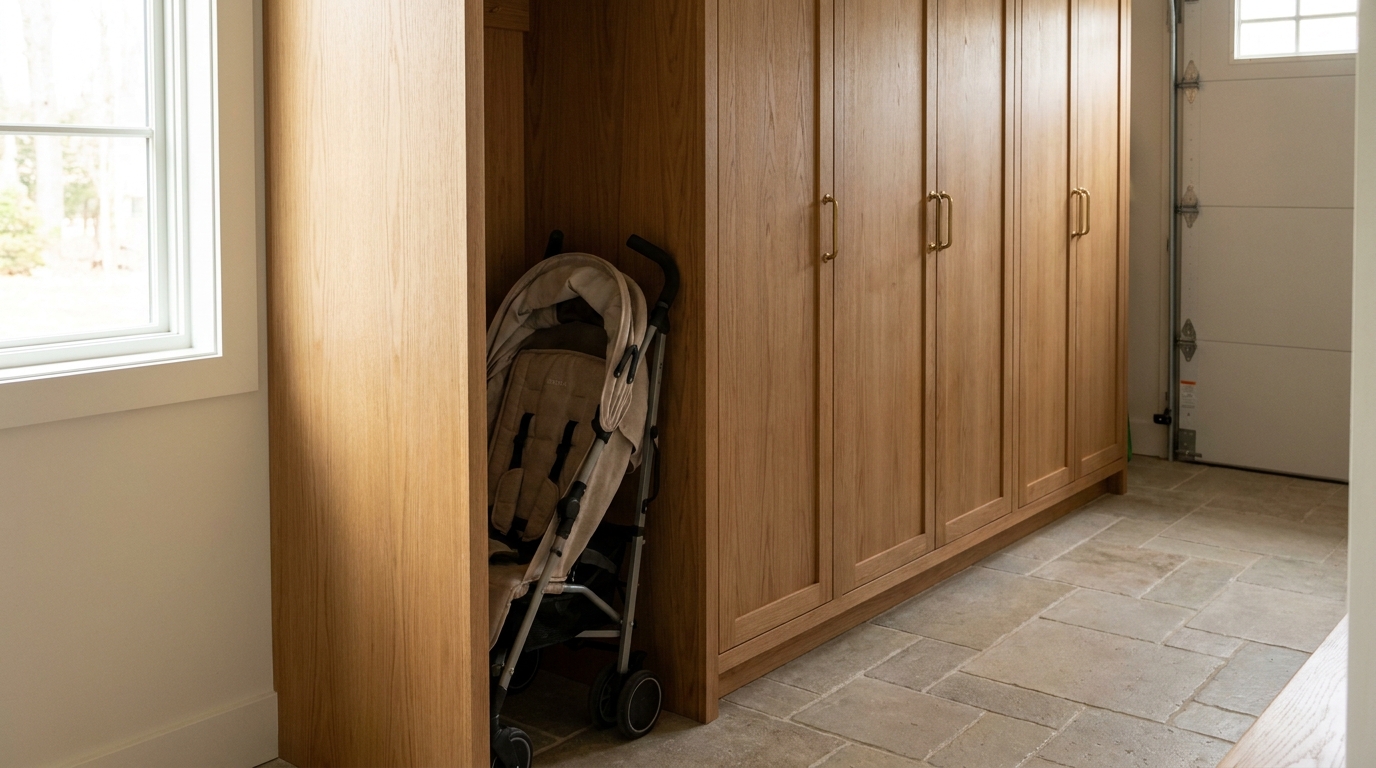
Garage Cabinet Clearance for Charger and Driver Door
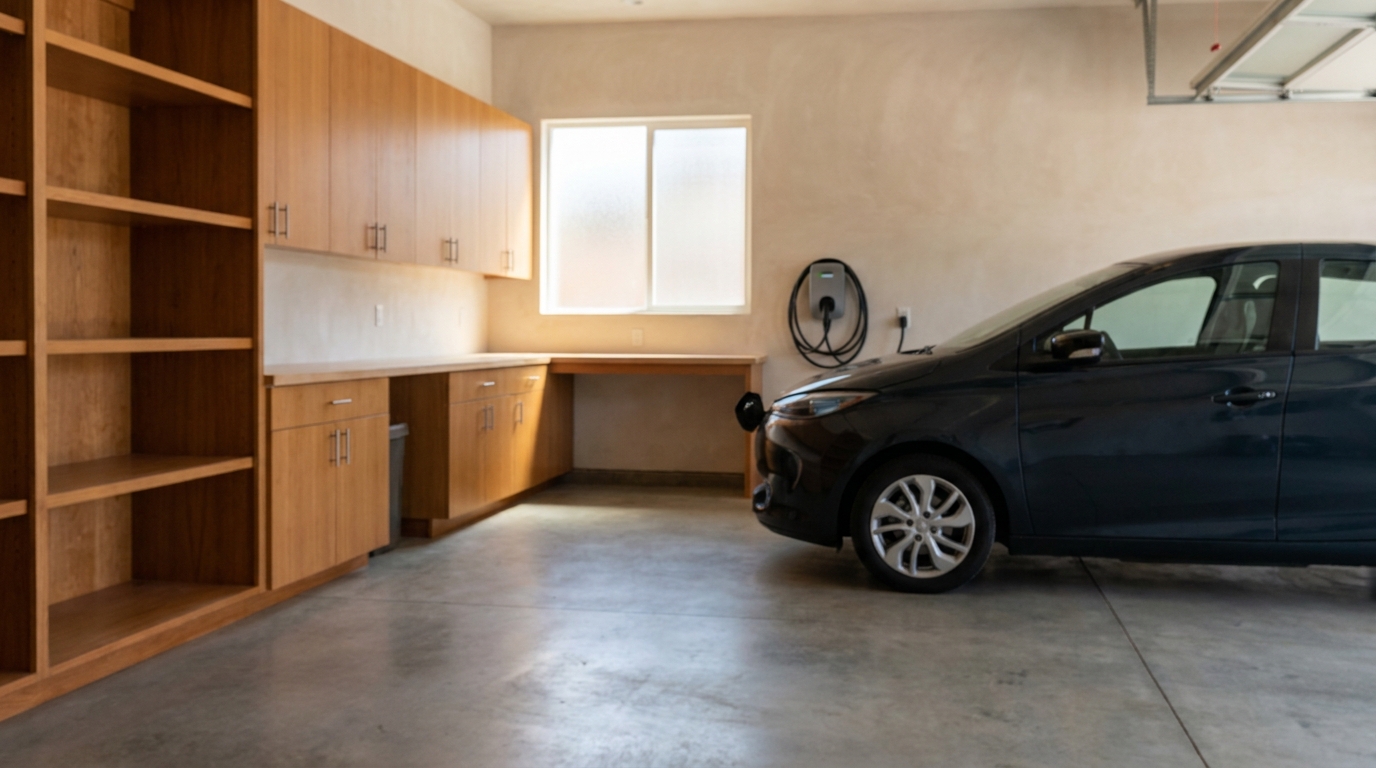
Garage cabinet clearance is the gap you leave so a wall of storage does not trap the driver or the charge cable. Most drivers of electric vehicles charge overnight at home, and that equipment is frequently installed in a garage [1]. The cabinet run works only when the cable can still reach the port, the driver door can still open, and the cars can still park in the bay. We mark those three things on the floor before we draw a single box.
1. Park the cars and mark the doors
The problem. An empty garage looks wider than it is. A cabinet line drawn to the edge of that empty floor meets the driver door on the first night, or it meets the small door that covers the charge port.
Our practice, not a guessed inch count. We do not use a stock clearance number for cabinets beside a charger. Charge ports sit on different corners from one model to the next, and driver doors do not all swing the same way. The cars the household owns are the measuring tools.
What we mark on the floor:
- The driver door, fully open. Pull the car into the stall you use on a normal night. Open the driver door all the way, and tape the arc. The cabinet end, the handle, and any cabinet door stay outside that arc.
- The charge-port door. Open that door too. Some fold into the same zone as the driver door. Some sit on the front fender, the rear quarter, or the nose. The cabinet run stays outside that smaller arc so a person can connect the cable without leaning across a shelf.
- The bumper line. Roll the car in until it sits where someone will leave it on a tired evening. Mark the bumper. Cabinet faces and any shelf at bumper height stay behind that line so the car can still roll in.
- The second stall. Repeat the marks for the other daily driver, even if only one car charges today. A run that clears the electric vehicle and blocks the other driver is not finished.
- The door into the house. The United States Fire Administration lists a 20-minute fire-rated door that is self-closing and self-latching from the garage into the house among the garage fire-safety items to install [5]. Our boxes do not stop that door from swinging shut.
Why the car still needs to fit inside. FuelEconomy.gov says to park the car in a warmer place, such as a garage, to raise the starting temperature of the engine and the cabin [6]. The same page says that if you drive a plug-in hybrid or an electric vehicle, preheating the cabin while the car is plugged into the charger can extend range [6]. A cabinet plan that pushes the vehicle onto the driveway gives up both of those habits.
2. Count the cabinet doors, not only the car doors
The problem. The floor arc can look clear while a cabinet door still hits the driver door in mid-swing. A drawer on the end bay does the same thing when someone pulls it out.
Hinges and drawers follow the same marks. We swing every cabinet door that faces the driver-door arc or the charge-port arc. If a door travels into the arc, we hinge it the other way or end the run one box sooner. An end drawer that pulls into the standing space becomes a door, or that bay is not the end bay.
Look at the top of the door. The top corner of an open driver door can catch an upper cabinet that cleared the floor mark. Uppers that sit fully above that edge can stay, and uppers that intersect it move along the wall or come off the drawing. The end panel facing the car stays smooth, with the handle on the face that opens away from the driver.
3. Keep the charge cable on a short path
The problem. A wall unit on the back wall and a charge port on the far fender put the cable across the walk between the cars.
Protect the unit, and do not make a trip. The Alternative Fuels Data Center says a wall unit should be protected from contact by the vehicle and positioned to avoid tripping hazards [2]. Our practice is to leave a clear wall patch on the same side as the charge port, outside the door arcs and behind the bumper line, and we do not mount the charger. The cord then runs along the car instead of across the aisle.
A tough cord is still a bad floor plan. The same page says charging cords are built to withstand heavy use, even being driven over, and that power does not flow unless the vehicle is plugged in and charging [2]. We still keep the cord off the tire path and off the walking path. A cord that can survive a tire is not a cord that should live under one.
Level 1 already depends on a nearby outlet. The Alternative Fuels Data Center says many EV owners are able to meet their daily driving range requirements by charging overnight with Level 1 equipment, with no additional cost or installation, provided that a power outlet on a dedicated branch circuit is available near the parking spot [1]. Your vehicle comes with a Level 1 cordset for a standard 120-volt household outlet, for example in the garage or on the driveway [2]. If that outlet is already near the stall, new cabinets should not cover it or force the car forward until the cord falls short.
How close outlets already are, from a 2020 survey. A 2020 Residential Energy Consumption Survey, reported by the Department of Energy in September 2023, found that 67% of housing units in the United States had vehicle parking within 20 feet of an electrical outlet, a distance the Department of Energy said is within the reach of many EV charging cords [4]. That figure is not a cabinet rule. Measure the cord you have, and do not let new boxes turn a short reach into a long one.
Why the car sits there for hours. The Alternative Fuels Data Center describes Level 1 as about 5 miles of range per hour of charging, assuming 1.9 kilowatts [3]. The page gives an example: 8 hours of charging at 120 volts can replenish about 40 miles of electric range for a mid-size EV [3]. It describes Level 2 as about 25 miles of range per hour, and it notes that a Level 2 unit can range from 2.9 to 19.2 kilowatts [3].
The same page says most homes have 240-volt service available, and that EV owners commonly install Level 2 at home because it can charge a typical EV battery overnight [3]. Most EV owners do the majority of their charging at home, so the stall has to work as a real parking place for those hours [3].
4. Give the cord a place to hang
The problem. A cable that charges all night has to live somewhere in the morning. On the floor, it blocks the walk and the driver door. Inside a closed cabinet, the driver has to open a door into the same swing they just stepped through.
A hook the driver can reach. We plan a holster or a sturdy hook on an open end panel, or on the wall beside the future wall unit. The driver can reach it while standing in the stall, with the driver door already open, without opening a cabinet into that arc.
If the car charges outside. A January 2024 Department of Energy article says that if you charge outside at home, hang up the charger connector according to the manufacturer's recommendations when it is not in use [7]. The article says charging connectors are designed to be waterproof, but heavy snow or sleet can still freeze them [7]. We use the same kind of hang point indoors so the cord is not left in the walk.
Do not build the layout around an extension cord. The United States Fire Administration says to plug only one charging appliance into an outlet, and not to use an extension cord when charging an appliance [5]. We do not draw a cabinet plan that only works if an extension cord stretches across the bay. The vehicle's own cord, or the cord on the wall unit, has to reach the port from the patch we left open.
5. Keep fuels and paint out of the cabinets beside the charger
The problem. A new cabinet run is a magnet for the gas can, the paint, and the rags that used to sit on the floor. That is the wrong neighbor for charging equipment, and it is the wrong neighbor for a water heater or other appliance on that wall.
What belongs on those shelves. The United States Fire Administration says garage fires tend to spread farther and cause more injuries and dollar loss than fires that start in all other areas of the home [5]. It says to store oil, gasoline, paints, propane, and varnishes in a shed away from the home, and to keep items that can burn on shelves away from appliances [5]. Cabinets beside a charger are for gear that is not a flammable liquid, such as the charging manual.
Leave the appliance face clear. If a water heater or another appliance sits on the same wall, keep items that can burn off the shelves near it [5]. We stop the cabinet run short of that appliance instead of boxing it in.
6. Leave the wiring to a qualified electrician
The problem. Homeowners sometimes ask a cabinet crew to hide a cord inside a box and call that a charger installation. That is not our trade, and our team does not touch the wiring.
Who does that work. The Alternative Fuels Data Center says installation of charging equipment usually requires a licensed electrical contractor [2]. Electricians can tell a homeowner whether the home has adequate electrical capacity for vehicle charging, and a qualified electrician can add circuits when the home does not have enough capacity for Level 2 equipment [1].
Permits and the code stay with that contractor. Appropriate permits may be required from the local building and permitting authorities for the charging equipment installation [1]. The Alternative Fuels Data Center says EV charging infrastructure is considered a continuous load by the National Electrical Code, and that the electrical contractor should understand and use the appropriate National Electrical Code for the installation [1].
What we leave open. We do not open walls, choose breaker sizes, or mount the charger. We leave a clear wall patch, a cord path, and cabinet boxes that stop short of the driver door and the charge-port door.
What the household buys. Purchasing safety-certified equipment is recommended, such as products with the ENERGY STAR label, which are tested by a nationally recognized testing laboratory, along with having a certified electrical contractor [1]. If possible, consult the vehicle manufacturer's guidance on the charging equipment before buying a unit or hiring the electrical work [1].
Indoor gear and outdoor gear are not the same. Residential charging equipment is frequently installed in garages [1]. Outdoor installation and use are also safe in the rain, and outdoor installations require outdoor-rated equipment [1]. A driveway cord still has to reach without crossing a walk the family uses.
7. What we check on a design visit
The visit is a parking test. We ask you to pull the daily drivers in, open the driver doors, and open the charge-port door. We tape the arcs and the bumper lines, then we talk about what these cabinets should hold. On design visits around Charlotte, NC, that parking test comes first, whether the bay is a tight two-car garage or a wider one in Waxhaw.
Leave room for a later wall unit. We stop the boxes short of the marked port zone and finish the end panel so the run looks complete. The open wall stays large enough for a wall unit and a hang point. A qualified electrician is the person who says whether the home has adequate electrical capacity for vehicle charging [1].
You can see how our team approaches garage storage on projects that include closed cabinets. This question stays narrower. The cars have to park, the driver has to get out, and the charge cable has to reach.
What we bring back to the drawing:
- Door arcs and the bumper line, taken from your cars, not from a catalog width.
- The existing outlet, if Level 1 is the plan, and whether a cabinet would cover it [1].
- The wall patch for a future wall unit, clear of the bumper and the open doors [2].
- The hang point, reachable with the driver door open, and any cabinet door that would swing into that arc.
- Items that do not go in these cabinets, including oil, gasoline, paints, propane, and varnishes [5].
- The electrical panel, if it shares the wall. We do not cover the panel door. Whether the home has adequate electrical capacity for vehicle charging is a question for an electrician [1].
Practical takeaways
- Open the driver door and the charge-port door on the cars you own, mark both arcs, and keep the cabinet run outside them.
- Mark the bumper where you really park, so the cabinets do not steal the stall.
- Leave a wall patch near the port and behind the bumper so the cable does not cross the walk. A wall unit should be protected from contact by the vehicle and positioned to avoid tripping hazards [2].
- Keep a power outlet on a dedicated branch circuit near the parking spot, instead of covering it with a cabinet [1]. Do not plan the bay around an extension cord used while charging an appliance [5].
- Hang the cable where the driver can reach it. If you charge outdoors, hang the connector the way the manufacturer recommends [7].
- Keep oil, gasoline, paints, propane, and varnishes out of these cabinets, and keep items that can burn off shelves near appliances [5].
- Installation of charging equipment usually requires a licensed electrical contractor [2]. Our work is the cabinet run around the space that installation needs.
How we can help
Our team designs custom garage cabinets for households that still need to park and plug in. We measure the door swing and the charge-cable path first, then we draw a run that leaves both of them clear.
Have more questions or want to get in touch? You can reach us through our contact page, by phone at (704) 604-3870, or by email at design@theclosetrehab.com.
Citations
- Alternative Fuels Data Center, U.S. Department of Energy, "Charging Electric Vehicles at Home" (accessed 2026-10-12)
- Alternative Fuels Data Center, U.S. Department of Energy, "Electric Vehicles for Consumers" (accessed 2026-10-12)
- Alternative Fuels Data Center, U.S. Department of Energy, "Electric Vehicle Charging Stations" (accessed 2026-10-12)
- U.S. Department of Energy, "FOTW #1308, September 18, 2023: Sixty-Seven Percent of all Housing Units in the United States Have Vehicle Parking Within 20 Feet of an Electrical Outlet" (2023-09-18)
- U.S. Fire Administration, "Basement and Garage Fire Safety" (page last modified 2026-09-03)
- FuelEconomy.gov, "Fuel Economy in Cold Weather" (accessed 2026-10-12)
- U.S. Department of Energy, "Winterizing Your Electric Vehicle" (2024-01-30)