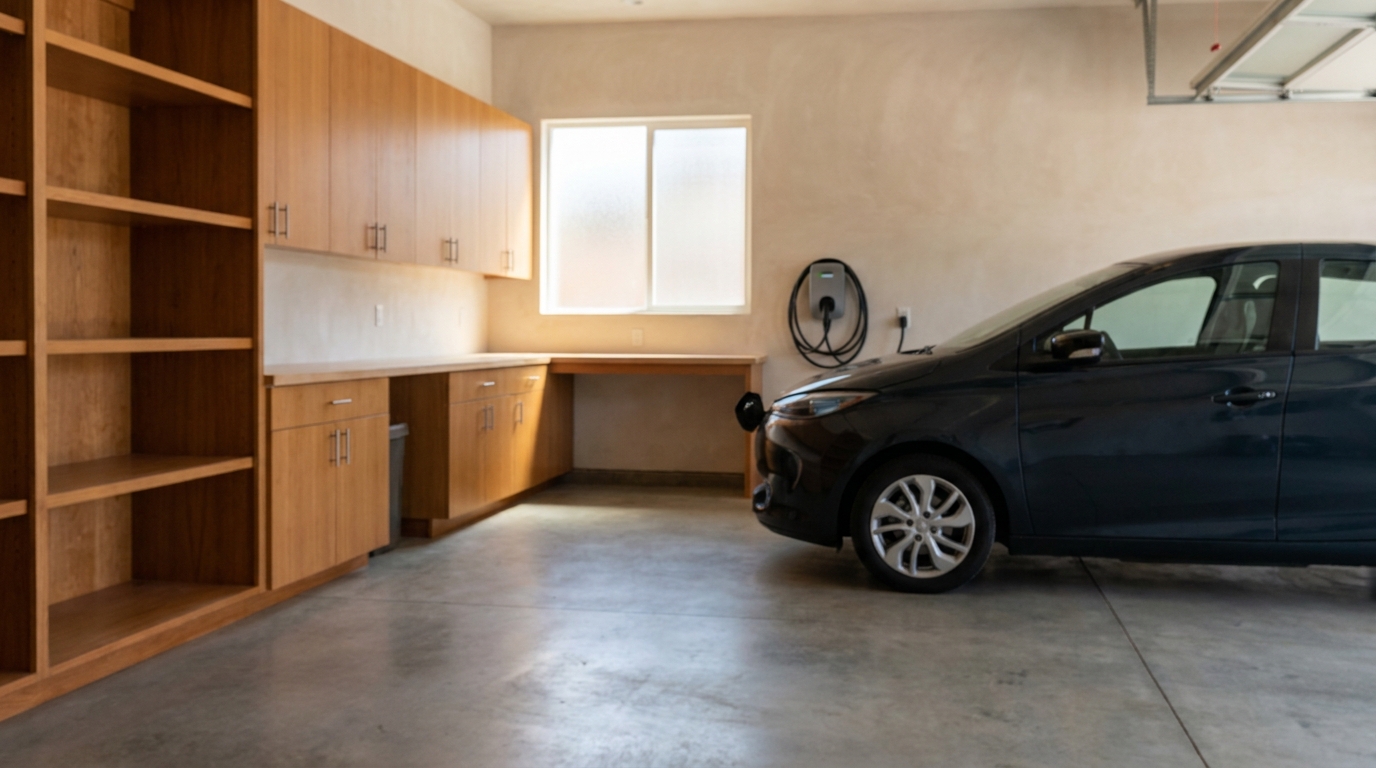
garage organization: wall slots and a taped mower bay
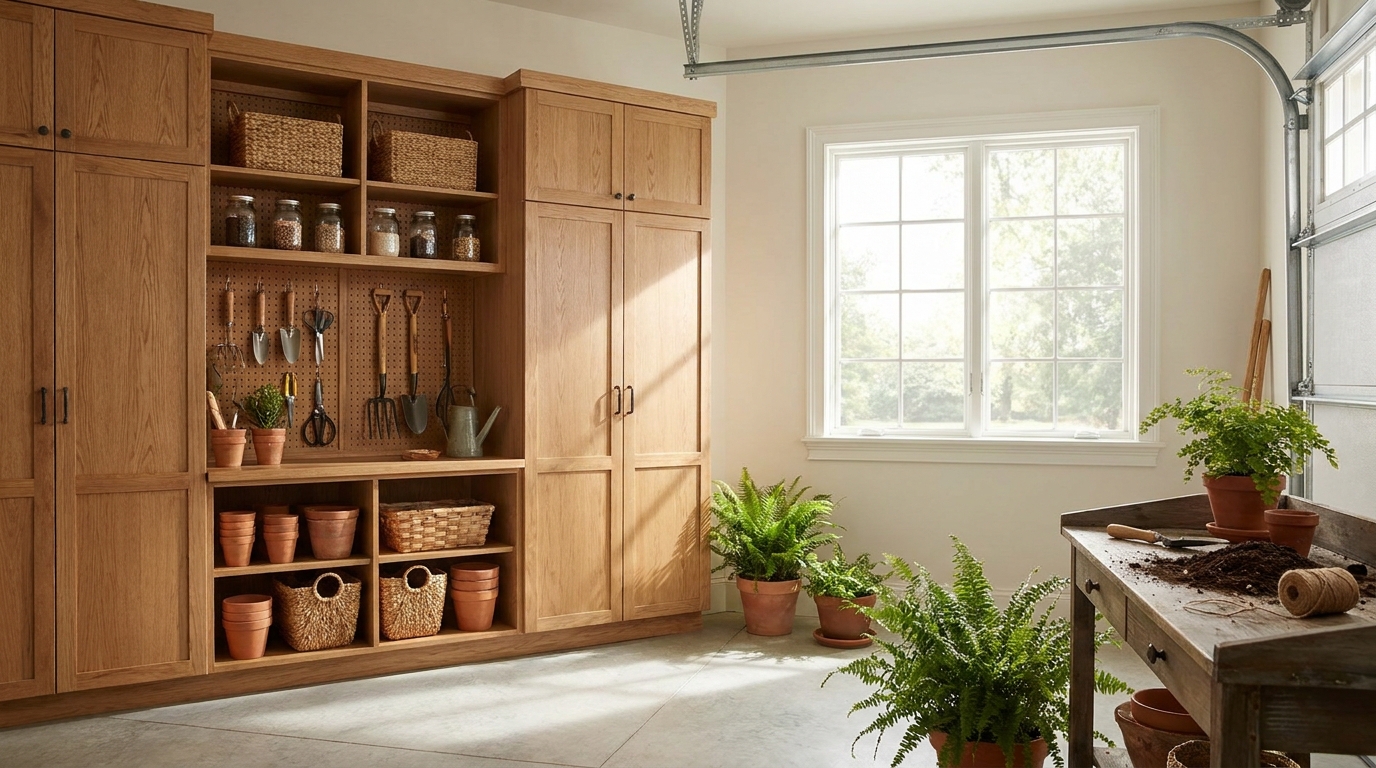
A two-car garage can hold the rakes, the shovels, and a push mower and still park both vehicles, if the long handles live on the wall and the mower has a marked footprint that stays out of the door swings. That is garage organization you can test with painter's tape before anyone builds a rack: tape the machine, tape the cars, and keep the walk from the house door to the overhead door clear. N.C. Cooperative Extension notes that hanging tools so they are not in contact with the ground may also help prevent rust, which is why those long handles belong in vertical slots instead of a damp pile on the slab [1]. We plan that wall and that floor patch together so the yard gear has a home and the parking bays stay parking bays.
1. Give every long handle its own vertical slot
The problem is the lean. During the growing season, garden tools are often an afterthought, left leaning where the work ended or tossed where they happen to fit [2]. In a Charlotte or Fort Mill garage, that lean becomes a fan of handles across a bumper. One bump and the stack hits the floor, and the metal sits in whatever moisture the slab is holding.
A slot beats a corner. The 2022 North Carolina Extension Gardener Handbook says to clean tools after each use and to store them in a dry, protected space, organized so you can find what you need [3]. A December 2022 Forsyth County note adds that tools should be fully dry before storage, and that hanging them off the ground may help prevent rust [1]. Iowa State University Extension guidance last updated in March 2024 says to hang or store tools in a dry location [4]. A November 2021 note from Union County Extension, the county that includes Waxhaw, says to hang or store tools where they will be protected and dry [5].
One opening per tool you own. We size vertical slots or divided grips to the handles in the garage, not to a catalog. A round-point shovel, a spade, a garden fork, a bow rake, and a hoe are the long tools the North Carolina handbook describes for digging, lifting, turning, smoothing, and weeding [3]. That same handbook says a home gardener does not need every tool on the list, and should buy only what the work requires [3]. A missing slot is how the extra rake ends up on the floor again.
Keep the handles full length. Penn State Extension, in guidance updated in June 2025, says longer handles can ease back strain, and that handles that are too short can make you bend forward too much [6]. We do not solve storage by cutting a shovel down so it fits a bin. The wall takes the length. The floor stays clear for feet and for tires.
Make the slot obvious. Clemson Extension's January 2020 winter tool-care note suggests a brightly colored stripe on the handle so the tool is easy to spot outdoors [2]. The same mark helps at home. If the bow rake's stripe matches a mark at its slot, anyone can put it back without a guessing game. Our garage storage layouts use that kind of cue on the wall, and we space the openings so one head does not knock into the next when you pull a single tool.
2. Dry the metal before it goes back in the slot
Dirt holds water against steel. University of Minnesota Extension, in a guide reviewed in 2026, says to clean tools in the fall before you put them away for winter, and to remove visible soil because dirt left on a tool gets in the way of later cleaning [7]. Forsyth County is direct about the next step: whatever you use to clean, the tool should be fully dry before you store it, or rust follows [1].
A light oil film is enough. Iowa State's March 2024 update says to wipe metal with an oily rag once the tool is clean and dry, and to sand rough wooden handles and wipe them with linseed oil so they are less likely to crack [4]. Minnesota Extension says to rub metal with a few drops of linseed oil, tung oil, or mineral oil, and not to use motor oil, because motor oil may transfer to plants [7]. That guide also says household bleach corrodes metal and is a poor choice for pruning and cutting tools that need a sharp edge [7]. A wet shovel should not sit in a slot until March.
The mower deck belongs in the same habit. Clemson's January 2020 note says to clean shovels, rakes, and, most importantly, the mower deck, because weed seeds can sit under the deck and wait for spring [2]. It also says mower blades and shovels should be sharpened, and that a hardware store can do the sharpening if you would rather not [2]. Union County's November 2021 note makes the same seasonal point: after you finish mowing, and maybe after chopping leaves, sharpen the blade so it is ready next spring [5]. A bay you can roll the mower out of makes that job likely.
A sharp edge is a safety point. The 2022 North Carolina handbook says sharp tools are safer and more effective than dull ones [3]. Penn State's June 2025 guidance says sharp, well-oiled tools require less energy and create less strain [6]. A slot that keeps the head off the traffic lane also keeps a car door from dinging that edge.
3. Tape a mower bay that still leaves room to park
Start with the machine you own. Roll the push mower, or the similar yard machine you actually store, into the spot you hope to use. Tape the outer edges of the deck and the handle where it rests when the machine is parked. Add a walking margin you can use in real shoes.
Let the tape be the measurement. Do not borrow a clearance number from a diagram. The outline on the floor is the size that matters for this garage and this machine.
Then bring in both cars. Pull the vehicles in the way you park on a normal night. Open the doors you use, including a rear door if someone loads from that side. If a door meets the tape, the bay moves. The car does not give up its swing so the mower can stay.
Check the view from the seat. Sit in each driver's seat and look toward the house door. A rake handle in that path is in the wrong slot, even if the floor looked fine while the cars were still in the driveway.
Leave a way to roll the machine out. Clemson's 2020 note treats deck cleaning as a real job because seeds collect underneath [2]. If you have to unload half the garage to reach the mower, the cleaning will not happen, and the machine will drift back into a parking lane. We set the bay along a side wall, or just past the nose of one car, then check the tape again with both vehicles inside.
A rider needs a larger rectangle. Tape a riding mower or garden tractor the same way, then see whether both cars still fit with their doors open. If they do not, the honest answer is one car outside, or the rider stored somewhere else, not a pretend narrower bay. We would rather show that result on the floor than discover it after the wall is built.
The bay is parking, not a place to start the engine. On a page updated in April 2025, and adapted from 2021 guidance, the American Academy of Pediatrics says to start and refuel mowers outdoors, not in a garage or shed [8]. The footprint is for a machine that is off. It is not a fueling spot, and it is not a place to run a gas engine before the overhead door is open. The tape should still show the handle where it rests when the mower is parked.
4. Keep the walk as clear as the parking lanes
Hoses belong off the path. A U.S. Consumer Product Safety Commission yardwork sheet, created in May 2020, calls garden hoses a tripping hazard and says to be mindful about where you place a watering hose to avoid trips and falls [9]. In the garage, the hose should not cross the lane beside the cars or the walk from the house door to the overhead door. A reel or a hook at the end of the tool run keeps it with the yard gear.
Walk the route before you call it done. Penn State's June 2025 gardening guidance says to plan ahead and remove obstacles so the path is safe [6]. With the tools in their slots and the mower inside the tape, walk from the house door to the overhead door, then around each car. If you have to step over a handle, the layout is not finished.
The machine is not a ride. The same pediatrics page says that each year more than 5,000 children are treated in emergency departments for injuries caused by power mowers [8]. In general, it recommends that children be at least 12 years of age to operate a walk-behind power mower and at least 16 years of age to operate a riding mower, and it says not to let children ride as passengers [8]. Those injuries happen in use, not because a rack failed.
A defined spot is easier to supervise. A marked bay is simpler to keep as a no-climb parking place than a mower left wherever it stopped. The page also says younger children should be indoors or well away when someone is mowing [8].
5. A marked bay is safer than a mower tipped in the aisle
The injury record is about use. A 2024 study of U.S. Consumer Product Safety Commission emergency-department data estimated 17,509 upper-extremity amputations from lawn mower injuries in the United States from 2014 through 2023 [10]. Grouped by age, the largest share of those national estimates was in people ages 50 to 59 (3,533 cases), followed by ages 40 to 49 (3,268 cases) [10]. That leading group is not a majority of every case. Among the 469 hospital records the authors reviewed directly, 91 percent of patients were men, and 97 percent of the amputations involved a finger [10].
Reaching under the deck shows up in the stories, not as a rate. The authors wrote that a common complaint in those records was reaching under a mower to clear debris, and they called that observation anecdotal and not standardized [10]. A mower parked flat in a marked bay is easier to roll outside before anyone works near the deck than a mower tipped across the walk. The pediatrics page says blade settings, including work to dislodge debris, should be done by an adult, with the mower off and the spark plug removed or disconnected [8]. That work belongs outside a cramped aisle, which is why the bay should make rolling the machine out the easy choice.
Do the seasonal jobs before the tool goes quiet. Clemson's January 2020 note and Union County's November 2021 note both treat sharpening as something you finish when mowing winds down, not as a surprise in April [2][5].
6. Fit the wall to this garage, not to a catalog photo
Count the tools on a Saturday. Bring every long handle in from the side yard and the trunk. That row is the slot count. The North Carolina handbook's shovel, spade, fork, bow rake, hoe, and a leaf rake if you use one, is a checklist, not a shopping order [3].
Skip the tools you do not own. If you do not own a fork, you do not need a fork slot. A second rake that stays at a house in Rock Hill counts only if it lives in this garage.
Hand tools are not long handles. Pruners and trowels can live in a small tray at the end of the rack. They do not need a tall slot, and they should not hang where a mirror will catch them. This wall is for long handles and the mower footprint. It is not a sports wall, not a workbench, and not a shelf for everything else the garage collects.
Check the trunk and the second car. In Ballantyne, Waxhaw, Wesley Chapel, and Indian Land, the garage is often the only covered spot for both cars and the mower. After the tape is down, open the hatch you use for mulch. If the bay blocks it, slide the bay along the side wall and shorten the slot run. Both cars should still park the way they do on a weeknight, doors open, house-door path clear.
Put tools away dry, every time. Minnesota's fall instruction and Forsyth County's rust note agree: soil off, fully dry, then back to the wall [7][1]. A slot works only if the household uses it on a tired evening, not only on installation day. When the Clemson-style stripe and the slot agree, the rake does not spend the night beside a tire [2].
Practical takeaways
- Slot the long tools. Give each rake, shovel, spade, fork, and hoe its own vertical opening so the metal stays off the floor. Extension guidance ties that habit to drier storage and less rust [1][4].
- Clean before you hang. Remove soil, let the tool dry fully, and use a few drops of linseed, tung, or mineral oil on the metal. Skip motor oil on garden tools, because it may transfer to plants [7].
- Tape the mower, then the cars. Mark the parked machine, including the handle where it rests, then confirm both vehicles still open their doors. Move the bay if the tape and a door conflict.
- Keep starting and refueling outside. The American Academy of Pediatrics says to start and refuel mowers outdoors, not in a garage or shed [8].
- Leave the walk open. Keep hoses and handles off the path from the house door to the overhead door. A May 2020 CPSC sheet flags hoses as a trip hazard [9].
- Sharpen when the season winds down. Clean the mower deck, where weed seeds can linger, and plan on a sharp blade before the machine sits for winter [2].
How we can help
Have more questions or want to get in touch? We measure the wall, the mower, and the way both cars park, then build vertical slots and a mower footprint around that layout. The visit is a free, no-obligation in-home design consultation, and a designer will come to your home. Reach us on our contact page, call (704) 604-3870, or email design@theclosetrehab.com.
Citations
- N.C. Cooperative Extension, Forsyth County Center, "Winter Is a Great Time for Garden Tool Care" (2022-12-01)
- Clemson Cooperative Extension, Home & Garden Information Center, "Winter Tool Care" (2020-01-23)
- NC State Extension Publications, "Appendix D. Garden Tools" (2022-02-01)
- Iowa State University Extension and Outreach, "How should I prepare my garden tools for winter?" (last updated 2024-03-20)
- N.C. Cooperative Extension, Union County Center, "Take Care of Your Gardening Tools" (2021-11-08)
- Penn State Extension, "Healthy Tips to Garden with Fewer Aches and Pains" (updated 2025-06-23)
- University of Minnesota Extension, "Clean and disinfect gardening tools and containers" (reviewed 2026)
- American Academy of Pediatrics, HealthyChildren.org, "Lawn Mower Safety: Information for Families" (updated 2025-04-03)
- U.S. Consumer Product Safety Commission, "Home Safe Yardwork checklist" (PDF created 2020-05-15)
- Nemirov et al., Hand (N.Y.), via National Library of Medicine PMC, "Epidemiological Analysis of Upper Extremity Amputations From Lawn Mower-Related Injuries" (2024-11-30)