Garage Storage System Charlotte: Cabinets vs Open
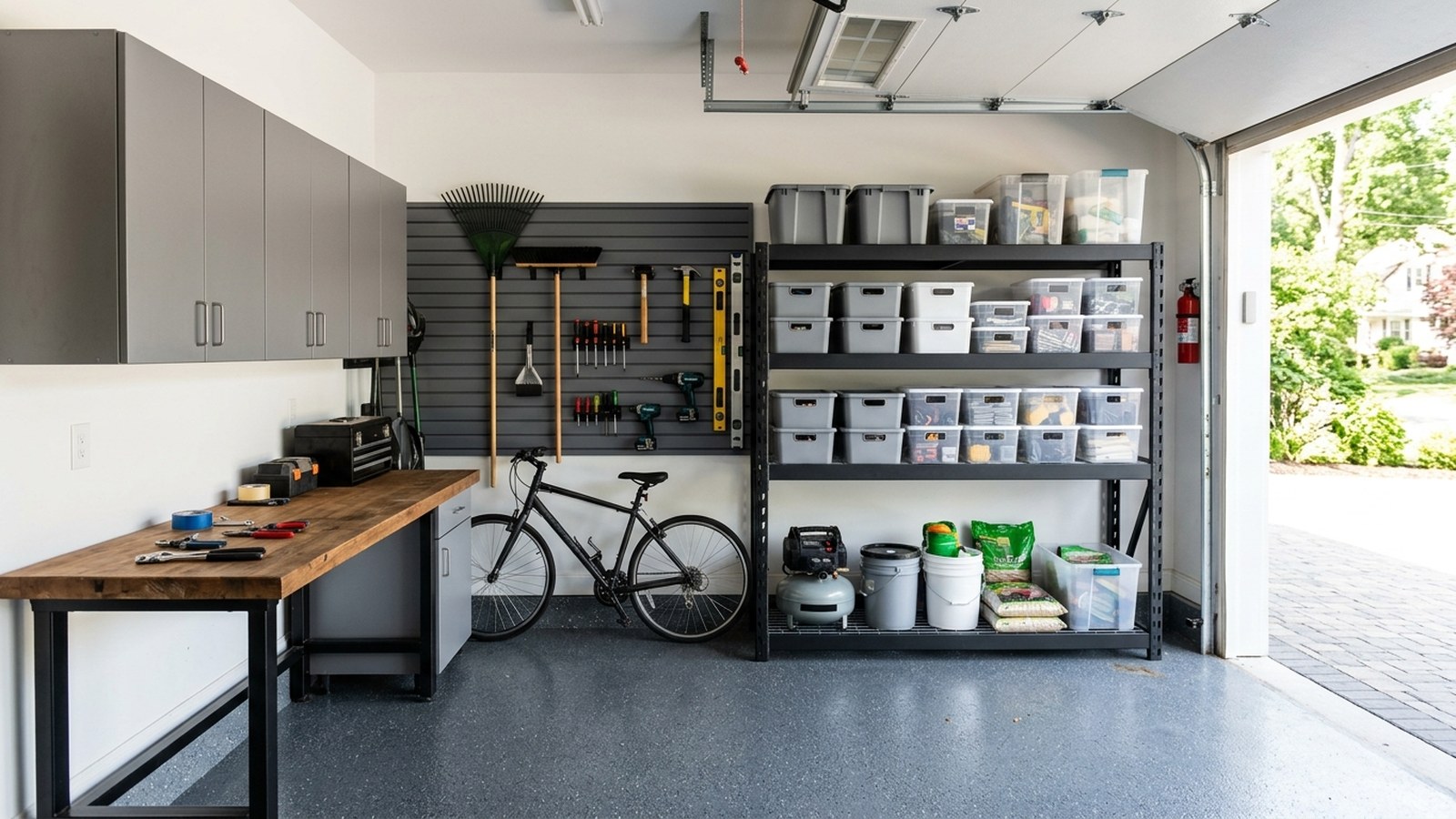
For most Charlotte-area garages, the smartest garage storage system Charlotte homeowners can install mixes closed wall cabinets with open organization rather than choosing one style alone. Closed cabinets hide clutter, protect tools and chemicals from dust and curious hands, and support safer storage of household products that need controlled access. Open systems (slatwall, hooks, open shelves, overhead racks) keep daily gear visible and off the floor so walkways stay clear. Fire and safety agencies stress that garages already carry extra risk from flammables, clutter, and heat sources, so how you store items matters as much as how pretty the walls look.[1][3]
Why Charlotte garages need a real system, not another pile of bins
Around Ballantyne, Fort Mill, Indian Trail, Rock Hill, and the rest of metro Charlotte, the garage is rarely just a place to park. It holds sports gear for year-round youth leagues, lawn equipment that works hard in humid summers, holiday totes, power tools, paint, and the overflow from a busy household. When everything lives on the floor, you lose parking space, trip more often, and spend longer hunting for a single wrench.
Clutter is not only an annoyance. Insurers and safety groups flag messy garages because people trip, objects fall, and paths to exits get blocked.[3] The U.S. Fire Administration notes that basements and garages present extra fire risks compared with other rooms, thanks to flammable liquids, stored combustibles, gas appliances, and electrical tools, and that garage fires tend to spread farther and cause more injuries and dollar loss than fires that start elsewhere in the home.[1]
A designed garage storage system answers those problems by giving every category a home: closed storage where protection and appearance matter, open storage where speed of access matters, and clear floor lanes for cars and people.
Wall cabinets: closed storage that protects and calms the room
Wall-mounted and freestanding garage cabinets are the closed half of a strong plan. Doors do three practical jobs that open shelves cannot match as well.
Dust and finish protection. Garages collect grit from cars, lawn equipment, and the open door. Cabinets keep fine tools, hardware drawers, and seasonal goods cleaner between uses so you are not wiping everything down before a project.
Visual calm. Closed doors turn a busy wall into a quiet plane. That design choice matters when the garage is the first space you see after work, or when guests walk through it into the house. Many Charlotte homeowners want the garage to feel intentional, not like a storage unit with a roof.
Access control. Paints, fertilizers, antifreeze, pesticides, and other household products belong out of reach of children and pets. AAA recommends storing those chemicals in a locked cabinet for exactly that reason.[3] The U.S. Environmental Protection Agency classifies many leftover household products (paints, cleaners, oils, batteries, pesticides) as household hazardous waste when they can catch fire, react, explode, corrode, or poison, and it urges people to follow label storage instructions carefully, keep products in original containers with labels intact, and never mix leftovers.[2]
Cabinets also support better zoning. You can put daily hardware in shallow drawers near a workbench, store bulk paper goods and pet supplies behind tall doors, and reserve a lockable unit for products that should stay secured. Purpose-built flammable-liquid safety cabinets (the rated metal cabinets used in workshops) go a step further when you keep solvents or fuels on site. Canadian Centre for Occupational Health and Safety guidance explains that storage safety cabinets exist to give temporary protection in a fire, to keep incompatible materials from mixing, and to restrict access to people who should not handle those products, and that cabinets must sit where they do not block exits or walkways.[4]
Where closed cabinets shine in Charlotte homes
- Power tools, batteries, and chargers that collect dust on open shelves
- Hardware, fasteners, and project supplies that spill and scatter
- Cleaning products, auto fluids, and lawn chemicals that need doors or locks
- Sports bags and off-season gear you do not want on display
- Anything you want protected from humidity-driven dust and from the next garage door cycle
Materials matter in our climate. Humid subtropical summers and temperature swings punish cheap particleboard. Look for moisture-resistant construction, sealed edges, quality hardware, and finishes made for unconditioned or semi-conditioned spaces so doors still close cleanly after a wet July week.
Open organization: speed, visibility, and vertical real estate
Open systems are the other half of a working garage. Consumer Reports garage organizing guidance starts with sorting items into categories (tools, household goods, gardening, sports, holiday décor), then putting small pieces into sturdy labeled bins and getting larger tools off the floor with wall hooks or racks.[5] That same logic scales into a full open wall: if you can see it and reach it, you will put it back.
Slatwall, pegboard, and track systems hold rakes, shovels, bikes, helmets, and ball bags on the wall so the floor stays free. Open shelves work well for labeled totes of seasonal décor and sports equipment you rotate through the year. Overhead racks use ceiling space for bulky, light-to-medium items you do not need weekly. Workbench-adjacent open storage keeps the three tools you reach for every Saturday at arm’s length.
Open storage is also honest about capacity. When shelves fill up, you see the excess and can donate or recycle instead of quietly stacking another cardboard box in a dark corner. AAA’s garage safety tips reinforce the basics that pair with open systems: keep the floor clear, store ladders on their sides, clean spills promptly, and light the room well so clutter does not become an injury.[3]
Where open systems win
- Daily sports gear and bikes that leave and return often
- Long-handled yard tools
- Labeled seasonal totes
- Frequently used hand tools on a peg wall
- Items that need air circulation and quick visual inventory
Open storage is weaker for chemicals, small loose parts, and anything that looks chaotic when left on display. It also asks more of your maintenance habits: dust settles, labels fade, and one messy weekend can undo the order.
Cabinets vs open: a practical comparison for real homes
| Need | Prefer closed cabinets | Prefer open systems | |------|------------------------|---------------------| | Hide visual clutter | Strong | Weak | | Protect from dust | Strong | Weak | | Child or pet access control | Strong (with locks) | Weak | | Grab-and-go sports gear | Fair | Strong | | Long tools and bikes | Fair | Strong | | Heavy bulk totes | Fair (with sturdy shelving inside) | Strong with wall/overhead racks | | Workbench workflow | Strong with drawers | Strong with peg/slat walls | | Fire-aware chemical storage | Strong (rated cabinet when needed) | Poor for liquids |
Most families do best with a hybrid garage storage system. Close the products and clutter you do not want to see or touch casually. Leave open the gear that moves every day. The U.S. Fire Administration’s garage guidance supports that zoning mindset: store oil, gasoline, paints, propane, and varnishes away from the living structure when possible, keep burnable items on shelves away from appliances, and limit how you charge equipment (one charging appliance per outlet, no extension cord while charging).[1]
Clear floors also support safer movement for every age in the household. AAA notes that messy garages cause injury when people trip and when objects fall, and it specifically recommends stashing tools and gear in drawers or containers so the floor stays clear.[3] A garage full of trip hazards is not only hard on knees after a soccer game. It is a risk zone for kids, pets, and older adults who still use the space for hobbies, cars, or storage.
Design principles we use for Charlotte garages
When we design a custom garage system, we start with how you live, not with a catalog photo.
1. Measure the cars and the walk paths first. Storage that blocks a door swing or steals the last inches of parking fails on day one. We map vehicle lengths, door clearance, and a walking lane before we place cabinets.
2. Inventory by frequency, not by room of origin. Group what you use weekly, monthly, and yearly. Weekly items live low and open or in easy drawers. Yearly items go higher, often in closed cabinets or overhead.
3. Zone like a kitchen. Chemical zone (secure), tool zone (workbench plus drawers and wall tools), sports zone (open and labeled), household overflow (closed tall cabinets), seasonal zone (overhead or high shelves). Zoning reduces the “everything is everywhere” pattern that makes open shelves fail.
4. Respect fire and chemical common sense. Keep combustibles off furnaces, water heaters, and other heat sources, and do not use the garage as a dump for oily rags or trash near ignition points.[1] Keep household products in original labeled containers and never mix leftovers.[2] Place any dedicated safety cabinet where it does not block egress.[4] OSHA construction standards for flammable liquids also reinforce using approved containers and controlled storage practices when those products are present on a worksite-style garage or shop.[6]
5. Build for humidity and real weight. Shelves and cabinets should match the load of paint cans, tile boxes, and sports equipment, not just the weight of empty baskets. Moisture-resistant panels and solid hardware pay off after a few Carolina summers.
6. Leave room to grow. Kids add sports. Hobbies expand. A good system has a little empty capacity so order survives the next season.
How to choose: a short decision path
Ask four questions before you buy freestanding units or hang another shelf:
- What must stay hidden or locked? Those items go in cabinets.
- What do we grab three times a week? Those items stay open and labeled.
- What is heavy, sharp, or toxic? Those items leave the floor and leave the kids’ reach.
- Do we still need both cars inside after storage is installed? If the answer is no, redesign before you install.
If your list is mostly tools, bulk goods, and chemicals, lean cabinet-heavy. If your list is bikes, balls, and lawn tools, lean open-heavy. If you have both (most Charlotte families do), plan a hybrid wall: cabinets along one run, slatwall and open shelving along another, overhead for the quiet bulk.
Cost, value, and what “custom” actually buys you
Off-the-shelf cabinets and wire shelves can work for a rental or a temporary fix. Custom work earns its place when the garage is odd-shaped, when you need full-height storage around windows and service doors, or when you want the garage to match the finish quality of the rest of the house. Custom also lets us size drawers for your tool collection, leave clearances for your specific vehicles, and combine closed and open elements into one continuous elevation instead of a patchwork of mismatched units.
Value shows up in daily minutes saved, in the ability to park inside again, and in safer storage of products that should never sit on the floor next to a water heater. Those benefits compound every season you stay in the home.
Practical takeaways
- Use closed wall cabinets for dust-prone tools, household overflow, and chemicals that need doors or locks.
- Use open systems (slatwall, hooks, open shelves, overhead) for daily sports gear, long tools, and labeled seasonal totes.
- Keep floors clear. Trip hazards and blocked paths are a real injury risk, not just a mess.[3]
- Treat paints, oils, solvents, and similar products as household hazardous materials: original containers, readable labels, no mixing, and secure storage.[2]
- Keep burnables away from appliances and heat sources; garage fires carry higher spread and loss risk than many other home fire starts.[1]
- Place any chemical safety cabinet so it never blocks exits or walkways.[4]
- Sort by category and frequency before you buy a single product, then size the system to what you actually keep.[5]
- In Charlotte’s humid climate, choose moisture-aware materials and sealed construction for long-term fit and finish.
- Hybrid layouts almost always beat pure-cabinet or pure-open plans for real family garages.
How we can help
The Closet Rehab designs and installs custom garage storage for Charlotte and the surrounding communities, including wall-mounted systems, cabinetry, overhead storage, workbench zones, and sports equipment layouts built around your gear and vehicles. Explore our garage storage solutions, see how our design process works, or request a free in-home design consultation. Call (704) 604-3870 or email design@theclosetrehab.com when you are ready to reclaim the floor and put a real garage storage system to work.
Citations
- U.S. Fire Administration (FEMA) - "Basement and Garage Fire Safety" (accessed 2026)
- U.S. Environmental Protection Agency - "Household Hazardous Waste (HHW)" (2026-06-01)
- AAA Via Magazine - "Do Hazards Lurk in Your Garage?" / Top Garage Safety Tips (2023-10-12)
- Canadian Centre for Occupational Health and Safety - "Storage Safety Cabinets for Hazardous Chemicals" (2023-02-15)
- Consumer Reports - "How to Organize Your Garage" (2022-04-07)
- Occupational Safety and Health Administration - "1926.152 - Flammable liquids" (accessed 2026)