Linen Closet Organization: Hall vs Bath Closets
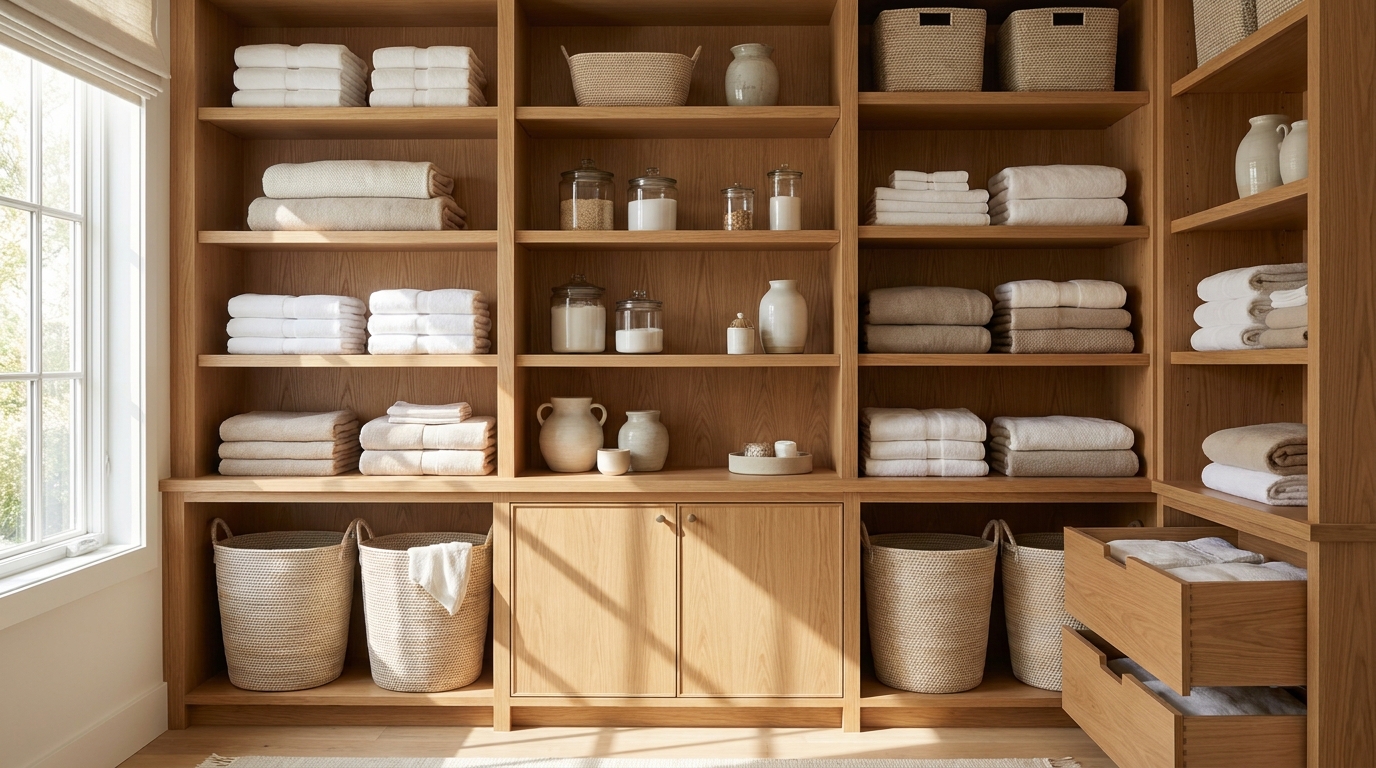
A hall linen closet and a bath-adjacent linen closet are not the same storage problem. The hall closet can hold overflow (guest sheets, extra blankets, bulk paper) if the shelves match the fold, not a leftover coat-closet grid. The bathroom closet has to survive daily grab-and-go plus shower humidity, so it needs shorter stacks, more air, and a restock path that does not dump last week's extras onto today's towels. Keep indoor humidity low (the EPA's target is below 60 percent, ideally 30 to 50 percent) and treat a damp bath closet as a moisture room first, a pretty shelf second. [1]
1. Two closets, two jobs
Hall linen closets sit away from the shower. They are usually deeper, taller, and used a few times a week: Sunday sheet change, guest-room reset, grabbing a spare blanket. That depth is useful only if you can reach the back without toppling the front row.
Bath-adjacent linen closets sit next to steam. They are often shallower reach-ins, and someone opens them with wet hands and a short fuse. Their job is this week's towels, a backup stack, washcloths, and maybe one toiletry bay. Everything else is overflow, and overflow belongs somewhere else.
When linen closet organization fails in Charlotte-area homes, it is usually because one closet is asked to do both jobs. A hall closet stuffed like a bath closet hides the guest set behind paper goods. A bath closet stuffed like a hall closet turns into a leaning pile that slumps the first time you pull from the middle.
We design custom closet systems around that split: daily reach in the bath, reserve inventory in the hall, and a restock route that keeps both usable.
2. Why a bathroom closet is a moisture closet
North Carolina has a humid climate with very warm summers, and that outdoor moisture shows up indoors after a long shower in Ballantyne, Fort Mill, or Waxhaw. [6] Hot, humid air from baths and showers can raise indoor humidity and feed mold if it is not exhausted. [3]
The EPA is blunt about bathrooms: places that are often or always damp are hard to keep completely free of mold, and the first fix is more ventilation (a fan or a window) plus more frequent cleaning. [1] Exhaust has to leave the house. A bath fan that dumps moisture into an attic, or a closet that never sees moving air, works against the towels you just dried. [2]
What that means for the closet, not just the fan:
- Store only dry textiles. University of Missouri Extension guidance (first issued in 1998 and reviewed in 2017) is still the right household rule: never let clothing or other fabric sit damp, spread out washcloths and towels, and dry washed fabrics thoroughly and quickly. Cotton and linen feed mildew when the closet is warm, damp, and still. [4]
- Leave air paths. A bath closet packed to the door stops circulation. George Washington University's Textile Museum notes that when humidity runs high, even a fan and some air movement help avoid mildew. [5]
- Do not treat the closet as a drying rack. A "almost dry" bath sheet on a tight shelf will sour the stack next to it. Hang it until it is actually dry, then fold it to the shelf.
- Watch the door and the gap. A solid door on a steamy bath closet traps the last of the shower. A louvered door, a wide undercut, or a short run of the bath fan after you leave the room does more for towels than another scented sachet.
- Keep indoor humidity in range. Measure it. The EPA's 30 to 50 percent ideal band is a closet-friendly target, not just an HVAC talking point. [1]
3. Depth and daily reach
Shallow bath closets (often a 12 to 16 inch reach-in) want one row of folds, not a front row and a forgotten back row. Fold the towel so the finished packet is an inch or two narrower than the shelf. If the fold hangs over the front edge, it will catch on the door and unzip the stack.
Deeper hall closets look generous and then waste the back 8 inches. Two options work: pull-out shelves or bins that come all the way forward, or a labeled back-row overflow that you only touch on restock day. A static double row of loose towels is how the "good" set disappears.
Put daily items at eye level. Organizing specialists interviewed by Wirecutter in a March 2026 guide put the sheets and towels you actually use where you can see and reach them, and they send the extras somewhere else if the closet cannot hold them comfortably. [7] That is the hall-versus-bath split in one sentence.
Reach map we use on site: bath closet middle shelves hold this week's towels plus one backup; the lowest shelf takes heavier extras (spare paper, washcloths); the top shelf holds a see-through bin of rare backups. Hall closet middle shelves hold sheet sets by bed size and guest towels; high shelves hold off-season blankets in a bag, not a free pile; the floor or lowest shelf takes the heaviest overflow.
North Carolina's insurance commissioner, in 2022 Safe Kids guidance, repeats a furniture rule that fits a tall linen tower: store heavy objects on lower shelves or in lower drawers, and do not park tempting grab items where a child would climb. [8] Extra cases of paper and stacked blankets belong low.
4. Shelf spacing that matches the fold, not the stud bay
Fixed builder shelves are usually set for paint cans or a single high stack. Linen closet organization lives or dies on the gap above the fold. If the shelf above sits on the towel, you cannot lift one without dragging the pile. If the gap is a foot of empty air, the stack slumps sideways.
We set bays from a finished fold, then add lift space. Bring one towel, one sheet set, and one blanket to the design visit, folded the way your household actually folds. Then we space the shelf so the stack has about 2 to 3 inches of clear space above it. That is enough to pinch and lift, not enough to start a second unofficial pile.
Typical bays in our Charlotte-area linen work (adjust to your fold, not a catalog): washcloths and hand towels, 8 to 10 inches; everyday bath towels, 12 to 14 inches with four to six towels per stack; sheet sets (one bundled set), 10 to 12 inches or a pull-out bin; guest towels in the hall closet, the same 12 to 14 inch bay divided by room; blankets and comforter bags, 16 to 18 inches, high in the hall closet and contained. Taller towel stacks mushroom at the bottom. A loose comforter slumps into the bay below.
Adjustable pins and dividers do the rest. Towel thickness changes when you switch brands. A 2-inch pin grid lets us recut the air gap. A 36-inch shelf with one long towel row will avalanche as soon as someone pulls from the center. Vertical dividers (or a series of open bins) turn that width into two or three independent stacks.
5. Fold stacks that do not collapse into a pile
The Textile Museum's conservation advice is written for heirlooms, but the physics is the same on a Tuesday bath towel: long-term folding without any relief at the crease, plus weight on top, puts pressure on the fold and can set a hard line or weaken the cloth. [5] Everyday linens do not need archival tissue. They do need shorter stacks and a fold that matches the shelf.
Rules that keep stacks standing:
- One category per bay. Bath towels do not share a shelf with a comforter and a bag of travel bottles.
- Bundle a sheet set. Fitted sheet, flat sheet, and pillowcases stay together (many households tuck the set into one pillowcase). You grab one packet, not three mismatched pieces.
- Cap the height. If you cannot lift the top towel with one hand without the stack leaning, the stack is too tall. Split it into two bays.
- Face the fold forward. A consistent edge is how you see that the backup stack is down to two towels before you are out.
- Do not crush the reserve set under the daily set. That is how overflow becomes a landslide. Daily in front or on its own shelf. Reserve in the hall closet or in a labeled bin behind a pull-out.
- Give in-season stacks air, not a sealed bag. Closets that stay still and damp are where cotton and linen mildew. Keep the door from packing shut, and only bag bedding that is fully dry and truly off-season. [4] [5]
Pick one method per bay (fold or roll) and stick to it. Mixed packets in the same opening look tidy for a day and then shed.
6. Overflow that stays usable
Overflow is not "the stuff that did not fit." Overflow is inventory you still want, parked where you can find it without wrecking the daily stack.
Wirecutter's experts (updated March 2026) generally recommend two to four sheet sets per bed and two to four towels per person. Anything beyond what the closet can hold comfortably should live somewhere else. [7] That number is a planning cap, not a shopping dare. If a family of four keeps twelve bath towels in a 15-inch bath closet, the closet is not the problem. The count is.
A usable overflow plan:
- Count what you actually rotate. Two towels per person in the bath closet, plus a guest pair, is a daily-use set. The rest is hall-closet reserve.
- Label the hall closet by destination, not by fabric. "Primary king," "guest queen," "kids bath." You should restock the bath closet in one trip.
- Give overflow its own opening. Do not balance extra blankets on the sheet stacks.
- Fold in the laundry room. Fold to the closet's packet size on a counter, then carry finished stacks. A laundry room with a real fold zone keeps half-folded piles out of both closets.
- Keep a landing shelf. One empty (or half-empty) hall shelf is the restock buffer. Without it, clean laundry lands on whatever is already there.
EPA moisture guidance also notes that closet interiors can run cooler than the rooms around them, so opening the door and moving air matters when condensation is a risk. [2] A packed hall closet in an interior corridor can still go musty if it never sees air.
7. A restock routine that protects the design
Daily, in the bath closet: one towel out, one towel in from the backup stack. When the backup hits two, refill from the hall closet. Do not refill from a still-damp dryer pile.
Weekly, in the hall closet: restock the baths, then rebuild the hall stacks. Guest sets stay bundled. Seasonal bedding stays in its bin.
After guests or a leak: wash, dry completely, and return sets to their labeled bay. Soiled or half-dry extras mildew faster than clean, dry ones. [4] The EPA's 24 to 48 hour window for drying wet materials is a mold-control rule, and it applies to a soaked bath mat as much as to a spill. [1] If the closet still smells musty after you pull the damp items, fix the moisture source (fan, leak, overpacked shelves) before you add more product. Moisture control is mold control. [1]
Practical takeaways
- Split the work. Bath closet = this week's dry towels and one backup. Hall closet = extra sheet sets, guest towels, blankets, and bulk paper.
- Measure humidity, not vibes. Stay under 60 percent relative humidity, ideally 30 to 50 percent, and run the bath fan so moisture leaves the house. [1] [2] [3]
- Never shelf a damp towel. Spread it, hang it, dry it fully, then fold it. [4]
- Space shelves from a real fold. Leave about 2 to 3 inches of lift space. Split any stack you cannot lift with one hand.
- One category per bay, dividers on wide shelves. That is what stops the center-pull avalanche.
- Cap inventory. Plan around two to four sheet sets per bed and two to four towels per person. The rest is labeled overflow. [7]
- Heavy items low. Extra cases and stacked blankets sit on the lowest shelf, not over your head. [8]
- Fold in the laundry room, restock on a landing shelf. Do not use the daily towel stack as a drop zone.
How we can help
Have more questions or want to get in touch? Our team will measure both closets, fold a real towel and sheet set with you, and draw a hall-versus-bath plan with shelf spacing that matches those folds (plus an overflow zone you can actually restock). Start at our contact page · (704) 604-3870 · design@theclosetrehab.com
Citations
- U.S. Environmental Protection Agency, "A Brief Guide to Mold, Moisture and Your Home" (2026-02-18)
- U.S. Environmental Protection Agency, "What are the main ways to control moisture in your home?" (2026-02-18)
- ENERGY STAR, "Indoor Air Quality Features" (n.d.)
- University of Missouri Extension, "How to Prevent and Remove Mildew — Home Methods" (1998; reviewed 2017-09)
- The George Washington University Museum and The Textile Museum, "Storing Textiles" (n.d.)
- NOAA NCEI / NCICS, "North Carolina - State Climate Summaries 2022" (2022)
- Wirecutter / The New York Times, "How to Organize a Linen Closet" (2026-03-11)
- North Carolina Department of Insurance, "Kids killed every year by TV tip-overs: Commissioner Causey urges safety ahead of Super Bowl weekend" (2022-02-09)