Bulky Bedding Storage Drawers for King Duvets
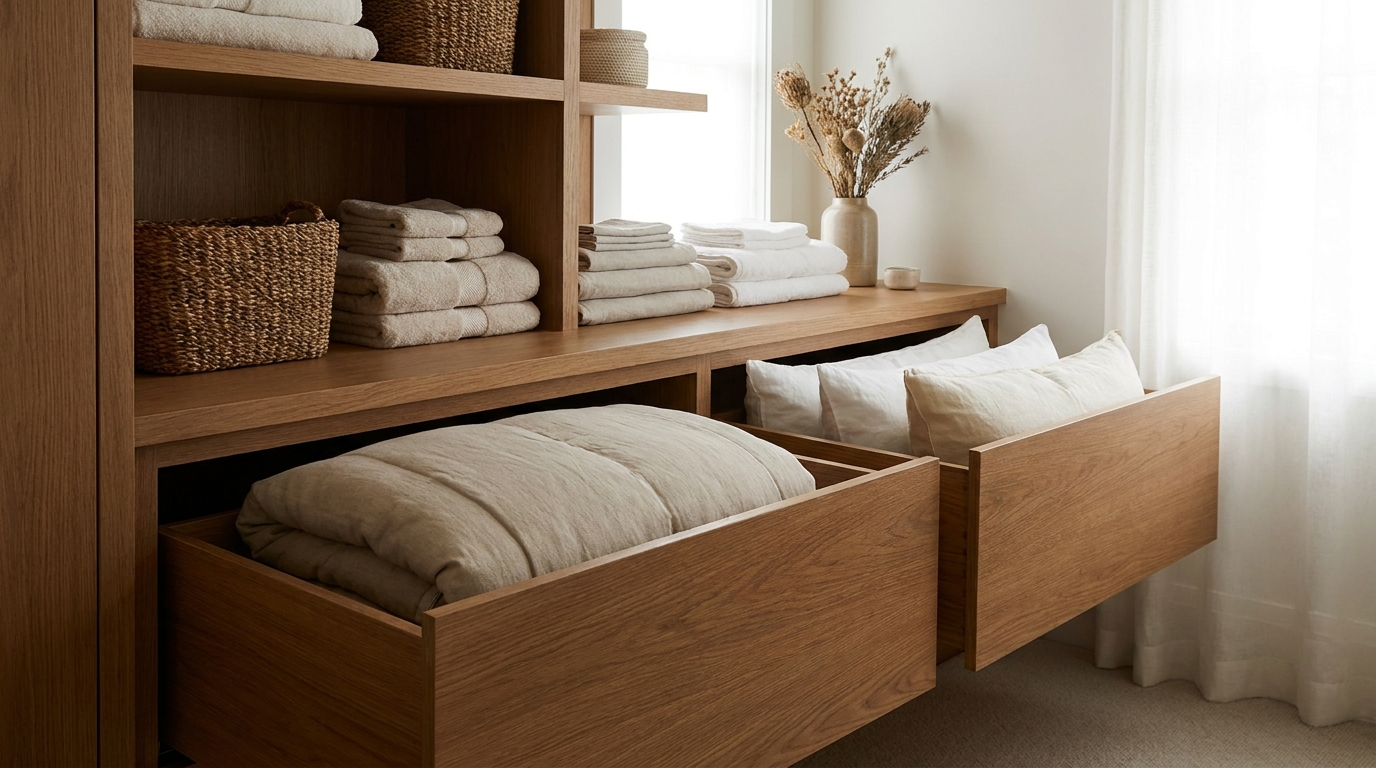
A king duvet, a pile of extra pillows, and a sleeping bag should not share one open shelf. Bulky bedding storage drawers, built into a hall or primary linen run, give each piece a deep bay so the duvet can rest in a loose fold instead of holding up everything above it. We size that bay around the folded piece you own, because brand sizes vary and no public standard sets the drawer depth. The result is a cabinet you can use on laundry day, not a stack you rebuild every time you need one item.
1. Why an open shelf flattens bulky bedding
The usual linen shelf looks orderly on the day it is folded. A king duvet goes down first, then extra pillows, then a sleeping bag. Within a few weeks the bottom layer is a hard pad, and pulling one item means lifting the whole pile.
Weight is the quiet problem. The 2002 National Park Service Museum Handbook says flat storage is ideal for most textiles because it supports the whole piece, and it says to avoid stacking whenever you can [4]. When stacking is absolutely necessary, that handbook says to be aware of the weight of one textile on another [4]. A duvet is built to hold air, and a season under other bedding presses that air out.
Folds add a second kind of wear. The same 2002 handbook notes that textiles tend to break along fold lines over time, so pieces should be folded as little as possible [4]. University of Georgia Extension calls storing a textile flat, without folds, the best method, and it notes that large pieces often cannot be stored that way [5]. If a stack is the only option, that guidance says not to place a larger or heavier textile on a smaller or more fragile one [5].
The daily cost is simple. The item you need is rarely the one in front, so a weekend sleeping bag means unpacking the duvet. Our team treats that as a design problem, not a folding failure.
Museum storage is a comparison, not a house template. The 2002 handbook says flat storage is impractical for most large items such as carpets, and that shallow drawers are well suited to flat textile storage [4]. A home linen run still has to support the textile, so we build a deep drawer you can open on laundry day.
2. What a deep drawer is for
Bulky bedding storage drawers are not a mixed bay with a nicer front. In our designs, each deep drawer has one job.
- King duvet. One drawer holds the duvet in a loose fold, or flat if the run is wide enough, with nothing on top of it. A second king duvet gets its own drawer.
- Extra pillows. Spare pillows sit in a single layer. A pillow bent in half to force the drawer shut is already crushed.
- Sleeping bags and camp quilts. These leave the shelf so they are not a weight on the bedding all season.
- Thin goods elsewhere. Sheet sets, pillowcases, and light throws go in shallower drawers above or beside the deep bays.
In Charlotte, this run often belongs in a hall outside the primary bedroom, where a shallow coat closet cannot take a king fold. We see the same crushed shelf in Fort Mill homes whose bedroom closets are already given over to clothes. A short run inside the primary bedroom works when that wall can take a deep box.
A drawer front changes the air around the textile, too. The 2002 handbook says closed cabinets give textiles extra protection from pests, and from water damage that might follow a flood or fire [4]. An open shelf does not offer that cover, and dust settles in the folds all week. A closed drawer is a simpler version of that idea, not a sealed museum case.
We specify full-extension slides so you can lift the duvet from the back without unloading the front. The right slide depends on the box and on the bedding you own. We do not quote one weight rating as if every king duvet were the same object.
3. Keep moisture out of the bay
A deep drawer only helps if the bedding goes in dry. The U.S. Environmental Protection Agency states that the key to mold control is moisture control, and that mold will not grow without water or moisture [1]. EPA guidance also says to dry wet or damp materials within 24 to 48 hours, because in most cases mold will not grow when drying happens in that window [1]. A duvet that felt mostly dry can still hold moisture in the center of the fold.
Keep indoor relative humidity below 60 percent where you can, and ideally between 30 and 50 percent [1]. EPA notes that relative humidity can be measured with a small, inexpensive meter available at many hardware stores [1].
Textile storage has a second target. The 2002 handbook says fibers readily take up and lose moisture, and it recommends storing textiles between 65 and 75 degrees Fahrenheit with relative humidity as close to 50 percent as possible [4]. It also says relative humidity under 35 percent can embrittle textiles, while high temperatures together with high relative humidity promote biological activity [4].
NC State Extension explains that mold needs a food source, moisture, a suitable temperature, and oxygen [2]. That publication lists textiles, along with wood, paper, and leather, among home materials that can feed mold [2]. Washing and drying clothes raise indoor humidity, and the same guide says to vent appliances such as the dryer to the outdoors [2]. A 2022 NC State checklist adds that the dryer should vent outside the house, not into a garage, crawl space, attic, or other indoor space [3].
If the linen run shares a wall with the laundry, we look at that vent during the visit. Bathing also raises humidity, and NC State Extension says to turn exhaust fans on while you bathe [2].
Plastic feels protective and often is not. University of Georgia Extension says not to wrap textiles in plastic, because plastic prevents air circulation and can cause mold and mildew [5]. A sealed bag around a slightly damp duvet holds that moisture against the cloth. Everyday bedding goes into the drawer loose and fully dry, not in a closed plastic sleeve.
If mold is already visible, deal with the textile before you redesign the cabinet. A 2022 NC State Extension guide, adapted from a 2018 University of Georgia publication, says mold can cause permanent damage to some clothing and fabrics [6]. That guide also says mold can be removed from most items if you clean and dry them quickly [6].
EPA notes that molds gradually destroy the things they grow on [1]. Washable bedding should be cleaned in a way the cloth can tolerate, then returned only when it is dry through.
4. How we plan the bays
We start with your bedding, not with a catalog depth. At the measure we want the king duvet, a spare pillow, and any sleeping bag that has to live in the house. Folding them shows the footprint, and the drawer has to clear it with enough ease that the front closes without compressing the fill.
- Depth before height. A tall, narrow slot forces a hard roll. We prefer a deeper bay so the fold stays loose. That depth is a choice for your piece, not a code dimension.
- One category on the front. "Duvet," "pillows," or "sleeping bags" stays honest. A drawer labeled "linens" becomes a shelf with a face.
- Room to lift. Full-extension slides and a clear grip keep ties and thick corners from catching on the opening.
- Flat goods stay shallow. Fitted sheets and pillowcases belong in a shorter drawer, so the deep bays keep their depth.
- An interior wall when the plan allows. The 2002 handbook says never to store textiles in attics or basements, against exterior walls, near heating or air-conditioning vents, or in spaces below water pipes [4]. UGA Extension says not to store textiles in attics, basements, or areas that are not heated in winter or cooled in summer, and to try to keep them off an outside wall [5]. It also says a too-humid area promotes mold and mildew, and that storage should stay ventilated [5].
Our design process covers measurements and how you use the space before anything is built. If the only wall is an exterior wall, we say so and talk about humidity before we pretend a drawer fixes the air. Dividers suit sheet sets, and they only steal width inside a duvet drawer.
5. Fold so the crease can move
A king duvet will almost always be folded. The win is a fold that is few, soft, and willing to change.
UGA Extension says that if a textile must be folded, use as few folds as possible and pad them with crumpled tissue or washed unbleached muslin [5]. Reposition those folds several times a year, because textiles tend to split where the same crease and pressure stay in place [5]. The 2002 handbook says the same for collection textiles: fold as little as possible, since textiles tend to break along fold lines, and pad folds with crumpled acid-free tissue [4].
That tissue step is heirloom and museum practice. Everyday bedding still needs to avoid one knife-edge crease that never moves. Each time the duvet goes back in the drawer, fold it the other way.
A spare that sits all season should be refolded when you change the bed, even if you do not wash it that day. Sleeping bags get the same treatment in their own bay, turned a few times a year. That habit is what UGA Extension recommends for folded textiles [5].
Airing is not hanging storage. UGA Extension says a heavy textile, such as a quilt or coverlet, should be supported evenly when aired, and that a clothesline stresses one narrow band of cloth [5]. We do not design a run that asks a king duvet to live on a hook. Support it across a bed after washing, then fold it loosely once it is fully dry.
6. Dust, pests, and a drawer that can still close
Clean bedding stores better than soiled bedding. The 2002 handbook says textile fibers are a food source for microbes and insects, and that soils and stains attract pests as well [4]. UGA Extension notes that storing soiled textiles raises the chance of insect, mold, or mildew problems [5]. Clean the piece the way its care instructions allow, dry it completely, and then put it away.
Dust is a fiber problem, not only a neatness problem. The 2002 handbook says dirt and dust contain silica that can cut and abrade textile fibers, especially as those fibers expand and contract when humidity changes [4]. A closed drawer cuts the dust an open shelf collects. It does not replace washing.
Smell is an early signal. A 2022 NC State Extension checklist says that a musty, earthy odor, or excess moisture, means there is the potential for mold growth, and that you should find the moisture and fix it first [3]. Do not cover that smell with fragrance and a tighter stack. Pull the piece out and look at the cabinet back for a leak or for condensation.
When mold is already in a closet, that 2022 checklist says poor ventilation may be the cause [3]. It suggests leaving the door open and, if the closet is full, removing about one-third of the contents so air can move [3].
That one-third figure applies when a closet already has a mold problem [3]. It is not a rule that every healthy drawer sit partly empty.
The handbook says mold and mildew grow in warm, damp locations and can leave irreversible brown stains [4]. If a leak wets the cabinet, dry the bedding within the 24 to 48 hour window EPA describes, and dry the box before anything goes back [1].
7. A rhythm that keeps the bays honest
The run fails when the drawer becomes a second shelf. Upkeep is short if the bays were planned for one job each.
- Dry, then store. A cool center in the fold means the duvet is not ready. Finish drying it on a bed or in the dryer.
- One type per drawer. If a category outgrows the bay, edit the count or add a drawer. Do not stack a new piece on the duvet.
- Move the fold. Reverse the duvet fold on the way back in, and turn a seasonal sleeping bag a few times a year.
- Treat a musty smell as moisture. Find the damp source before you add anything scented.
- Keep thin sets out of the deep bays. The duvet drawer stays a duvet drawer.
Practical takeaways
- Give each bulky piece its own deep drawer. A king duvet, extra pillows, and sleeping bags should not form one stack.
- Size the bay from the real fold. Depth is our design practice for your duvet, not a published standard dimension.
- Keep sheets in shallower drawers. Thin sets above or beside the deep bays keep those bays from turning into a mixed pile.
- Dry before the drawer closes. EPA guidance is to dry damp items within 24 to 48 hours, and mold will not grow without moisture [1].
- Do not chase bone-dry air. Keep indoor relative humidity below 60 percent, ideally 30 to 50 percent [1]. The 2002 handbook recommends textile storage near 50 percent and says levels under 35 percent can embrittle fibers [4].
- Skip sealed plastic. UGA Extension says plastic wrap blocks air circulation and can lead to mold and mildew on textiles [5].
- Store clean pieces. Soils and stains attract pests, and soiled textiles are more prone to insect, mold, or mildew problems [4][5].
- Answer a musty smell. A 2022 NC State checklist says that odor means you should find the moisture and fix it [3].
- Place the run with the air in mind. Keep textiles out of attics, basements, and spots against exterior walls, near heating or cooling vents, or below water pipes [4].
How we can help
A hall or primary linen run is a focused project: deep drawers for bedding that should never live in a crushed stack, and shallower drawers for the flat sets beside them. The same measured approach we use for custom closets applies here. We fit the drawer to the folded piece and to the wall you have. Our design process starts with an in-home visit and measurements, then a plan before anything is built.
Have more questions or want to get in touch?
Visit our contact page, call (704) 604-3870, or email design@theclosetrehab.com.
Citations
- U.S. Environmental Protection Agency, "A Brief Guide to Mold, Moisture and Your Home" (2026-02-18)
- NC State Extension, "Preventing Mold in Your Home" (2022-04-22)
- NC State Extension, "Mold and Moisture Checklist" (2022-04-04)
- National Park Service, "Museum Handbook, Part I, Appendix K: Curatorial Care of Textile Objects" (2002)
- University of Georgia Cooperative Extension, "Heirlooms" (undated)
- NC State Extension, "Removing Mold From Household Items" (2022-04-22)