Pool Towel Closet Storage Off the Bath Linen
Pool towels, lake towels, life jackets, and sunscreen need their own vented bay. They should not land on the washer, and they should not share the everyday bath linen closet. A damp towel against a clean stack holds moisture where you cannot see it. A life jacket under that pile is a jacket you will not grab on the way out the door.
Pool towel closet storage is that bay: wet hooks with air moving through them, a dry shelf for towels that are actually dry, a hook for each jacket size, and a shaded spot for sunscreen where you can read the date. Families in Charlotte, and along Lake Wylie by Fort Mill and Rock Hill, run this loop all summer. The swim ends, the gear comes inside wet, and the bath closet is the nearest door. That is the wrong door.
The bay does not keep anyone safe in the water. The U.S. Coast Guard recommends wearing your life jacket at all times when the boat is underway [6]. A hook at home only makes the jacket findable so you can put it on before you leave.
1. Why the bath linen closet is the wrong shelf
The bath closet is for towels that are already clean and dry. A wet pool towel changes the moisture in that small space. The Environmental Protection Agency notes that moist areas, such as poorly ventilated bathrooms, can encourage mold and other biological contaminants [2]. The same page says wet materials should be dried as soon as possible, ideally within 24 to 48 hours, and that indoor relative humidity should stay below 60 percent, ideally between 30 and 50 percent [2].
A shut linen closet packed with damp guest towels works against that. EPA's mold course says buildings and furnishings often get wet and must be dried quickly, within 24 to 48 hours, to avoid mold growth, and that more air circulation generally speeds drying [1]. A closed cabinet does not provide that movement. It holds the damp against the towels you want for a shower.
University of Georgia Extension, in a mold checklist fully reviewed in 2023, says mold in a closet may come from poor ventilation [4]. The checklist says you can increase airflow by leaving the door open, and that a full closet should lose about a third of its contents [4]. Cracking the door is a stopgap. It is not a plan for a summer of pool days. Wet gear needs its own bay, with air moving and with clean linen out of the drip.
2. Dry the towel before it joins the clean stack
A vented bay is not an indoor clothesline with a door on it. University of Minnesota Extension, on a page reviewed in 2018, says molds grow quickly on damp indoor surfaces, and that drying clothes on an indoor line is one of the ways a household adds moisture molds can use [3]. That page says to dry clothing on a line outside, or in a dryer that sends moist air outdoors [3]. It also says mold in bedding, curtains, drapes, and clothes can be dealt with by washing or dry cleaning [3].
The Georgia checklist lists hanging laundry inside to dry as one habit that can add humidity [4]. If a towel smells musty, do not put it back. The checklist says a musty, earthy odor, or visible excess moisture, means there is the potential for mold growth [4].
Wet hooks are a pause, not a finish. Spread the towel so it is not bunched. Let air move. Then wash it, or dry it fully, before it joins the stack you hand a guest. The wash belongs in the laundry room, not as a heap on the washer lid. A pile on the machine stays damp, blocks the next load, and teaches everyone that the lid is storage. We keep the wet pause at the bay, and the wash cycle in the laundry room.
3. Guest towels are not a shared pile
Pool water and a used towel are different problems. CDC's 2013 fact sheet, Facts About MRSA and Swimming Pools, says MRSA does not survive long in pools and other treated water that have proper disinfectant and pH, and that there have been no reports of MRSA spreading through contact with recreational water [5]. The sheet still tells swimmers not to share towels or razors [5]. It says indirect contact can happen when people share those items, or touch surfaces such as handrails and locker-room benches, and that infection is most likely when the germ meets an uncovered cut or scrape [5]. It also tells pool operators to wash towels after each use [5].
At home, the reading is simple. A pool towel is for one person until it is washed. Do not refold a damp one onto the stack a child will use after a bath, and do not drop it on the bath linen because the hooks were full. Clean pool towels live on a dry shelf in the same bay, with a gap before the wet hooks. The bay is not a substitute for covering a cut or for staying out of the water when a doctor has said to. It only keeps used towels off the everyday stack.
4. Life jackets you can see, worn on the water
Jackets belong in this bay because they come home wet and then disappear. They do not belong here as a safety claim. In 2024, where the cause of death was known, 76 percent of fatal boating incident victims drowned, and where life jacket use was known, 87 percent were not wearing a life jacket, the Coast Guard's boating safety FAQ reports [6]. That same answer says the Coast Guard recommends wearing your life jacket at all times when the boat is underway, and it asks boaters to wear the jacket [6]. A closet does not change those 2024 figures. It does not prevent drowning. Storage makes the jacket findable.
Federal rules, as that FAQ states them, generally require a Coast Guard-approved wearable life jacket in good and serviceable condition, and of the appropriate size, for each person on board [6]. On a vessel that is underway, children under 13 must wear an appropriate Coast Guard-approved life jacket unless they are below deck or in an enclosed cabin [6]. A state rule can differ on waters that state controls, so the state boating authority is the place to confirm the local line [6]. Lake Wylie sits on the line between the Carolinas. Do not guess from a hook label. Check the rule, then match the jacket to the person.
The FAQ also describes a written warning for life jackets that were not readily accessible because they were in a closet in the forward cabin of the boat [6]. That example is about the boat, not the hallway at home. It still draws a bright line. A jacket buried where you cannot reach it is not ready. On the water, wear it. At home, hang it where you see it on the way to the car.
A few layout habits keep the hooks honest:
- Give each size its own hook, with child sizes separate from adult sizes, at a height a standing adult can reach.
- Do not pile bins, coolers, or wet towels on top of the jackets. You should be able to see the size and the condition before you leave.
- Read the label before you assign a hook. The Coast Guard says inflatable life jackets are generally intended for people over 80 pounds, and that the intended wearer must be over 16 to meet carriage requirements [6].
- If you use a paddleboard past the narrow limits of a swimming or bathing area, the FAQ treats that board as a vessel, which means a life jacket comes with it [6]. The hook is where you pick it up. The water is where you wear it.
Between trips, bring the jackets in, let them dry with air around them, and hang them. The bay is where you see them. It is not where they stay while the boat is moving.
5. Sunscreen out of the heat, with a date you can read
Sunscreen fails quietly when it cooks in a car or bakes on a deck. To keep it in good condition, the Food and Drug Administration recommends that you not expose sunscreen containers to direct sun [7]. FDA says to protect them by wrapping the containers in a towel or keeping them in the shade when they will sit outside in the heat for a long time, which is why labels must say to protect the product from excessive heat and direct sun [7]. A dashboard, a sunny windowsill, and a deck box in full afternoon light are the wrong addresses. A bin inside the bay, out of the window, is the house version of that shade.
Dates matter as much as shade. FDA says a sunscreen with no expiration date should be treated as expired three years after purchase, because a nonprescription drug needs a printed date unless testing shows it stays stable for at least three years [7]. Do not use a product past its date, or an undated bottle you did not buy within the last three years [7]. Discard it if it is expired or if you do not know its age, because it may no longer be safe and effective [7]. We set the bin where the date faces out, so you are not digging through bath linen to check.
Two label facts belong next to that bin, because guests grab what is nearest. FDA does not recommend sunscreen for infants under six months old and says to keep those infants out of the sun, and to ask a doctor before using sunscreen on a child that young [7]. Spray bottles need a second look. FDA reports past incidents in which people using spray sunscreen near an open flame caught fire, and it notes that other sprays can still contain flammable ingredients such as alcohol [7]. Keep sprays off the grill shelf and away from a water heater.
6. How we lay out the bay
We treat this as a small closet with one job, in the same custom way we plan other closets in the house. The wall might be a shallow reach-in off a back hall in Ballantyne, a pool bath in Waxhaw or Wesley Chapel, or a cabinet near the door you use for the drive from Indian Land toward the lake. We measure that wall. We do not borrow the bath closet and hope.
Four zones, and they do not touch:
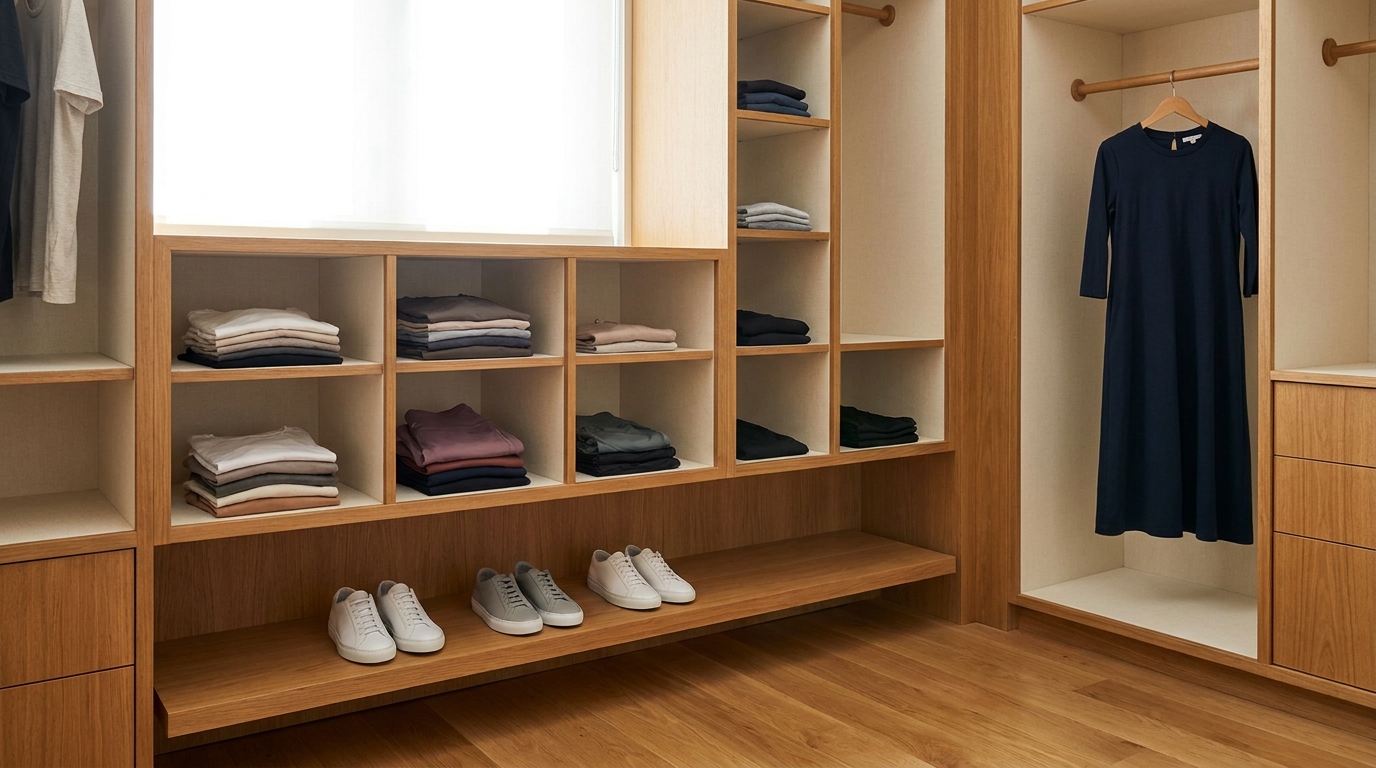
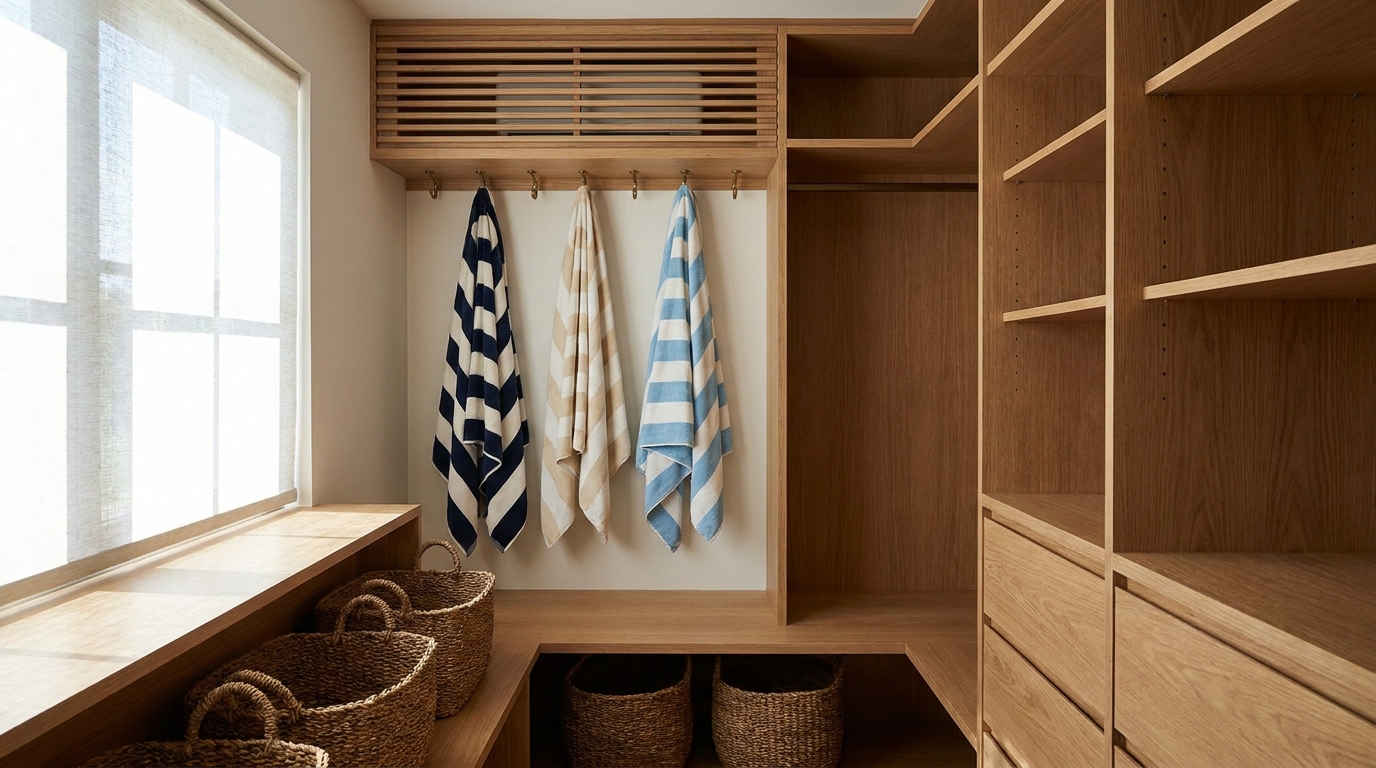
- Wet hooks with a vented door, a slotted panel, or an open section so air can move. This is the pause for towels that just came in. It is not the clean stack.
- Dry towels on a shelf that never takes the drip. Pool towels and lake towels can live here once they are actually dry, still separate from everyday bath linen.
- Life jackets on open hooks by size, visible from the doorway, with nothing stored on top of them.
- Sunscreen in a lidded bin out of direct sun, dates forward, sprays kept away from any flame source in the house.
Where water will drip, the surface has to tolerate being wiped. EPA says that in areas that may get wet, choose materials that do not absorb water and that stay stable when wet, and it gives a bathroom example of non-porous molding instead of a porous material such as wood [2]. We use that idea on the drip shelf. A surface you can wipe dry beats a shelf that stays damp after every swim.
A few choices keep the bay from turning into a junk closet:
- Do not store dripping towels in a plastic bag. The bag traps the moisture the vent was meant to let out.
- Leave enough empty hook space that a full Sunday does not force towels onto the dry shelf.
- Label the child jacket hook and the adult hooks so the right size is obvious when you are already late.
- Keep the bay for this gear only. It is not a row of personal mudroom cubbies, and it is not a garage sports rack.
If that wall sits near a shower, still keep the wet hooks off the bath linen. A fan vented outdoors, or an open window when conditions allow, helps during and after a shower [2]. It does not make the linen shelf a drying rack.
Practical takeaways
- Give pool towels, lake towels, life jackets, and sunscreen a vented bay of their own. Keep them out of the everyday bath linen and off the washer.
- Dry wet fabric quickly. EPA's guidance on wet furnishings is to dry them within 24 to 48 hours, and air movement helps [1]. A shut cabinet full of damp towels does the opposite [3].
- If a closet smells musty, treat that as a moisture problem [4]. Wash the towel. Do not refold it onto the clean stack.
- Do not share used pool towels. CDC's fact sheet tells swimmers not to share towels, and it tells pool operators to wash towels after each use [5].
- Hang each life jacket where you can see the size. The Coast Guard recommends wearing it whenever the boat is underway [6]. The hook does not replace wearing it, and it does not prevent drowning.
- Keep sunscreen out of direct sun and excessive heat, and throw it out when the date has passed or when you do not know how old it is [7].
- Put the bay on the path you walk from the pool, or from the car toward Lake Wylie, and size it to that wall.
How we can help
Our team designs this bay around the door you use, the number of swimmers in the house, and the jackets you really own. We separate wet hooks from dry towels, keep each jacket size visible, and put sunscreen where the date can be read. The result is a small piece of custom storage that protects the bath linen and makes lake day easier to start.
Have more questions or want to get in touch? Visit our contact page, call (704) 604-3870, or email design@theclosetrehab.com. The contact page is where you can ask about a free in-home design consultation. We will look at the wall with you and plan the bay to fit it.
Citations
- U.S. Environmental Protection Agency, "Mold Course Chapter 2: | US EPA" (2025-12-01)
- U.S. Environmental Protection Agency, "Biological Contaminants and Indoor Air Quality | US EPA" (2026-04-01)
- University of Minnesota Extension, "Dealing with and preventing mold in your home | UMN Extension" (2018)
- University of Georgia Cooperative Extension, "Mold and Moisture Home Inspection Checklist | CAES Field Report" (2023-03-01)
- Centers for Disease Control and Prevention, "Facts About MRSA and Swimming Pools" (2013-05-31)
- U.S. Coast Guard, "Frequently Asked Questions" (n.d.)
- U.S. Food and Drug Administration, "Sunscreen: How to Help Protect Your Skin from the Sun | FDA" (2026-09-10)