Laundry Room Product Storage: A Higher Closed Cabinet
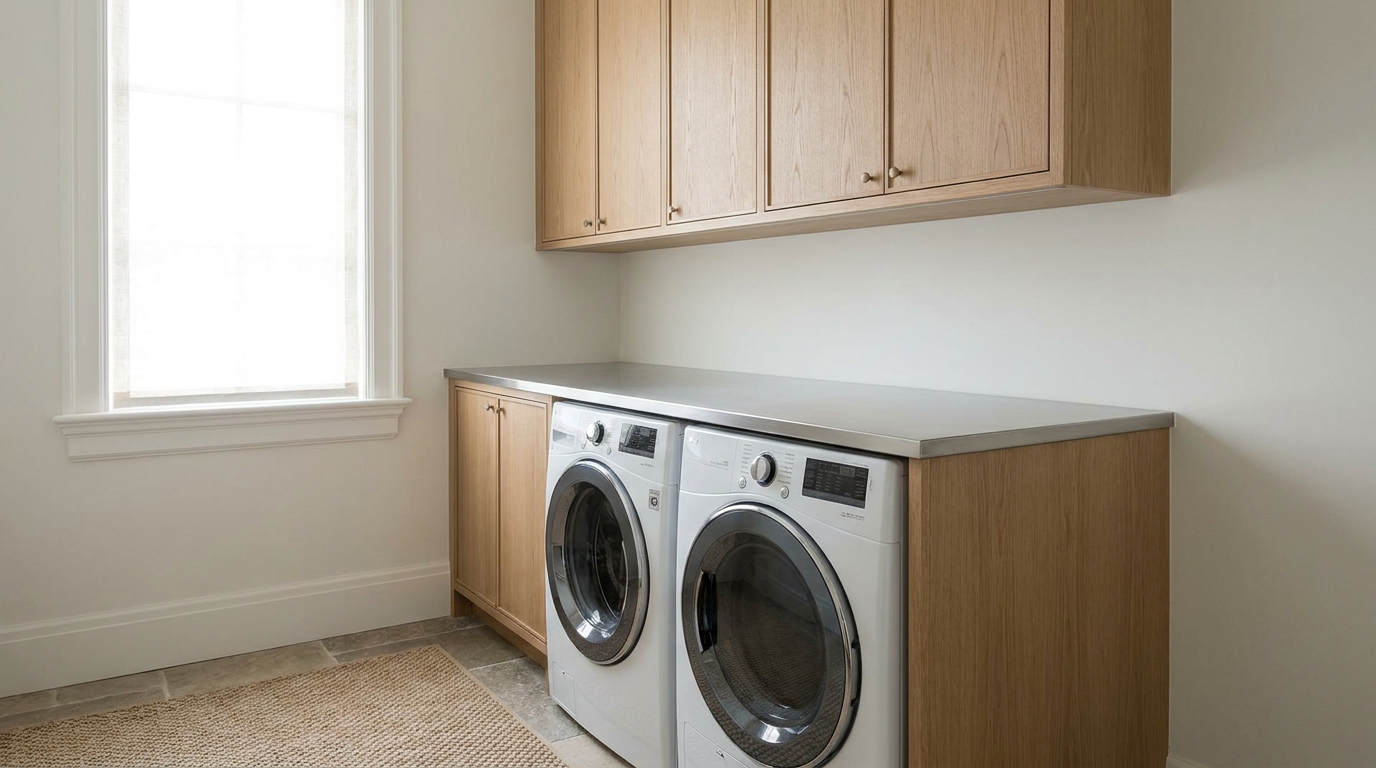
Detergent, bleach, and stain treatments do not belong on the dryer. That flat top is handy for the person running the load, and it is wide open to anyone else who walks in, including a small child. Laundry room product storage that holds up is a closed cabinet, set higher on the wall, with a latch that stays shut.
The American Academy of Pediatrics is plain about placement. A high, locked cabinet is best, and laundry products should not sit on the washer or dryer, or in the drawers under the machines.[1] Packets and pods raise the stakes, because a bite or a splash can cause serious harm. Liquid detergent, bleach, and stain sprays still do not belong in the open.[1][4]
We build that cabinet as its own assignment. It is not an air-dry rod, not a home for the vacuum, and not a redesign of the whole laundry. It is the shelf that gets the chemistry off the machine.
1. Why the dryer top keeps failing
The dryer top feels like storage because it is empty, flat, and right where you are standing. You set the jug down to find a sock, leave the pod tub open, or park a stain stick where you will see it tomorrow. None of that looks careless in the moment.
It adds up. The American Academy of Pediatrics warns that a child can grab a packet from the laundry basket, the top of the washer or dryer, or a counter in the time it takes an adult to reach for a pair of socks.[1] Young children move quickly, and they often reach higher than adults expect.[1]
Packets are made to dissolve on contact with water, wet hands, or saliva.[1][6] The film around the detergent is made to dissolve when it meets moisture.[2] A dryer top collects damp hands, splashes, and humid air. A closed cabinet will not fix a loose cap, but it gets the container off that wet surface.
If the machine is the only shelf, every bottle migrates there. Labels face the wrong way, and a child sees color and shape instead of a warning. Out of sight is part of the job, not a decorating preference.[1][2]
2. A cabinet for products, not a second utility closet
This cabinet has a short inventory. It holds laundry detergent in liquid, powder, or packet form, plus bleach, stain treatments, pretreat sprays, and fabric softener if you use it. That list is laundry room product storage in the literal sense.
It is not a broom closet. Vacuums, mops, and the hall utility cabinet are a different project. If the door opens onto cords and garage tools, the detergent jug loses that fight and ends up back on the dryer.
The products in the kit are not equally risky. Liquid and powder detergents can irritate the mouth, skin, or eyes. Serious injuries from those forms are not common, but they can happen.[4] Stain removers, pretreatments, and fabric softener can irritate if they are swallowed or splashed, and some stain products cause a painful rash.[4]
Ordinary bleach often causes less harm than its reputation. A small swallow might mean mouth irritation and vomiting, and more serious problems are unlikely unless the amount is large.[4] Newer concentrated bleach can cause serious burns.[4]
Rust remover is different. Some formulas contain strong acids, including hydrofluoric acid, which can cause severe pain, tissue damage, and even death.[4]
Pods are their own category. Biting into one can cause serious injury or even death, and individual pods have been associated with fatality.[4] If a pod tub or a rust remover is in the house, it should not be the first thing a child can reach. The cabinet keeps each product in its own bottle, label on, behind a door you can close.
3. Packets, pods, and the case for up, closed, and latched
Single-load packets are concentrated. The American Academy of Pediatrics says traditional detergent is much less toxic, and that even a small amount of packet detergent in a child's mouth or eyes can cause serious breathing or stomach problems, eye scratches, eye irritation, coma, or death.[1] If children age 6 or younger live in the home or visit, the Academy suggests considering traditional detergent instead of packets.[1] The cabinet still matters, because the rest of the kit does not become harmless when the pods are gone.
In January and February 2024, poison centers across the United States received 1,423 reports of exposure to laundry detergent packets in children age 5 and younger.[1] America's Poison Centers reports the same National Poison Data System figure: as of February 29, 2024, poison centers had managed 1,423 cases that year for children 5 and younger.[2] An exposure means contact, such as a taste, a splash, or detergent in an eye, not automatically a poisoning.[2]
Contact can still be serious. Poison Control lists effects that can come on quickly after a child bites a pod: severe vomiting, severe breathing trouble, burns to the esophagus, and coma, plus burns to eyes and skin.[3] America's Poison Centers describes excessive vomiting, wheezing, gasping, marked sleepiness, breathing trouble serious enough to need a ventilator, and scratches to the eyes.[2] In its November 2021 safety alert, Publication 390, the U.S. Consumer Product Safety Commission said children have been hospitalized after ingesting packet contents, including loss of consciousness, excessive vomiting, drowsiness, throat swelling, and breathing trouble that required a breathing tube, and that eye contact has caused severe irritation and temporary vision loss.[6]
Packaging has improved, and it is not the whole fix. Voluntary safety standards for these pods were published in 2015.[1] According to Poison Control, since those 2015 standards, the rate of exposures has decreased by about 30%, and the rate of cases needing medical treatment has decreased by about 40%.[3] Pod exposures are still more likely to cause symptoms, need medical care, and end in serious outcomes than traditional laundry products.[3]
The Academy's April 5, 2024 update says reports have decreased slightly and the products remain extremely toxic.[1] That update also reported that more than 8 million packages were under recall because the outer bag can split near the zipper, including certain lot codes of Tide Pods, Gain Flings, Ace Pods, and Ariel Pods.[1] A zipper is not a cabinet.
The 2021 alert says to lock packets up in the original package, out of sight and reach, because they are soft, colorful, and resemble candy, toys, and teething products.[6] The Academy adds that they can look like candy or gummy treats.[1] A glass door puts that look on display. A solid door, a higher mount, and a latch follow the warning better than a tidier dryer top.
Broader figures keep the claim in scale. In 2024, household cleaning substances were the top category among children 5 and under, with 87,031 cases, or 10.1% of substances in those exposures.[7] That count covers many cleaners, not laundry products alone, and Poison Control says these pediatric exposures are nearly always unintentional.[7]
In 2024, 99.2% of all poison exposures in children younger than 6 were unintentional.[7] In that same group, 97% of exposures were nontoxic, minimally toxic, or had at most a minor effect.[7] Pods, concentrated bleach, and rust remover are what make an accident more dangerous than a typical splash.[1][4]
4. Bleach and stain kits that should not share a puddle
A splash of ordinary bleach might cause minor skin irritation, while a child sitting in a puddle can develop a serious rash.[4] Household bleach is typically 3% to 6% hypochlorite.[5] Swallowing that household strength can irritate the mouth and throat and does not usually cause serious toxicity, while higher-strength solutions can burn the esophagus and stomach.[5]
Do not mix bleach with ammonia or with an acid.[5] Bleach plus acid forms chlorine gas, which burns the eyes, nose, and throat, causes coughing, and heavier exposure can injure the lungs.[5] Bleach plus ammonia forms chloramine gas, which is less likely than chlorine gas to cause serious toxicity, though the two still should not be mixed.[5] Ammonia shows up in some glass cleaners, and acids show up in vinegar and in some toilet bowl cleaners.[5]
The Academy's laundry guidance matches that rule. Never mix cleaning products, and do not combine detergent with ammonia or other household cleaners, because some mixtures release irritating or dangerous fumes.[1] A stain kit piled against a bleach jug is how those mixes start. Caps come off, and two products meet in a bowl or on a shirt.
The U.S. Environmental Protection Agency groups many household cleaners with products that can contain hazardous ingredients and and that can present hazards to children and pets if left around the house.[8] Follow the storage directions on the label.[8] Keep products in their original containers, never pour them into food containers, do not remove the labels, and never mix leftovers, because incompatible products might react, ignite, or explode.[8]
A measuring cup is a bad bleach pitcher. Children and adults have swallowed bleach from a cup, thinking it was water, and a cup left on the washer invites that mistake.[4] Spray bottles are a common source of unintentional poisoning, so they belong up and away too.[1] A shallow tray holds sticks and sprays upright, caps on, labels out, with bleach and any rust remover left in their own bottles.
5. What we build into a laundry product cabinet
Up, closed, and latched is the standard we design to. The latch is not a certified rating, only a pause for an adult hand, and it matters because children climb and often reach higher than adults expect.[1] The 2021 CPSC alert says to lock packets up and keep them out of sight and reach.[6]
In many Charlotte-area houses, the laundry sits off the kitchen or the mudroom. Children in homes we see around Ballantyne, Indian Land, and Rock Hill walk past the machines on an ordinary afternoon, so a door that only mostly closes will be open by bedtime. Here is what we check on a design visit.
- Set the bottom of the cabinet above a small child's standing reach, then add a latch an adult can work with one hand. Height without a latch is incomplete.[1][6]
- Use an opaque door so colorful packets do not read as a row of treats.[1][6]
- Leave enough depth for gallon jugs and pod tubs to stand upright, with the lid able to close. A crushed tub on its side is an open tub.
- Give stain sticks and spray bottles a lipped tray so they do not roll out.[1]
- Keep bleach in its original jug, on its own part of the shelf, away from products you might be tempted to combine with it.[4][5][8]
- Do not put these products in the drawer under the washer or dryer. The Academy names that drawer as a place to avoid.[1]
- Check the door swing against the dryer door. If the cabinet is a fight to open, the jug returns to the machine.
- Put heavier jugs on the lower shelf of that same high cabinet and packet tubs above them, on a surface that wipes clean.
Our laundry room storage work can include this cabinet, but the product cabinet is still its own brief. We measure the bottles you buy, because a pod tub, a bleach jug, and a row of sprays rarely share one opening. Adjustable pins, or one fixed shelf plus a tray, usually fit better.
The adult path matters as much as the height. You should open the door, take what the load needs, close the cap, and set the latch before the cycle starts. If that takes a step stool every time, people will skip it. A Waxhaw ranch and a Fort Mill two-story do not share the same ceiling or machine height, so we settle that balance in the room.
6. The habit that makes the cabinet work
A good cabinet cannot chase a bottle you left out. Take a packet or a capful only when the machine is ready, and keep your hands dry on a packet.[2][6] Close the tub, put it back, shut the door, and set the latch before you look for the missing sock.
If a child wants to help, do not hand over a single-load packet.[2] The Academy says the same, and it says the packet should stay in the original container until it goes into the washer.[1] Original containers, original labels, and tight caps show up in Academy guidance, Poison Control guidance, and EPA guidance for household products that can be hazardous.[1][4][8]
If a packet is bitten, or detergent gets in an eye, call instead of guessing. The Academy and the CPSC both point to Poison Help at 1-800-222-1222, and Poison Control describes that help as free and available at any hour.[1][3][6]
For pod contents in an eye, rinse gently with running water for 15 minutes, then call.[3] For another laundry product in the eyes or on the skin, flush for at least 15 minutes, then get poison-center guidance.[4] We build the cabinet. We do not give medical advice.
Practical takeaways
- Move detergent, bleach, and stain treatments off the dryer and out of any drawer under the machines.[1]
- Use a closed, higher cabinet with a latch. Height alone is not the plan, and a colorful open shelf is not storage.[1][6]
- Keep products in their original containers, labels on, caps tight.[1][4][8]
- Store packets where children cannot see or reach them, and close the container as soon as you take one.[2][3]
- Never mix bleach with ammonia or with acids such as vinegar, and do not mix leftover cleaners to use them up.[1][5][8]
- If children age 6 or younger live with you or visit, consider traditional detergent instead of packets.[1]
- Save Poison Help, 1-800-222-1222, before you need it.[1][6]
- If the cabinet is awkward, it will sit empty. Door swing and shelf height are part of the safety plan.
How we can help
We design and build custom cabinets for homeowners who want laundry products in one closed, higher place. On a free in-home design consultation, our team looks at the machines you have, the bottles you buy, and who walks through the room. Then we size the cabinet, the latch, and the shelves so the dryer top can be a dryer top again.
The cabinet can stand alone, or it can sit inside a larger plan for the laundry. Either way, the assignment stays narrow: detergent, bleach, and the stain kit, up and behind a door.
Have more questions or want to get in touch?
Visit https://theclosetrehab.com/contact-us/ , call (704) 604-3870 , or email design@theclosetrehab.com . Ask for a laundry product cabinet and a free in-home design consultation, and we will look at the room with you.
Citations
- American Academy of Pediatrics, HealthyChildren.org, "Laundry Room and Detergent Safety" (2024)
- America's Poison Centers, "Laundry Detergent Packets" (2024)
- Poison Control, "What happens if a child eats a Tide Pod?" (n.d.)
- Poison Control, "Children and laundry products" (n.d.)
- Poison Control, "Chlorine gas: Get the facts" (n.d.)
- U.S. Consumer Product Safety Commission, "Single-Load Liquid Laundry Packets: Harmful to Children" (2021)
- Poison Control, "National poison center statistics, 2024" (2024)
- U.S. Environmental Protection Agency, "Household Hazardous Waste (HHW)" (2026)