Laundry Room Hanging Storage Off the Door
Laundry room hanging storage belongs in the laundry, not on the door. A dedicated ventilated hang bay (a rod, a fold-down bar, or an open-front cabinet with airflow) gives sweaters, silk, and other delicates a place to air-dry in place so they never drape over the door, the machines, or a nearby hallway. That is not a full laundry-layout lecture. It is one job: hang or lay garments to dry, then get the moisture out of the room before it condenses on cabinets, clothing, or cool walls. EPA guidance is blunt that mold control starts with moisture control, and that indoor humidity should stay below 60 percent (ideally 30 to 50 percent).[1][2] If a hang bay is closed, unventilated, or parked against a hot dryer, it can become a damp closet instead of a drying station.
1. Why delicates end up on the door
Most homes already air-dry some of the wash. Care labels require a drying method, and many garments are marked to line dry, drip dry, or dry flat rather than tumble.[7] National Park Service laundry guidance, last updated in 2021, still encourages air-drying on clotheslines or drying racks because clothing makers recommend it for some fabrics.[8] The problem is not the habit. The problem is the landing spot.
When there is no planned hang bay, wet items land wherever they fit:
- Over the laundry door, which blocks the opening, traps humid air in a small room, and leaves drip marks on the slab or the door face.
- Across the top of the washer or dryer, which puts fabric next to heat, lint, and moving parts.
- On a shower rod in another room, which spreads moisture and wet-laundry odor through the house.
- Over a chair back or a bedroom door, which stretches knits and keeps the garment in the way for hours.
A door is a poor drying rack. It is a vertical, poorly ventilated surface that sits in a high-traffic opening. Wet fabric hanging there also keeps the door from closing, so humid air stays in the laundry instead of mixing with drier air from the rest of the house. EPA specifically lists increased ventilation and air movement (opening doors or windows when practical, using fans as needed) as a way to prevent condensation.[1] A door covered in wet shirts works against that advice.
Our team sees this most in compact laundry closets in Charlotte, Ballantyne, and Fort Mill, where the machines already fill the footprint. Without a designed rod or fold-out bay, the door becomes the only horizontal-to-vertical surface left.
2. What laundry room hanging storage should actually do
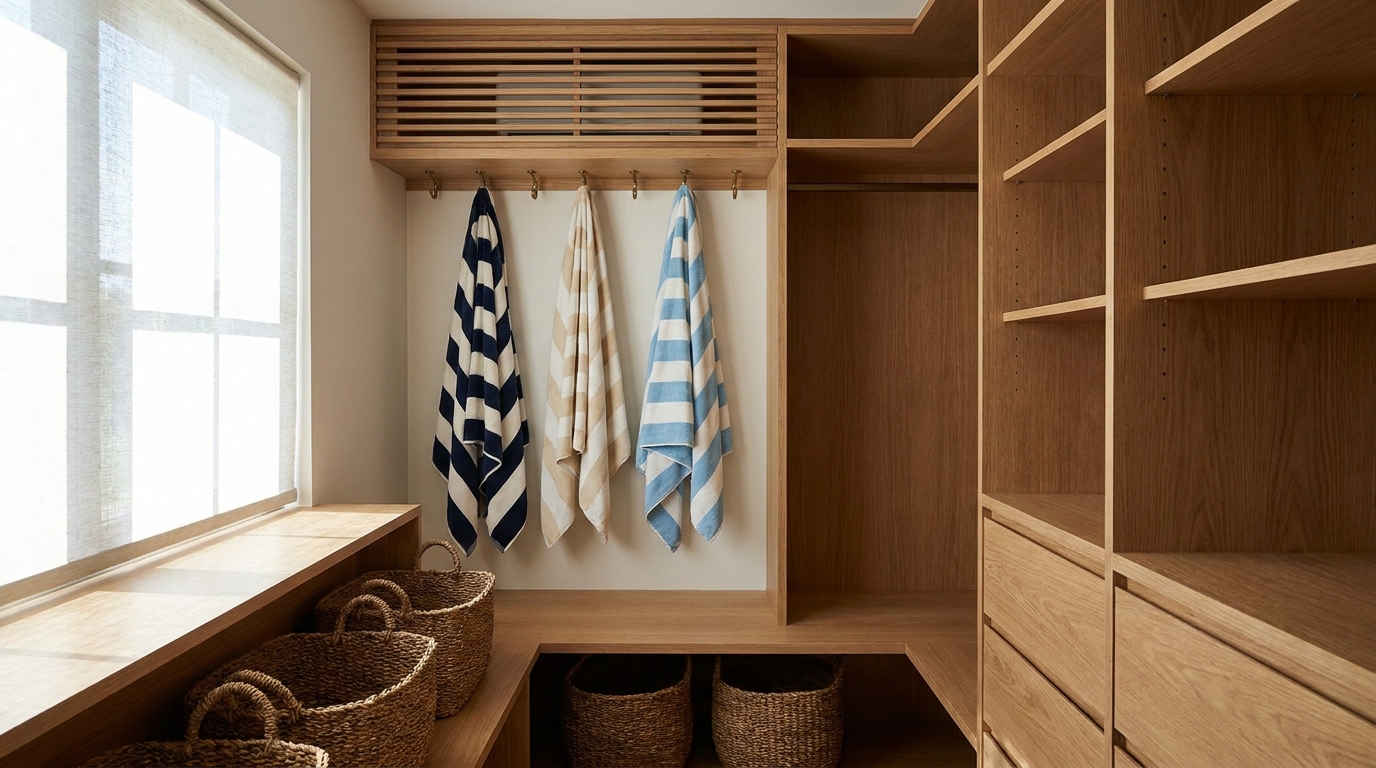
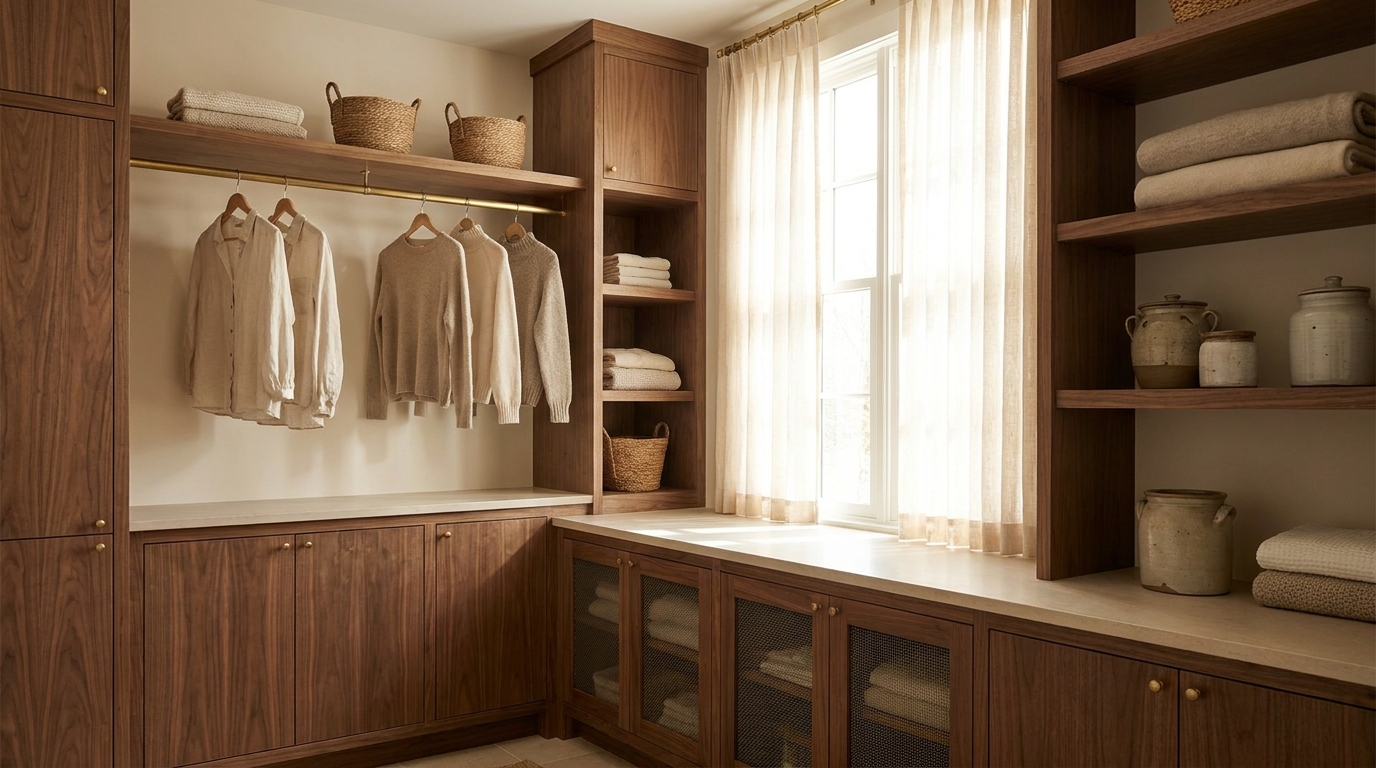
A hang bay is a planned drying station next to the washer, not a leftover closet rod. On our laundry room storage work, hanging rods are already part of the kit: sturdy bars for air-drying delicates and for hanging freshly pressed pieces before they go back to the closet. The hang bay we mean here is more specific. It is sized, ventilated, and kept clear of the dryer so garments can finish drying without becoming a moisture problem.
A useful hang bay does four jobs:
- Holds wet garments off doors, floors, and appliance tops.
- Lets air move around fabric so items dry within a reasonable window, not over several damp days.
- Separates hang-dry pieces from dry-flat knits, so sweaters are not stretched on a hanger while blouses drip on a rod.
- Keeps the drying load away from the dryer cabinet, lint path, and exhaust.
Typical hardware, used as a set rather than as a single gadget:
- A full-width hang rod at a height that keeps hems off the floor and off the machines.
- A fold-down or pull-out rod that parks flush when you do not need it, then opens into the room for a wash load.
- A short valet section for a few drip-dry shirts, spaced so air can pass between hangers.
- A mesh or slatted shelf (or a pull-out drying tray) for items that must dry flat.
- Open, louvered, or no doors on the drying bay itself. A tight, solid-door cabinet is a closet, not a dryer.
The hang bay is distinct from sorting hampers, folding counters, and ironing boards. Those stations matter, but they do not replace a ventilated rod. If the only “air-dry” option is a closed upper cabinet, wet wool and damp synthetics will sit in still air. EPA’s mold house tour notes that high room humidity can grow mold on indoor items, including clothing, and that laundry dryers that are not vented outdoors raise humidity and can lead to mold.[3]
3. Hang, drip, or dry flat: follow the care label
Federal care-label rules require a drying method on the garment, and the Care Labeling Rule glossary (16 CFR Part 423, Appendix A) names the methods a hang bay should support:[7]
- Line dry: hang damp from a line or bar, indoors or out.[7]
- Drip dry: hang dripping wet, with or without hand shaping.[7]
- Dry flat: lay the item out horizontally for drying.[7]
- Block to dry: reshape to original dimensions while drying.[7]
- Line dry away from heat and line dry in shade when those warnings appear.[7]
That is why a rod alone is not enough. Knitwear and many sweaters should not hang while wet. The Woolmark Company, which sets wool-care standards, recommends drying sweaters and other knitwear flat. Line drying or hanger drying can stretch a wet knit because the moisture makes the garment heavier, so it grows in length and loses shape.[10] Woven pieces such as tailored trousers or a jacket can hang on a hanger, out of direct sunlight.[10] Direct heat (a radiator, a dryer top, a hot supply pipe) is a poor drying surface for wool.[10]
Build the bay so both methods fit:
- Hang zone: a rod with open air above and below, enough width for hangers to sit an inch or more apart, and a drip edge or easy-clean floor finish under it.
- Flat zone: a pull-out mesh tray, a slatted shelf, or a fold-down screen large enough for a sweater to lie in its true shape.
- Short-term staging: a couple of hooks for a single blouse that only needs an hour, not a weekend on the door.
Read the sewn-in label before you choose the spot. If the label says dry flat, the rod is the wrong tool. If it says line dry or drip dry, a door hook is still the wrong tool because it crowds the opening and bunches the garment.
Air-drying is also an energy choice, not only a fabric choice. A 2025 University of Michigan analysis, reported by EurekAlert, found that household dryers use about 3 percent of U.S. residential energy (about six times the energy used by washing machines). Over a dryer’s lifetime, 100 percent line drying could save a household upwards of $2,100. A mix of line drying and dryer use ranked as the second most economical option, ahead of simply buying a more efficient dryer.[6] ENERGY STAR notes that about 80 percent of U.S. households have a clothes dryer and that the average consumer runs more than 280 laundry cycles a year, enough that those conventional cycles can use more energy than a refrigerator uses in a full year.[5] You do not need to abandon the dryer. You do need a real place for the share of the load that should never go in it.
4. Moisture control so a hang bay does not grow mold
Indoor air-drying moves water out of fabric and into the room. Pacific Northwest National Laboratory’s Building America guidance states that clothes dryers vent about a gallon of water for each typical load. If that moisture empties into a crawlspace, attic, or other building cavity, moisture damage can follow, which is why dryers must vent outdoors (except listed ventless units with a condensate drain).[9] A hang bay does not have a duct. Every ounce that evaporates from a wet sweater stays in the laundry until ventilation, a dehumidifier, or the home’s air system removes it.
That is the design constraint. EPA’s core mold points apply directly to a drying cabinet:
- The key to mold control is moisture control.[1][2]
- Dry wet or damp materials within 24 to 48 hours in most cases, or mold is more likely to grow.[1][2]
- Keep indoor humidity below 60 percent, ideally 30 to 50 percent, and measure it with an inexpensive humidity meter.[1]
- Reduce humidity by venting clothes dryers and other moisture sources to the outside, using air conditioning or dehumidifiers, and increasing ventilation.[1][2]
- Increase air movement by opening doors or windows when practical and using fans as needed.[1]
- Condensation on windows, walls, or pipes is a signal to dry the surface and cut the moisture source.[1]
EPA’s laundry-room note is specific: improperly vented clothes dryers increase room humidity and may lead to mold, and clothes dryers must be vented outdoors.[3] The same logic applies to a sealed hang cabinet. If wet clothes sit behind solid doors in still air, you have built a small, humid closet. EPA’s bedroom-closet example in the same house tour is the cautionary picture: high room humidity can grow mold on furnishings or clothing.[3]
Keep a humidity meter in the laundry. If readings sit above 60 percent while clothes hang, add a dehumidifier or more air movement rather than adding more wet items.[1][2] If a sweater is still cool and damp at 48 hours, the bay is too tight, the room is too humid, or the washer did not extract enough water.[1] Fix leaks first. A hang bay cannot compensate for a dripping supply valve or a dryer that dumps moisture into the room.[1][2]
The 2025 Michigan authors noted that indoor line drying works if you have some room that does not get too humid or too cold.[6] In Charlotte, Wesley Chapel, Waxhaw, and Rock Hill, summer air already carries a lot of moisture. A hang bay without airflow is a poor match for that climate. The cabinet has to breathe.
5. Keep the hang bay off the dryer
The hang space should sit beside the laundry pair, not on it. CPSC Publication 5022 (reprinted 2012) explains that fires can occur when lint builds up in the dryer or the exhaust duct, blocking airflow and causing heat build-up.[4] Clean the lint screen before or after each load. Damp clothes at the end of a normal cycle, or cycles that run longer than usual, can mean a blocked screen or duct.[4] Clean the vent and exhaust duct periodically, confirm air is leaving the outdoor hood, and clean behind the dryer, where lint collects.[4] Keep the area around the dryer clean and free of clutter.[4] Replace plastic or foil accordion duct with rigid or corrugated semi-rigid metal duct so the run does not kink, crush, or trap lint.[4]
That clutter rule is why we do not treat the dryer top as a hang rail. Wet shirts on the cabinet, baskets against the sides, and a rod mounted so garments brush the dryer door all work against clearance and cleaning. Building America also warns against devices that strip lint and dump dryer heat back into the house, because they add unwanted moisture indoors.[9] A hang bay should not become a makeshift indoor dryer vent.
CPSC also notes a different hang-dry case: clothing soiled with volatile chemicals such as gasoline, cooking oils, cleaning agents, or finishing oils. Wash more than once if possible, and preferably hang those clothes to dry rather than using the dryer.[4] That is another argument for a dedicated rod that is not the appliance.
NFPA’s 2017 summary of 2010 to 2014 home fires involving dryers or washers estimated about 15,970 such structure fires a year, with about 92 percent involving dryers. Dust, fiber, or lint was the leading item first ignited in dryer fires (26 percent), tied with clothing (26 percent).[11] Those figures are more than a decade old, so treat them as historical context, not this year’s count. The design takeaway has not aged out: keep lint paths clean, and do not store fabric against the machine.
Give the dryer a clear service gap. Pull-out rods and fold-down bars should open into the room, not across the dryer door. In Indian Land and Fort Mill laundry closets, that often means a rod on the side wall or a fold-down bar on an adjacent cabinet, never a rack that rests on the dryer.
6. Design details that keep air moving
A hang bay fails quietly: clothes take two days to dry, the room smells sour, and the inside of a cabinet feels cool and damp. Airflow is the fix.
- Prefer an open niche or louvered front on the drying section. Closed uppers can still hide detergent.
- Keep the bay one item deep. A second row of hangers blocks the first.
- Put the rod over a washable floor or a shallow drip tray, not over raw particleboard.
- Put the mesh shelf at mid-height so air can pass above and below a sweater. Woolmark notes that mesh screens speed drying because air can reach both faces of the garment.[10]
- Confirm the dryer vents outdoors through smooth metal duct, not into the hang bay, attic, or a lint box.[3][9]
- Run a laundry exhaust fan while items hang. EPA lists exhaust fans among humidity-reduction tools, alongside venting dryers and using dehumidifiers.[2]
- In interior rooms with no window (common in Ballantyne and Wesley Chapel plans), a dehumidifier is often the backup. EPA recommends dehumidifiers when needed.[1][3]
- Once garments are dry, move them. A packed rod cannot dry the next load.
Piedmont summers put more water in the air before you add a wet load. A hang bay that works in January can stall in July unless the fan or dehumidifier is part of the routine.[6] If the dryer vent is loose, crushed, or dumped indoors, the hang bay sits in a steam cloud.[5][9]
7. How we plan hang bays for Charlotte-area homes
We start with the garments you actually air-dry, then we fit a bay that can finish those pieces without stealing the door. In a Waxhaw mudroom laundry, that might be a fold-down rod over a short run of cabinets. In a Rock Hill reach-in laundry closet, it might be a side-wall rod plus one pull-out mesh tray. In a larger Charlotte or Fort Mill laundry, it can be an open hang niche with a rod, a flat shelf, and a humidity meter on the side panel.
What we specify:
- A ventilated hang section, never a sealed drying closet with solid doors on wet clothes.
- Rod plus dry-flat tray, so knits and woven pieces each have the right surface.[7][10]
- Clearance around the dryer for lint cleaning and for CPSC’s clutter-free zone.[4]
- A moisture plan: outdoor dryer vent, fan or dehumidifier, and a humidity target under 60 percent, ideally 30 to 50 percent.[1][2][3][9]
- Finishes that tolerate drips, because a hang bay will see water.
We do not ask you to give up the dryer. The 2021 National Park Service laundry brief notes that ENERGY STAR certified dryers use about 20 percent less energy than conventional models, and ENERGY STAR’s 2024 heat-pump overview puts those models around 70 percent less energy than conventional electric dryers, with lower drying temperatures that are gentler on clothes.[5][8] The hang bay is for the load those machines should not take: delicates, labeled line-dry pieces, and the items you already refuse to tumble. Give them a real station, keep the door free, and keep the room dry enough that the cabinet never becomes a mold site.
Practical takeaways
- Stop using the laundry door as a drying rack. It blocks airflow and parks wet fabric in a traffic opening.[1]
- Plan laundry room hanging storage as a ventilated bay: rod for line-dry and drip-dry items, mesh or slatted tray for dry-flat knits.[7][10]
- Read the care label. Line dry, drip dry, and dry flat are different methods in the federal care-label glossary.[7]
- Do not hang wet sweaters. Dry knits flat so they do not stretch under their own wet weight.[10]
- Keep indoor humidity below 60 percent, ideally 30 to 50 percent, and dry damp items within 24 to 48 hours.[1][2]
- Vent the dryer outdoors and never into the hang bay, attic, or a room cavity.[3][9]
- Keep the dryer clear of hanging clothes and clutter. Clean the lint screen every load and treat the area around the machine as a service zone, not a rack.[4]
- Open the bay. Solid doors on wet laundry create a humid mini-closet. Use open fronts, louvers, or a fold-down rod in the room air.[1][3]
- Air-dry the share of the wash that should not tumble. Mixed line drying and dryer use was more economical than efficiency upgrades alone in the 2025 Michigan analysis, as long as the drying room does not stay too humid.[6]
- Move dry clothes off the rod. A packed hang bay cannot dry the next load.
How we can help
Our team designs custom laundry storage for homes across Charlotte, NC, Fort Mill, SC, Rock Hill, SC, Ballantyne, NC, Waxhaw, NC, Wesley Chapel, NC, and Indian Land, SC. If you want a ventilated hang bay and fold rod that keep delicates off the door, we will measure the room, plan the rod and dry-flat tray around your machines, and keep moisture and dryer clearance in the drawing. See how hanging rods fit into our laundry room storage work, then talk with us about a bay sized to your actual air-dry load.
Have more questions or want to get in touch?
https://theclosetrehab.com/contact-us/ (704) 604-3870 design@theclosetrehab.com
Citations
- U.S. Environmental Protection Agency, "A Brief Guide to Mold, Moisture and Your Home" (2026-02-18)
- U.S. Environmental Protection Agency, "What are ten things I need to know about mold?" (2025-09-25)
- U.S. Environmental Protection Agency, "Text Version of the Mold House Tour" (2025-09-25)
- U.S. Consumer Product Safety Commission, "Overheated Clothes Dryers Can Cause Fires" (Publication 5022, reprinted 2012)
- ENERGY STAR / U.S. EPA, "Save More On Laundry with a Heat Pump Clothes Dryer" (2024-08-12)
- EurekAlert! / University of Michigan, "Clothes dryers and the bottom line: Switching to air drying can save hundreds" (2025-03-10)
- Legal Information Institute, 16 CFR Appendix A to Part 423, "Glossary of Standard Terms" (CFR; drying terms include line dry, drip dry, and dry flat)
- U.S. National Park Service, "Laundry Practices and Water Conservation" (2021-08-11)
- PNNL Building America Solution Center, "Proper Clothes Dryer Venting" (live 2026)
- The Woolmark Company, "How do I dry wool?" (live 2026)
- National Fire Protection Association, "Home fires involving clothes dryers and washing machines" (2017-03-01; data years 2010–2014)