Mudroom Cubbies: One Per Person, Separate Wet Zone
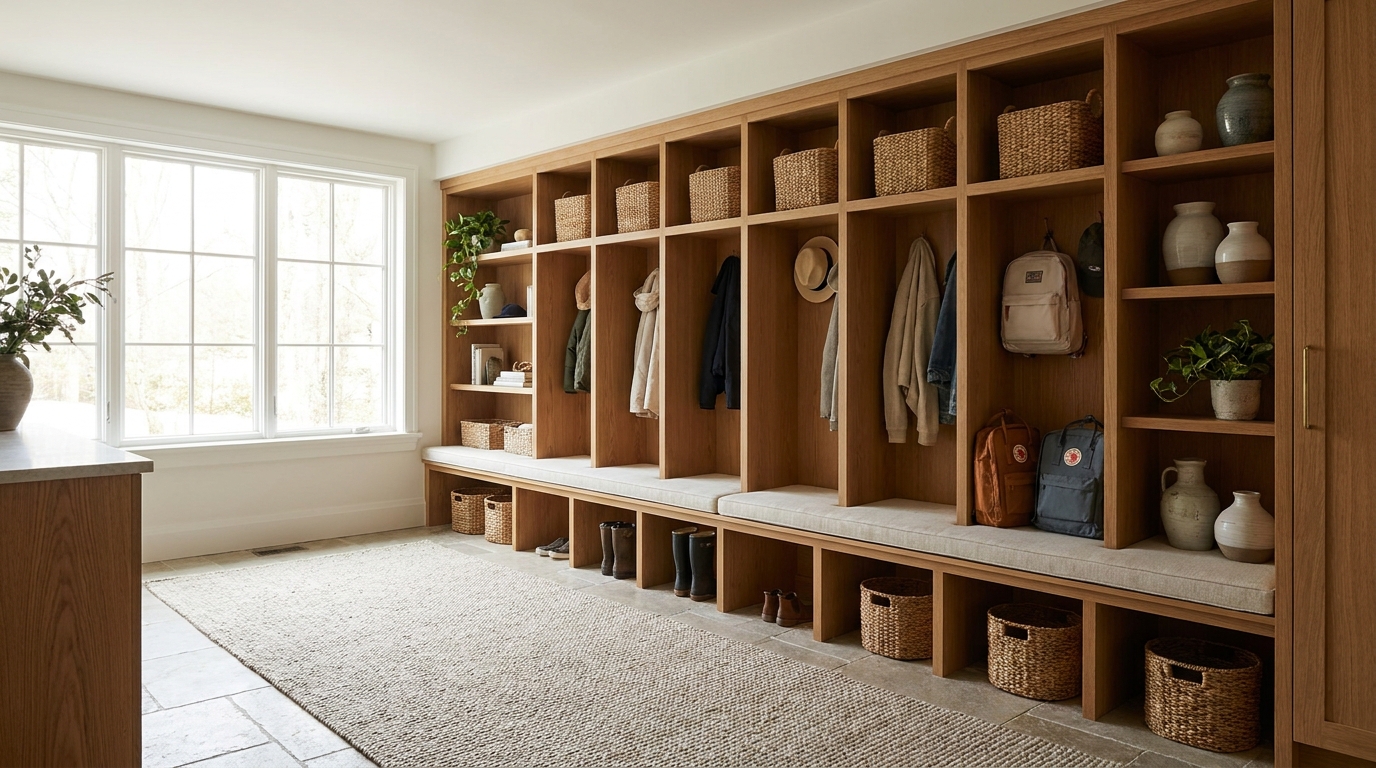
The mudroom that holds up for a Charlotte family is not a shared coat rail and a pile of shoes. It is one assigned cubby per person, plus a separate wet-gear zone where boots and rain jackets can dry without soaking the backpacks next door. Wet items left in a closed cubby stay damp long enough to feed musty odors and mold. The EPA's guidance is to dry wet or damp materials within 24 to 48 hours, and to keep indoor humidity below 60 percent (ideally 30 to 50 percent). [1]
That split (personal dry cubbies, shared drying) is what we design for Fort Mill, Ballantyne, and Waxhaw households that come in from summer storms and winter rain with a backpack, a lunchbox, and muddy shoes all at once.
1. Why one cubby per person beats a shared pile
A shared bench looks tidy in a photo. In real life it becomes one person's soccer bag, another person's poster, and a third person's wet hoodie on the same hook. When nobody owns a slot, nobody resets the room.
Assigned cubbies fix the ownership problem. Each person gets a labeled bay with a hook, a shelf, and a bin. N.C. Cooperative Extension's home-organization guidance is to create a drop zone in a high-traffic area and make it functional with bins, tags, and labels so things have a home instead of a pile. [2]
A named slot is faster than a "family" shelf. UGA Extension's clutter-control circular tells households to follow a 60-second rule: if putting something away takes no more than a minute, put it away now instead of setting it down "for the time being." [3] A cubby with your name on it makes that rule realistic after school.
Kids can maintain a cubby they can reach. Kid-height hooks and a low bin turn cleanup into a chore they can finish. UGA Extension also recommends assigning age-appropriate jobs so everyone contributes, and notes that a new chore takes about two weeks to become a routine. [3]
What we put in each personal bay:
- One primary hook for a daily backpack or work bag
- A second hook for a dry jacket or hat
- A mid-height shelf for a lunchbox, water bottle, or charger
- A floor or low bin for dry shoes that live at the door
- A label (name, initial, or color) a child can read at a glance
That is the dry half of the system. The wet half lives somewhere else on purpose.
2. What belongs in a personal cubby (and what does not)
Personal mudroom cubbies should hold the gear that has to leave the house tomorrow morning, and only the dry version of that gear.
Keep in the assigned cubby: dry backpacks and work bags, dry everyday jackets, lunchboxes, keys, and sneakers that are not dripping.
Keep out of the assigned cubby: rain jackets that are still wet, boots with mud or standing water in the sole, soaked practice uniforms, umbrellas that have not dripped out, and seasonal overflow (ski gear in July, beach towels in January).
The reason is moisture, not neatness. UGA Extension lists textiles among the household materials that feed mold when moisture is present, and it repeats the EPA target of keeping indoor humidity below 60 percent, ideally 30 to 50 percent. [4] A wet raincoat zipped into a closed cubby is a textile plus moisture in a still pocket of air.
ENERGY STAR is direct about hanging wet fabric indoors: if you are not using a dryer, dry clothes outdoors rather than hanging them inside, because indoor hanging adds humidity to the house. [5] Wet gear needs a zone built to dry, not a cubby built to hide it.
3. The shared wet-gear zone (this is the piece most mudrooms skip)
A wet-gear zone is a shared bay, locker, or open wall for items that arrived wet. Everyone uses it. Nobody owns it the way they own a cubby. The job is airflow, drip control, and a short stay.
Give wet items air, not a lid. Open slats, a ventilated locker, or hooks with space between them beat a closed cabinet. EPA guidance is that if wet or damp materials dry within 24 to 48 hours, mold usually does not start. [1] Closed doors slow that clock.
Catch the drip before it hits the finish floor. A boot tray, grated mat, or removable liner under the wet hooks keeps water off hardwood and out of the dry shoe bins. UGA Extension's entry-system advice is to capture soil, pollutants, and moisture at the door with a hard walkway, a scraper mat outside, and an absorbent mat inside, then leave outdoor shoes at the door. [6]
Keep the wet zone next to the bench, not inside the cubbies. Sit, shoes off, wet jacket on the drying hook, dry backpack into your cubby. If the drying hooks are across the room, wet gear lands in the nearest cubby "just for tonight."
A simple wet-gear wall we specify often includes:
- Two or three heavy hooks reserved for dripping jackets
- A boot tray long enough for the household's wettest day
- A slatted or open shelf so air moves under the boots
- A rag hook for wiping mud, not for storing wet towels
- A small closed cabinet nearby for dry extras so they never share a bin with the wet pair
ENERGY STAR's humidity range for a building is generally 30 to 50 percent relative humidity, and levels above that range may promote mold growth. [5] One ventilated bay is easier to keep in that range than a room where every cubby is a mini damp closet.
4. Bench, hooks, and the drop-off sequence
The bench is the pause that makes the layout work. People sit down, shoes come off, and hands are free to hang the backpack in the right cubby.
Put the bench on the door people actually use. In many Ballantyne and Waxhaw homes that door is the garage entry, not the front foyer. The cubbies belong on that wall.
Use two hook heights. Adults hang at standing reach. Kids hang where they can get the backpack off without dragging a stool over. A stool next to a tall unit is also a climbing invitation (see section 6).
Plan the path as a short script:
- Wipe or scrape at the mat so moisture stays at the door. [6]
- Sit on the bench and take off wet shoes.
- Wet shoes and jackets go to the shared drying zone.
- Dry backpack, keys, and lunchbox go to the assigned cubby.
- Hands are empty before anyone walks into the kitchen.
UGA Extension notes that the greatest concentration of household dust is often in carpeting near the entryway, which is one more reason we prefer a hard floor and a real mat at the drop zone, not wall-to-wall carpet under the bench. [6]
5. Charlotte rain, humid summers, and wet winters
This is a Piedmont layout, not a ski-country mudroom. North Carolina has a humid climate with very warm summers and moderately cold winters. NOAA's 2022 state climate summary puts the long-term statewide average near 49.6 inches of precipitation a year, generally highest in summer and peaking in July. [7]
Summer is the wet-gear season people forget. Afternoon and evening thunderstorms are common when the Bermuda High draws moisture inland, so a July practice or a Fort Mill carpool can soak a backpack even when the morning was dry. [7] If that pack goes into a closed cubby overnight, you have handed the EPA's 24-to-48-hour drying window to a dark box. [1]
Winter here is often rain, not a snow day. Families still come in with umbrellas and boots, so the wet-gear zone has to work in January as well as July.
Humidity is the quiet problem. EPA and ENERGY STAR both point to the 30 to 50 percent indoor range as the target that discourages mold. [1][5] A mudroom that opens to a garage can also pull in warm, moist air. We leave breathing room in the wet bay and we do not hide wet clothes behind finished doors.
6. Anchor tall cubbies and keep the floor clear
Tall cubby towers and shelf units are furniture with shelves (and often doors). Children climb them for a backpack on the top shelf. That is a tip-over problem, not just a scuff mark.
CPSC's February 2024 tip-over report estimated an annual average of 17,800 emergency-department-treated instability or tip-over injuries from 2020 through 2022. About 7,800 of those injuries were to children under 18. Of the estimated 6,400 furniture-related injuries to children in that period, about 1,000 involved shelving, a shelving unit, or a bookcase. [8]
Anchor the unit to the wall. UGA Extension's childproofing checklist says to use brackets, braces, or wall straps to secure unstable or top-heavy furniture to the wall. [9] We treat that as part of the install, not a weekend afterthought.
Store the heavy and tempting items low. CPSC notes that tip-overs can be affected by a top-heavy design, use on carpet, unused or defective restraints, heavy objects on top of furniture, or multiple open drawers. [8] In a mudroom that means backpacks on hooks a child can reach, closed upper cabinets for off-season gear only, no baskets perched on the crown of a tall unit, and a clear floor in front of the bench.
Clear floors also cut trip risk. UGA Extension flags falls when people have to maneuver around piles, and notes that dust, pollen, and mold spores collect on clutter. [3]
7. Materials and ventilation that match a wet room
A mudroom is closer to a utility room than a living-room built-in. Finishes have to take grit, drip, and backpacks.
Prefer hard, wipeable surfaces at the wet line. Easy-to-wipe interiors beat fabric bins that stay damp. UGA Extension lists wood, textiles, paper, and leather as mold food when moisture is present. [4] We still use finished wood for the system. We do not line the wet bay with carpet or cloth.
Leave air paths. ENERGY STAR's dehumidifier guidance treats indoor moisture as a building issue: vent dryers outdoors, use bath and kitchen fans, and do not treat the house like a drying rack. [5] In the mudroom, that means space between hooks, a tray that does not seal boots into a puddle, and open or louvered doors on the wet locker.
Measure humidity if the room feels sticky. EPA notes that an inexpensive humidity meter is enough to check whether you are under 60 percent, and ideally in the 30 to 50 percent band. [1] Off-season coats belong in a closed cabinet, not in tomorrow's cubby.
8. How we design family cubby systems
On our mudroom and drop zone page, you can see the pieces we specify together: individual cubbies, hooks at two heights, a bench with shoe storage, and backpack zones. The layout in this post is how we put those pieces in an order that keeps wet and dry apart.
We start with a headcount. How many people use the door every day? Who carries a backpack? Who comes home with a soaked team bag? The number of assigned cubbies is that headcount, plus one overflow bay if the wall allows it.
We place the wet zone first. Once the drying hooks and boot tray have a home next to the bench, the personal cubbies take the rest of the wall. Doing it the other way around usually leaves wet gear with nowhere honest to go.
We match heights to the actual kids in the house. A first-grader and a high-schooler should not share one hook height. We also specify a hard floor and a real mat run, following UGA Extension's three-part entry system (hard walkway, scraper, absorbent mat) so the cubbies are not doing the job of a doormat. [6]
That order keeps a wet raincoat out of a dry backpack on a school-night downpour.
Practical takeaways
- Give every person one labeled cubby for dry daily gear, and keep wet items out of that cubby.
- Build a shared wet-gear zone with open air, a boot tray, and reserved drying hooks next to the bench.
- Dry wet jackets and boots within 24 to 48 hours, and aim for indoor humidity below 60 percent, ideally 30 to 50 percent. [1][5]
- Use a mat-and-shoe-off sequence at the door so moisture and grit stop before they reach the kitchen. [6]
- Put the bench on the door people actually use (often the garage entry).
- Anchor tall cubby units to the wall, keep heavy items low, and leave the floor in front of the bench clear. [8][9]
- Label cubbies so a child can reset their own slot in under a minute. [2][3]
How we can help
Have more questions or want to get in touch? We design assigned cubbies, wet-gear walls, and bench-plus-hook layouts for Charlotte-area families, and we will measure the real door you use every day. Start on our contact page · (704) 604-3870 · design@theclosetrehab.com
Citations
- U.S. Environmental Protection Agency, "A Brief Guide to Mold, Moisture and Your Home" (2026-02-18)
- N.C. Cooperative Extension (Yancey County Center), "Uncovering Your Clean Slate" (2022-12-30)
- University of Georgia Cooperative Extension, "Household Clutter Control" (2025-12-05)
- University of Georgia Cooperative Extension, "Preventing Mold in Your Home" (2023-03-01)
- ENERGY STAR, "Dehumidifiers" (page accessed 2026-08-17)
- University of Georgia Cooperative Extension, "Reduce Indoor Contaminants: Leave Your Shoes at the Door" (2025-12-04)
- NOAA NCEI / NCICS, "North Carolina - State Climate Summaries 2022" (2022)
- U.S. Consumer Product Safety Commission, "Product Instability or Tip-Over Injuries and Fatalities Associated with Televisions, Furniture, and Appliances: 2023 Report" (2024-02)
- University of Georgia Cooperative Extension, "Childproofing Your Home: A Room-by-Room Safety Checklist" (2025-10-10)