Custom Pot and Pan Storage in Drawers by the Range
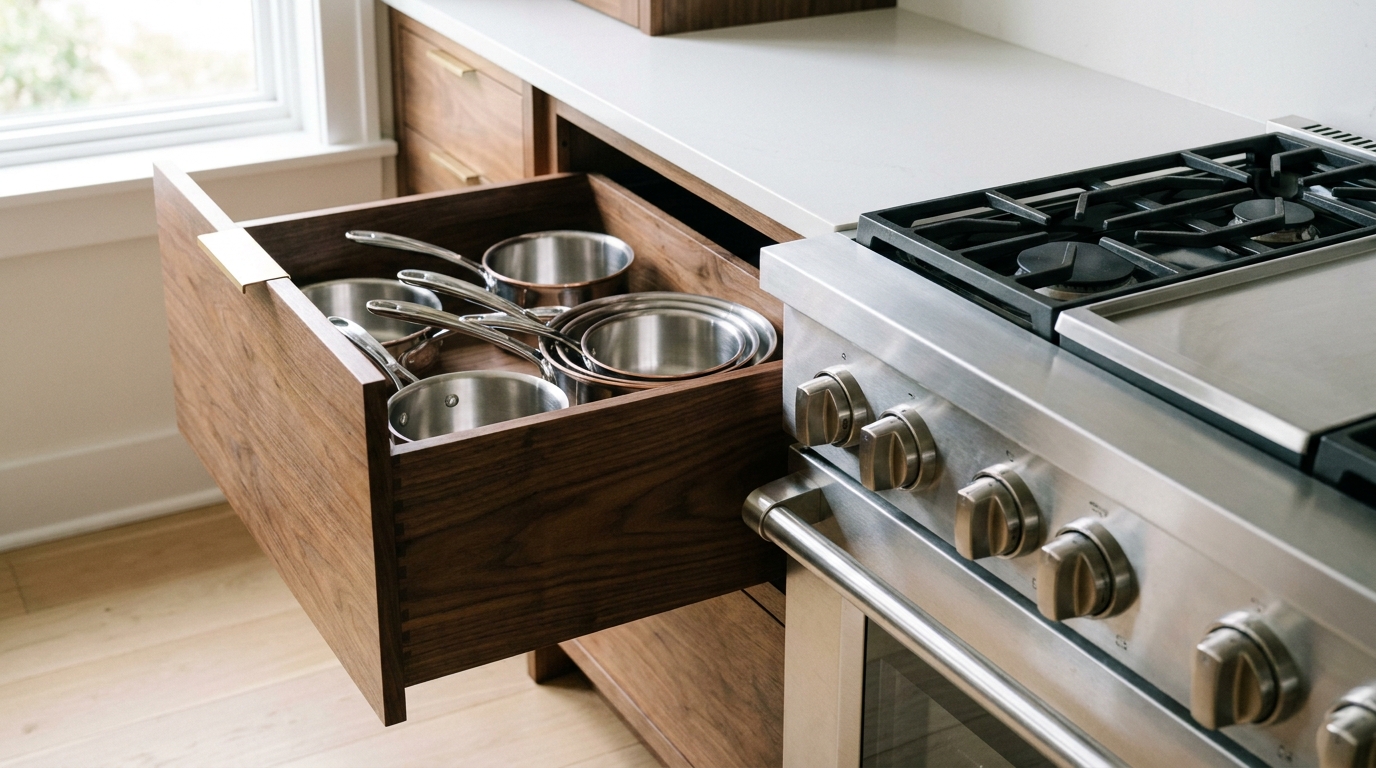
The pans you cook with every night belong in a deep drawer beside the range, with lids standing in their own slots, so the cooktop stays clear. That is custom pot and pan storage: cabinet storage planned around the pieces you actually lift, not a new kitchen. Cooking is a leading cause of reported home fires, home fire injuries, and home fire deaths, and ranges or cooktops account for over half (51%) of home cooking fire incidents in the National Fire Protection Association's 2020 to 2024 annual averages [1]. A closed bay next to the burners gives those pans a home that is not the stovetop.
1. Clear the cooktop before you add another rack
A crowded cooktop is usually a storage problem. Last night's skillet is still on a back burner, a lid is balanced on the griddle, and a towel hangs where a hand can grab it. That is what happens when the cabinet beside the range is a dark shelf and a pile.
The risk is real. In its 2024 national estimates, the U.S. Fire Administration reports 160,300 residential building cooking fires, 120 deaths, 2,175 injuries, and $481,200,000 in dollar loss [2]. The National Fire Protection Association tells households to keep anything that can catch fire, including oven mitts, wooden utensils, food packaging, towels, or curtains, away from the stovetop [1].
A pan left on a cold burner is one guest away from a burner that is not cold. Closed storage is how you stop using the cooktop as a shelf.
A deep drawer next to the range puts the nightly pans behind a closed front, so the cooktop can be a cooking surface again. You still stay with the pan while you fry, grill, boil, or broil, because storage does not watch the pot for you. Unattended equipment is a factor in one quarter (25%) of reported home cooking fires and in half of the associated deaths, based on those same 2020 to 2024 averages [1].
Lids have a safety job as well as a storage job. The U.S. Fire Administration says to keep a pan lid or a baking sheet nearby, and to cover the pan with it if the pan catches fire [3]. The National Fire Protection Association says to smother a small grease fire by sliding the lid over the pan and turning off the stovetop, then to leave the pan covered until it is completely cool, and never to throw water on the fire [1].
A vertical lid slot beside the range is how "nearby" becomes a real place, instead of a lid buried under three others. You take one lid, and you put it back in the same slot.
Turn pot handles toward the back of the stove while you cook so nobody bumps them [3]. A drawer does not replace that habit. It does keep spare pans off the back burners, which is where those handles are supposed to point.
2. Put the heavy pans where your body is strongest
Cast iron, a full Dutch oven, and a stacked set of saucepans are awkward loads with odd handles. The usual base cabinet makes the lift worse: you open a door, bend, and drag the bottom pan out from under two others.
A 2020 safety sheet from the Washington State Department of Labor and Industries says lifting from the floor is twice as risky as lifting while you are standing upright [4]. The same sheet says the best place for heavy things, or for things you use often, is waist level [4]. Lifting above your shoulders puts you at risk for neck and shoulder injuries, and heavy items should not be stored overhead because a falling object can injure you [4]. A ceiling rack is a poor home for the weeknight skillet.
Food-service guidance points the same way, and it names pots and pans. A December 2020 fact sheet from the Texas Department of Insurance, Division of Workers' Compensation, tells employers to train people who handle utensils, pots and pans, and other kitchen loads to avoid reaching below mid-thigh height or above shoulder height [5]. It says to store the heaviest items at mid-height, not on the floor or the bottom shelf, and to keep heavy items between mid-thigh and chest height, which it calls the power zone [5].
This is workplace advice for restaurants and food preparation, not a home building code. The body mechanics still apply when the load is your own skillet.
A 2003 ergonomics guide for healthcare kitchens, from the Occupational Health and Safety Agency for Healthcare in British Columbia, says to store items between knee and shoulder height whenever possible [6]. Frequently used, heavier items should sit in that band, as close to waist height as possible, with lighter items on the lowest and highest shelves [6]. Move closer to the object, or move the object closer to you, and do not extend your reach past comfort or twist to reach behind yourself [6].
OSHA's hospital food-service guidance says frequent reaching above the shoulders, or an extended reach for a heavy container, can cause back and shoulder injury [7]. Prolonged or repetitive bending into a deep sink or container contributes to back disorders [7]. One control is to put the work in front of the person instead of reaching above or behind for supplies [7].
A drawer that rolls the pan to the front of the cabinet is that idea in cabinet form. The OSHA page covers hospital food service, not a home remodel, so we treat it as a posture lesson rather than a cabinet standard.
A base cabinet is still low. The bottom drawer in a stack is closer to a floor lift than to a waist lift, even when it rolls smoothly, and custom pot and pan storage should not pretend otherwise. Put the heaviest nightly pan in the drawer you can open without folding to the floor.
Lighter lids and the saucepan you use once a month can take the lower or higher opening. If the only cabinet is a single low box, a drawer that brings the pan to you still beats a crawl into a shelf. That is still not a waist-high lift.
3. Give every lid a slot, not a pile
Most lid chaos is a stacking problem. Flat lids slide, and they hide the pan you wanted, so you lift two pieces to free one. The Texas fact sheet tells food-service workers to keep frequently used items in the most accessible spots, to face the object, and not to twist and reach behind or to the side [5]. A pile fails that test, because the pan you need is at the back, under a lid that belongs to something else.
We plan the bay by how often you use each piece, not by a matching-set photo. The order below is the one we use in the kitchen.
- Nightly pieces get the prime drawer. That is the skillet, the saucepan, and the one pot that actually hits the burner on a weeknight. They sit in a single layer when the piece is heavy, with handles aimed the same way so you can take a straight grip.
- Lids stand on edge in a divided slot, a shallow drawer above the pans, or a file along the side of the deep drawer. You see the rim. You do not audition the whole stack.
- Weekend pieces move out of the prime bay. A roasting pan, a fish poacher, or the giant stockpot can live one cabinet farther away. They are real cookware. They are not the reason you cannot find Tuesday's skillet.
- One pan, one lift. Do not nest three unlike shapes if the bottom one is the heavy one. The 2003 healthcare-kitchen guide says not to lift a load that is unevenly balanced, and to keep the load close to the body [6]. A stuck nest is an unbalanced load with a surprise weight.
A straight wrist helps once the pan is in your hand. The December 2020 food-service sheet says to use a neutral, handshake-style grip on a pan, because a straight wrist is stronger than a bent one [5]. That grip is easier when an open drawer presents the handle than when you fish it out of a corner. The sheet is workplace guidance, and it is still a fair test of a home drawer: if you have to cock your wrist to extract the skillet, the bay is not finished.
Pegs or a simple upright file can keep lids from becoming a second pile. We choose after we see your lids, not from a catalog photo.
4. Size the bay to the pans on your counter
Bring the real cookware out before anyone talks about drawer fronts. Set the weeknight pans on the counter, set the lids beside them, and set aside the pieces you have not used since a holiday. The bay should be designed for the first group. The second group needs a home, just not the one closest to the flame.
Measure what you see, not what a stock cabinet assumes. Note the tallest pot with its lid off, because the lid may live in the slot, and note the widest skillet with its handle, because the handle is what hits the drawer side. Note which pieces are too heavy to stack. That list is the brief, and a drawer that refuses your skillet is not storage.
Slides and boxes have to match that list. On our cabinet accessories and profiles page, drawer boxes include a Baltic birch dovetail with soft-close undermount slides, and a Baltic birch dovetail side-mount option that is not soft-close. We do not publish a single weight rating for a pot drawer, because two saucepans and a stack of cast iron are not the same load.
In the visit, we match the box and the slide to those pans. Soft-close is welcome when your hands are full, and it is not a substitute for a slide that can carry the load.
A few habits keep the bay honest after it is built. None of them call for another gadget.
- Put pans away dry, and put them away in the slot they came from. A damp nest marks the drawer and undoes the map.
- Let a hot pan cool on a clear counter spot before it goes back among other pans and wood dividers. The cooktop is not that cooling rack. Anything that can catch fire stays off the stovetop between meals, mitts and towels included [1].
- Keep a landing space on the counter beside the range so a hot pan has somewhere to go that is not an open drawer of cool cookware.
- If a new pan joins the set, retire one that no longer earns the prime drawer. The bay is a fixed size. The collection is not.
Pulls and the drawer profile should match the cabinets you already have. The same accessories page shows those choices, so the bay looks planned with the room rather than bolted on later.
5. Plan the cabinet you have, not a whole new kitchen
This work is a cabinet interior. It is not a gut remodel, and it is not a claim that we replace your kitchen. If the box beside the range is sound, we build the drawer stack, the lid slots, and a front that fits the room. If a door swing fights the oven door, we see that in the kitchen and adjust the plan before anything is built.
We also look at how you stand when you cook. A taller cook and a shorter cook do not share one comfortable reach, which is why the 2003 guide says shelf height should not rise above the shoulder of the shortest worker [6]. A single "standard" pot drawer disappoints for that reason.
Homeowners from Ballantyne and Waxhaw to Fort Mill, Indian Land, and Rock Hill describe the same cabinet. The range sits between two base boxes that were finished before anyone asked which skillet comes out on a Tuesday. One of those boxes can become the cookware bay, and the other can stay what it is. We are not rearranging the whole kitchen to store a saucepan.
What we need from you is ordinary. Bring a list of the pans you reach for on a normal week, an honest pass at the pieces you are keeping out of guilt, and a look at the open cabinet so we can see the hinges, the toe kick, and the oven door. From that, our team draws the bays: which opening takes the heavy skillet, which opening files the lids, and which pieces move one cabinet over.
If the cookware is the pain and the rest of the kitchen works, stop there. Custom cabinet storage can fix a cookware pile without a new countertop, a new appliance, or a new lighting plan. The bay should stand on its own.
Practical takeaways
- Give the pans you use every night a deep drawer beside the range, and keep the cooktop clear of spare pans, mitts, towels, and packaging [1].
- File lids on edge in a vertical slot or a shallow drawer so you can grab one lid without unstacking the rest.
- Put the heaviest piece in the drawer closest to waist height. Leave the lowest opening for lighter pieces, because a 2020 Washington safety sheet says lifting from the floor is twice as risky as lifting while you are standing upright [4].
- Do not hang your heaviest pans overhead. Lifting above the shoulders raises the chance of a neck or shoulder injury, and a falling pan is its own hazard [4].
- Size the bay to the pans on your counter, including handles, and match the drawer box to that load. Our cabinet accessories and profiles page shows the dovetail box options we plan from.
- Keep a lid you can actually reach. For a small grease fire, slide that lid over the pan, turn the burner off, leave the pan covered until it is cool, and do not use water [1][3].
How we can help
Have more questions or want to get in touch? Bring us the pans you use on a normal week and we will plan the drawers and lid slots around them, inside the cabinets you already have. A free in-home design consultation is the straightforward way to start. Visit https://theclosetrehab.com/contact-us/ , call (704) 604-3870 , or email design@theclosetrehab.com .
Citations
- National Fire Protection Association, "Safety with cooking equipment" (2026)
- U.S. Fire Administration, "Residential building cooking fire trends (2015-2024)" (2026)
- U.S. Fire Administration, "Cooking Fire Safety" (2026)
- Washington State Department of Labor and Industries, "Store it off the floor" (2020)
- Texas Department of Insurance, Division of Workers' Compensation, "Ergonomics for the Food Services Industry Fact Sheet" (2020)
- Occupational Health and Safety Agency for Healthcare in British Columbia, "An Ergonomics Guide for Kitchens in Healthcare" (2003)
- Occupational Safety and Health Administration, "eTool : Hospitals - Food Services - Work-related Musculoskeletal Disorders" (2026)