Bedroom Built-In Cabinets That Replace Nightstands
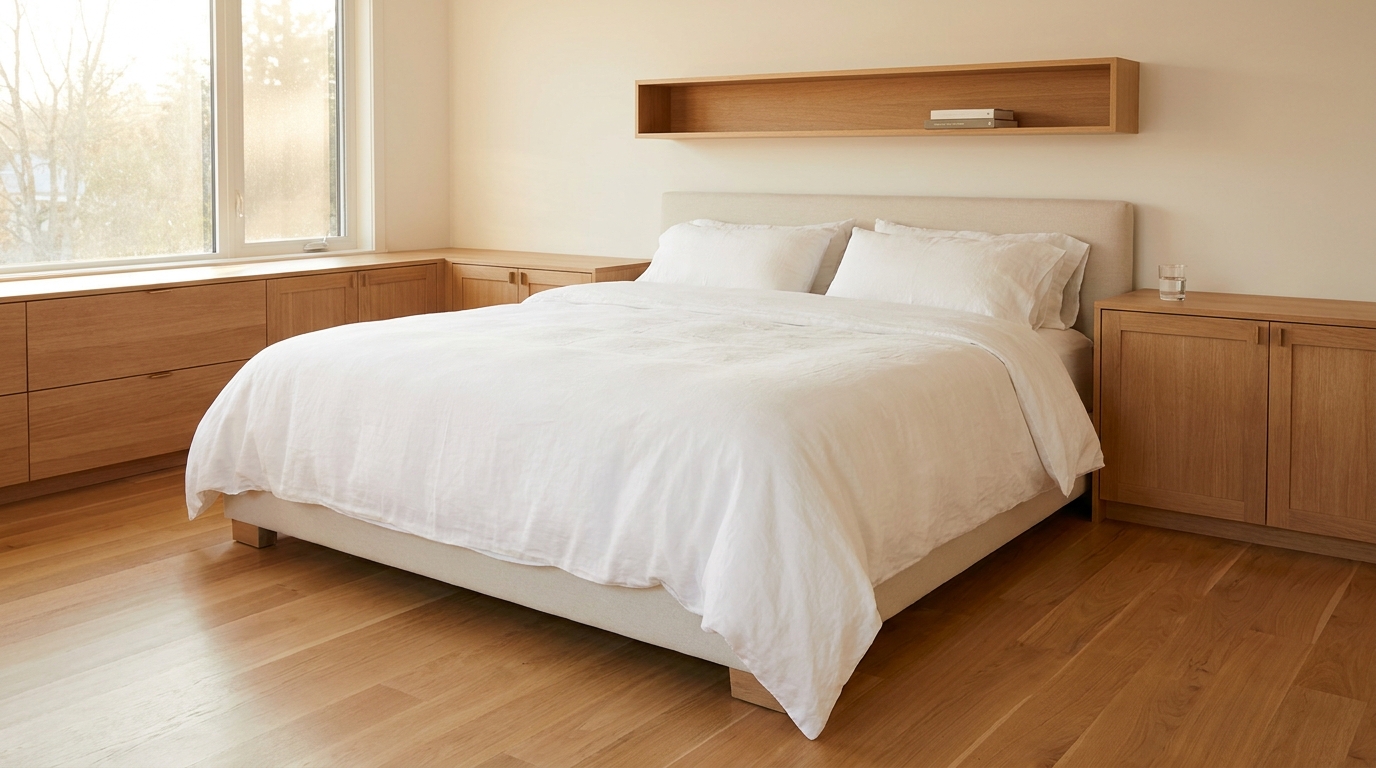
Low flanking cabinets and a shallow shelf at the head of the bed can replace nightstands, so books, a water glass, and a charger have a fixed home and the floor stays clear. Bedroom built-in cabinets used this way are casework beside the mattress, not a closet, a media wall, or a fold-down bed. Harvard Health, in its living-room fixes, says to get rid of books, baskets, boxes, electrical cords, newspapers, shoes, and other small items that may get in your path. [1] Mayo Clinic patient education says to keep clothes and objects off the bedroom floor, and to keep steps and hallways clear of clutter. [2]
1. Why the floor around the bed fills up
A nightstand often becomes a pile. The book slides off a table that is too narrow. The charger will not reach, so the cord runs under the rug. Then the water glass, a shoe, and a sweater end up on the floor you walk at night.
That is a safety problem, not only a tidy-up problem. The same Mayo Clinic guide says to remove electrical cords and wires from under carpet or area rugs, and to coil or tape them next to the wall so they are out of the way. [2] It says to put a lamp and a flashlight near the bed so they are easy to reach, and to put night lights where you need them. [2] It also says to put a telephone in the bedroom and to keep a cordless telephone near you. [2] The kitchen part of that guide says to keep items you use often within easy reach. [2]
The U.S. Fire Administration's home fire escape guidance, last reviewed in April 2025, says residents could have less than 2 minutes to escape a home fire once the smoke alarm sounds. [3] It tells households to find two ways out of every room and to make sure doors and windows are not blocked. [3]
In a primary bedroom in Waxhaw or Fort Mill, a king bed can leave a lane that is already tight. A bulky freestanding nightstand makes that lane worse. The fix is built-in storage that stops at the edge of the walk.
2. Low cabinets and a shallow shelf, not a second closet
Bedroom built-in cabinets that replace nightstands stay simple. We use a low cabinet on one or both sides of the bed, with the top near mattress height so it works as a landing. A shallow shelf at the head holds the book, glasses, and a small lamp. Closed storage below takes what you do not need at 11 p.m.
This is not a closet. There is no hanging rod and no hamper in the plan. It is not a television wall, and it is not a wall bed.
The bed stays a bed. The casework only does the job the nightstands were failing at. A few limits matter more than the door style:
- Keep the cabinets low. A tall tower beside the pillow eats the room and puts weight up high.
- Keep the head shelf shallow so it does not crowd pillows or catch your shoulder.
- Put tonight's items in the open. Put spare cables and tissues in a drawer.
- Give each sleeper a landing if two people share the bed.
- Leave the walking lane. If you must turn sideways to pass, the cabinet is too deep.
We fasten the casework to wall framing during the install. It is not a chest on carpet that rocks when a drawer is pulled. A freestanding dresser that stays in the room is a separate piece. Section 5 explains why the new cabinets do not settle that question.
3. A home for the book, the glass, and the phone
The shelf works when the things you reach for in the dark stay in one spot. A paperback can stand in a shallow bay or lie flat. Glasses go in a small tray. A flashlight sits where your hand expects it, which matches the advice to put a lamp and a flashlight near the bed so they are easy to reach. [2]
Water ruins a careless top. We set the glass on a finished surface you can wipe, away from the receptacle, so a spill is not aimed into the outlet. Our cabinet and shelf finishes are what we sort through when that top has to take water rings and still match the room.
Humidity is a house problem, not a cabinet problem. EPA guidance updated in 2026 says to keep indoor relative humidity below 60 percent, and ideally between 30 and 50 percent. [8] A bedside cabinet cannot dry a muggy room. We still choose a wipeable surface, because the glass will sweat either way.
Dust is the other reason to get belongings off the carpet. EPA notes that household dust can contain many biological contaminants, including dust mites, pollen, and pet allergens, and that ordinary activity can stir that dust into the air. [8] The same page lists reducing clutter among the steps that prevent pests. [8]
Built-ins do not filter air. They do make a damp mop possible. People with allergies or asthma may need to clean more often. [8]
4. Charging where heat can leave and cords stay off the rug
A phone under a pillow, or a charger buried in bedding, is the habit to stop. The National Fire Protection Association's September 23, 2026 Fire Prevention Week guidance says devices and chargers produce heat during normal charging. [6] It says to charge on a table, desk, or other hard, flat surface, not on a bed, a couch, or under a pillow, because soft surfaces can trap heat and block airflow. [6]
Our shelf is that hard surface, with air around the phone. We do not design a sealed cubby stuffed with cloth for a charging device. If something you plug in has a fan or a vent, say so at the visit so we leave it in the open.
Use the cord and charger that came with the device, or one the manufacturer approved, because the wrong charger can damage the battery and raise the chance of fire. [6] Unplug when the battery is full, and do not leave it plugged in longer than needed. [6] Stop using it if it feels very hot, swells, smokes, or smells strange. [6] NFPA said in that release that it does not yet track how many U.S. home fires involve lithium-ion batteries, even as it warns that a damaged or badly charged battery can overheat, start a fire, or explode. [6]
A telephone in the bedroom, and a cordless phone kept near you, is also what that guide asks for. [2] Charge on the shelf, unplug when full, and leave the phone there. You do not have to sleep on it to keep it close.
Cords need the same honesty. An NFPA article for homeowners, publication date January 17, 2024, quotes NFPA 1 requirements for extension cords and relocatable power taps in the home. [7] Extension cords and flexible cords shall not extend through walls, ceilings, or floors, under doors or floor coverings, or be subject to environmental or physical damage. [7] Extension cords shall plug directly into an approved receptacle, power tap, or multiplug adapter and, except for an approved multiplug extension cord, serve only one portable appliance. [7]
A power strip has to connect directly to a permanently installed receptacle. [7] Its cord is under the same rule against running under a floor covering. [7]
A cord that lives under the bedroom rug is the pattern those rules describe. The better plan is a real receptacle at the shelf, sized for the lamp and the charger. New outlets belong to a qualified electrician, not to the cabinet install.
Bedrooms already appear in the fire figures. In NFPA's May 2026 report on home electrical fires for 2020 through 2024, bedrooms accounted for 12 percent of those fires and 21 percent of the civilian deaths. [5] Fires between midnight and 8 a.m. were 22 percent of those fires but 52 percent of the civilian deaths. [5]
Smoke alarms stay in the layout. U.S. Fire Administration guidance last reviewed on September 21, 2026 says to put smoke alarms inside and outside each bedroom and sleeping area, because a closed door may slow smoke, heat, and fire. [4] Put them on the ceiling or high on the wall, and follow the manufacturer's placement instructions. [4]
Only a qualified electrician should install hardwired smoke alarms. [4] We do not cap an alarm with a soffit or block the test button.
5. The path you walk at night, and the path out
A clear floor is the path to the bathroom, and it is the path to a door or window. Harvard Health's living-room fixes say to get rid of books, baskets, boxes, electrical cords, newspapers, shoes, and other small items that may get in your path. [1] Mayo Clinic patient education says to keep clothes and objects off the bedroom floor, and to coil or tape electrical cords and wires next to the wall and remove them from under carpet or area rugs. [2] Fire escape guidance says doors and windows should not be blocked, and that you should know two ways out. [3]
Built-ins help only if they do not create a new block. We check door swing and drawer pull with the mattress and bedding in place. A thick topper changes the gap. If a drawer only opens when you stand in the hall, the cabinet is in the wrong spot.
Freestanding furniture beside a bed has its own record. A February 2024 CPSC staff report states that it had not been reviewed or approved by the Commission and may not represent the Commission's views. [9]
It counted 217 reported tip-over deaths involving a television, furniture, or an appliance from January 1, 2013, through July 31, 2023. [9] The bedroom had the largest number, 97 deaths (45 percent). [9] Fatality counts for 2021 through 2023 should be considered incomplete because of a lag in reporting. [9]
That count is not a nightstand study, and cabinets do not erase it. It is a reason to pause before adding another tall, loose piece beside the bed. The same report notes CPSC's Anchor It campaign, started in 2015, on furniture and television tip-overs. [9]
If a dresser or bookcase stays freestanding, secure it with the anchor meant for that piece. Our built-in is screwed to framing. It does not replace an anchor on anything left on its own feet. Keep heavy items low, not on a high surface a visiting child might climb.
6. Light at the bed without lighting the whole room
You need to see the page, the glass, and the floor. You do not need the whole room bright. Mayo Clinic patient education says to put night lights where you need them, and to put a lamp and a flashlight near the bed so they are easy to reach. [2] Harvard Health's bedroom fix is to light the pathways you know you will use when it is dark, and to install night lights or motion sensor lights. [1] We put the switch at the outer edge of the shelf or on the cabinet face, and we give the flashlight a lip so it cannot roll off.
A 2022 consensus paper in PLOS Biology, for healthy adults, recommends that in the three hours before bedtime the melanopic light level at the eye stay at or below 10 lux. [10] The sleep environment should stay as dark as possible, at or below 1 lux of that same measure at the eye. [10] If a nighttime task needs vision, the paper still caps the light at 10 lux melanopic at the eye. [10]
Melanopic light is a measure of how strongly light hits the body's light-sensitive system, not only how bright a page looks. The authors say these targets do not replace rules for seeing clearly and staying safe. [10]
We do not promise a shelf lamp hits those numbers. What we provide is a small reading light aimed at the book, on its own switch, so one person can read while the room stays dim.
7. How we fit the piece to a primary bedroom
The bed leads, and the cabinets follow. We measure the mattress with the bedding you actually use, because a pillow-top moves the landing height. We mark the outlets, the window, the door swing, and the path to the bathroom before we draw anything.
In Ballantyne and Wesley Chapel, the bed often sits on a window wall and the walk is pushed to the sides. A deep nightstand on the window side blocks the comfortable path. A shallower cabinet, or a shelf with no cabinet on that side, keeps the lane. One useful side of storage is better than two sides that both collide with the walk.
Keep the nightly list short: a book, glasses, water, a phone while it charges, a lamp, and a flashlight. A sound machine or anything with a vent stays on an open surface. A tall book stack is a library, and a library belongs on another wall. This shelf should stay shallow enough to dust in a minute.
Hardware should be findable by touch. Slab doors read quiet, and a simple shaker face fits many houses nearby.
Our spaces page shows the other rooms we build. This piece is planned around the bed, not around hanging clothes. The steps from the first measurement to installation are on how it works.
Practical takeaways
- Use low flanking cabinets and a shallow shelf in place of nightstands. Harvard Health says to get rid of books, baskets, boxes, electrical cords, newspapers, shoes, and other small items that may get in your path. [1] Keep clothes and objects off the bedroom floor, and coil or tape cords next to the wall. [2]
- Charge on that hard shelf, in open air, with the manufacturer charger. Unplug when full. Do not charge under a pillow or in a cloth-filled cubby. [6]
- Do not run an extension cord or power-strip cord under the rug, through a wall, or under a door. [7] Ask a qualified electrician for a receptacle at the shelf.
- Keep doors and windows clear. You may have less than 2 minutes after the smoke alarm sounds. [3]
- Leave smoke alarms inside and outside the bedroom, on the ceiling or high on the wall, and do not cover them with casework. [4]
- Fasten the built-in to framing, and anchor any freestanding dresser that stays. A February 2024 CPSC staff report counted 217 tip-over deaths involving a television, furniture, or an appliance from January 2013 through July 2023. The bedroom was the leading room, and counts for 2021 through 2023 are incomplete. [9]
- Give each reader a small light on its own switch. The 2022 evening and nighttime light targets apply to healthy adults. They are not a rating for one lamp. [10]
- Set the water glass on a wipeable top, away from the outlet. EPA's humidity range, below 60 percent and ideally 30 to 50 percent, is a whole-room issue a cabinet cannot fix. [8]
How we can help
Have more questions or want to get in touch? Call (704) 604-3870, email design@theclosetrehab.com, or use our contact page at https://theclosetrehab.com/contact-us/. We offer a free in-home design consultation and will measure the bed, the outlets, and the walking path before we draw bedroom built-in cabinets to replace the nightstands.
Citations
- Harvard Health Publishing, "Quick fixes to keep you from falling" (2023-08-22)
- Mayo Clinic, "Home Safety Tips" (2017-11-13)
- U.S. Fire Administration, "Home Fire Escape Plans" (2025-04-10)
- U.S. Fire Administration, "Smoke Alarms" (2026-09-21)
- National Fire Protection Association, "Home Fires Caused by Electrical Failure or Malfunction | NFPA Report" (2026-05-01)
- National Fire Protection Association, "Fire Prevention Week, Oct. 4-10, focuses on lithium-ion battery charging safety" (2026-09-23)
- National Fire Protection Association, "Electrical and Fire Safety Considerations At Home During the Cold Winter Months | NFPA" (2024-01-17)
- U.S. Environmental Protection Agency, "Biological Contaminants and Indoor Air Quality | US EPA" (2026-04-01)
- U.S. Consumer Product Safety Commission, "Product Instability or Tip-Over Injuries and Fatalities Associated with Televisions, Furniture, and Appliances: 2023 Report" (2024-02)
- PLOS Biology, "Recommendations for daytime, evening, and nighttime indoor light exposure to best support physiology, sleep, and wakefulness in healthy adults" (2022-03-17)