Window Seat Storage: Drawers or a Hinged Lid
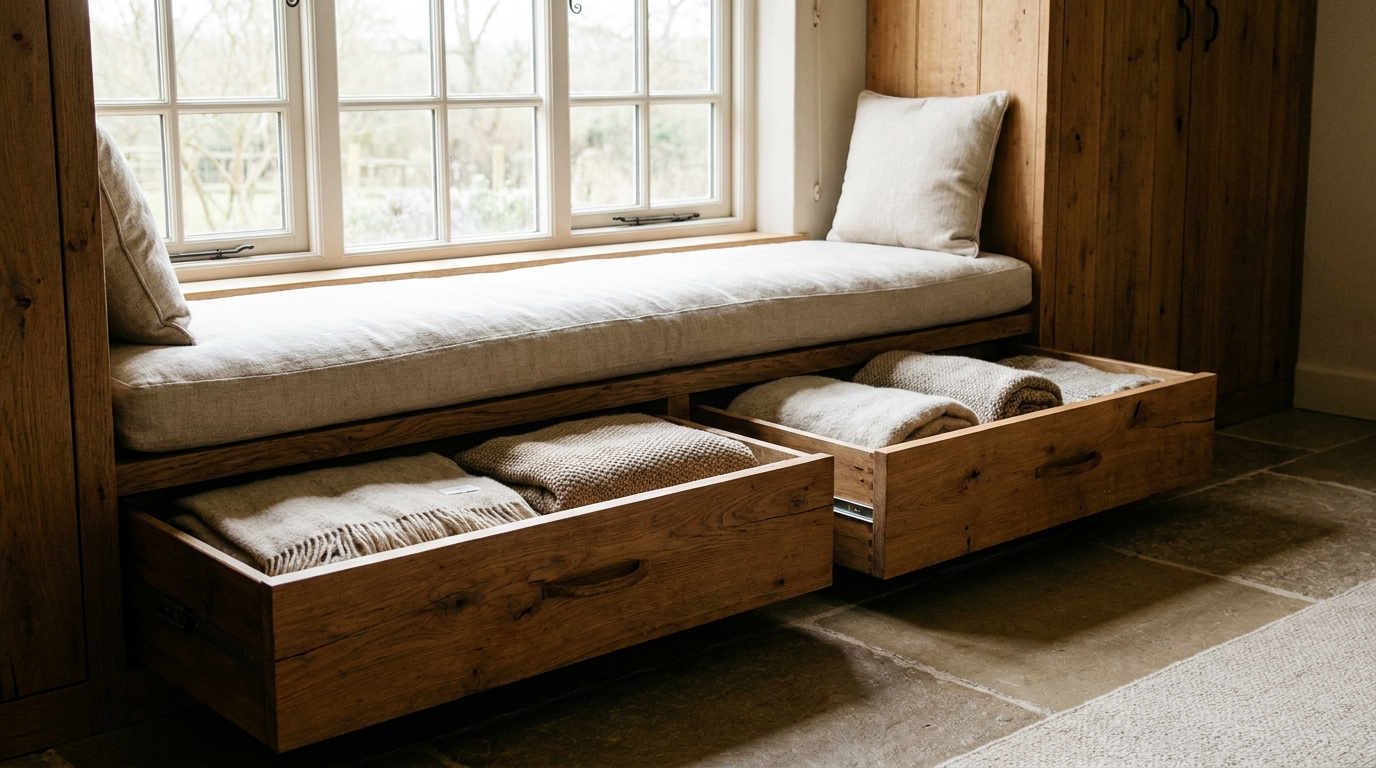
Window seat storage can be a row of drawers or a hinged lid, and the better choice is the one that still leaves a walk path when it is open. Drawers keep throws, kids' books, and a few games in separate bays you can reach without lifting the cushion. A hinged lid makes one deep bin, which is simple until the raised lid blocks the path or a child has to reach under it. We build either version for a window you already sit beside, not for the cavity under a stair and not as a stand-in for a nightstand.
1. What belongs under the seat
The problem is a pretty window with a messy floor in front of it. Throws slide off the cushion, picture books stack on the sill, and game boxes live underfoot because nothing nearby was planned for them.
The seat should fix that pile, and only that pile. Storage under the cushion has three jobs: throws you actually use, the kids' books that belong in that room, and a few games.
- Throws. One bay for the blankets that live on the seat. A pile that needs a second bay is too big for this seat.
- Kids' books. The titles someone reads here, not the whole household library.
- A few games. Boxed games that come out at this seat and go back the same day.
- Nothing else by default. Clothes, files, and craft overflow turn the seat into a closet you unload before anyone can sit.
A living room, a playroom, or a bedroom window wall is the usual spot. In Charlotte, that wall often has the best light and the worst pile on the floor. We see the same pattern in Waxhaw.
Our spaces page covers the rooms we plan most often, from closets and pantries to home offices and mudrooms. A window seat is that same custom fit, drawn for one wall and the three groups you named.
2. Drawers or a hinged lid
A hinged lid looks like the obvious box. You lift the cushion, drop everything in, and close it. On a weekday, the throw you want is at the bottom. Someone has to stand up, hold the lid, and stand in the path.
Drawers split the same volume into jobs. You open the throw drawer, the book drawer, or the game drawer, and the rest stays put. You do not empty the seat to find one board book.
- Choose drawers when more than one person uses the seat, when kids need their own books, or when a falling lid is a worry. Each front names one group.
- Choose a hinged lid when the seat is mostly throws, adults open it, and the raised lid can rest without blocking the walk or the window latch.
- Do not stack the two ideas. A lid over a drawer wastes the height and still makes you move the cushion.
- Keep the cavity shallow enough to see. A bin packed to the top is a shelf you cannot search. A drawer that will not close is the same problem with a front on it.
3. Leave a walk path when the storage is open
A seat that only works while it is shut is furniture in the way. The open drawer, or the raised lid, has to leave the path people already use.
We measure with the storage open, not from the closed front. The deepest drawer is pulled all the way out, or the lid is raised to where it will stay. Then we walk the route people already use.
If you have to turn sideways, the box is too deep or the seat sticks too far into the room. We shorten the drawer, or use a shallower bank, before we call the path clear.
- A lid has two bad swings. Toward the room, it crosses the walk. Toward the glass, it can cover the sash and the latch. We look at both in the house.
- Spill is part of the path. Books and games left on the floor erase the clearance the box just saved.
A 2003 HUD healthy homes publication tells households to eliminate tripping hazards and to pick up hazards such as toys or shoes [9]. We size the seat so the open storage is not itself an obstacle.
If anyone would use that window to get out of the room, leave the opening, the latch, and the floor in front of it clear. Do not build the seat across the only way to reach the sash. That is planning for your household, not a commercial exit standard.
4. Throws that stay dry and out of the sun
Throws fail here for two quiet reasons. They go in damp, or they sit against a cold, sunny sill.
The U.S. Environmental Protection Agency says the key to mold control is moisture control, and that mold will not grow without water or moisture [3]. Dry water-damaged areas and items within 24 to 48 hours to prevent mold growth [3]. If wet or damp materials are dried within 24 to 48 hours after a leak or spill, in most cases mold will not grow [3].
A throw that felt dry on the couch can still be cool in the middle of the fold. It should wait until it is dry through. Keep indoor relative humidity below 60 percent where you can, and ideally between 30 and 50 percent [3].
If condensation or moisture collects on windows, EPA says to dry the wet surface quickly and reduce the moisture source, because condensation can be a sign of high humidity [3]. Molds gradually destroy the things they grow on [3].
A second EPA page says molds can grow on virtually any substance if moisture is present, and that there are molds that can grow on wood, paper, carpet, and foods [4]. The wood of the seat and the paper of the books join that list once the sill stays wet.
Light is the other kind of wear. The George Washington University Museum and The Textile Museum says light is one of the greatest threats to textiles [7]. The most serious damage comes from ultraviolet radiation in daylight and in fluorescent and halogen bulbs [7].
The whole light spectrum can fade dyes and make fibers brittle, including incandescent light and, to a lesser degree, LED lighting [7]. Shades or shutters closed during the sunniest part of the day offer some protection [7]. We apply that to stored throws, not as a rule that the cushion stay in the dark.
University of Georgia Extension, writing about textile heirlooms, says never to wrap textiles in plastic, because plastic blocks air circulation and can cause mold and mildew [8]. Clear plastic also fails to protect a textile from light [8]. The same page says to try to keep textiles off an outside wall, and that a too-humid spot promotes mold and mildew [8].
A window seat is on an outside wall, so we do not use it for heirloom quilts. Everyday throws can live there if they go in dry, unbagged, and out of the sun while stored.
ENERGY STAR says protective coatings and improved frames block damaging ultraviolet sunlight that can discolor carpets and furnishings [6]. That sentence is about those window technologies, not about every pane already in a house.
5. Books that can live at the glass
Kids' books belong near the seat where someone reads them. They do not belong in a damp pile on the sill.
The Library of Congress preservation guide, updated in 2026, says a cool environment, 70 degrees Fahrenheit or below, with 30 to 55 percent relative humidity, is safe for most books [2]. Books should have minimal exposure to light, and ideally none to direct or intense light [2]. Shades, curtains, or protective boxes help prevent damaging light [2].
A closed drawer is only a plain version of that box. A sunny seat can still run warmer than a shaded shelf across the room.
Keep shelved books upright, not leaning, and support them with a bookend if they need it [2]. Books too large to stand can lie flat and horizontal, fully supported underneath [2]. Never store a book spine up, because gravity will cause the text block to loosen or detach from the cover [2].
Dust feeds the moisture problem. The guide says dust can hold particles that discolor books, attract pests, and absorb moisture from the air, which can cause mold to grow [2]. A drawer that closes keeps more of that dust off the covers.
- Sort by size. Large picture books lie flat. Matching chapter books stand together.
- Edit the row. Outgrown titles leave so the bay stays the size we built.
- Leave the sill clear. Direct light is what the guide says to avoid, and a wet sill is a moisture problem for paper [2][4].
6. A few games, and a lid that does not fall
Games are what make a hinged lid feel like a toy chest. In Publication 5099, document code 012012, the U.S. Consumer Product Safety Commission says it knows of children who died when lids of containers used for toy storage fell on their heads or necks [1]. There have been incidents of permanent brain damage [1]. Many deaths involved toy boxes or chests, and children have also died in trunks, footlockers, decorator cubes, and blanket chests used for toy storage [1].
Fatal suffocation incidents have happened when children climbed into storage containers, such as cedar chests, to play or hide and became trapped [1]. Typical accidents happened when children used the chest to pull themselves up, so the lid fell from the open position, or when a young child tried to open the lid [1]. Children were reaching over and into the chest when the lid dropped, and it either fell on their heads or trapped them at the neck between the lid and the edge [1].
Open chests or bins with no lids, chests with lightweight removable lids, or chests with sliding doors or panels will not present the risk of a falling lid [1]. If you choose a vertically opening lid, look for a support that holds the lid open in any position, and check that it really keeps the lid from falling [1]. On a chest that already has a freely falling hinged lid, CPSC recommends removing the lid, or installing a support that holds the lid open in any position [1]. Check that support often, because some need to be adjusted or tightened so they keep working [1].
A window seat is not named in that publication. If children will reach in, or could climb inside, drawers avoid the falling lid CPSC describes [1]. A lid, if you still want one, needs a support that stays open in any position, not a lid that drops on its own [1]. Keep the games few and boxed, and put them back in the drawer instead of on the floor [9].
7. Check the window before you build the seat
A drafty or leaking sash is a poor place to sit, and a poor place for cloth and paper. ENERGY STAR says windows with air leaks or drafts, and windows with degraded sills and sashes, waste energy and are very uncomfortable to sit next to when it is cold and windy [5]. Degraded windows can also leak water into the walls and allow insects and other pests into the home [5].
We look under the window before we draw the box. If water is coming in, the seat waits.
Glass can also sweat on a cold morning. EPA says condensation on windows can be a sign of high humidity, and says to dry the surface and reduce the moisture source [3]. We leave the sill visible enough to check.
Close shades during the sunniest part of the day when nobody is sitting there [7]. You can use the window while you are in the seat. Stored throws and books do not need that sun all afternoon.
8. How we size the seat
We start with the path and the three groups, not with a catalog bench. At the visit we look at what will live here and at how people walk past the window.
- Path first. The open drawer, or the raised lid, has to leave the walk you use. If it does not, we change the depth before we change the cushion.
- Who reaches in. If children open the storage, drawers are our default, because of the falling-lid hazard CPSC describes [1].
- A dry sill before cloth or paper. Humidity, condensation, and a leaking sash get a look first [3][5].
- A cushion the household can sit. Feet should meet the floor comfortably. We set that in the room, not from one published bench height. The front also has to shut without crushing books or forcing a damp throw inside.
Our design process starts with an in-home visit. We measure, listen to how you use the window, and plan before anything is built. That visit is free, and there is no obligation.
Practical takeaways
- Limit the seat to three groups. Throws, kids' books, and a few games.
- Prefer drawers when children reach in. A freely falling lid is the hazard CPSC describes for toy storage, so a hinged lid needs a support that holds it open in any position [1].
- Pick up what lands on the floor. A 2003 HUD healthy homes publication says to clear tripping hazards such as toys or shoes [9].
- Store throws dry and unbagged. Mold needs moisture, and plastic wrap blocks air around textiles [3][8].
- Hold indoor humidity below 60 percent where you can, ideally 30 to 50 percent, and dry a wet throw or sill within 24 to 48 hours [3].
- Give books less light. A 2026 Library of Congress guide calls 70 degrees Fahrenheit or below, and 30 to 55 percent relative humidity, safe for most books, with little or no direct light [2].
- Skip a wet or drafty sash. Those windows are uncomfortable to sit beside and can leak water into the wall [5].
- Leave the sash clear if someone would use that window to get out. Do not cover the latch or the floor in front of it.
How we can help
A window seat is a small project with a clear test. The drawers or the lid still leave a walk path, and throws, books, and games each have a place. We measure that path in your room and build the storage to match. See the rooms we plan on our spaces page, or read how a project starts on our design process page.
Have more questions or want to get in touch?
Visit our contact page, call (704) 604-3870, or email design@theclosetrehab.com.
Citations
- U.S. Consumer Product Safety Commission, "CPSC Warns Consumers of Dangers with Toy Chest Lids" (Publication 5099, document code 012012; file last-modified 2021-07-26)
- Library of Congress, "Storing Your Books" (2026-07-23)
- U.S. Environmental Protection Agency, "A Brief Guide to Mold, Moisture and Your Home" (2026-02-18)
- U.S. Environmental Protection Agency, "What are ten things I need to know about mold?" (2026-09-08)
- ENERGY STAR, "High Performing Windows or Storm Windows" (undated)
- ENERGY STAR, "Complete Thermal Enclosure System" (undated)
- George Washington University Museum and The Textile Museum, "Caring for Textiles" (undated)
- University of Georgia Cooperative Extension, "Heirlooms" (undated)
- U.S. Department of Housing and Urban Development, "Making Your Home a Healthier and Safer Place to Live" (2003)